

Contents
- Quick answer
- What is the NY biennial statement?
- Who must file a biennial statement in New York?
- When is the biennial statement due?
- How do you file a NY biennial statement online?
- What does past due mean and how do you fix it?
- What should Canadian owners of a New York company watch?
- How does New York compare with the Ontario annual return?
- Frequently asked questions
- Conclusion
- How Mayo Law can help
- Disclaimer
The NY biennial statement is the short form that New York corporations and limited liability companies (LLCs) file with the New York Department of State (DOS) every two years. It costs US$9 and keeps the state's mailing address for lawsuits current. For a Canadian who owns a New York company, it is one small part of cross-border compliance, and it is easy to miss because it runs on a different clock from the Ontario annual return.
A Canada-US group can owe both filings, so we also set the statement beside the Ontario annual return. Statutes, fees and Department of State instructions are stated as of October 2026.
Quick answer
A NY biennial statement is a US$9 filing due every two years, usually in the month your New York corporation or LLC was formed or authorized. Most companies can file online with their DOS ID number. A missed filing shows as past due on state records, and a corporation can later face a US$250 fine after a mailed notice.
What is the NY biennial statement?
The NY biennial statement is a record update that tells the Department of State where to send legal papers and, for a corporation, who runs it. Two statutes create the duty, one for corporations and one for LLCs.
For corporations, section 408 of the Business Corporation Law (BCL) requires a statement with four items:
- the name and business address of the chief executive officer (CEO);
- the street address of the principal executive office;
- the post office address, inside or outside New York, where the Secretary of State mails a copy of any legal papers (process) served on the corporation; and
- the number of directors on the board and how many of them are women.
For LLCs, section 301(e) of the Limited Liability Company Law (LLCL) asks for one item: the post office address for process, again inside or outside New York.
Section 408(2) of the Business Corporation Law says the form may request only the four corporate items in section 408(1), and the information is given as of the date the statement is signed. So the statement is neither a tax return nor an ownership report. It does not ask a corporation for its shareholders or its revenue.
The law does leave room to report this information through the tax system. Section 408(8) of the Business Corporation Law and section 301(e)(2) of the Limited Liability Company Law let the Commissioner of Taxation and Finance and the Secretary of State agree to collect it on tax reports. Even then, a company keeps filing with the Department of State until it has in fact filed a tax report or, for an LLC, a filing fee payment form containing the information. As of October 2026, the Department's biennial statement page still sends corporations and LLCs to its own e-Statement Filing Service.
Who must file a biennial statement in New York?
New York business corporations and LLCs must file, and so must corporations and LLCs formed elsewhere that are authorized to do business in New York, with one narrow exception for farm corporations. The table shows how that applies to the entities a Canadian owner usually meets.
| Entity | Must file? | Details |
|---|---|---|
| New York corporation | Yes, Business Corporation Law s. 408 | CEO, office, process, board |
| New York LLC | Yes, LLC Law s. 301(e) | Process address |
| Authorized foreign corporation | Yes, Business Corporation Law s. 408 | CEO, office, process, board |
| Authorized foreign LLC | Yes, LLC Law s. 301(e) | Process address |
| Canadian parent | No, unless authorized | Its New York subsidiary files |
| Farm corporation | Generally no | Business Corporation Law s. 408(5) |
The farm exception in section 408(5) of the Business Corporation Law covers a corporation engaged in producing crops, livestock and livestock products on land used in agricultural production. It does not apply to a farm corporation that has filed statements through the Department of Taxation and Finance.
In these New York statutes, "foreign" generally means formed outside New York. The Business Corporation Law defines a foreign corporation as a for-profit corporation formed under laws other than New York's, with purposes a New York business corporation could have, and the Limited Liability Company Law expressly includes a foreign country. An Ontario business corporation and a Delaware LLC are both foreign here. A Canadian corporation becomes "authorized" through the process in our guide to foreign qualification.
Ownership does not change the filing duty. Section 408 of the Business Corporation Law applies to "each domestic corporation", so a New York corporation owned by a Canadian files like any other, and the duty sits with the company, not its shareholders. Section 301(e) of the Limited Liability Company Law reaches "every limited liability company", which includes a one-member LLC.
Sections 408 and 301(e) and the Department's page speak only of business corporations and LLCs. The Department's fee schedule lists no Biennial Statement for limited partnerships or not-for-profit corporations, so check the governing statute for those entities rather than assuming this filing applies.
When is the biennial statement due?
The biennial statement is due every two years, usually in the calendar month when the company's original certificate of incorporation, articles of organization or application for authority was filed with the Department of State. A corporation formed in March files in March of every second year.
Section 408(3) of the Business Corporation Law and section 301(e)(1) of the Limited Liability Company Law add a detail the Department's page leaves out: the filing month follows the "effective date thereof if stated". If your formation document stated its own effective date, check your month against that date.
Three timing rules matter:
- Do not file early. The Department says a statement should not be filed before the month it is due, and its e-Statement Filing Service says a statement cannot be filed online before the first business day of that month. A company that files early must file again in the correct month.
- Do not rely on a reminder. The Department sends an email notice at the start of the due month only if it has an email address for the company. You can add one through its Email Address Submission/Update Service.
- Do not count on rush handling. Expedited handling is not available for biennial statements.
How do you file a NY biennial statement online?
You file through the Department's e-Statement Filing Service, using the company's exact name and DOS ID number, and you pay the $9 fee by card. The Department says most business corporations and LLCs can file this way.
- Step 1: Look up the company in the Corporation and Business Entity Database and copy its exact name and DOS ID number.
- Step 2: Confirm that this is the company's due month, which follows the filing date or stated effective date of its original document.
- Step 3: Gather the current details. An LLC needs its process address. A corporation also needs the CEO's name and business address, the principal executive office and its board counts.
- Step 4: Enter the DOS ID number and name in the e-Statement Filing Service exactly as they appear on the Department's records.
- Step 5: Pay with MasterCard, Visa or American Express, then keep proof of the filing with your corporate records.
If the statement cannot be filed online, the Department's page tells you to ask its Statement Unit for a paper form, by mail or email. The request must include the exact name of the company and either its date of formation or authorization or, for a past due filing, its DOS ID number.
What does the biennial statement cost?
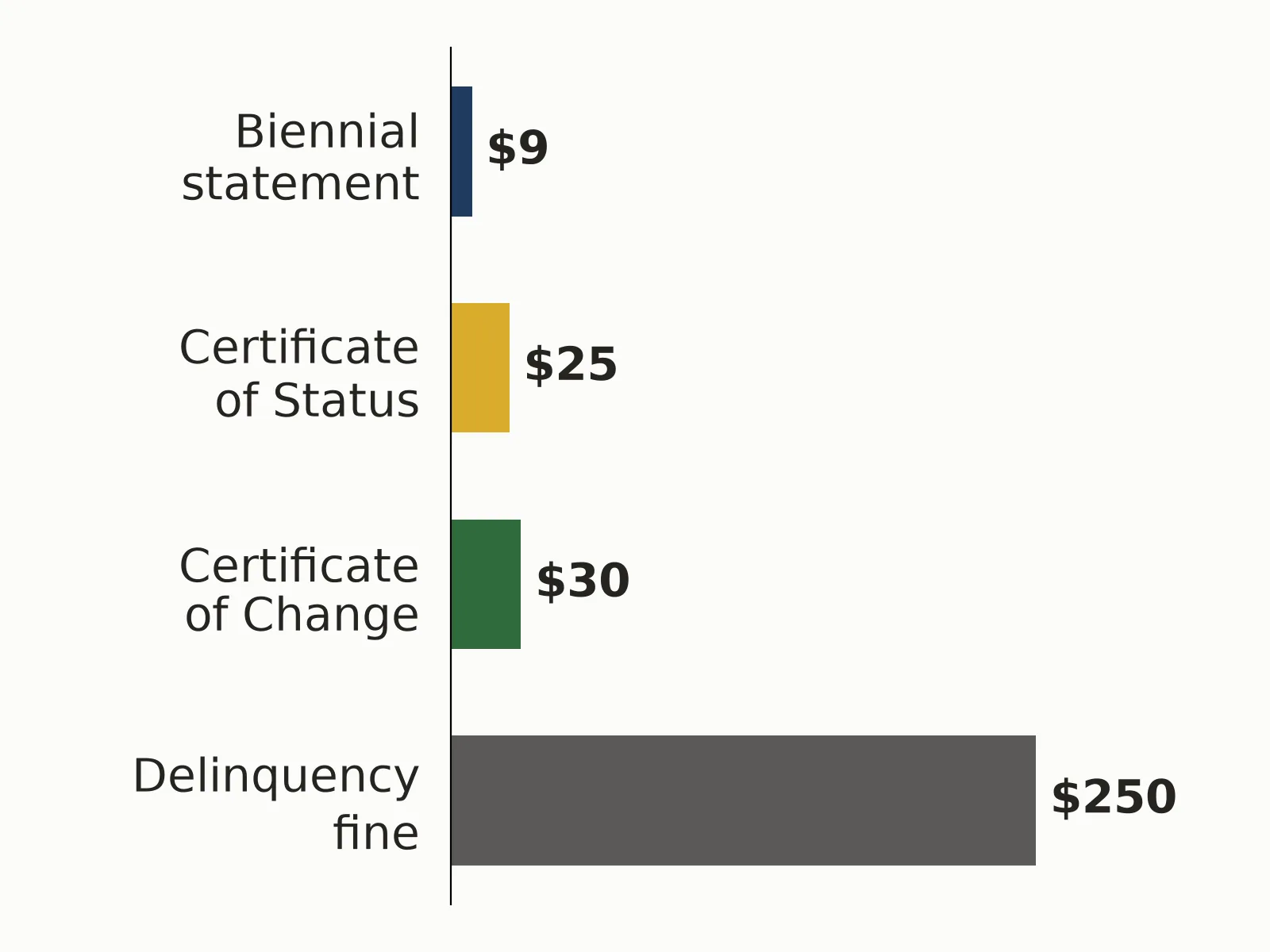
The biennial statement fee is US$9 for a corporation or an LLC, set by section 104-A(r) of the Business Corporation Law and section 1101(c) of the Limited Liability Company Law. Other costs arise only when something needs fixing or proving.
- Biennial Statement Amendment: $9, for a corporation.
- Certificate of Status: $25, plus an optional $25, $75 or $150 for faster handling, according to the Department's Certificate of Status page and fee schedule.
- Certificate of Change: $30 when the company files it to change its process address.
- Delinquency fine: $250, for a corporation, under section 409 of the Business Corporation Law.
How do you change an address between filings?
A corporation changes its CEO details or office address with a $9 Biennial Statement Amendment, and any company changes its process address with a Certificate of Change or a Certificate of Amendment. A process address can also be updated on the statement itself when the statement falls due.
Section 408(7) of the Business Corporation Law allows the amendment, on the Department's form, for the CEO and office items only. The Department is clear that the process address "may not be amended in a Biennial Statement Amendment". Section 408(1)(c) of the Business Corporation Law and section 301(e)(1) of the Limited Liability Company Law say the address given on the statement "shall supersede any previous address on file".
Between filing months, the process address moves by Certificate of Change or Certificate of Amendment. A Certificate of Change falls under Business Corporation Law section 805-A for a New York corporation and section 1309-A for an authorized foreign corporation, and under Limited Liability Company Law section 211-A for a New York LLC and section 804-A for an authorized foreign LLC.
Keep the address current because of how lawsuits start. Under section 306 of the Business Corporation Law and section 303 of the Limited Liability Company Law, personal service on the Secretary of State is complete when the Secretary is served, and the Secretary then sends a copy by certified mail to the address on file. The Department warns that companies move, forget to update the address and risk a default judgment.
What does past due mean and how do you fix it?
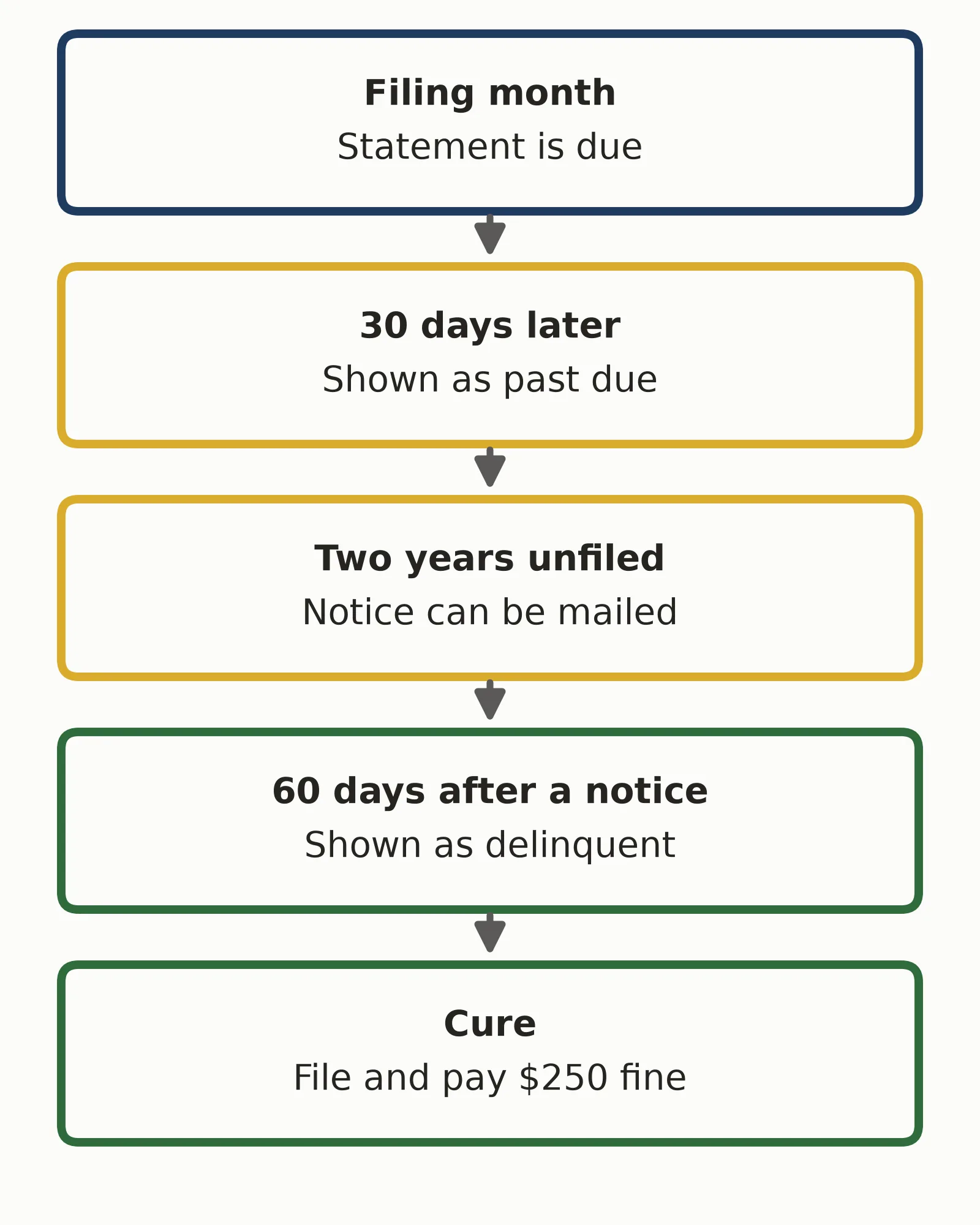
Past due means Department of State records show the statement was not filed, which for a corporation appears after 30 days under section 409(1) of the Business Corporation Law. You fix it by filing the statement, online if you can.
The Department's page describes the same past due record for corporations and LLCs. It adds that any Certificate of Status or status letter will reflect the past due filing, which "may prevent the corporation or LLC from completing certain business transactions". A lender, buyer or investor who asks for that certificate will see the note.
To clear it, follow the Department's steps:
- Step 1: File the past due statement online.
- Step 2: If it cannot be filed online, ask the Statement Unit for a form, giving the exact name and the date of formation or authorization or the DOS ID number.
- Step 3: If you need clean proof, request a new Certificate of Status when you file or at any time after.
The Department's page does not say whether one filing clears several missed cycles. If a company has missed more than one, ask the Statement Unit before you assume that it does.
Is there a fine for a past due corporation?
Yes, a US$250 fine can apply at a later stage, although the Department's page does not mention it. Section 409(2) of the Business Corporation Law says a corporation that has failed to file for two years is shown as delinquent 60 days after a notice of delinquency is mailed to its last known address. The delinquency is removed when the corporation files the current statement and pays the fine. Section 409(3) requires the notice to state the cure, the fine and the period during which no fine is imposed.
No official page we read says how often the Department sends these notices, so treat section 409 as what the law allows, not as a prediction. Section 409(4) of the Business Corporation Law excludes corporations that submit the statement through a tax report. The rule is written for corporations: section 301(e) and section 1101 of the Limited Liability Company Law set no matching fine.
Can a missed statement dissolve the company?
Not under the biennial statement provisions: Business Corporation Law sections 408 and 409 and Limited Liability Company Law section 301(e) do not list dissolution as a result of a missed statement. A separate route to dissolution sits in the Tax Law, for corporations.
Under Tax Law section 203-a, the tax authority may list corporations that have not filed the reports that tax article requires for two consecutive years, or that are delinquent in paying those taxes for any two years, and the Secretary of State then declares them dissolved by proclamation. Section 203-b does the same for an authorized foreign corporation's authority to do business. Those are tax defaults, not biennial statement defaults, so a clean biennial record says nothing about tax standing.
What should Canadian owners of a New York company watch?
Canadian owners should confirm which entity is the filer, keep an address on file that someone actually monitors, and put the New York month on the same calendar as their Canadian filings. Most of the risk here is a missed notice, not a difficult form.
- Who files. A New York subsidiary files in its own name, usually in the month it was formed. A Canadian corporation authorized in New York files too, usually in the month of its application for authority. If you have not yet chosen an entity, our comparison of an LLC and a corporation in New York covers that decision. The choice also changes what the statement asks for.
- Where papers go. Sections 408 and 301(e) allow an address "within or without this state", so a Toronto address is permitted. Pick one that will still be answered in two years, and tell whoever opens the mail that New York legal papers can arrive by certified mail.
- Board counts. A corporation reports its number of directors and how many are women. That applies to an authorized Canadian corporation as well as a New York one.
- Proof for a closing. Check the record early if a New York entity is heading into a financing or sale. A Certificate of Status is requested in writing, by mail, hand delivery or email, and the Department says it cannot be ordered online or by telephone.
- Other New York filings. The statement does not replace tax filings. It also does not replace the beneficial ownership disclosure that the Department says applies to LLCs formed under the law of a foreign country and authorized in New York. The Department's questions and answers, based on law in effect in December 2025, say LLCs formed in New York or another state are exempt. Our beneficial ownership guide covers the federal side.
For the wider picture of holding a US business from Canada, see our guide on whether a Canadian can own a business in the US.
How does New York compare with the Ontario annual return?
The Ontario annual return does a similar record-keeping job, but an Ontario business corporation generally files it every year, pays no government fee and carries a dissolution risk under its corporate statute. The biennial statement comes every second year at US$9.
| Point | New York | Ontario corporation |
|---|---|---|
| Filing | Biennial statement | Annual return |
| Main statute | BCL s. 408; LLCL s. 301(e) | Corporations Information Act s. 3.1 |
| How often | Every two years | Generally every year |
| Due | Anniversary filing month | Within 6 months of year-end |
| Government fee | US$9 | $0 |
| Filed through | e-Statement Filing Service | Ontario Business Registry |
| Identifier | DOS ID number | Company key |
| First consequence | Past due record | Default, leave needed to sue |
| Further consequence | US$250 fine (corporations) | Dissolution order possible |
Our guide to the Ontario annual return has the full rules. In short, section 3.1 of Ontario's Corporations Information Act requires a return each year, and section 11(2) of O. Reg. 400/21 limits that to Ontario business corporations, Corporations Act and not-for-profit corporations, and licensed foreign corporations. Section 11(3) adds a narrow exception: a corporation is exempt in a year if it is required to file a tax return under section 150 of the Income Tax Act (Canada) but is not required to file a tax return in that year. The Ontario Business Registry page says the return is due within 6 months of the fiscal year-end, and Ontario's fee page lists the return for an Ontario corporation at $0.
The consequences differ too. Under section 18(1) of the Corporations Information Act, a corporation in default cannot maintain a court proceeding in Ontario about its business without leave of the court. Under section 241(3) of Ontario's Business Corporations Act, the Director may give notice that a dissolution order will issue unless the corporation complies within 90 days. Ontario also has a shorter clock for changes: section 4(1) of the Corporations Information Act requires a notice of change within 15 days.
A federal corporation is different again. It files its annual return with Corporations Canada rather than in Ontario, but a federal corporation carrying on business in Ontario can still have Corporations Information Act filings, such as the initial return under section 3(1).
Take a group with an Ontario parent that has a December 31 year-end and a New York subsidiary formed in March. The parent generally files its Ontario annual return by June 30 of every year. The subsidiary files its statement in March of every second year. Put both on the same compliance calendar, and read our guide to extra-provincial registration if the New York company also operates in Ontario.
Frequently asked questions
Is the NY biennial statement the same as an annual report?
No. New York corporations and LLCs file a Biennial Statement with the Department of State every two years, not a report each year. It holds a few contact details and, for corporations, board counts. It is not a financial report and it does not replace any New York tax filing.
Can you file a biennial statement early?
Not online. The Department of State's e-Statement Filing Service says a statement cannot be filed before the first business day of the month in which it is due. The Department also says a statement should not be filed before that calendar month, and a company that files early will again be required to file in the correct month.
Is there a late fee for a past due biennial statement?
A corporation can face a US$250 fine under section 409 of the Business Corporation Law once it has failed to file for two years and 60 days have passed after a mailed notice of delinquency. The Department's page lists the US$9 filing fee and no late fee. Sections 301(e) and 1101 of the Limited Liability Company Law set no matching fine.
Does a single-member LLC have to file?
Yes. Section 301(e) of the Limited Liability Company Law applies to every LLC to which the chapter applies, and it makes no exception for a company with one member. The statement for any LLC gives the post office address for process, so the form asks very little of a small company.
Where do I find a DOS ID number?
Search the company's name in the Department of State's Corporation and Business Entity Database. The Department says the exact name of the entity and its DOS ID number can be found there, and you need both to use the e-Statement Filing Service. Enter them exactly as the record shows them.
Do we still file if the company has stopped doing business?
Expect to keep filing until the company is formally closed. The Department says a domestic corporation or LLC remains active until it dissolves, and a foreign one remains active until it surrenders or terminates its application for authority. Closing means filing the right certificate, such as a Certificate of Surrender of Authority for a foreign company that still exists at home.
Does the statement update our address for process?
Yes. The address given on the statement replaces the earlier address on file, under section 408(1)(c) of the Business Corporation Law and section 301(e)(1) of the Limited Liability Company Law. Between filing months, a company uses a Certificate of Change or a Certificate of Amendment. A Biennial Statement Amendment cannot change that address.
Does a Canadian parent company file its own statement?
Only if it is itself authorized to do business in New York. Section 408 covers domestic corporations and authorized foreign corporations, so owning shares of a New York subsidiary does not make the parent a filer. The subsidiary files in its own name, in its own month.
Conclusion
The NY biennial statement is a US$9 filing, and most of the trouble comes from forgetting it. Find your filing month, add an email address as a backstop, and keep the process address current. If a company is already past due, file now, because the record will otherwise show up the next time someone asks for a Certificate of Status. For a Canadian owner, the useful habit is one calendar that holds the New York and Canadian deadlines side by side.
How Mayo Law can help
Mayo Law is a cross-border firm with offices in Toronto and New York, and Joseph Mayo is licensed in Ontario and New York. Our lawyers help Canadian owners of US companies keep their filings in order on both sides of the border, including past due records and address changes. If you want a lawyer to go through your entity's position, we offer a paid one-hour consultation, because a lawyer reviews your documents and situation in depth. You can start through our compliance practice.
Disclaimer
This guide is for general information only and is not legal or tax advice. Reading it does not create a solicitor-client or attorney-client relationship. Laws, fees and government guidance change, and the right steps depend on your entity and your facts. Mayo Law provides legal services in Ontario and New York.