

Contents
- Quick answer
- How each instrument works
- SAFE vs convertible note: the key differences
- How the valuation cap sets your dilution
- How interest and maturity change a convertible note
- Which should a founder choose?
- Securities law: both are securities
- What happens at the priced round
- Frequently asked questions
- Conclusion
- How Mayo Law can help
- Disclaimer
Most founders raising their first outside money end up choosing between two documents: a SAFE or a convertible note. The SAFE vs convertible note decision looks like paperwork, but it changes how much of your company you sell, what happens if the next round never comes, and which securities filings you owe in Ontario or the United States.
Both instruments let an investor put money in today and receive shares later, usually at the next priced round. The difference is in what the investor holds while waiting. A convertible note is a loan that carries interest and comes due on a maturity date. A SAFE is not a loan: it has no interest and no maturity date. This guide explains how each one works, walks through the dilution math with worked examples, and sets out the securities rules a Canadian or US startup has to follow when it issues either one.
Quick answer
In the SAFE vs convertible note choice, the real difference is debt. A SAFE gives an investor a right to future shares with no interest and no maturity date. A convertible note is a loan that accrues interest and must convert or be repaid by a set date. Both are securities that need a prospectus or Regulation D exemption.
How each instrument works
What is a SAFE?
SAFE stands for simple agreement for future equity. Y Combinator introduced the original SAFE in late 2013 as a replacement for convertible notes, and in 2018 it released the post-money SAFE, which it now calls its standard SAFE, according to Y Combinator's own Post-Money SAFE User Guide. The US Securities and Exchange Commission describes a SAFE as an agreement in which the company "generally promises to give you a future equity stake," and its 2017 investor bulletin warns that SAFEs are not common stock. Founders often call it a SAFE note, although it is not a note in the debt sense.
Under the post-money SAFE, the investor's money converts automatically into preferred shares when the company sells shares in a priced round. Y Combinator's guide says there is no minimum raise needed to trigger that conversion. If the company is sold or goes public first, the SAFE holder receives the greater of its money back or what it would get as if it had converted at the valuation cap. If the company shuts down, the holder is entitled to its purchase amount back, but only after creditors and outstanding debt, including convertible notes, are paid.
A SAFE has no maturity date. In theory it can stay outstanding for years without anyone having to extend a deadline. That is convenient for founders. It also means a SAFE investor has no date on which they can demand repayment.
What is a convertible note?
A convertible note is a loan that the parties expect to turn into shares instead of being repaid. The SEC's investor bulletin draws the line clearly: convertible notes are debt that pays interest, while SAFEs are not. A typical note sets a principal amount, an interest rate, a maturity date, and the conversion terms (often a valuation cap, a discount, or both).
Interest on a note usually accrues rather than being paid in cash, and the accrued interest converts along with the principal. That means the investor ends up with more shares than the principal alone would buy. If the maturity date arrives and no qualifying round has happened, the note is due. The company and the noteholders can agree to an extension or a conversion, but the noteholder holds a creditor's claim while they talk, and that changes the bargaining position.
SAFE vs convertible note: the key differences
Whether you search it as SAFE vs convertible note or convertible note vs SAFE, the short version is that a SAFE removes interest, maturity and creditor status, and a convertible note keeps them. The table below sets the main terms side by side.
| Term | SAFE | Convertible note |
|---|---|---|
| Legal character | Right to future shares | Debt (a loan) |
| Interest | None | Accrues, then converts |
| Maturity date | None | Fixed repayment date |
| Valuation cap | Common | Common |
| Discount | Optional version | Common |
| If the company shuts down | Money back after creditors | Creditor claim for repayment |
| Paperwork | One short standard form | Note plus negotiated terms |
Y Combinator publishes several versions of the SAFE: a valuation cap only (its standard version), a cap and a discount, a discount only, and a version with no cap and no discount but a most favored nation (MFN) clause. Under the MFN version, if the company later issues SAFEs on better terms, the holder can amend its SAFE to match them. Y Combinator's guide notes that the MFN usually gives the holder one chance to amend, and that the holder takes the later SAFE's terms as a whole rather than picking clauses.
How the valuation cap sets your dilution
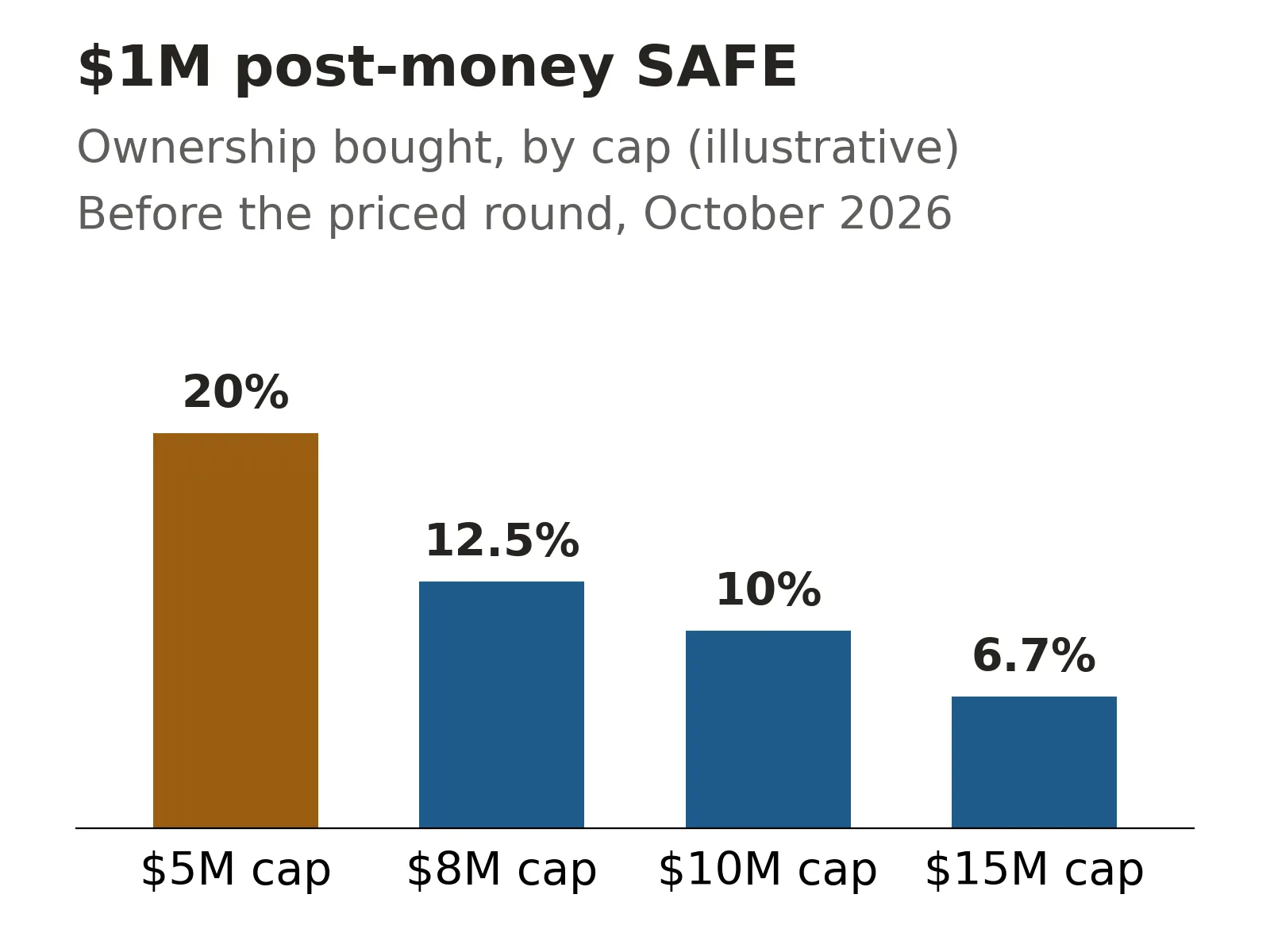
The valuation cap is the term that matters most in both instruments, because it caps the price at which the investor's money converts. With a post-money SAFE, the cap is stated as a valuation after all the SAFE money comes in. Y Combinator's guide explains that this makes the ownership sold easy to calculate: the purchase amount divided by the post-money valuation cap.
Using that method, a $1,000,000 SAFE buys 20% of the company at a $5,000,000 post-money cap, 12.5% at $8,000,000, 10% at $10,000,000 and about 6.7% at $15,000,000. Those percentages are measured before the priced round. The SAFE holders are then diluted, along with the founders, by the new money and any new or larger option pool in that round. For a deeper look at how each round shrinks founder ownership, see our guide to what equity dilution means for founders.
A discount works differently. It gives the investor a lower price than the new investors pay in the priced round. Y Combinator's guide expresses it as a Discount Rate: a 20% discount equals a Discount Rate of 80%. If new investors pay $2.00 per share, a 20% discount gives the SAFE or note holder a price of $1.60. When an instrument has both a cap and a discount, the investor gets whichever price produces more shares.
Founders often stack several SAFEs or notes at different caps before the first priced round. Each one adds to the dilution, so it is worth keeping a running cap table that shows every instrument on an as-converted basis.
How interest and maturity change a convertible note
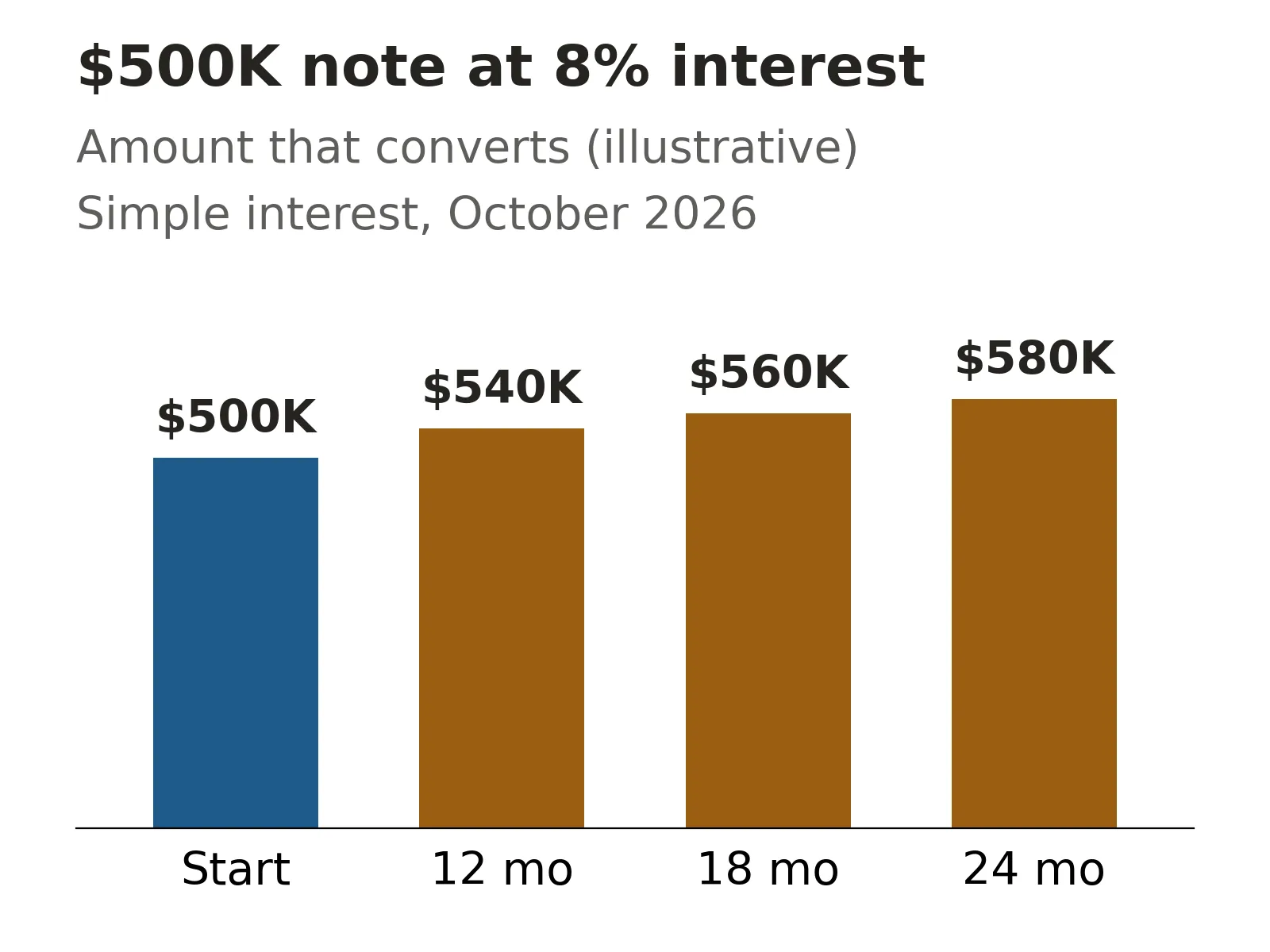
Interest is the main economic difference. Take an illustrative $500,000 note at 8% simple interest (an assumption for this example, not a market figure). After 12 months, $540,000 converts. After 18 months, $560,000 converts. After 24 months, $580,000 converts. At the same conversion price, the 24-month figure buys 16% more shares than the $500,000 principal alone. A SAFE for the same $500,000 converts $500,000 no matter how long the round takes.
The convertible note maturity date is the other lever. When a note matures before a priced round, the noteholders can ask for repayment. If the company cannot repay in cash, the options are an amendment: a later maturity date, a conversion at an agreed price, or new terms. Each of those needs the noteholders' agreement, and a group of noteholders can use the deadline to negotiate. A SAFE never creates that pressure point.
Which should a founder choose?
Neither instrument is right for every raise. These questions usually decide it:
- Who are your investors? Some investors ask for the creditor position and interest of a note. Others are used to the SAFE and expect it.
- How soon is the priced round? If the next round could be years away, a note's maturity date can arrive first. A SAFE has no such clock.
- How many closings? Y Combinator's guide points out that a SAFE lets a founder close with each investor as soon as both sides sign and the money is wired, without a single coordinated closing.
- What are you willing to negotiate? With the standard SAFE, the guide says the cap is usually the only term to negotiate. A note adds the rate, the maturity date and what happens at maturity.
- Where is the company incorporated? The Y Combinator forms use US terms such as preferred stock and stockholders. An Ontario corporation under the Business Corporations Act (Ontario) or a federal corporation under the Canada Business Corporations Act issues shares, and its articles have to allow the class of shares the SAFE converts into.
Before either document goes out, it helps to settle the founders' own terms first. Our guide on shareholders agreement clauses that prevent founder disputes covers the provisions investors usually ask about.
Securities law: both are securities
A SAFE and a convertible note are both securities, so issuing either one is a distribution that needs a prospectus exemption in Canada or a registration exemption in the US. The paperwork being short does not change that.
In Ontario, the Securities Act defines "security" to include any document evidencing an option, subscription or other interest in or to a security, and any note or other evidence of indebtedness (s. 1(1), e-Laws, current to October 13, 2026). Section 53 then bars a distribution without a prospectus unless an exemption applies. The common exemptions for startups are:
- Accredited investor: section 73.3(2) of the Securities Act (Ontario), with the definition in National Instrument 45-106. For individuals, that includes net income before taxes over $200,000 in each of the last two calendar years (or $300,000 with a spouse), financial assets over $1,000,000 net of related liabilities, or net assets of at least $5,000,000. These are Canadian dollar amounts.
- Private issuer: section 73.4(2) of the Act and section 2.4 of NI 45-106, for a company whose securities have transfer restrictions and are owned by no more than 50 people (not counting employees and former employees), sold to listed groups such as founders, close friends, close business associates and accredited investors.
- Family, friends and business associates: section 2.5 of NI 45-106, which in Ontario also requires a signed risk acknowledgement under section 2.6.1.
A sale under the accredited investor exemption or the family, friends and business associates exemption must be reported in a report of exempt distribution filed no later than 10 days after the distribution (NI 45-106 s. 6.1, Ontario Securities Commission consolidation current to December 4, 2025, checked October 2026). The OSC's consolidated text of NI 45-106 sets out every condition.
In the US, most SAFE and note rounds rely on Rule 506 of Regulation D. Rule 506(b) limits an offering to no more than 35 purchasers in any 90-day period, and accredited investors are not counted toward that limit (17 CFR 230.506(b) and 230.501(e)). Rule 506(c) requires every purchaser to be accredited and the issuer to take reasonable steps to verify that status. An individual is accredited with income over $200,000 in each of the two most recent years ($300,000 jointly with a spouse or spousal equivalent) and a reasonable expectation of the same this year, or net worth over $1,000,000 excluding the primary residence (17 CFR 230.501(a)). Within 15 calendar days after the first sale, the company must file a notice on Form D with the SEC (17 CFR 230.503, eCFR current to October 13, 2026). These are US dollar amounts.
| Rule | Ontario | United States |
|---|---|---|
| Main exemption | Accredited investor, s. 73.3 | Rule 506(b) or 506(c) |
| Income test | Over $200,000 (CAD) | Over $200,000 (USD) |
| Wealth test | $1M financial assets | $1M net worth |
| Filing | Exempt distribution report | Form D notice |
| Deadline | 10 days after | 15 days after first sale |
A cross-border round can trigger both sets of rules. A Delaware company selling SAFEs to Ontario angels needs to check Ontario's exemptions for those buyers, and an Ontario company selling notes to New York investors needs to check Regulation D. The SEC's own advice to investors is worth reading too: its investor bulletin on SAFEs lists the questions a careful investor will ask, which is useful preparation for a founder.
What happens at the priced round
When the company sells preferred shares in a priced round, both instruments usually convert. Under the post-money SAFE, conversion is automatic and the SAFE then ends. Y Combinator's guide says SAFE holders receive a separate series of preferred shares (Safe Preferred Stock) with the same rights as the new investors' shares, except that the per-share liquidation amount, conversion price and dividend amount are based on the SAFE holder's lower price per share.
A convertible note converts according to its own terms, which may require a minimum round size before conversion is automatic. The term sheet for the priced round will deal with the existing SAFEs and notes. Our guide to the NVCA term sheet explains the terms US venture investors usually bring to that negotiation, and our explainer on common stock vs preferred stock covers the rights the converted shares carry.
Frequently asked questions
Is a SAFE debt or equity?
A SAFE is not debt. It carries no interest and no repayment date. It is a contract right to receive shares in the future, usually at the next priced round. The SEC says SAFEs are not common stock, and Y Combinator, which publishes the standard form, says it has always intended the SAFE to be an equity security. Tax treatment is a separate question for a tax advisor.
Do convertible notes have to be repaid?
A convertible note is a loan, so the principal and accrued interest are owed on the maturity date if the note has not converted. If the company cannot pay, it can ask the noteholders to extend the maturity date or convert the note on agreed terms. The noteholders do not have to agree, and that gives them bargaining power when the note comes due.
What happens to a SAFE if the startup fails?
Under the Y Combinator post-money SAFE, if the company dissolves, the SAFE holder is entitled to its purchase amount back. That claim ranks behind creditors and outstanding debt, including convertible notes, and alongside preferred shareholders. When a company winds down with little money left, there may be nothing to pay, and the SEC's investor bulletin warns that a SAFE holder can be left with nothing.
What is the difference between a pre-money and a post-money SAFE?
The original 2013 SAFE stated its valuation cap before the SAFE money came in. The post-money SAFE, released in 2018, states the cap after all SAFE money is counted. That lets founders and investors calculate ownership directly: the purchase amount divided by the post-money cap. A $1,000,000 SAFE at a $10,000,000 post-money cap equals 10% before the priced round.
Can a Canadian startup use a SAFE?
Yes. Canadian startups issue SAFEs, but the Y Combinator forms were written with US corporate terms such as preferred stock. An Ontario or federal corporation issues shares, so the document and the company's articles have to work together. The sale also needs a prospectus exemption under Ontario securities law, such as the accredited investor or private issuer exemption.
Do I need to file anything when I issue a SAFE or a convertible note?
Often, yes. In Ontario, a sale under the accredited investor exemption or the family, friends and business associates exemption requires a report of exempt distribution within 10 days. In the US, a company relying on Rule 506 must file a Form D notice with the SEC within 15 calendar days after the first sale. A cross-border round can require both.
Which is better for founders, a SAFE or a convertible note?
The SAFE appeals to founders because it has no interest, no maturity date and fewer terms to negotiate. A convertible note can still be the better fit when investors insist on creditor protection or the company expects a priced round soon. The cap, any discount and how many instruments are stacked usually matter more than the choice of form.
Conclusion
The SAFE vs convertible note choice comes down to interest, maturity and who carries the risk while the company waits for a priced round. A SAFE keeps things simple and removes the deadline. A note gives investors interest and a creditor's claim. Whichever you pick, the valuation cap decides how much of the company you sell, and both instruments are securities that need an exemption and, in most cases, a filing in Ontario or with the SEC.
How Mayo Law can help
Mayo Law advises startups on both sides of the border from offices in Toronto and New York. Joseph Mayo, our principal attorney, is licensed in Ontario and New York, and our lawyers prepare SAFEs and convertible notes, review investor terms, and handle the Ontario and US securities filings that come with a raise. Our startup lawyer page explains how we work with founders. The first step is a paid one-hour consultation, because a lawyer reviews your round, your cap table and your investors' locations in depth.
Disclaimer
This article is for general information only and is not legal, tax or financial advice. Reading it does not create a solicitor-client or attorney-client relationship. Securities rules and thresholds change, and the right structure depends on your company, your investors and where they are located. Mayo Law provides legal services in Ontario and New York.