

Contents
- Quick answer
- What is a force majeure clause?
- How do Ontario courts read a force majeure clause?
- How do New York courts read a force majeure clause?
- What should a force majeure clause say?
- What does a force majeure clause example look like?
- What if the contract has no force majeure clause?
- How does force majeure work in a U.S.-Canada contract?
- Frequently asked questions
- Conclusion
- How Mayo Law can help
- Disclaimer
A force majeure clause excuses a party from performing a contract when an event beyond its control, one that the clause's words reach, prevents performance. The clause does only what its words say. The courts whose decisions govern Ontario and New York contracts start from the same place: the excuse comes from the clause, it covers only the events its words reach, and a party's own costs or financial trouble do not count. This guide explains how the Supreme Court of Canada, the Ontario Court of Appeal, the New York Court of Appeals and the U.S. Court of Appeals for the Second Circuit, applying New York law, have read these clauses, what a clause for a U.S.-Canada business should say, and what happens when a contract has none. Mayo Law's contract lawyers draft and review these clauses for Ontario and New York agreements.
Quick answer
A force majeure clause excuses performance only for the events its words reach, only when that event prevents performance, and only if the party follows any notice and mitigation terms the clause sets. Ontario and New York courts read the clause narrowly. Without one, the fallbacks are frustration in Ontario and impossibility or frustration of purpose in New York.
What is a force majeure clause?
A force majeure clause is a contract term that allocates the risk of events outside the parties' control, such as war, strikes, natural disasters or government orders, by excusing, suspending or extending performance while the event lasts. A contract without one leaves the parties to frustration in Ontario or impossibility in New York, both described later in this guide.
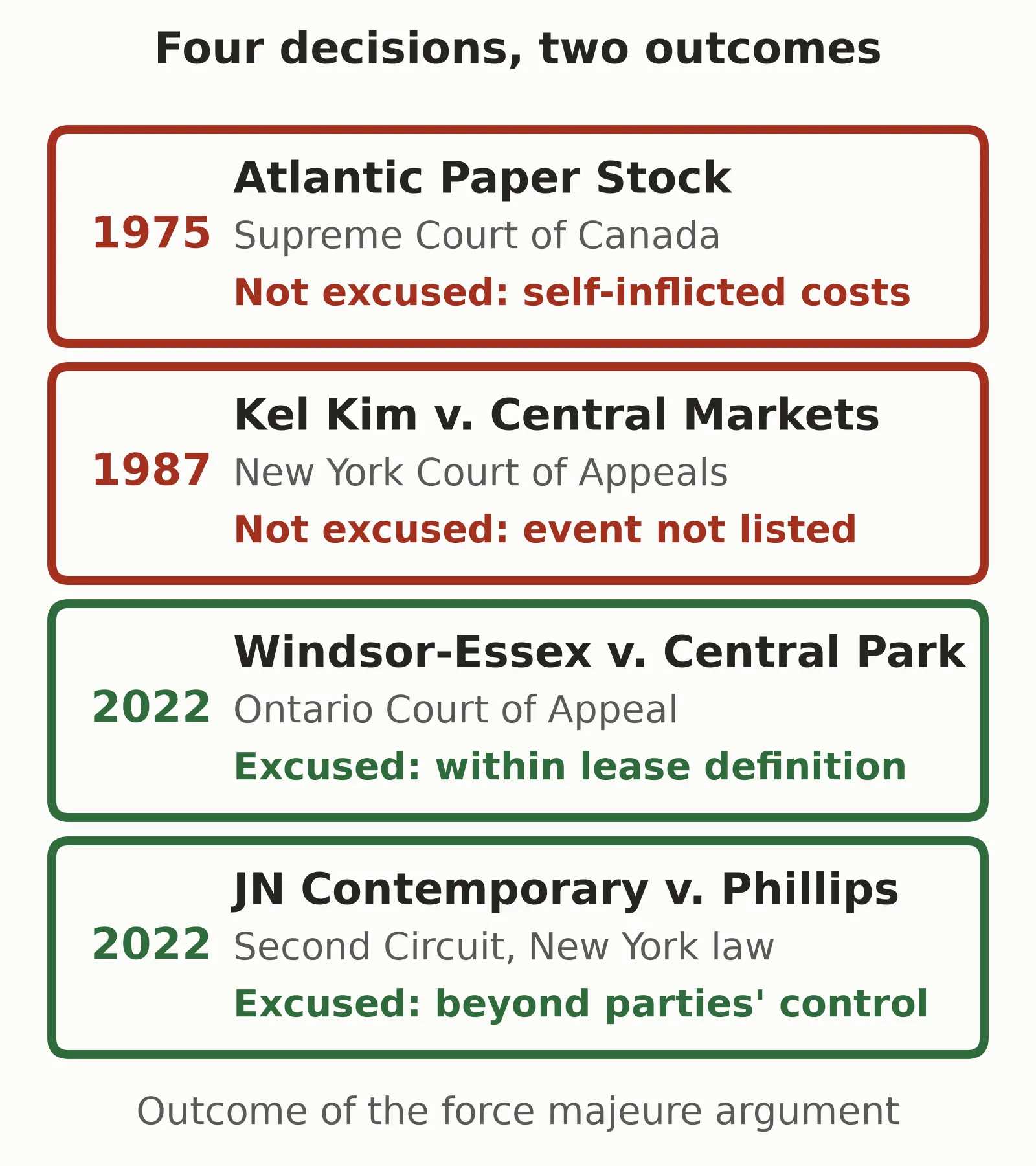
The Supreme Court of Canada (SCC) described the clause in Atlantic Paper Stock Ltd. v. St. Anne-Nackawic Pulp and Paper Company Limited, [1976] 1 S.C.R. 580, decided in April 1975. In the words of Justice Dickson, an act of God clause or force majeure clause "generally operates to discharge a contracting party when a supervening, sometimes supernatural, event, beyond control of either party, makes performance impossible. The common thread is that of the unexpected, something beyond reasonable human foresight and skill." The SCC treated an act of God clause and a force majeure clause as the same kind of term. The New York Court of Appeals, New York's highest court, used similar words in Beardslee v. Inflection Energy, LLC in 2015: a force majeure event is "an event beyond the control of the parties that prevents performance under a contract and may excuse nonperformance", citing its 1987 decision in Kel Kim Corp. v. Central Markets, Inc., 70 N.Y.2d 900.
A typical clause has four parts. The first is a statement that performance is excused, suspended or extended. The second is a list of the events that qualify, often closed by a catch-all phrase. The third sets the duties of the affected party, usually notice and mitigation. The fourth gives the consequences, such as an extension of time, a suspension of payment, or a right to terminate if the event lasts too long. Our guide to the off-take contract shows how the clause fits into a long-term supply deal.
How do Ontario courts read a force majeure clause?
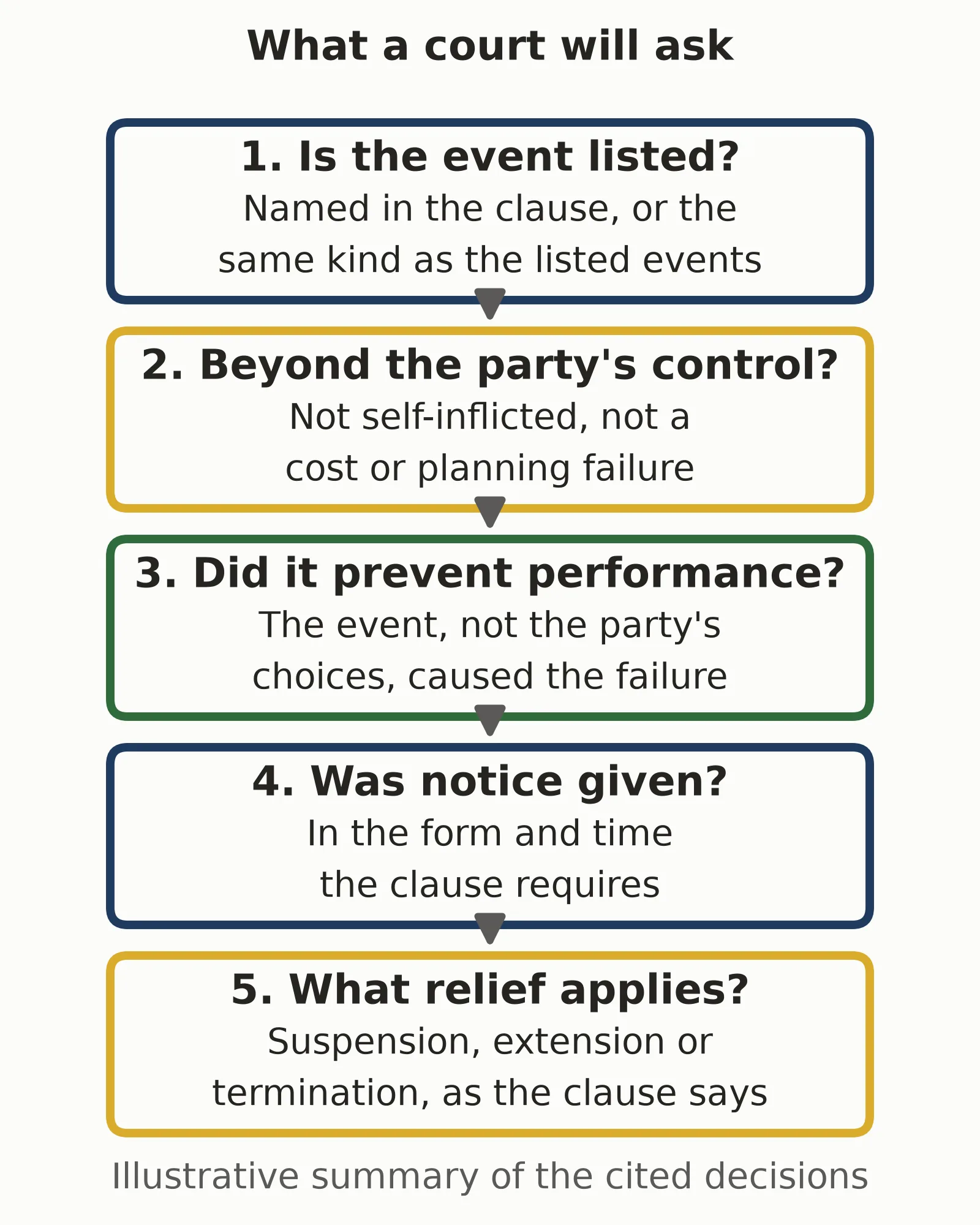
Ontario courts enforce the clause as written: the Supreme Court of Canada reads the listed events as a group, requires an unexpected event beyond the party's control, and refuses the excuse to a party whose own costs or planning caused the failure. The SCC's decisions bind courts in every province, Ontario included. This guide covers the common-law approach; Quebec's civil law is outside its scope.
Atlantic Paper Stock is the Supreme Court of Canada's decision on the point. A pulp and paper mill at Nackawic, New Brunswick, agreed to buy at least 10,000 tons of waste paper a year for ten years from two suppliers. The obligation was subject only to "an act of God, the Queen's or public enemies, war, the authority of the law, labour unrest or strikes, the destruction of or damage to production facilities, or the non-availability of markets for pulp or corrugating medium". After fourteen months the mill stopped taking deliveries and pleaded non-availability of markets. The SCC read that phrase ejusdem generis, that is, in the light of the specific events listed before it, and held that it "must be limited to an event over which the respondent exercises no control". The judgment records the mill's production costs of $150.29 a ton in June 1970 and $186.94 a ton in June 1971 against an average selling price of $120 a ton, and, quoting the trial judge, says the mill "simply priced itself out of any available market". Justice Dickson wrote: "I do not think St. Anne can rely on a condition which it brought upon itself." The suppliers' appeal was allowed and the trial judge's damages of $49,145 and $59,145 were restored.
The Ontario Court of Appeal upheld a words-first reading of a pandemic closure in Windsor-Essex Catholic District School Board v. 2313846 Ontario Limited (Central Park Athletics), 2022 ONCA 235, decided on March 23, 2022. Two school boards rented space in a sports facility that provincial lockdowns closed from March 17 to August 11, 2020. The court recorded that there was no dispute the lockdowns "triggered a force majeure event, as defined in the leases". The dispute was about effect. The clause said that where the landlord could not enable the tenant to use the premises, rent "shall fully abate" until the landlord restored that ability. The court dismissed the landlord's appeal, so the tenants' rent abated for the closure period, and ordered costs of $15,000. The lesson runs both ways: the same event can leave a tenant paying full rent under one clause and nothing under another, because the clause's words decide.
An express clause also displaces the common-law fallback. In Naylor Group Inc. v. Ellis-Don Construction Ltd., 2001 SCC 58, the Supreme Court of Canada held that where parties have made specific provision for supervening circumstances, the doctrine of frustration is inapplicable. A party that negotiated a narrow clause has, in effect, agreed to carry the risks it left out.
How do New York courts read a force majeure clause?
New York courts construe a force majeure clause narrowly: the New York Court of Appeals held in Kel Kim Corp. v. Central Markets, Inc., 70 N.Y.2d 900, in 1987 that a party is excused only if the clause specifically includes the event that actually prevents performance. The Second Circuit summarized that holding in JN Contemporary Art LLC v. Phillips Auctioneers LLC in 2022.
As the Second Circuit described the case, Kel Kim leased premises for a roller skating rink. The lease required it to carry a set amount of liability insurance, and its force majeure provision excused delay caused by "labor disputes, inability to procure materials, failure of utility service, restrictive governmental laws or regulations, riots, insurrection, war, adverse weather, Acts of God, or other similar causes beyond the control of such party". After six years Kel Kim could not renew its policy because of a crisis in the insurance market. The Court of Appeals held that the clause did not apply: the inability to obtain insurance was neither listed nor a "similar cause", because the listed events concern "a party's ability to conduct day-to-day commercial operations on the premises". The catch-all phrase is read as covering only "things of the same kind or nature as the particular matters mentioned". New York trial courts repeat the Court of Appeals' starting point, as the Supreme Court, New York County, a trial court, did in Urban Archaeology Ltd. v. 207 E. 57th St. LLC in 2009, quoting Kel Kim at page 902: "once a party to a contract has made a promise, that party must perform or respond in damages for its failure", even when unforeseen circumstances make performance burdensome.
Money trouble does not excuse performance in New York either. In 933 Broadway, LLC v. Godiva Chocolatier, Inc., decided by the Supreme Court, New York County, in April 2022, the court granted summary judgment to a landlord for pandemic-period rent, quoting the Court of Appeals' 1968 rule in 407 E. 61st Garage, Inc. v. Savoy Fifth Ave. Corp., 23 N.Y.2d 275, that "where impossibility or difficulty of performance is occasioned only by financial difficulty or economic hardship, even to the extent of insolvency or bankruptcy, performance of a contract is not excused".
The narrow reading still excuses a party when the words fit. In JN Contemporary Art, decided on March 23, 2022, the United States Court of Appeals for the Second Circuit applied New York law to an auction agreement. Phillips had agreed to offer a painting at its May 2020 New York auction with a guaranteed minimum of $5,000,000 for the seller. The clause allowed Phillips to terminate if the auction was postponed "for circumstances beyond our or your reasonable control, including, without limitation, as a result of natural disaster, fire, flood, general strike, war, armed conflict, terrorist attack or nuclear or chemical contamination". The court held that the COVID-19 pandemic and the governor's orders restricting nonessential businesses were circumstances beyond the parties' reasonable control, affirmed the dismissal of the seller's claim, and did not decide whether the pandemic was a "natural disaster". Citing its 1993 decision in Harriscom Svenska, AB v. Harris Corp., it added that a party excused by force majeure was not required to provide substitute performance, and noted that the agreement contained no such requirement. A federal appellate reading of New York law is persuasive rather than binding in the state courts, but it rests on the state cases it quotes.
The two jurisdictions line up more than they differ. The table below sets the main points side by side, from the decisions cited in this guide, Ontario's Frustrated Contracts Act and New York's Uniform Commercial Code (UCC).
| Question | Ontario | New York |
|---|---|---|
| Source of the excuse | The clause's own words | The clause's own words |
| Unlisted event | Not covered (Atlantic Paper) | Not covered (Kel Kim) |
| Catch-all phrase | Read with the listed events | Same kind as the list |
| Cost increase alone | No excuse (Atlantic Paper) | No excuse (407 E. 61st Garage) |
| Government lockdown | Within the lease definition (2022 ONCA 235) | Beyond control where worded so (JN) |
| No clause at all | Frustration; the Frustrated Contracts Act | Impossibility, frustration of purpose; UCC 2-615 |
What should a force majeure clause say?
A useful clause names the events, sets the causation test, fixes the notice and mitigation duties, excludes what the parties do not mean to cover, and says what happens next: suspension, extension, cost sharing or termination after a set period. Each choice follows from how the Supreme Court of Canada and the New York Court of Appeals read the words.
- Events: list them. The Ontario and New York decisions above excused only events the clause named or clearly caught. A U.S.-Canada supply or service contract usually needs more than storms and strikes: border closures, transport and port interruptions, epidemics and the government orders that follow them, sanctions and export controls, a change in trade measures such as new tariffs, and a cyber incident that disables a party's systems. Each is a drafting choice; none is covered unless the words reach it.
- Cost changes: decide expressly. In Atlantic Paper Stock, soaring production costs did not excuse the mill, and in New York, financial hardship does not excuse performance. A party that wants relief from a tariff increase or a price spike needs an express term, such as a price adjustment or renegotiation clause, rather than a force majeure clause alone.
- Causation: choose the verb. "Prevents" sets a higher bar than "hinders or delays". The clause should also say that the event must be the cause of the failure and that the party could not have avoided it with reasonable care.
- Exclusions: a clause can exclude the obligation to pay money, a party's own fault, and events that were already foreseeable when the contract was signed, such as a strike that had been announced.
- Notice: require written notice within a fixed number of days, with the evidence and the expected duration, and say what happens if notice is late.
- Mitigation: require the affected party to use reasonable efforts to overcome the event and to resume performance when it ends.
- Suspension or termination: suspension extends the time for performance while the event lasts. A termination right, for example after 90 or 120 days of suspension, lets either party walk away without damages. Say which obligations survive and who keeps or refunds deposits and prepayments.
How the clause interacts with the rest of the contract matters as much as its own words. A limitation of liability clause caps damages when the excuse fails, an indemnification clause may shift third-party losses caused by a suspension, and the governing-law clause decides whether Ontario or New York law applies.
What does a force majeure clause example look like?
A force majeure clause for a cross-border supply contract usually has six parts: a definition that lists the events, an effect provision, exclusions, a notice term, a mitigation duty and a termination right. The example below shows each part with what it does; it is an illustration of structure, not wording drafted for any particular deal.
- Definition: "Force Majeure Event means an event beyond the reasonable control of the affected party that it could not have avoided by reasonable care, including fire, flood, earthquake, epidemic, war, terrorism, riot, strike or lockout (other than by the affected party's own workforce), a border closure or transport interruption, an order of a government or court, a new sanction, export control or tariff, and a cyber incident that disables the affected party's systems." This part names the events and ties the catch-all to reasonable control. Listing a tariff covers an order that stops performance; a tariff that only raises costs falls under the price-change exclusion below and needs the separate price adjustment clause described above.
- Effect: "A party prevented from performing an obligation by a Force Majeure Event is excused from that obligation, and the time for performance is extended, for as long as the event continues." This part sets the causation test ("prevented") and limits relief to the affected obligation.
- Exclusions: "A Force Majeure Event does not excuse the payment of money due, and does not include a change in market prices, a party's financial inability, or an event the party knew of when it signed this agreement." This part answers Atlantic Paper Stock and the New York financial-hardship rule in advance.
- Notice: "The affected party shall give written notice within 10 days of learning of the event, describing it, its expected duration and the obligations affected, and shall update the other party every 30 days." This part gives the other side the facts it needs to plan.
- Mitigation: "The affected party shall use commercially reasonable efforts to overcome the event and resume performance." This part records the duty and lets the other party test it.
- Termination: "If a Force Majeure Event continues for more than 120 consecutive days, either party may terminate this agreement on 15 days' written notice, and prepayments for goods not delivered shall be refunded." This part fixes the exit and settles the money.
What if the contract has no force majeure clause?
Without a clause, Ontario law offers only frustration, which discharges the whole contract when performance becomes radically different from what was undertaken, and New York law offers impossibility, frustration of purpose and, for sales of goods, UCC section 2-615. All of these are harder to meet than a well-drafted clause.
In Ontario, the Supreme Court of Canada stated the test in Naylor Group: frustration occurs when a situation has arisen for which the parties made no provision in the contract and performance becomes "a thing radically different from that which was undertaken by the contract". Frustration ends the contract; it does not pause it. The Frustrated Contracts Act, R.S.O. 1990, c. F.34, then sorts out the money for any contract governed by Ontario law that has become impossible of performance or otherwise frustrated. Under section 3, sums paid before the discharge are recoverable and sums payable cease to be payable; the court may let the party that received money keep or recover its expenses where that is just; and where the contract itself provides for the frustrating circumstances, the court gives effect to that provision first. Under section 2, the Act does not apply to insurance contracts, to most contracts for carriage of goods by sea, or to specific goods that perished before the risk passed, all as of Ontario's e-Laws consolidation current to November 3, 2026.
In New York, the impossibility defense is narrow. As the court put it in 933 Broadway, quoting Kel Kim, impossibility excuses performance "only when the destruction of the subject matter of the contract or the means of performance makes performance objectively impossible", and the impossibility "must be produced by an unanticipated event that could not have been foreseen or guarded against in the contract". Frustration of purpose is a separate and equally narrow defense, raised and rejected in the same case. For a sale of goods, New York's UCC section 2-615 adds a statutory excuse. A seller's delay or non-delivery is not a breach if performance "has been made impracticable by the occurrence of a contingency the non-occurrence of which was a basic assumption on which the contract was made or by compliance in good faith with any applicable foreign or domestic governmental regulation or order". Where only part of its capacity is affected, the seller must allocate production fairly among its customers, and it must notify the buyer "seasonably" of the delay or non-delivery and of any allocation.
How does force majeure work in a U.S.-Canada contract?
In a cross-border contract the governing-law clause decides whether Ontario or New York law reads the clause, so the two clauses must be drafted together and the event list must cover disruptions on both sides of the border. Because both jurisdictions read the clause narrowly, the list matters more than the choice of law.
Three points come up in almost every U.S.-Canada supply, distribution or services agreement. First, name the events that cross-border trade actually faces: a closure or slowdown at the border, a transport or port interruption, a sanction or export control on either side, a tariff or other trade measure, and an order of either government. Second, decide where a government order fits: in Windsor-Essex the lockdown fell within the leases' definition of force majeure, and in JN Contemporary Art the governor's orders fell within "circumstances beyond reasonable control"; neither court said a clause listing only natural disasters would reach the event, and the Second Circuit left that question open. Third, align the clause with the forum selection clause and the governing law, and with any master service agreement that sits above individual orders, so that a suspension under one document does not put a party in breach of another. A party relying on the clause should also keep a record of what the event was, when it started, the notice given, and what was done to overcome it.
Frequently asked questions
Is a pandemic a force majeure event?
Only if the clause's words reach it. In Windsor-Essex (2022 ONCA 235) the parties agreed that provincial lockdowns were a force majeure event as the leases defined it, and in JN Contemporary Art the Second Circuit held that the pandemic and New York's orders on nonessential businesses were circumstances beyond the parties' reasonable control. A clause that lists only fire, flood and war gives no such answer.
Does a force majeure clause excuse paying rent or an invoice?
Usually not, unless the clause says so. A clause can exclude payment obligations, and New York courts hold that financial hardship alone does not excuse performance. In Windsor-Essex the tenants' rent abated because the lease said rent "shall fully abate" while the landlord could not provide the space; in 933 Broadway v. Godiva the tenant stayed liable for pandemic-period rent.
What happens if my contract has no force majeure clause?
The general law applies, and it is narrower. In Ontario the doctrine of frustration discharges a contract only when performance has become radically different from what was undertaken, and the Frustrated Contracts Act then adjusts the money. In New York a party must show objective impossibility, frustration of purpose or, for goods, the impracticability excuse in section 2-615 of New York's Uniform Commercial Code.
Are tariffs or price increases a force majeure event?
A cost increase on its own did not excuse performance in either jurisdiction: the Supreme Court of Canada refused the mill's excuse in Atlantic Paper Stock despite production costs above its selling price, and the New York Court of Appeals held in 407 E. 61st Garage (1968) that financial hardship does not excuse performance. A party that wants relief from new tariffs needs express words, such as a listed trade-measure event or a separate price adjustment clause.
Do I have to give notice to rely on a force majeure clause?
If the clause requires notice, follow it to the letter: Ontario and New York courts enforce these clauses as written, and where the clause makes notice a condition of relief, a missed notice period can cost the excuse. Even where the clause is silent, prompt written notice that describes the event, its expected length and the obligations affected creates the record a court will later read, and it starts the mitigation discussion with the other party.
Is force majeure the same as frustration of contract?
No. A force majeure clause is a negotiated term that usually suspends or extends performance for the events it lists, and in Naylor Group the Supreme Court of Canada held that where the parties have provided for supervening circumstances the doctrine of frustration does not apply. In Ontario, frustration is the common-law fallback: it ends the contract rather than pausing it, and it needs a radical change. In New York the comparable fallbacks are impossibility and frustration of purpose, both read narrowly.
Conclusion
The clause is only as good as its list of events and the procedure around it. The Supreme Court of Canada read the clause by its listed events and refused relief for self-inflicted costs, and the Ontario Court of Appeal gave a lockdown exactly the effect the lease's words provided. The New York Court of Appeals excuses only listed events or events of the same kind, and the Second Circuit excused an auction house because its clause reached circumstances beyond reasonable control. A business signing an Ontario or New York contract should name the events it fears, decide what happens to money and time while the event lasts, and follow the notice terms when the event arrives. Where the contract is silent, frustration and impossibility are a much narrower safety net.
How Mayo Law can help
Mayo Law is a cross-border business law firm with offices in Toronto and New York. Joseph Mayo, our principal attorney, is licensed in Ontario and New York, and our lawyers draft, review and negotiate supply, distribution and service agreements governed by either law, including force majeure, limitation of liability and termination clauses, and advise parties who need to invoke or answer a force majeure notice. We offer a paid one-hour consultation in which a lawyer reviews the contract and the facts in depth. You can start through our contract lawyer page.
Disclaimer
This guide is general information about force majeure clauses under Ontario and New York law as of November 2026. It is not legal advice, and reading it does not create a solicitor-client or attorney-client relationship. Court decisions and statutes change, and the outcome in any case depends on the contract's words and the facts. Mayo Law provides legal services in Ontario and New York.