

Contents
- Quick answer
- What is Series A funding?
- How does a Series A round work, step by step?
- What documents does a Series A use?
- Where do Series A terms go in a Canadian company?
- Who has to approve the new preferred shares?
- What does investor due diligence check?
- Which securities filings follow the closing?
- Frequently asked questions
- Conclusion
- How Mayo Law can help
- Disclaimer
Series A funding is a round in which a startup sells investors a new series of preferred shares, named Series A, at a set price per share. On the legal side, it means a stack of documents, a change to the company's charter, shareholder approvals and securities filings, and several of those work differently for a Delaware corporation and a CBCA or Ontario corporation.
For founders in Ontario or New York who are raising across the border, our cross-border business lawyers review that whole set before anything is signed. This guide walks through it step by step, so you know what the investors' lawyers will send you and what your company will be asked to prove.
We name the documents from the National Venture Capital Association (NVCA) model set and show where the same terms go in a corporation under the Canada Business Corporations Act (CBCA) or Ontario's Business Corporations Act (OBCA). We also set out the two filing deadlines that can follow a closing: the Securities and Exchange Commission (SEC) Form D and Ontario's report of exempt distribution.
Quick answer
Series A funding is a priced round in which investors buy a new series of preferred shares. The company gets the approvals its statute and charter require, amends its charter and signs the deal documents. Form D follows within 15 calendar days for a Rule 504 or 506 offering; Ontario's accredited investor exemption needs Form 45-106F1, generally within 10 days.
What is Series A funding?
Series A funding is the round in which a startup sells a new series of preferred shares to investors at a set price per share. "Series A" names that series of preferred stock: the NVCA's model certificate of incorporation calls the shares "Series A Preferred Stock".
If the company raised seed money through a simple agreement for future equity (SAFE) or a convertible note, the Series A closing deals with it: the NVCA model stock purchase agreement has a closing section on the "Conversion and Termination of Convertible Securities". Our guide on SAFEs and convertible notes explains how those instruments convert, and pre-seed vs seed covers the earlier rounds.
The shares the Series A investors receive are preferred shares: a class or series that carries rights the founders' common shares do not, such as a liquidation preference, conversion rights and protective provisions, all of which appear in the NVCA model certificate. The Delaware General Corporation Law (DGCL) lets a corporation issue classes or series of stock with "such designations, preferences and relative, participating, optional or other special rights" as are stated in its certificate of incorporation or an amendment to it, or in a board resolution where the certificate expressly gives the board that authority (section 151(a)). Our guide to common stock vs preferred stock sets out the differences in plain terms.
How does a Series A round work, step by step?
A Series A round can move from a signed term sheet to due diligence, then board and shareholder approval of the new preferred shares, the charter amendment, the signing and closing of the purchase documents, and finally the securities filings. The order below is illustrative; your documents and the investors' counsel set the actual sequence.
- Step 1: Term sheet. The lead investor and the company agree on the main terms: price, amount, the preferred share rights and board seats. Our guide to the NVCA term sheet goes through those terms one by one.
- Step 2: Due diligence. The investors' lawyers review the company's records, capitalization, contracts and intellectual property.
- Step 3: Approvals. The board approves the round, and the shareholders approve the charter change by the vote the corporate statute or the charter requires.
- Step 4: Charter amendment. A Delaware corporation amends its certificate of incorporation (the NVCA model uses an amended and restated certificate); a CBCA or OBCA corporation sends articles of amendment to the Director (CBCA section 177; OBCA section 171).
- Step 5: Closing. The parties sign the purchase agreement and the side agreements, the investors pay and the company issues the preferred shares.
- Step 6: Filings. The company files its securities-law notices: Form D with the SEC when the round relies on Rule 504 or 506 of Regulation D, and the report of exempt distribution when it relies on an Ontario exemption that requires one, such as the accredited investor exemption.
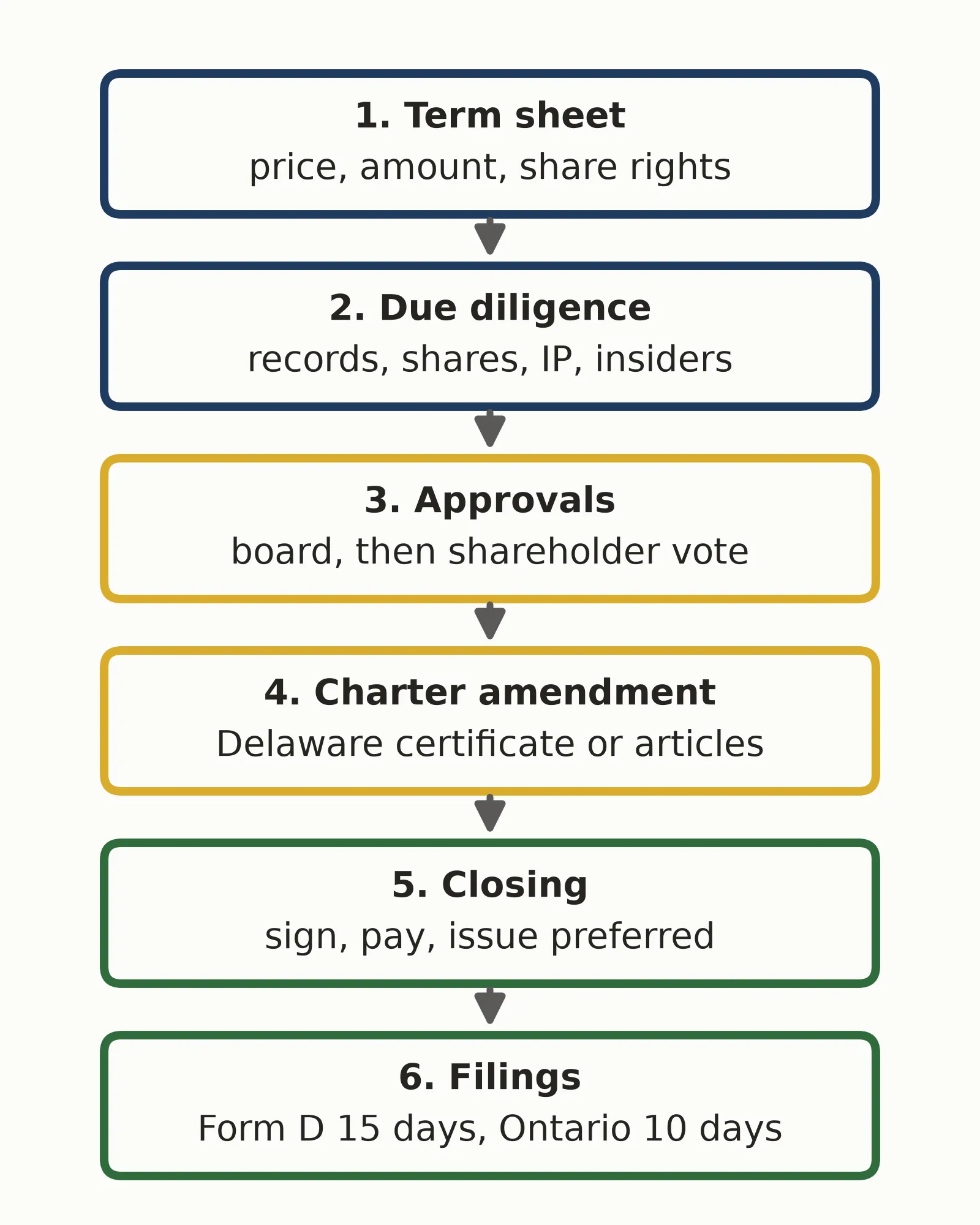
The NVCA's model stock purchase agreement assumes the charter step comes first: it provides that the company "shall have adopted and filed with the Secretary of State of the State of Delaware on or before the Initial Closing" the amended and restated certificate of incorporation. In other words, under the model the preferred shares have to exist in the charter before they are sold.
What documents does a Series A use?
The NVCA's model set for US venture financings, including Series A funding, centers on five documents: an amended certificate of incorporation, a stock purchase agreement, an investors' rights agreement, a voting agreement, and a right of first refusal and co-sale agreement. The NVCA publishes them free, with a management rights letter, an indemnification agreement and a model legal opinion.
The NVCA describes its model legal documents as "the industry-embraced model documents to be used in venture capital financings". Its page lists the dates of the current versions: October 2025 for the certificate of incorporation, stock purchase agreement and investors' rights agreement, June 2026 for the voting agreement, and April 2026 for the right of first refusal and co-sale agreement. Here is what each core document covers, from the model text itself:
- Certificate of incorporation: the preferred share terms, with sections on dividends, liquidation, voting, election of directors, the right to convert into common shares and adjustments to the conversion price for diluting issues.
- Stock purchase agreement: the purchase and sale of the preferred stock, and the company's representations, including on its capitalization, its intellectual property and certain transactions with insiders.
- Investors' rights agreement: registration rights such as a demand registration, delivery of financial statements, and "Rights to Future Stock Issuances".
- Voting agreement: how the parties vote their shares on the composition of the board, and an optional drag-along right in brackets.
- Right of first refusal and co-sale agreement: the company's right to buy shares a key holder proposes to transfer "at the same price and on the same terms", and the investors' right to join that sale.
These Series A documents connect to the rest of your records. The share counts in the stock purchase agreement have to match your cap table, and the new preferred shares change every existing holder's percentage, which our guide on equity dilution works through.
Where do Series A terms go in a Canadian company?
In a Canadian corporation, the preferred share terms go into the articles, through articles of amendment, rather than a certificate of incorporation, and voting and governance terms can go into a shareholder voting agreement or a unanimous shareholder agreement. The CBCA and Ontario's OBCA both provide for each of these.
Both statutes let the articles authorize a class of shares to be issued in one or more series, and either fix each series' "designation, rights, privileges, restrictions and conditions" or authorize the directors to fix them (CBCA section 27; OBCA section 25). Creating a new class of preferred shares, or changing the maximum number of shares, is an amendment to the articles (CBCA section 173; OBCA section 168); our guide to articles of amendment in Ontario walks through the Ontario filing.
The voting and governance side has its own homes. Under the Ontario Business Corporations Act, a written agreement between two or more shareholders "may provide that in exercising voting rights the shares held by them shall be voted as therein provided" (section 108(1)), which is the role the NVCA voting agreement plays, and CBCA section 145.1 says the same for a federal corporation. An agreement among all the shareholders may restrict the directors' powers to manage the business (OBCA section 108(2)); under the CBCA, this is a unanimous shareholder agreement, and a purchaser of shares subject to one "is deemed to be a party to the agreement" (section 146(3)).
| Term | Delaware company | CBCA or OBCA company |
|---|---|---|
| Preferred share rights | Certificate of incorporation | Articles of amendment |
| Board voting | Voting agreement | Shareholder voting agreement |
| Share purchase | Stock purchase agreement | Purchase agreement (contract) |
The table above is a map, not a rule that every term must go in one place: which document carries a given right is a drafting choice, within what each statute allows. Founders weighing where to incorporate before the round can compare the options in our guide to the Delaware C corp.
Who has to approve the new preferred shares?
In Delaware, the board adopts the charter amendment and a majority of the outstanding stock entitled to vote must approve it; under the CBCA and the OBCA, an amendment creating a new class needs a special resolution of at least two-thirds of the votes cast. Some classes may also get a separate vote, and a board-designated series can skip the shareholder vote.
Delaware's DGCL section 242(b) requires the board to adopt a resolution setting out the amendment and declaring its advisability, and the amendment is adopted when "a majority of the outstanding stock entitled to vote thereon, and a majority of the outstanding stock of each class entitled to vote thereon as a class" has voted in favor. Holders of a class vote separately when the amendment would increase or decrease the authorized shares of that class, change its par value, or alter its powers, preferences or special rights "so as to affect them adversely" (section 242(b)(2)). The certificate of incorporation can, however, remove the class vote on a change in the number of authorized shares.
In Canada, a special resolution is passed by at least two-thirds of the votes cast, or signed by all the shareholders entitled to vote on it (CBCA section 2(1); OBCA section 1(1)). Both statutes give a separate class vote when the articles would "create a new class of shares equal or superior to the shares of such class" (CBCA section 176(1)(e); OBCA section 170(1)(e)), unless the articles provide otherwise for that kind of amendment.
There is one route around the shareholder vote. If the articles already authorize a class of preferred shares in series and let the directors fix each series' terms, the directors can designate the Series A shares themselves: under the CBCA they send articles of amendment designating the series to the Director before the shares are issued (section 27(4)), and the OBCA's separate vote on a new equal or superior class or series does not apply to a series created under section 25 (section 170(1)(e)). In Delaware, the board can fix the terms by resolution where the certificate expressly gives it that authority (section 151(a)).
| Statute | Shareholder vote | Separate class vote |
|---|---|---|
| Delaware (DGCL s. 242) | Majority of outstanding stock | Share count, par or adverse change |
| Federal (CBCA ss. 173, 176) | Two-thirds of votes cast | New equal or superior class |
| Ontario (OBCA ss. 168, 170) | Two-thirds of votes cast | New equal or superior class |
The table shows only the statutory default, and the Canadian class votes apply unless the articles provide otherwise. In Delaware, the certificate of incorporation can require a larger vote than the statute (DGCL section 242(b)(4)), and earlier preferred share terms, such as the protective provisions in the NVCA model certificate, can add approval requirements of their own, so the approvals for your Series A round depend on those documents as well.
What does investor due diligence check?
Investor due diligence in Series A funding checks that the company's records back up the representations it makes in the stock purchase agreement. In the NVCA model, those cover the company's capitalization, its intellectual property and transactions with insiders, among other subjects, so those are the records to have in order before the investors' lawyers start their review.
The NVCA model stock purchase agreement asks the company to state its authorized capital "immediately prior to the [Initial] Closing", so every share, option, warrant and convertible security has to reconcile with the corporate records, not just with a spreadsheet. Our cap table guide explains which legal records a cap table has to match.
For Series A investors, the model's representations point to the records to gather:
- Corporate documents: the charter, the bylaws and minute books that contain "minutes of all meetings of directors and stockholders and all actions by written consent".
- Intellectual property: the model states that each current and former employee "has assigned to the Company" the rights they developed for it.
- Insider dealings: the model states that the company is not indebted to its directors, officers or employees, outside ordinary expenses.
- Earlier instruments: the model has a closing section on the "Conversion and Termination of Convertible Securities".
Where the records do not support a representation, the company can either fix the gap before signing or list it as an exception on the disclosure schedule, which the NVCA model makes part of the representations, and the investors decide whether to accept it.
Which securities filings follow the closing?
After Series A funding closes, a company selling under Rule 504 or 506 of Regulation D files a Form D notice with the SEC within 15 calendar days of the first sale. In Ontario, a company that relies on the accredited investor exemption files Form 45-106F1, for most exempt distributions within 10 days.
A company that sells its Series A financing privately in the US can rely on Rule 506 of Regulation D. Under Rule 506(b), there may be no more than 35 purchasers in any 90-calendar-day period, but accredited investors are not counted (Rule 501(e)), and the company may not use general solicitation (Rule 502(c)). Under Rule 506(c), the company may advertise the round, but all purchasers must be accredited investors and the company "shall take reasonable steps to verify" that status.
The notice deadline is set by Rule 503: a company relying on Rule 504 or 506 files Form D "no later than 15 calendar days after the first sale of securities in the offering", moved to the next business day when the 15th day falls on a weekend or holiday.
In Ontario, the Ontario Securities Commission (OSC) Form 45-106F1 page says that "for most exempt distributions, Form 45-106F1 must be filed no later than 10 days after the distribution", and lists distributions under section 73.3(2) of the Securities Act (Ontario), the accredited investor exemption, among those that need it. The same page notes that companies relying on the private issuer exemption generally do not need to file a report, if certain conditions are met. A round that relies on both Rule 506 and Ontario's accredited investor exemption has both deadlines to meet for the same closing.
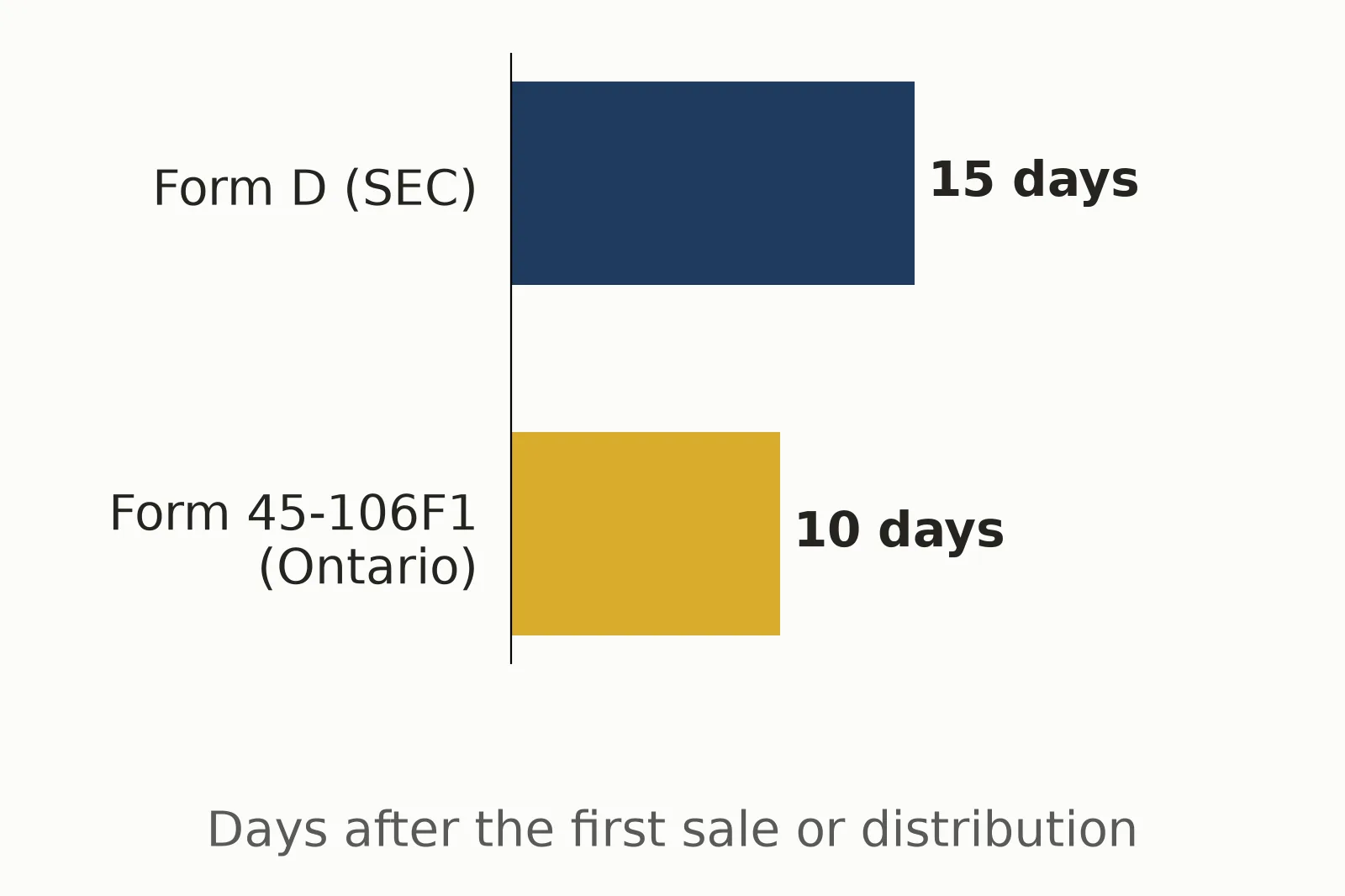
The two deadlines run from different events: Form D from the first sale in the offering, Form 45-106F1 from the distribution. A round with several closings needs both clocks tracked, and Rule 503 requires an amended Form D in some cases, such as to correct a material mistake of fact, so the filing plan belongs on the closing checklist.
Frequently asked questions
What is Series A funding in simple terms?
It is a round in which a startup sells investors a new series of preferred shares, named Series A, at an agreed price per share. Those shares carry rights the founders' common shares lack, and the company signs a set of legal documents and amends its charter to create those shares.
Do Series A investors always get preferred shares?
Not necessarily: the investors receive whatever class and terms the amended certificate or articles create, because the rights of the shares come from the company's charter. The NVCA model documents, which the NVCA describes as models for venture capital financings, are built around preferred stock: the model stock purchase agreement covers the "Purchase and Sale of Preferred Stock".
What is a right of first refusal and co-sale agreement?
In the NVCA model, it gives the company the right to buy shares that a key holder named in the agreement proposes to transfer, "at the same price and on the same terms" offered to the buyer, and gives the investors the right, but not the obligation, to sell some of their own shares in that same transfer.
Can a Canadian corporation use the NVCA documents?
Not as written. The NVCA model set is written for a US corporation with a certificate of incorporation filed in Delaware. A CBCA or OBCA corporation has articles instead, so the preferred share terms go into articles of amendment and the voting and governance terms into Canadian shareholder agreements, drafted to fit the statute that governs the company.
What shareholder vote does a Series A need in Ontario?
Creating a new class of preferred shares amends the articles, and the OBCA requires a special resolution for that: at least two-thirds of the votes cast at a meeting, or the written consent of every shareholder entitled to vote. Existing classes can also vote separately when a new class is equal or superior to theirs, unless the articles provide otherwise. That separate vote does not apply to a series the articles already let the directors create under section 25.
When is Form D due after a Series A round?
For a round relying on Rule 504 or 506, Rule 503 of Regulation D makes Form D due no later than 15 calendar days after the first sale of securities in the offering. If the 15th day falls on a Saturday, Sunday or holiday, the deadline moves to the next business day. The company can file amendments later, and must in some cases.
Does a Canadian company need to file anything when US investors buy in?
It can. According to the OSC, a company relying on Ontario's accredited investor exemption files a report of exempt distribution on Form 45-106F1, for most exempt distributions within 10 days, and a company relying on the private issuer exemption generally does not need to file one, if certain conditions are met. Which exemption fits a sale to US investors, and whether a US filing is also needed, depends on how the shares are offered to them.
Conclusion
Series A funding is a commercial milestone, but legally it is a sequence: a term sheet, diligence on your records, board and shareholder approval, a charter amendment that creates the preferred shares, a closing under a purchase agreement and its side agreements, and filings on a fixed clock. The documents differ between a Delaware corporation and a CBCA or OBCA corporation, and a cross-border round can trigger both the SEC's 15-day Form D deadline and Ontario's report of exempt distribution, due within 10 days for most exempt distributions.
The more of your corporate records, share issuances and earlier instruments are in order before the term sheet, the less there is to fix or disclose before the closing.
How Mayo Law can help
Mayo Law advises startups and growing companies on cross-border business law from offices in Toronto and New York, and Joseph Mayo is licensed in Ontario and New York. Our startup lawyers review Series A term sheets and documents, prepare the corporate approvals and charter changes, and plan the securities filings on both sides of the border.
Consultations are paid, one-hour sessions, because a lawyer reviews your documents and your company's situation in depth. To start, visit our international business law page.
Disclaimer
This article is for general information only and is not legal advice. Reading it does not create a solicitor-client or attorney-client relationship. Securities and corporate rules change, and the right steps for a financing depend on your company's documents and the investors involved. Mayo Law provides legal services in Ontario and New York.