

Contents
- Quick answer
- What is a cap table?
- What goes on a cap table?
- Issued, outstanding and fully diluted shares
- A cap table example, step by step
- Is the cap table the legal record in Ontario?
- What does Delaware law require?
- How do you keep a cap table accurate?
- Frequently asked questions
- Conclusion
- How Mayo Law can help
- Disclaimer
What is a cap table (capitalization table)? It is the table that shows who owns a company: every founder, investor and employee, the class and number of shares each one holds, and the options, warrants and convertible instruments that could become shares later. Carta, a cap table software company, describes it as tracking ownership from the day a company incorporates through every funding round, new hire and change in ownership.
The cap table matters most when money or people come in: a funding round, an option grant or a sale all change it. For founders in Ontario or New York who are setting up or raising money, our cross-border business lawyers review this document alongside the corporate records it summarizes.
This guide explains what goes on a cap table, the difference between issued and fully diluted shares, and how a simple agreement for future equity (SAFE) and an option pool change the numbers. It also covers the legal records the cap table has to match: the securities register under Ontario's Business Corporations Act and the stock ledger under the Delaware General Corporation Law (DGCL).
Quick answer
A cap table, short for capitalization table, lists every holder of a company's shares and of rights to get shares, with the number, class and percentage each holds. It is a working model, not the legal record: an Ontario corporation must keep a securities register, and a Delaware corporation a stock ledger. The cap table should match that record.
What is a cap table?
A cap table is a record of a company's ownership: it shows who holds each class of shares and each right to acquire shares, and what percentage of the company each holder would own on a stated basis. Many startups keep it in a spreadsheet at first and move it to cap table software as the number of holders grows.
A cap table answers three practical questions: who owns the company today, who could own part of it tomorrow, and how a new issuance would change both answers.
What goes on a cap table?
A cap table lists each holder, each class or series of shares, the number of shares or rights held, and the resulting percentage, together with the instruments that are not shares yet: stock options, warrants, SAFEs and convertible notes. A good one also records the date and terms of every issuance.
- Holders: founders, investors, employees, advisors and any company that holds shares.
- Share classes: common shares and any preferred shares or series, each in its own column.
- Options and the pool: options granted to people, plus the part of the option pool not yet granted.
- Convertible instruments: SAFEs, convertible notes and warrants, shown on an as-converted basis where the conversion can be estimated.
- Issuance details: date, price or other consideration, vesting terms and certificate or register entry for each grant.
Preferred shares bring their own rights, such as a liquidation preference, and those rights change how sale proceeds are split. Our guide to preferred stock explains them. The cap table records who holds the preferred shares; the company's articles or certificate of incorporation set out what those shares carry.
Issued, outstanding and fully diluted shares
Issued shares are the shares the company has actually issued (the Delaware franchise tax counts treasury shares among them), and the fully diluted count adds every share that could be issued under options, the option pool, warrants and convertible instruments. Authorized shares are the ceiling the articles or certificate of incorporation allow.
The counts answer different questions. The issued count shows the shares already in existence. The fully diluted count shows what percentage a new share will represent once every promise to issue shares is kept. The authorized count shows how many more shares the company can issue under its articles or certificate of incorporation as they stand.
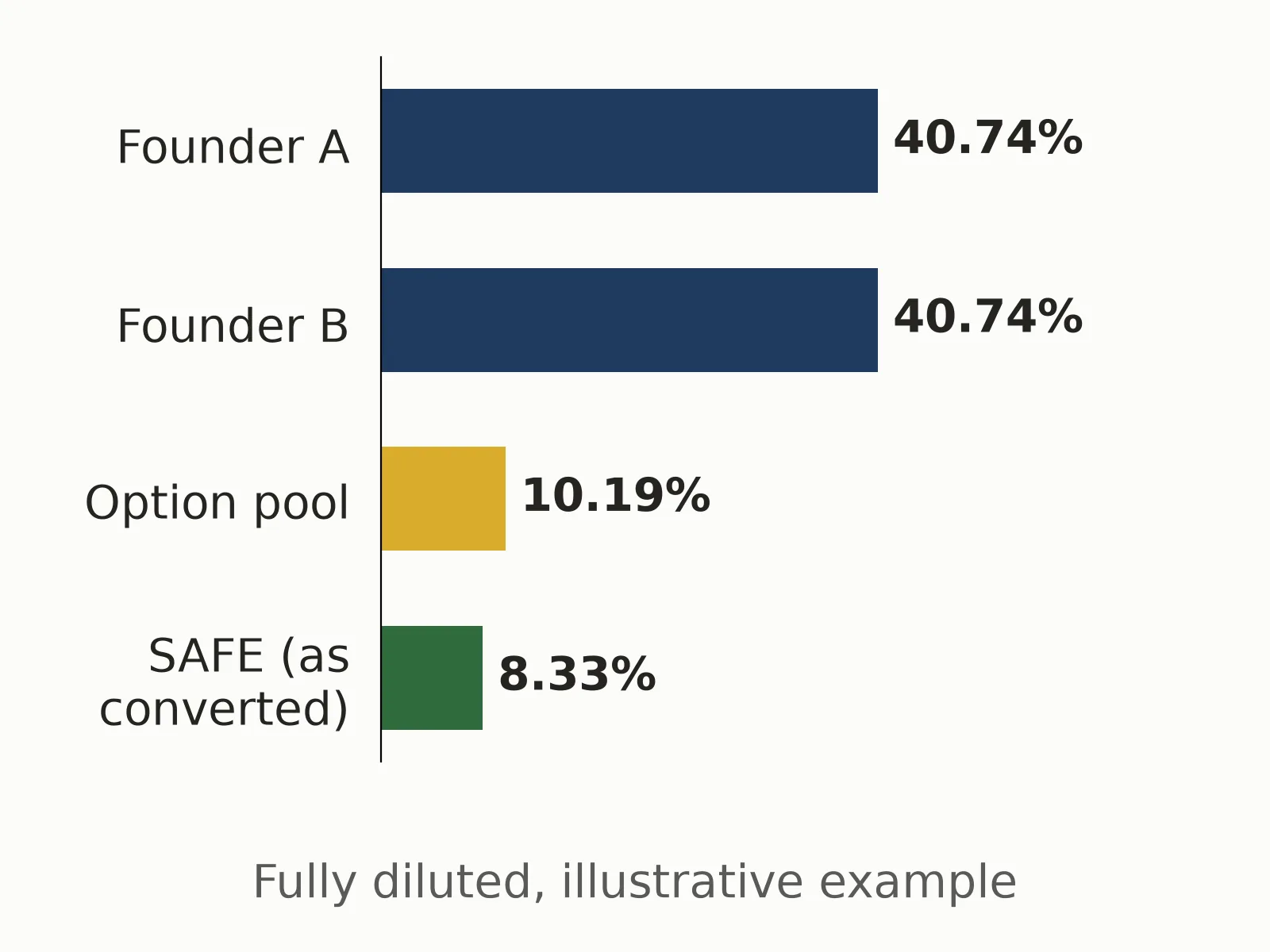
Founders are often surprised by the gap between the issued and fully diluted percentages. In the example below, two founders own all of the issued shares but just over 81 per cent on a fully diluted basis. Our guide to equity dilution works through how later rounds shrink each percentage.
A cap table example, step by step
The clearest way to read a cap table is to build one: start with the founders' shares, add the option pool, then add a SAFE on an as-converted basis, and compare each holder's share of the issued total with their share of the fully diluted total. The example below is illustrative and uses round numbers.
- Step 1: Two founders each take 4,000,000 common shares at incorporation, for 8,000,000 issued shares. Each owns 50 per cent.
- Step 2: The company sets aside an option pool of 1,000,000 shares for future hires. None of these shares is issued yet.
- Step 3: An investor buys a post-money SAFE for $500,000 with a $6,000,000 post-money valuation cap.
- Step 4: The SAFE is shown as the shares it would convert into at the cap, so the fully diluted total becomes 9,818,182.
Y Combinator (YC), which publishes the standard post-money SAFE, explains on its SAFE documents page that "the ownership you sell equals the investment amount divided by the valuation cap." Here that is $500,000 divided by $6,000,000, or 8.33 per cent. YC describes a pre-money valuation as the valuation "immediately before the company receives the investment" and a post-money valuation as the valuation "immediately after the investment is made." YC also says the post-money cap is "post" the options and option pool that exist before the priced round, so the pool sits inside the capitalization the SAFE percentage is measured against. Solving for the SAFE's share of that capitalization gives about 818,182 shares (calculated: 9,000,000 divided by 11). Our SAFE vs convertible note guide compares the SAFE with a note.
The table shows the result: the founders hold every issued share, but 40.74 per cent each once the pool and the SAFE are counted.
| Holder | Issued % | Fully diluted % |
|---|---|---|
| Founder A | 50.00% | 40.74% |
| Founder B | 50.00% | 40.74% |
| Option pool | 0% | 10.19% |
| SAFE (as converted) | 0% | 8.33% |
| Total | 100% | 100% |
A SAFE "isn't shares in your startup until it converts into preferred stock," in YC's words, which is why its column on the issued side is zero. YC publishes United States versions and a Canada version of the valuation-cap SAFE and tells companies formed in Canada to consult a lawyer licensed there before using it.
The pool matters as much as the SAFE. If a new or increased pool is adopted as part of a later priced round, YC notes that its post-money cap is not "post" that pool, so the increase is not measured into the SAFE's percentage. Our guide to startup stock options covers how the pool is granted.
Is the cap table the legal record in Ontario?
No: in Ontario the record the Business Corporations Act requires of who holds shares is the securities register, and the cap table should be built from it and match it. The Act also requires a register of individuals with significant control, which looks through registered holders to the individuals behind them.
Section 140(1) of the Business Corporations Act (Ontario), on the consolidation current to October 29, 2026, lists the records a corporation must prepare and maintain, including "a securities register complying with section 141" and "a register of individuals with significant control over the corporation complying with section 140.2."
- Securities register (s. 141): the names of registered shareholders, their addresses and "the number and class of shares registered in the name of such holder," plus "the date and particulars of the issue of each security and warrant," and a separate register of transfers.
- Significant control register (s. 140.2): each individual with significant control, how that control arises, and when it began and ended. The corporation must check it at least once each financial year and record new information within 15 days of learning it.
- The 25 per cent test (s. 1.1): a significant number of shares is any number that carries 25 per cent or more of the votes attached to all outstanding voting shares, or 25 per cent or more of all outstanding shares by fair market value.
- Issuing shares (s. 23): subject to the articles, the by-laws and any unanimous shareholder agreement, the directors decide when shares are issued, to whom and for what consideration, and a share cannot be issued until it is fully paid.
Two practical points follow. First, an option or a SAFE is not on the securities register as shares until shares are actually issued, so the cap table carries information the register does not. Second, the significant control test uses outstanding shares, so the count of outstanding shares, not the fully diluted count, is the one to compare against it. In the example above, each founder holds 50 per cent of the outstanding shares and so passes the 25 per cent test.
Section 145(1) lets registered shareholders, beneficial owners and creditors examine the records listed in section 140(1) during business hours, free of charge, but it excludes the significant control register. The cap table itself is not one of the listed records. For the wider set of company records, our guide to company by-laws explains the governing documents the register sits beside.
What does Delaware law require?
Delaware law makes the corporation's stock ledger, not the cap table, the record of its stockholders, and it treats the ledger as the only evidence of who may vote. Stock options are issued on terms set in a board resolution, and the number of shares issued also feeds one of the two ways Delaware calculates the annual franchise tax.
- Stock ledger (s. 219(c)): the DGCL records subchapter defines it as the records "in which the names of all of the corporation's stockholders of record, the address and number of shares registered in the name of each such stockholder, and all issuances and transfers of stock of the corporation are recorded," and says it "shall be the only evidence" of who may vote at a stockholders' meeting.
- Electronic records (s. 224): the ledger may be kept in electronic form, including distributed networks, if it can be converted into "clearly legible paper form within a reasonable time."
- Options (s. 157): under the DGCL stock subchapter, rights and options to acquire stock are issued "for the consideration as set forth in a resolution of the board of directors."
- Inspection (s. 220): a stockholder may inspect the stock ledger on a written demand under oath for a proper purpose, and any director may examine it for a purpose reasonably related to the director's position.
The Delaware Division of Corporations explains on its franchise tax calculation page that the franchise tax can be calculated by the authorized shares method or the assumed par value capital method, and that a corporation should "use the method that results in the lesser tax." The second method needs "figures for all issued shares (including treasury shares) and total gross assets," which is where an accurate issued count pays off.
Applying the Division's published method to an illustrative Delaware startup with 10,000,000 authorized shares at a par value of $0.00001, 8,000,000 issued shares and $500,000 in gross assets gives very different results (calculated):
- Authorized shares method: $250 for the first 10,000 shares plus $85 for each further 10,000 shares or part of them, 999 steps, for $85,165.
- Assumed par value capital method: assumed par of $0.0625 ($500,000 divided by 8,000,000 issued shares) times 10,000,000 authorized shares (all with a par value below the assumed par) is $625,000 of assumed par value capital, which works out to $250, so the $400 minimum applies.
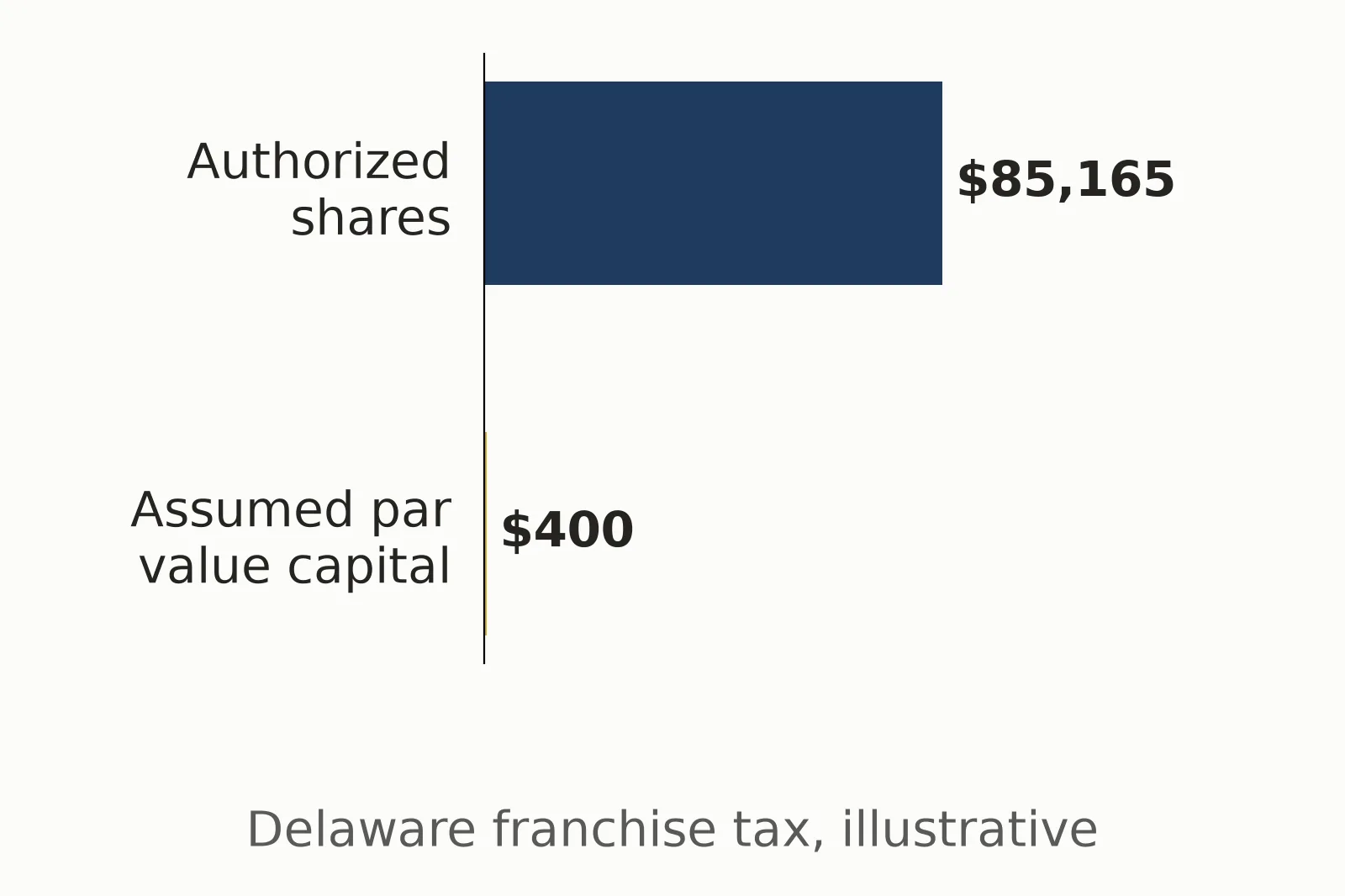
The Division states that the minimum tax is $175 under the authorized shares method, with a maximum of $200,000 under either method. The Division's own worked examples show that 10,005 authorized shares pays $335, and 100,000 shares pays $1,015. Our guide to the Delaware C corp sets out the other annual costs.
How do you keep a cap table accurate?
Keep a cap table accurate by updating it from the signed documents every time shares, options or convertible instruments are issued, transferred, exercised or cancelled, and by reconciling it with the securities register or stock ledger before every raise, option grant or sale.
- Work from the source documents: board or director resolutions, subscription agreements, option grants, SAFEs and transfer instruments.
- Record every change on the day it happens: issuance, transfer, option exercise, expiry, repurchase or cancellation.
- Keep the issued and fully diluted views separate but side by side: one for voting and the Ontario significant control test, one for pricing.
- Model before you sign: run every new SAFE, note or pool increase through the table before the documents are final.
- Reconcile before diligence: compare the table with the register or ledger and the minute book before a priced round.
Cross-border companies have one more step. A Canadian founder with a Delaware parent and an Ontario subsidiary, or a company that has moved its shares from one to the other, has two sets of records to keep in line. Our guide to pre-seed vs seed funding covers the records to fix before a first priced round, and our guide to the National Venture Capital Association (NVCA) term sheet covers the term sheet itself.
Frequently asked questions
Is a cap table a legal document?
In Ontario, a cap table is not one of the records the Business Corporations Act requires: the Act requires a securities register and a register of individuals with significant control, and in Delaware the DGCL makes the stock ledger the only evidence of who may vote. The cap table should be built from those records and agree with them.
Who can see a company's cap table?
The inspection rules are written around the legal records rather than the cap table. In Ontario, registered shareholders, beneficial owners and creditors may examine the securities register and the other records in section 140(1) of the Business Corporations Act, but not the significant control register. In Delaware, a stockholder may inspect the stock ledger on a written demand under oath for a proper purpose.
Does a SAFE count as shares on the cap table?
A SAFE is not shares until it converts, so it does not appear in the issued column. Y Combinator says a SAFE converts into preferred stock when the company raises a priced round. A fully diluted view can still show the SAFE on an as-converted basis, using YC's post-money method: the investment divided by the post-money valuation cap gives the percentage it would become.
Should the option pool be counted in the fully diluted total?
Under Y Combinator's post-money SAFE, yes: YC says the post-money cap is "post" the options and option pool that exist before the priced round. Leaving the existing pool out of the fully diluted total would therefore overstate every other holder's percentage compared with the method the SAFE itself uses to measure its own share.
What is the difference between authorized and issued shares?
Authorized shares are the maximum the articles or the certificate of incorporation allow the company to issue, while issued shares are the ones actually issued to holders. In Delaware the difference also matters for the franchise tax, because the assumed par value capital method uses the issued share count and total gross assets reported to the Division of Corporations.
Does Ontario's significant control register use the fully diluted numbers?
No. Section 1.1 of the Business Corporations Act (Ontario) measures a significant number of shares against outstanding shares: 25 per cent or more of the votes attached to all outstanding voting shares, or 25 per cent or more of all outstanding shares by fair market value. The count of outstanding shares, not the fully diluted count, is the one to compare against that test.
When should a founder update the cap table?
Update the cap table whenever the company issues, transfers, repurchases or cancels shares, grants or cancels options, or signs a SAFE, convertible note or warrant. In Ontario the significant control register must also be reviewed at least once each financial year and updated within 15 days after the corporation learns of new information.
Conclusion
A cap table is the clearest picture of who owns a company and who could own it after every promise to issue shares is kept. It works only if it matches the legal record: the securities register and significant control register for an Ontario corporation, and the stock ledger for a Delaware corporation. Keep the issued and fully diluted views separate but side by side, model each SAFE and pool change before signing, and reconcile the table with the register before investors ask for it. In Delaware, an accurate issued count can also change the franchise tax bill.
How Mayo Law can help
Mayo Law is a cross-border business law firm with offices in Toronto and New York. Joseph Mayo, our principal attorney, is licensed in Ontario and New York. Our lawyers work with founders on incorporations, share issuances, option plans, SAFEs and priced rounds on both sides of the border, including the registers and ledgers the cap table has to match. Our startup lawyers can review your cap table against your corporate records. The first step is a paid one-hour consultation, because a lawyer reviews your documents and your plans in depth.
Disclaimer
This article is for general information only and is not legal, tax or financial advice. Reading it does not create a solicitor-client or attorney-client relationship. The example is illustrative, and laws, tax rules and published methods change, so confirm the current rules for your company before you act. Mayo Law provides legal services in Ontario and New York.