

Contents
- Quick answer
- What is a non-solicitation agreement?
- Customer and employee non-solicits compared
- Is a non-solicitation agreement legal in Ontario?
- How do Ontario courts test a non-solicit?
- How do New York courts test a non-solicit?
- How do Ontario and New York compare?
- How should an employer draft one?
- Frequently asked questions
- Conclusion
- How Mayo Law can help
- Disclaimer
A non-solicitation agreement is a promise, usually inside an employment contract, that an employee will not go after the employer's clients or staff after leaving. Ontario's 2021 ban on non-competes, in the Employment Standards Act, 2000 (ESA), left these clauses standing, so they now do much of the work of protecting client relationships. New York courts test them under a strict reasonableness standard of their own.
For a business with people in Toronto, New York or both, the clause often carries the weight that a non-compete once did. It belongs with the rest of the company's cross-border business law planning, because the same words can hold in one jurisdiction and fail in the other. This guide sets out what each kind of non-solicit covers, how Ontario and New York courts decide whether to enforce one, and the drafting choices the cases turn on.
Quick answer
A non-solicitation agreement bars a former employee from actively pursuing the employer's customers or staff, usually for a set time. Ontario's ESA does not ban it, but Ontario courts enforce it only if it is clear and reasonable. New York courts apply a three-part reasonableness test and strictly construe the clause.
What is a non-solicitation agreement?
A non-solicitation agreement is a restrictive covenant in which an employee agrees not to solicit, or actively pursue, the employer's clients, customers or employees, usually for a fixed period after the job ends. It limits approaches, not the right to work. It usually appears as a clause of an employment contract.
The Ontario government's guide to the Employment Standards Act describes a non-solicit agreement as a term that prohibits an employee from soliciting, or actively pursuing, clients, customers, vendors, business partners or other employees of the employer, during employment or after it ends. The ministry adds that it often, but not always, applies only for a specified period after the employment ends.
A simple example shows the difference from a non-compete. A sales manager leaves to join a competitor. A non-compete would try to stop her taking the new job at all. A non-solicit lets her take it but says she may not phone the clients she served at the old company and invite them to move their business. The first restricts where she works; the second restricts whom she approaches.
That distinction is the reason the clause matters so much in Ontario. Since October 25, 2021, an Ontario employer cannot enter into a new non-compete with most of its employees, as our guide to the Ontario non-compete ban explains. The non-solicit, together with non-disclosure terms, which the ESA also leaves standing, is what remains to protect client relationships and the team.
Customer and employee non-solicits compared
A customer non-solicitation clause protects the employer's client relationships, while an employee non-solicitation agreement protects its workforce from being recruited away. A contract can include both, and each needs its own clear limits on whom it covers and for how long.
The table below sets the two side by side. Both are judged on how narrowly they are drawn, but they protect different interests.
| Point | Customer non-solicit | Employee non-solicit |
|---|---|---|
| What it protects | Client relationships | The employer's team |
| Usual restriction | No approaches to named clients | No recruiting of co-workers |
| Ontario ESA ban applies? | No | No |
| Case example | Brown & Brown (2015) | None cited here |
| Court test | Reasonableness | Expected: reasonableness |
On the customer side, the most common problem is reach. In New York, the Court of Appeals held in Brown & Brown that a customer non-solicit was overbroad to the extent it covered customers the employee had never met, did not know about and had done no work for. The Supreme Court of Canada made a related point in Elsley, an Ontario appeal, saying an employer could not have a proprietary interest in people who were not actual or potential customers.
On the employee side, the Ontario ministry's definition expressly includes other employees among the people a non-solicit may protect. None of the Ontario or New York decisions discussed in this guide sets a separate test for staff non-solicits, so the working assumption is that the same reasonableness analysis applies to them as to any other restrictive covenant.
Is a non-solicitation agreement legal in Ontario?
Yes, a non-solicitation agreement is legal in Ontario: the ESA prohibits non-compete agreements entered into on or after October 25, 2021, but the ministry states in its guide that the ESA does not prohibit non-solicit agreements or non-disclosure agreements. The ministry adds that employees may have greater rights under the common law.
The ban sits in Part XV.1 of the Employment Standards Act, 2000. According to the ministry's ESA policy and interpretation manual, Part XV.1 was added by the Working for Workers Act, 2021 and was deemed to have come into force on the day that bill was introduced. Non-competes entered into on or after that date are void; the Act does not void earlier ones.
The ministry's guide defines a non-compete under the ESA as an agreement, or any part of one, that prohibits the employee from engaging in any business, work, occupation, profession, project or other activity that competes with the employer's business after the employment ends. The ban has two exceptions. The first covers a seller who becomes the buyer's employee on the sale or lease of a business run as a sole proprietorship or partnership. The second covers executives, which the ministry lists as the chief executive officer, president, the other named chief officer roles and any other chief executive position.
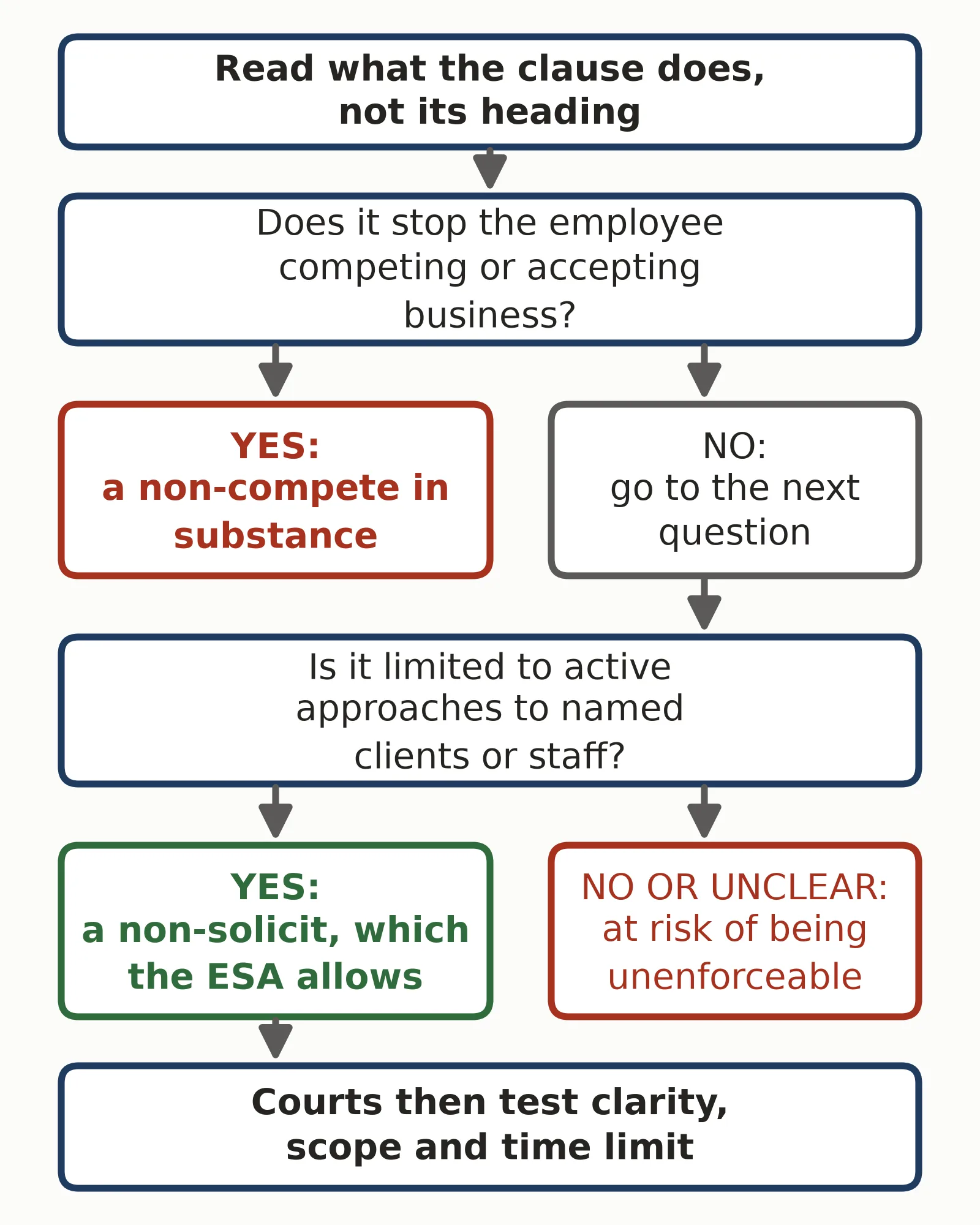
Substance decides, not the heading
The ministry is clear that the words used do not settle the question: the substance of the agreement is what matters. Its own example is a clause headed "Non-Competition" that only stops the employee from contacting former customers for two years. Despite the heading, the ministry says the substance is about soliciting, not competing, so the clause is not a prohibited non-compete.
The rule runs both ways. A clause labelled as a non-solicit that in substance stops the employee from competing can be treated as a non-compete. For an Ontario employee who is not an executive, and outside the sale-of-business exception, that clause would be void under the ESA if it was entered into after the ban took effect. Employees and former employees can file a claim with the ministry over a prohibited non-compete, and a penalty for refusing to sign one is treated as a reprisal.
How do Ontario courts test a non-solicit?
Under Supreme Court of Canada law, which Ontario courts apply, a restrictive covenant in an employment contract is prima facie unenforceable and is upheld only if the employer shows it is clear and reasonable. In Donaldson Travel, a clause that also stopped the employee from accepting business was read as a non-compete and could not be saved.
The governing tests come from two Supreme Court of Canada decisions. The first is Elsley v. J.G. Collins Insurance Agencies, [1978] 2 S.C.R. 916, an appeal from Ontario. The Court said a covenant in restraint of trade is enforceable only if it is reasonable between the parties and with reference to the public interest. It added that covenants in employment contracts face more rigorous tests than those in a sale of a business.
The second is Shafron v. KRG Insurance Brokers (Western) Inc., 2009 SCC 6, an appeal from British Columbia. The Court said reasonableness depends on the covenant's geographic and temporal scope and the extent of the activity it prohibits. An ambiguous covenant is, by definition, prima facie unreasonable and unenforceable, and the employer carries the onus of showing reasonableness.
Courts will not rewrite a bad clause
Shafron also limits how far a court will repair a defective covenant. The Court held that notional severance, reading a clause down to make it reasonable, is not an appropriate way to cure a defective restrictive covenant. Blue-pencil severance, striking words out, may be used only in rare cases where the part removed is trivial and not part of the main purport of the covenant.
The Court of Appeal for Ontario applied these rules in Donaldson Travel Inc. v. Murphy, 2016 ONCA 649. A travel agent had agreed not to "solicit or accept business" from any corporate accounts or customers serviced by her employer. The court agreed the words "or accept business" made the clause a non-competition clause rather than a non-solicitation clause, and because it also had no time limit, it was unreasonable and unenforceable.
The employer's request to sever the words "or accept business" failed, with the court citing Shafron. The decision suggests that a clause stands on firmer ground in Ontario when it is written as a non-solicit from the start: limited to active approaches, to a defined group of clients or staff, and to a stated period.
Elsley shows the other side of the analysis. In that exceptional case the employer won, because, on the facts, the Court found that a simple non-solicitation clause would not suffice to protect the employer's client connection. For most Ontario employees today, though, a broader clause of that kind would be a non-compete under the ESA.
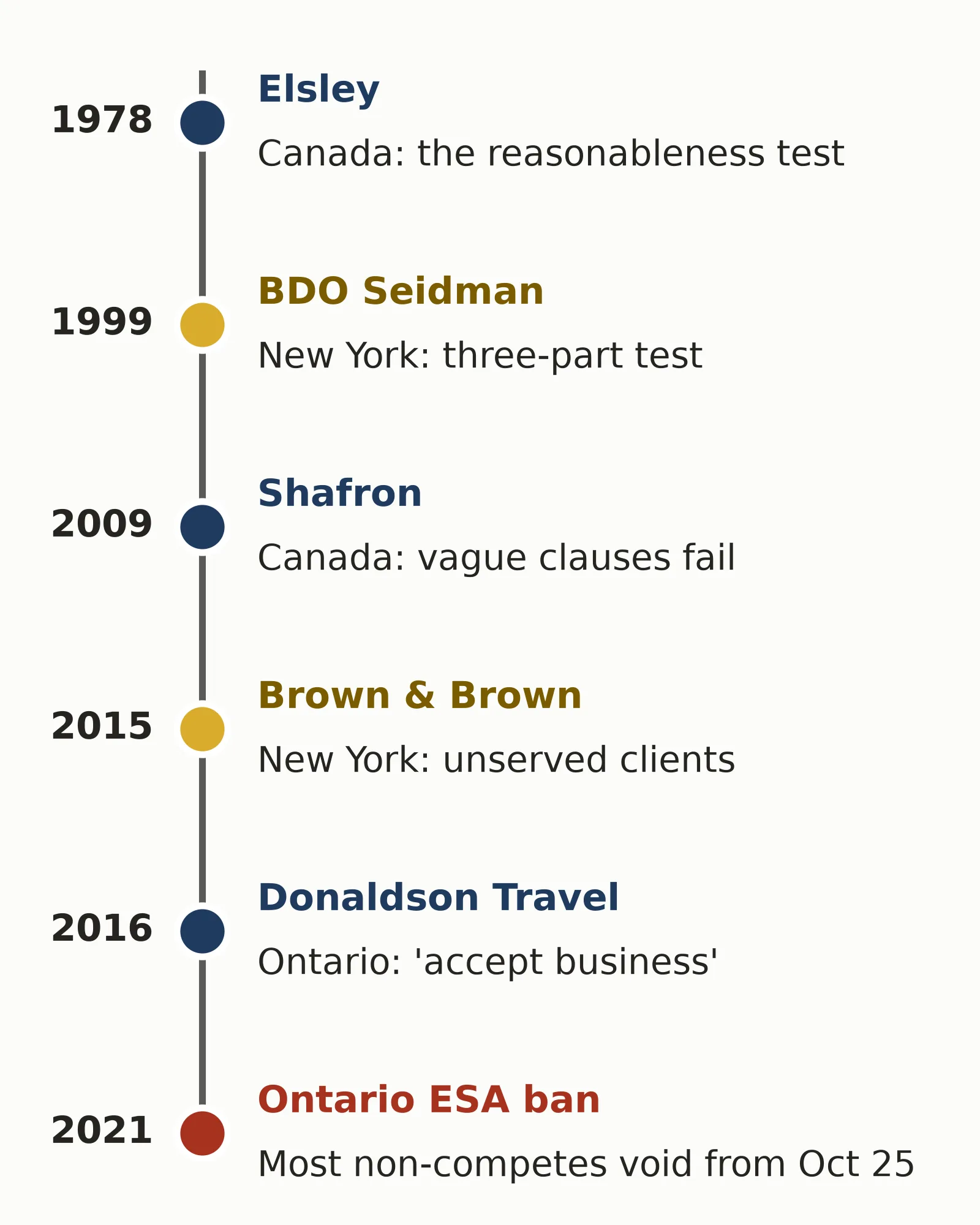
Figure 2 lines up the dates: Elsley in 1978, BDO Seidman in New York in 1999, Shafron in 2009, Brown & Brown in New York in 2015, Donaldson Travel in 2016, and Ontario's ESA ban on non-competes from October 25, 2021.
How do New York courts test a non-solicit?
New York courts enforce a non-solicitation agreement only if it passes a three-part reasonableness test. The restraint must be no greater than needed to protect a legitimate interest of the employer, must not impose undue hardship on the employee, and must not injure the public. Failing any one part makes it invalid.
The test comes from BDO Seidman v Hirshberg, 93 NY2d 382 (1999), which the Court of Appeals restated in Brown & Brown, Inc. v Johnson, 25 NY3d 364 (2015). The Court also said that New York requires the employer to prove all three parts, and that New York courts strictly construe restrictive covenants because of the public policy against the loss of a person's livelihood.
New York courts look most closely at a non-solicitation agreement that reaches past the employee's own client work. In Brown & Brown, a two-year clause barred the employee from soliciting, accepting or servicing any customer of the employer's New York offices. The Court held it overbroad to the extent it reached customers outside her own work for the employer.
Partial enforcement and choice of law
Unlike the Ontario approach in Shafron, New York courts have the power to sever and partially enforce an overbroad employee covenant. Following BDO Seidman, the Court of Appeals in Brown & Brown said partial enforcement may be justified if the employer shows an absence of overreaching or coercive use of dominant bargaining power and a good-faith effort to protect a legitimate interest.
The way the clause was signed can matter. In Brown & Brown, the agreement was handed to the employee on her first day of work, and the parties disputed whether it was explained to her and whether she could have sought advice and negotiated its terms. Those facts raised questions about overreaching, so the Court sent the case back rather than decide partial enforcement on the early record.
The same case limits a common drafting shortcut. The employment agreement chose Florida law, which the Court described as focused almost entirely on the employer's interests. The Court of Appeals held that applying Florida's restrictive covenant rules to the employee's non-solicitation provision would violate New York public policy, so the choice-of-law clause was unenforceable as to that provision and New York law applied. For the wider New York non-compete picture, see our guide on whether non-competes are enforceable in New York.
How do Ontario and New York compare?
Both jurisdictions let employers use non-solicits and both test them for reasonableness, but they differ on how far a court will repair an overbroad clause and on the source of the test. An employer with staff in both places should check one clause against each set of rules before using it for everyone.
The table summarises the main differences. An Ontario court is less willing to repair a flawed clause, so precise drafting matters even more there.
| Issue | Ontario | New York |
|---|---|---|
| Non-compete rule | ESA ban since Oct 25, 2021 | BDO Seidman court test |
| Non-solicits allowed? | Yes, if reasonable | Yes, if reasonable |
| Who must prove it | The employer | The employer, all three parts |
| How courts read it | Ambiguity is fatal | Strictly construed |
| Court can trim it? | Rarely; no reading down | Sometimes, if no overreaching |
| Main cases | Elsley; Shafron; Donaldson | BDO Seidman; Brown & Brown |
An Ontario employer with a New York office, or a New York company with an Ontario team, may need two versions of its restrictive covenants. Our guide to breach of employment contract in Ontario and New York covers what happens on each side when a valid covenant is broken.
How should an employer draft one?
An employer should draft a non-solicit as narrowly as its real interest allows. That means naming the clients or staff it covers, limiting it to active solicitation, setting a clear period, and avoiding words such as "accept business" that can turn it into a non-compete.
The points below follow from the decisions and the ministry guidance cited in this guide.
- Define the people covered: clients or staff the employee actually dealt with, not every customer of the business. Brown & Brown turns on this, and Elsley limits the employer's interest to actual or potential customers.
- Restrict approaches only: "solicit" or "actively pursue", not "accept business" or "deal with". Donaldson Travel shows what the extra words cost.
- State a time limit: the clause in Donaldson Travel had none, which helped sink it. Shafron lists temporal scope as part of the reasonableness test.
- Use clear terms: under Shafron an ambiguous covenant is prima facie unenforceable, and Ontario courts will not read it down.
- Write it for each jurisdiction: in Brown & Brown, the Court of Appeals refused to apply Florida law to a New York employee's non-solicit, holding it contrary to New York public policy.
- Present it fairly: in New York, how the clause was imposed can affect whether a court will partially enforce it.
- Cover information separately: a non-solicit does not protect confidential information, while the ESA leaves non-disclosure agreements standing; ownership of work product is covered in our guide to the intellectual property assignment agreement.
Employers reviewing their agreements after a dismissal should also check the termination terms, which our guide to termination without cause in Ontario covers. Where a business is being sold, restrictive covenants given by a seller are judged less strictly than those given by an employee, a point Elsley and Shafron both make, and one buyers should plan for when they buy an existing business.
Reviewing these clauses is part of the contract work our contract lawyers do for employers on both sides of the border.
Frequently asked questions
What is a non-solicitation agreement in simple terms?
It is a promise by an employee not to approach the employer's clients, customers or staff to take their business or recruit them, usually for a set time after the job ends. It does not stop the person from working for a competitor, which is what separates it from a non-compete agreement.
Are non-solicitation agreements enforceable in Ontario?
They can be. Ontario's Employment Standards Act, 2000 does not prohibit them, but the courts enforce one only if the employer shows it is clear and reasonable in its geographic and temporal scope and the activity it restricts. An ambiguous clause is prima facie unenforceable, and in Donaldson Travel a clause that also stopped the employee from accepting business was struck down.
Does Ontario's non-compete ban apply to non-solicits?
No. The ministry's guide to the Act states that the ESA prohibits non-compete agreements but does not prohibit non-solicit agreements or non-disclosure agreements. A clause called a non-solicit that in substance prevents competition can still be treated as a non-compete, because the ministry looks at substance rather than the heading.
Are non-solicitation agreements enforceable in New York?
They can be, if they are drawn narrowly. New York courts apply the BDO Seidman test: the restraint must be no greater than needed to protect a legitimate employer interest, must not impose undue hardship on the employee and must not harm the public. A clause covering customers the employee never served has been held overbroad.
How long can a non-solicitation agreement last?
Neither Ontario's ESA nor the New York decisions cited here set a fixed maximum. In Ontario, Shafron treats the length as part of the reasonableness test, together with geographic scope and the activity restricted. In New York, the question is whether the restraint is greater than the employer's legitimate interest needs. In Donaldson Travel, the absence of any time limit was one reason the Ontario clause failed.
Can a court fix an overbroad non-solicit?
In Ontario, rarely. Shafron rules out reading a clause down and allows striking words only where they are trivial. In New York, the Court of Appeals has recognized a power to partially enforce an overbroad employee covenant where the employer did not overreach and acted in good faith to protect a legitimate interest.
Is an employee non-solicitation agreement different from a customer one?
Yes. An employee non-solicitation agreement stops a former employee from recruiting co-workers, while a customer non-solicitation clause stops approaches to clients. Both are restrictive covenants that courts are expected to test for reasonableness, and the Ontario ministry's definition of a non-solicit expressly covers other employees as well as clients, customers, vendors and business partners.
Conclusion
A non-solicitation agreement is now one of the main tools left to most Ontario employers to protect client relationships and staff after someone leaves, and New York courts still enforce reasonable ones. In both places, the clause is most likely to hold if it is narrow, clear and limited in time. Ontario courts will not rewrite a flawed clause, and a few extra words such as "or accept business" can turn it into an unenforceable non-compete. New York courts can trim an overbroad clause, but only for an employer that did not overreach. A business with staff in both jurisdictions should check its covenants against each set of rules.
How Mayo Law can help
Mayo Law is a cross-border law firm with offices in Toronto and New York. Joseph Mayo, our principal attorney, is licensed in Ontario and New York, and our lawyers review and draft employment agreements, non-solicits, confidentiality terms and other restrictive covenants for employers with staff on either side of the border. We offer a paid one-hour consultation, because a lawyer needs to review your agreements and your situation in depth before advising.
Disclaimer
This guide is for general information only and is not legal advice. Reading it does not create a solicitor-client or attorney-client relationship. Court decisions and legislation change, and the outcome of any dispute depends on its own facts and the exact wording of the agreement. Mayo Law provides legal services in Ontario and New York.