

Contents
- Quick answer
- Holding company vs operating company
- Why owners use a holding company: Canada's rules
- How profits move up to the holdco
- The passive income limit on the small business deduction
- How to set up a holding company in Canada
- A US subsidiary under a Canadian holdco
- When a holding company is not worth it
- Frequently asked questions
- Conclusion
- How Mayo Law can help
- Disclaimer
A holding company is a corporation that owns assets, usually the shares of another company, instead of running a business itself. Owner-managers who ask about a holding company, Canada-wide or in Ontario, are usually after three things: keeping surplus cash away from the risks of the operating business, moving profit up from that business without an immediate layer of corporate tax, and building a cleaner base for a sale or for succession. A holdco also adds a second corporation to maintain, and some tax rules work against it.
This guide explains how the structure works for an Ontario owner, the statutes that govern it, the setup steps, the yearly cost, and the cases where it is not worth the trouble. Every rule below was checked against the Business Corporations Act (Ontario), the federal Income Tax Act and official Canada Revenue Agency and Ontario pages as of October 2026. It covers the legal mechanics, not personal tax advice.
Quick answer
A holding company in Canada is a corporation that owns shares or investments for its owner. In Ontario you incorporate it like any company, for a $300 online government fee, and usually transfer your operating company shares to it under a section 85 rollover. It suits owners with surplus profit, creditor risk or succession plans.
Holding company vs operating company
The two corporations do different jobs. The operating company, often called the opco, signs the contracts, hires the staff and carries the business risk. The holding company, or holdco, owns the opco's shares and keeps the money the opco does not need. The table shows how the roles usually split.
| Feature | Operating company | Holding company |
|---|---|---|
| Main activity | Sells goods or services | Owns shares and investments |
| Staff and contracts | Usually yes | Usually none |
| Exposure to business claims | Direct | Indirect, as shareholder |
| Typical income | Active business income | Dividends, interest, gains |
| Yearly filings in Ontario | T2 and annual return | T2 and annual return |
The separation rests on two sections of the Business Corporations Act. Section 15 gives a corporation the capacity, rights, powers and privileges of a natural person, so a holdco can own shares, lend money and sign agreements in its own name. Section 92(1) says shareholders are not, as shareholders, liable for the corporation's acts, defaults, obligations or liabilities, apart from a short list of statutory exceptions. A holdco that owns the opco's shares is a shareholder like any other. A guarantee the holdco signs for an opco loan is a different matter: that is the holdco's own promise, and lenders often ask for one.
Why owners use a holding company: Canada's rules
Four reasons come up in holdco planning for Ontario owner-managers. Each one depends on a specific rule, and each has a limit.
Keeping surplus cash out of reach of business claims
Money that stays in the operating company is exposed to anyone who sues that company or wins a judgment against it. When the opco pays surplus profit to the holdco as a dividend, the cash leaves the opco's balance sheet. Because of section 92(1), the opco's creditors generally have no claim against the holdco's assets just because the holdco is a shareholder. The protection is strongest when dividends are paid regularly while the opco is healthy. A dividend paid when the opco cannot meet its debts is a different story, as the next section explains.
Deferring tax on profit the owner does not need yet
Subsection 112(1) of the Income Tax Act lets a corporation resident in Canada deduct, in computing its taxable income, a taxable dividend it receives from a taxable Canadian corporation. In plain terms, profit can usually move from the opco to the holdco without a second layer of corporate income tax, and the owner pays personal tax only when the holdco later pays a dividend out to them. Part IV tax under section 186 can still apply in some cases, for example when the paying opco receives a dividend refund for the dividend it paid.
Preparing for a sale
Buyers and their lawyers look closely at what sits inside a company. Keeping excess cash and investments in a holdco leaves a cleaner operating company to sell. The lifetime capital gains exemption for qualified small business corporation shares in section 110.6 of the Income Tax Act has asset tests, and moving passive assets out of the opco is one reason owners use a holdco before a sale. Whether a particular sale qualifies is a tax question for an accountant or tax advisor.
Family and succession planning
A holdco can own the opco on behalf of a family and hold shares for the next generation. The tax on split income rules in section 120.4 of the Income Tax Act limit how dividends paid to family members are taxed, so a holdco is not a simple way to shift income to a spouse or children. The corporate side of the plan, such as share classes, directors and a shareholders' agreement, still needs to be drafted with care.
How profits move up to the holdco
Profit moves from the opco to the holdco by dividend, and these intercorporate dividends follow both corporate law and tax law. Under section 38(1) of the Business Corporations Act, the opco's directors declare the dividend, subject to the articles and any unanimous shareholder agreement. Section 38(3) adds a solvency test: the directors must not declare a dividend, and the corporation must not pay it, if there are reasonable grounds to believe the corporation is, or after the payment would be, unable to pay its liabilities as they become due, or that the realizable value of its assets would fall below its liabilities plus the stated capital of all classes.
The test has teeth. Under section 130(2)(d), directors who vote for or consent to a dividend paid contrary to section 38 are jointly and severally liable to restore the amount to the corporation. In practice that means three habits: pay dividends while the opco is clearly solvent, record each one in a directors' resolution, and keep the financial statements that show the test was met.
Two anti-avoidance rules sit in the background. Subsection 55(2) of the Income Tax Act can deem a dividend not to be a dividend and treat it instead as proceeds of disposition or a gain, a rule aimed at dividends paid to reduce the gain on a later share sale. Section 245, the general anti-avoidance rule, denies the tax benefit of avoidance transactions that misuse or abuse the Act. Large or unusual dividends, especially close to a sale, need tax advice before they are paid.
The passive income limit on the small business deduction
The small business deduction gives a Canadian-controlled private corporation a lower federal rate on its first $500,000 of active business income. The Canada Revenue Agency lists the net federal rate on that income at 9% (page dated May 30, 2025), and section 125(2) of the Income Tax Act sets the business limit at $500,000. Associated corporations share one limit (section 125(3)), and under section 256(1)(a) a holdco and the opco it controls are associated.
Investment income earned inside the group can shrink that limit. Under section 125(5.1)(b), the reduction is the corporation's business limit divided by $500,000, multiplied by 5 times the amount by which the adjusted aggregate investment income of the corporation and its associated corporations, for taxation years ending in the preceding calendar year, exceeds $50,000. (Section 125(5.1) applies whichever of this reduction and a separate taxable-capital reduction is greater.) Put simply, for a corporation with the full limit, every dollar of passive income above $50,000 takes $5 off the limit. Our calculation from that formula, for a group that otherwise has the full $500,000 limit: $75,000 of passive income leaves $375,000; $100,000 leaves $250,000; $125,000 leaves $125,000; and $150,000 leaves nothing.
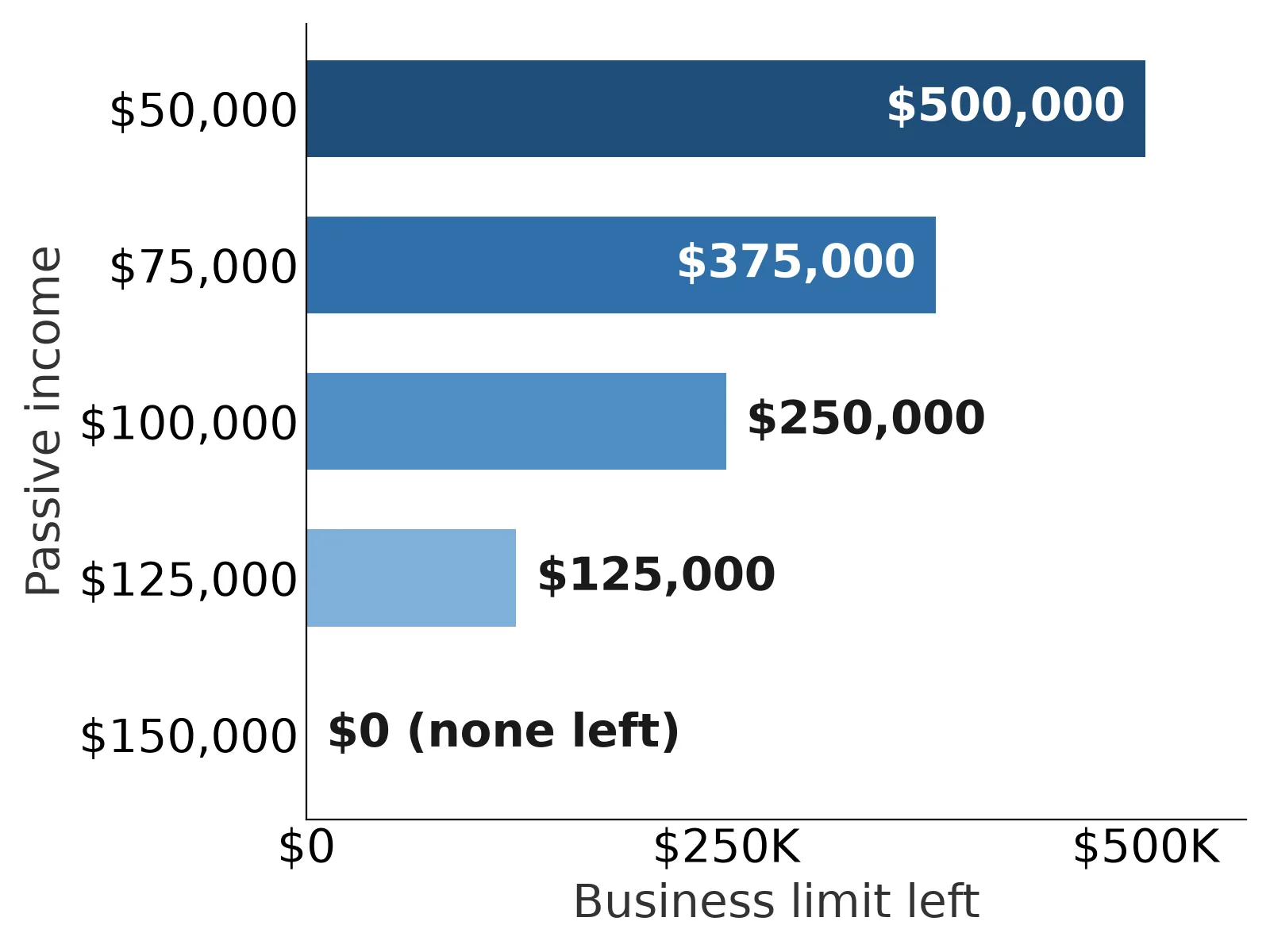
This matters for a holdco because the holdco's investment portfolio counts toward the group total. An owner who builds a large portfolio inside the holdco can lose part or all of the opco's federal small business rate, because the passive income in the holdco and the active income in the opco are tested together. Ontario does not follow this federal reduction. Ontario's Ministry of Finance states that Ontario does not parallel the federal phase-out of the $500,000 small business limit for corporations earning between $50,000 and $150,000 of passive investment income, so an eligible Ontario corporation keeps its Ontario small business deduction (Corporate Income Tax page, updated April 27, 2026).
How to set up a holding company in Canada
Most Ontario setups follow the same six steps. The order matters, because the share transfer in step 4 is the tax-sensitive part and should be planned before anything is filed.
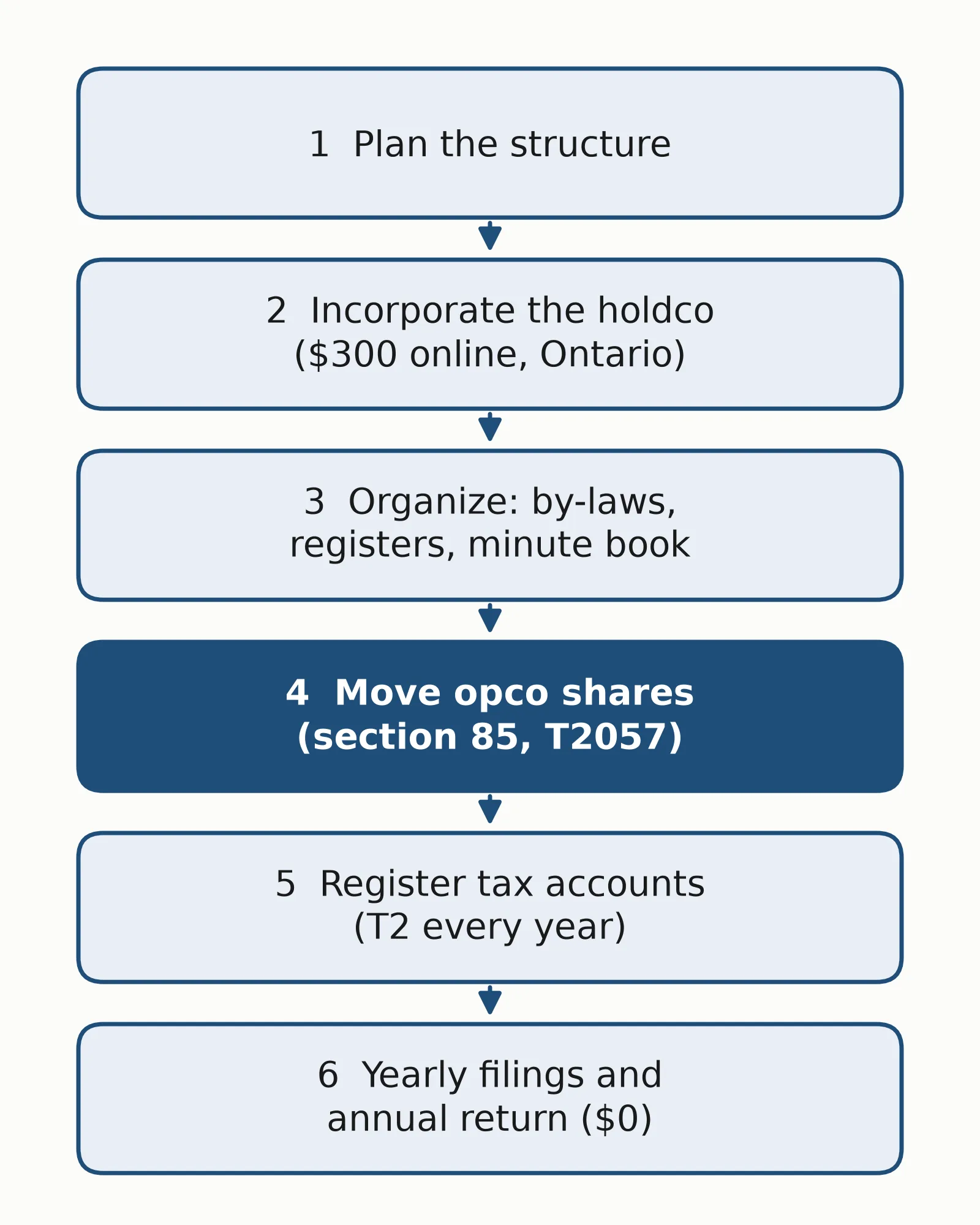
Step 1: Plan the structure
Decide who will own the holdco (you alone, or with a spouse or other family members), what it will hold, and how the opco's shares will reach it. If the opco already exists, the plan usually involves an exchange of your opco shares for holdco shares. If you are starting fresh, the holdco can subscribe for the opco's shares from day one. Your accountant should model the tax result before step 4.
Step 2: Incorporate the holdco
An Ontario holdco is incorporated on the Ontario Business Registry. Ontario's fee page, updated September 29, 2026, lists incorporation at $300 online with immediate processing, or $300 by mail in 15 business days. A holdco that does not deal with the public can use a number name, which the Business Corporations Act defines as the corporation number followed by the word Ontario and a legal ending such as Inc. If you want a word name instead, our guide to the NUANS name search explains the report. Our step-by-step guide on how to incorporate a business in Ontario covers the filing itself. Federal incorporation under the Canada Business Corporations Act is also possible; compare the two sets of filings before you choose.
Step 3: Organize the corporation
After incorporation the holdco needs by-laws, directors and officers, an issuance of shares to its owners, and a minute book. Section 140.2(1) of the Business Corporations Act requires an Ontario corporation, a typical holdco included, to keep a register of individuals with significant control (section 140.2(8) exempts offering corporations and corporations whose shares are listed), showing each such individual's name, date of birth, latest known address and tax residence. Our guide to company by-laws explains the core governing document of an Ontario holding company.
Step 4: Move the opco shares under section 85
Subsection 85(1) of the Income Tax Act lets a taxpayer dispose of eligible property to a taxable Canadian corporation for consideration that includes shares of that corporation, at an amount the two agree on in a joint election. Used with care, it lets you move your opco shares into the holdco without triggering the gain at that moment. The election is made on CRA form T2057 (page dated March 13, 2026), and the corporate side needs a share exchange agreement, directors' resolutions and updated securities registers in both companies.
Step 5: Register tax accounts
The holdco needs its own business number and corporate income tax account. The Canada Revenue Agency states that all resident corporations, apart from tax-exempt Crown corporations, Hutterite colonies and registered charities, must file a T2 return for every tax year, even when no tax is payable. A holdco that only receives dividends still files.
Step 6: Keep up the yearly filings
Each year the holdco files its T2, prepares financial statements, records dividends and other decisions in its minute book, and files an Ontario annual return. Ontario's fee page lists the annual return for an Ontario corporation at $0, with immediate processing online.
What a holdco costs to run
The government side is small. The direct Ontario costs we could verify this month are in the list below; the larger costs are professional fees, which vary with the work and are not set by any government.
- Incorporation: $300 online on the Ontario Business Registry.
- Annual return: $0 for an Ontario corporation.
- Amalgamating the holdco with the opco later: $330 online, if the structure is ever unwound that way.
- Accounting and tax: a second set of financial statements and a second T2 every year.
- Legal: the share exchange documents at setup, and minutes for dividends and other decisions afterwards.
All amounts are in Canadian dollars, from Ontario's fee page updated September 29, 2026. The yearly accounting cost is usually what decides whether a holdco pays for itself, so ask your accountant for a quote before you commit.
A US subsidiary under a Canadian holdco
Some Ontario owners also run, or plan to run, a business in the United States. A Canadian holdco can own a US corporation, but the tax rules change at the border. Subsection 112(1) applies to dividends from taxable Canadian corporations, so dividends from a US subsidiary follow a different set of Canadian rules for foreign affiliates.
On the US side, Article X of the Canada-United States Income Tax Convention, as amended by the 1995 Protocol and published by the Internal Revenue Service, caps US tax on dividends paid to a Canadian resident beneficial owner at 5% of the gross dividend where the owner is a company holding at least 10% of the voting stock of the paying company, and 15% in other cases. A Canadian holdco that owns a US subsidiary outright fits the 5% case, subject to the treaty's other conditions. Our guides on whether a Canadian can own a business in the US and starting a business in both Canada and the US cover the entity choices on each side.
When a holding company is not worth it
Asking whether you need a holding company? Canada's rules make it a tool, not a default. It usually adds little in these situations:
- No surplus: if you take out nearly everything the opco earns to live on, there is little cash to protect or defer.
- Small profits: the yearly accounting and filing cost can outweigh the benefit.
- Large passive portfolio: investment income above $50,000 in the group starts to cut the opco's small business limit.
- Income splitting as the main goal: the tax on split income rules limit what a holdco can do for family members.
- No appetite for paperwork: two minute books, two registers and two tax returns need someone to keep them current.
For many owners the right answer is to start with one well-organized operating company and add a holdco once surplus cash builds up. Our guide to Ontario business structures compares the starting options, and our guide to shareholder loans in Canada covers another way owners take money out of a corporation, with its own tax traps.
Frequently asked questions
Can I be the only director and shareholder of my holding company?
Yes. Under section 115(2) of the Business Corporations Act, an Ontario corporation that is not an offering corporation needs a board of at least one individual, and one person can hold all the shares. The holdco still needs its own minute book, by-laws, share register and register of individuals with significant control, and it should record its decisions in writing, usually as signed resolutions of the sole director and shareholder.
Does a holding company in Canada file a tax return with no income?
Yes. The Canada Revenue Agency states that all resident corporations, apart from tax-exempt Crown corporations, Hutterite colonies and registered charities, must file a T2 return for every tax year, even if no tax is payable. A holdco that only received a dividend, or nothing at all, still files a T2 and an Ontario annual return each year.
Is there tax on dividends from my operating company to my holdco?
Usually there is no corporate income tax on them because subsection 112(1) of the Income Tax Act lets the holdco deduct a taxable dividend received from a taxable Canadian corporation. Part IV tax can apply when the paying company receives a dividend refund, and subsection 55(2) can recharacterize some dividends as gains. Personal tax applies when the holdco later pays you.
Does a holding company protect me from lawsuits against my business?
It can protect cash that has already been paid up to the holdco, because under section 92(1) of the Business Corporations Act shareholders are generally not liable for the corporation's obligations. It does not protect money left in the operating company, assets covered by a guarantee the holdco signed, or a dividend paid when the operating company failed the solvency test in section 38(3).
How much does it cost to set up a holding company in Ontario?
The Ontario government fee to incorporate is $300 online, and the yearly annual return has no government fee, according to Ontario's fee page updated September 29, 2026. The larger costs are professional: legal work on the share exchange and corporate records, and accounting for a second set of financial statements and a second T2 return every year.
Can a Canadian holding company own a company in the United States?
Yes. A Canadian corporation can own the shares of a US corporation. Under Article X of the Canada-United States tax treaty, US tax on dividends paid to a Canadian company that holds at least 10% of the voting stock is capped at 5% of the gross dividend. Canadian tax on those dividends follows the foreign affiliate rules, not subsection 112(1).
What is a section 85 rollover?
It is a joint election under subsection 85(1) of the Income Tax Act that lets you transfer eligible property, such as your operating company shares, to a taxable Canadian corporation in exchange for consideration that includes shares of that corporation, at an agreed amount. Done correctly, it defers the gain. The election is filed on CRA form T2057.
Conclusion
A holdco earns its place when an operating company produces more profit than its owner needs, when business risk makes it sensible to move cash out regularly, or when a sale or family succession is on the horizon. The rules that make a holding company work in Canada, from subsection 112(1) and the section 85 rollover to the solvency test in section 38(3), are the same rules that can go wrong when steps are skipped. Plan the share transfer with your accountant, keep both minute books current, and watch the passive income in the group.
How Mayo Law can help
Mayo Law is a cross-border business law firm with offices in Toronto and New York. Our lawyers set up holding company structures for Ontario owner-managers, including the incorporation, the share exchange documents, the minute books and registers, and the shareholders' agreement that sits above both companies, and we work alongside your accountant on the tax side. For owners with a US business, we also handle the corporate work on the US side. Joseph Mayo, our principal attorney, is licensed in Ontario and New York. A holdco plan starts with a paid one-hour consultation, because a lawyer needs to review your current structure and goals in depth before advising on it. You can book one through our incorporation lawyer page or our international business law page.
Disclaimer
This article is general information about the federal tax rules and Ontario corporate rules for a holding company, as of October 2026. It is not legal or tax advice, and reading it does not create a solicitor-client or attorney-client relationship. Tax rules and government fees change; confirm current figures with the official sources named above and get advice on your own situation before you act. Mayo Law provides legal services in Ontario and New York.