

Contents
- Quick answer
- What is a buy-sell agreement?
- What events trigger a buyout?
- How is the price set?
- How does a shotgun clause work?
- Who buys the shares, and who funds it?
- What changes in a Canada-US buy-sell agreement?
- Buy-sell agreement drafting checklist
- Frequently asked questions
- Conclusion
- How Mayo Law can help
- Disclaimer
A buy-sell agreement is the contract that decides what happens to a co-owner's stake when that owner dies, becomes disabled, leaves or falls out with the others. It sets who buys, at what price and with what money, before anyone has a reason to argue. For co-owners of an Ontario or New York company, and for anyone holding shares across the Canada-US border, it is a core piece of cross-border business law, and the answers change with the jurisdiction.
This guide covers buyout triggers, price, shotgun clauses, insurance funding, Canada-US issues and a drafting checklist, with statutes and court decisions cited as of October 2026. Our business lawyer in Toronto page describes our work on shareholder agreements and business sales.
Quick answer
A buy-sell agreement is a contract among business owners that sets when an owner's interest must or may be sold, who buys it, how the price is fixed and how the purchase is paid for. It usually covers death, disability, departure and deadlock, and it often sits inside a shareholders' or operating agreement.
What is a buy-sell agreement?
A buy-sell agreement can be a stand-alone contract, or a set of clauses inside a shareholders' agreement, a partnership agreement or a limited liability company (LLC) operating agreement, and either way it controls how an ownership interest in a private business changes hands. The parties are the owners and sometimes the business itself. You will also see it called a buyout agreement.
Buy-sell agreements matter most in private companies, because their shares have no public market. An owner who wants out, or a family that inherits, may have nobody to sell to. The remaining owners have the opposite worry: a stranger, or an heir who never worked in the business, ending up as their partner. A business buy-sell agreement settles both problems in advance by answering four questions: what triggers a sale, who buys, at what price, and how the buyer pays.
In Ontario, where those clauses sit can change who is bound. Under section 108(2) of the Ontario Business Corporations Act (OBCA), a written agreement among all the shareholders can restrict the directors' powers, which makes it a unanimous shareholder agreement. Section 108(4) then deems a transferee of shares subject to that agreement to be a party to it.
In New York, Business Corporation Law (BCL) section 620 allows written voting agreements among shareholders, but restricting the board calls for a provision in the certificate of incorporation. Our guide to shareholder agreements and bylaws explains that split, and our list of clauses that prevent founder disputes shows where buy-sell terms sit among the other protections.
What events trigger a buyout?
The usual triggers in a buy-sell agreement are death, disability, departure and deadlock, and each one needs its own definition and its own rule on whether the sale is forced or optional.
- Death: the agreement can require a purchase or only allow one. In Connelly v. United States, 602 U.S. 257 (2024), decided by the Supreme Court of the United States, the surviving brother had an option to buy, and the company had to redeem the shares if he declined.
- Disability: use a test someone can apply, such as being unable to do the job for a stated number of months, confirmed by a doctor the owners have agreed on. A bare reference to disability leaves the test for the owners to argue over.
- Departure: retirement, resignation and dismissal can carry different results. Some agreements pay a full price to a good leaver and a reduced price to a bad leaver, so define both.
- Deadlock: owners who cannot agree on a major decision can be sent through mediation first, then to a buyout, sometimes by a shotgun clause.
- Other events: bankruptcy, loss of a professional licence, or a serious breach of the agreement can be added. In Matter of Schwimmer (2007), a New York trial-level decision not selected for official publication, the court found that a shareholder's dissolution petition had triggered the agreement's buyout provisions.
Two choices matter as much as the buyout triggers themselves. The first is whether the trigger creates an obligation or an option: an obligation gives a seller certainty, while an option gives the buyers room to decline. The second is the order of purchase. The agreement in Schwimmer gave the company 90 days to act, then gave the other shareholders 45 days. That sequence is a drafting choice, not a rule of law, and yours should match who actually has the money.
LLC owners in New York have a further reason to write this down. Under Limited Liability Company Law section 606, a member may withdraw only as the operating agreement provides and, unless it says otherwise, not before dissolution and winding up (older LLCs can differ). Under section 603, unless the operating agreement says otherwise, a person who is assigned a membership interest receives distributions and allocations but does not, by the assignment alone, become a member or gain a member's rights or powers. Under section 604, that takes the vote or written consent of at least a majority in interest of the other members, again unless the operating agreement says otherwise. Section 417 already requires a written operating agreement, so that is the natural place for these terms.
How is the price set?
The price in a buy-sell agreement is usually set by one of four methods: a fixed amount the owners keep updating, a formula, an independent appraisal, or a shotgun offer in which one owner names the number. Each method trades certainty against accuracy, as the table shows.
| Method | How it works | Main risk |
|---|---|---|
| Fixed price | Owners sign an agreed value | Goes stale if not updated |
| Formula | Book value or earnings multiple | May miss real value |
| Appraisal | Independent valuator at the trigger | Cost and delay |
| Shotgun offer | One owner names the value | Favours the better-funded owner |
New York courts have held owners to the method they chose. In Sitler v Saratoga Associates, 101 AD3d 1451 (2012), the Appellate Division, Third Department, affirmed a buyout at US$67.93 a share. The shareholders' agreement required the company to buy a deceased shareholder's stock at adjusted book value, made its valuation method the sole method, and defined that value by the company's regular accounting practices with board approval. The company paid the estate US$114,054.47 for 1,679 shares. The executor argued for US$175. Adjusted book value had been US$153.26 a share for the quarter ending in September 2006, before accrued tax liabilities were included.
A buy-sell formula should state the accounting basis, the valuation date, who does the calculation and how a dispute over it is resolved. In Schwimmer, the owners had agreed that a missing certificate of value, or one more than 12 months old, would be replaced by a calculation from the company's accountants, binding unless a party showed fraud or other gross error. The court would not let the selling shareholder challenge the accountants' qualifications, because the agreement gave no way to do so.
Clear buy-back terms can also avoid a court fight. In Breslin v Frankel (2018), another New York trial-level decision not selected for official publication, the court said buy-back provisions are designed to benefit both parties by avoiding costly and lengthy litigation over the fair value of a minority shareholder's shares.
An appraisal clause should name who picks the valuator, the standard of value, and whether a minority discount applies. If the agreement is silent on those points, you are likely to have the same dispute the appraisal was meant to prevent.
Without a contract price, a court can end up setting the number. Under New York BCL section 1104-a, holders of 20% or more of the votes in a corporation with no listed or regularly quoted shares can petition for dissolution on grounds such as oppression. Under section 1118, the corporation or other shareholders can then elect, within 90 days after the petition is filed or later if the court allows, to buy the petitioner out at fair value on terms the court approves. If the parties cannot agree on fair value, the court can determine it as of the day before the petition was filed. In Ontario, section 248(3)(f) of the OBCA lets a court in an oppression application direct a purchase of a security holder's securities, and section 248(6) bars a corporation from paying under that order if it fails a solvency test.
How does a shotgun clause work?
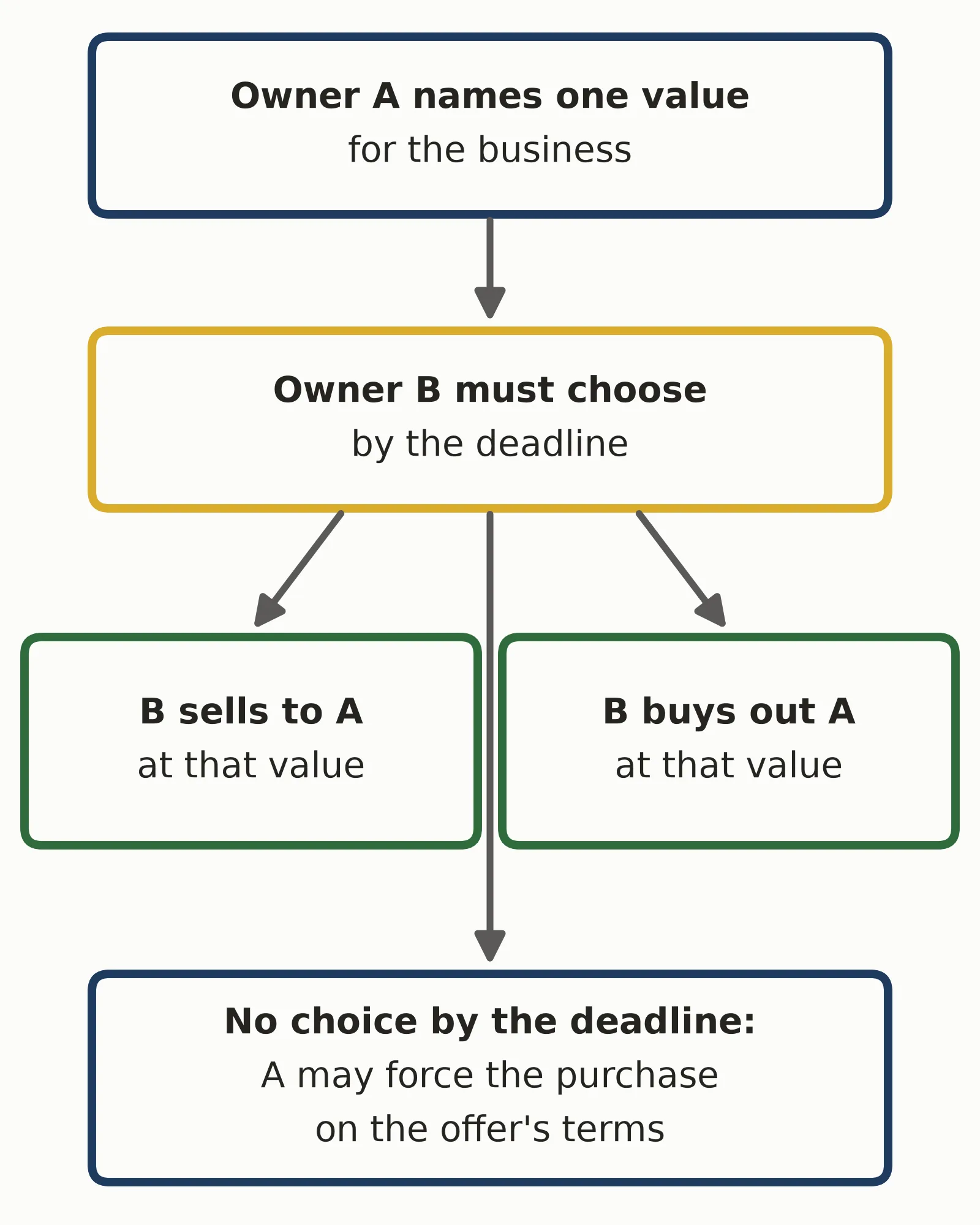
A shotgun clause lets one owner name a value, after which the other owner must either sell at that value or buy the first owner out at it, so the owner naming the price does not know which side of the deal they will land on.
The Court of Appeal for Ontario described the usual features in Western Larch Limited v. Di Poce Management Limited, 2013 ONCA 722. The offeror offers to buy the other side's interest or to sell its own, at a specified value. The offeree chooses by a set date. If the offeree does not choose, the offeror may force the purchase on the terms in the offer. The court added that not every clause has all these features, so the wording of yours controls. Figure 1 shows the usual sequence.
What Ontario courts require
Western Larch arose from a partnership agreement rather than a shareholders' agreement, but the court spoke of shotgun provisions generally and listed unanimous shareholder agreements and joint venture agreements alongside partnership agreements. The decision gives its amounts in dollars with no currency code. The offer valued the whole partnership at $258,871,780. The departing side, whose partnership share was 16.75%, was paid about $33 million when the deal closed on June 14, 2010, including partnership debt payable over four years with interest. It claimed $79 million more than it had been paid, largely on the basis that the valuation should have been at fair market value. The court dismissed the appeal, which left three damages issues for trial. The main points were these:
- Strict compliance: under Western Larch, an offer must comply strictly with the clause to be enforceable, because forcing a partner out is treated as a draconian remedy.
- Not perfection: Western Larch says strict compliance is not perfect compliance. A court looks at the parties' commercially reasonable expectations and the wording of the agreement.
- Alternatives: under Western Larch, an offer with a non-compliant alternative stays enforceable if it also contains a compliant one, but the court will enforce only the compliant one.
- Small defects: Western Larch holds that elements of non-compliance that are commercially insignificant and fully remedied by damages do not defeat the offer. The court warned that a damages claim can sometimes be very cold comfort, because a departing owner has no control over the business after leaving.
- Price: the Western Larch agreement did not require fair market value: the partners could have written that in and did not. The court said it should be reluctant to rescue a party who later regrets a carefully designed deal.
Western Larch also explains why a shotgun clause tends to produce a sensible price: the offeror knows it may be bought out at the same value, so self-interest does the policing. The court quoted its earlier statement in Aronowicz v. Emtwo Properties Inc., 2010 ONCA 96, that a shotgun provision, carefully drafted, ensures that pulling the trigger generates "the best and highest price" in exchange for ending the relationship. That is the court's view of a carefully drafted clause, and a funding gap can undercut it, as the funding section below explains.
The limits come from the agreement's own terms. In Zeubear Investments Ltd. v. Magi Seal Corporation, 2010 ONCA 825, as Western Larch describes it, the offer asked for full payment on closing although the unanimous shareholder agreement required at least 50% in cash with the balance by promissory note, and the agreement's mandatory terms overrode the offer. Western Larch also refers to decisions refusing to enforce offers that added conditions the clause did not contemplate, such as a non-competition covenant or a release.
Can you withdraw a shotgun offer?
The Court of Appeal for British Columbia held in Blackmore Management Inc. v. Carmanah Management Corporation, 2022 BCCA 117, that the shareholders' agreement in that case did not permit an offeror to revoke a shotgun offer during the election period. The court said a party wanting that right should have bargained for an express term, and it cited Western Larch. This is a British Columbia decision on one agreement, so treat it as persuasive in Ontario rather than binding.
The funding problem
The weakness of a shotgun clause is money. An owner who cannot raise the funds cannot reverse the offer, however low the price. That happened in Western Larch: the departing partner tried and failed to finance a purchase, and the court noted that a fresh offer might have come in lower once the other side had seen that weakness. If one owner has much deeper pockets, consider a longer election period, a financing condition or a different mechanism.
Shotgun clauses in New York
New York law on this point is stated here from the general contract rule, not from a shotgun-clause decision: an unambiguous agreement is enforced according to its terms, as the Third Department quoted in Sitler v Saratoga Associates (2012). Ontario's strict-compliance decisions do not bind a New York court, so a New York agreement should spell out the form of notice, the election period, the closing steps and the result of silence rather than leave them to case law.
Who buys the shares, and who funds it?
The buyer under a buy-sell agreement is either the remaining owners, under a cross-purchase agreement, or the company, under an entity purchase agreement (also called a stock redemption), and that choice decides who needs the cash and can change a US estate tax bill.
| Point | Cross-purchase | Entity purchase |
|---|---|---|
| Buyer | Remaining owners | The company |
| Insurance owner | Each owner, on the others | The company |
| Premium risk | An owner may stop paying | Company controls payment |
| Solvency test | No company payment | Applies to the company |
| US estate tax | Proceeds go to the owner | Proceeds can raise company value |
Hybrid or wait-and-see forms sit between the two and can give the owners the first chance to buy, with the company as the backstop. The Connelly agreement worked that way, and the agreement in Schwimmer reversed the order by putting the company first. With more than a few owners, a cross-purchase also multiplies policies: four owners each insuring the other three need 12 policies (4 x 3, our calculation).
Can the company legally pay?
A company can pay only if it passes the solvency tests in its governing statute. Section 30(2) of the OBCA bars the payment if there are reasonable grounds to believe the corporation is or would be unable to pay its liabilities as they fall due, or that its assets would be worth less than its liabilities and stated capital. Section 31 relaxes the capital test for some non-assignable agreements with current or former directors, officers or employees, but section 31(3) still applies a liquidity test and a narrower asset test. Section 34 of the Canada Business Corporations Act (CBCA) has a parallel limit for federal corporations.
In New York, BCL section 513 bars a purchase if the corporation is or would be made insolvent, and shares may be purchased only out of surplus. If the company fails the test on the day, the agreement should say what happens next, such as a shift to the owners or a deferred purchase.
Life insurance and the Connelly decision
Life insurance is a common way to fund a death buyout, but in the United States the owner of the policy now matters more. In Connelly v. United States, 602 U.S. 257 (2024), a unanimous Supreme Court held that, for federal estate tax, an obligation to redeem shares at fair market value does not offset life insurance proceeds set aside for the redemption. All sides accepted that proceeds payable to a company are an asset that increases its value.
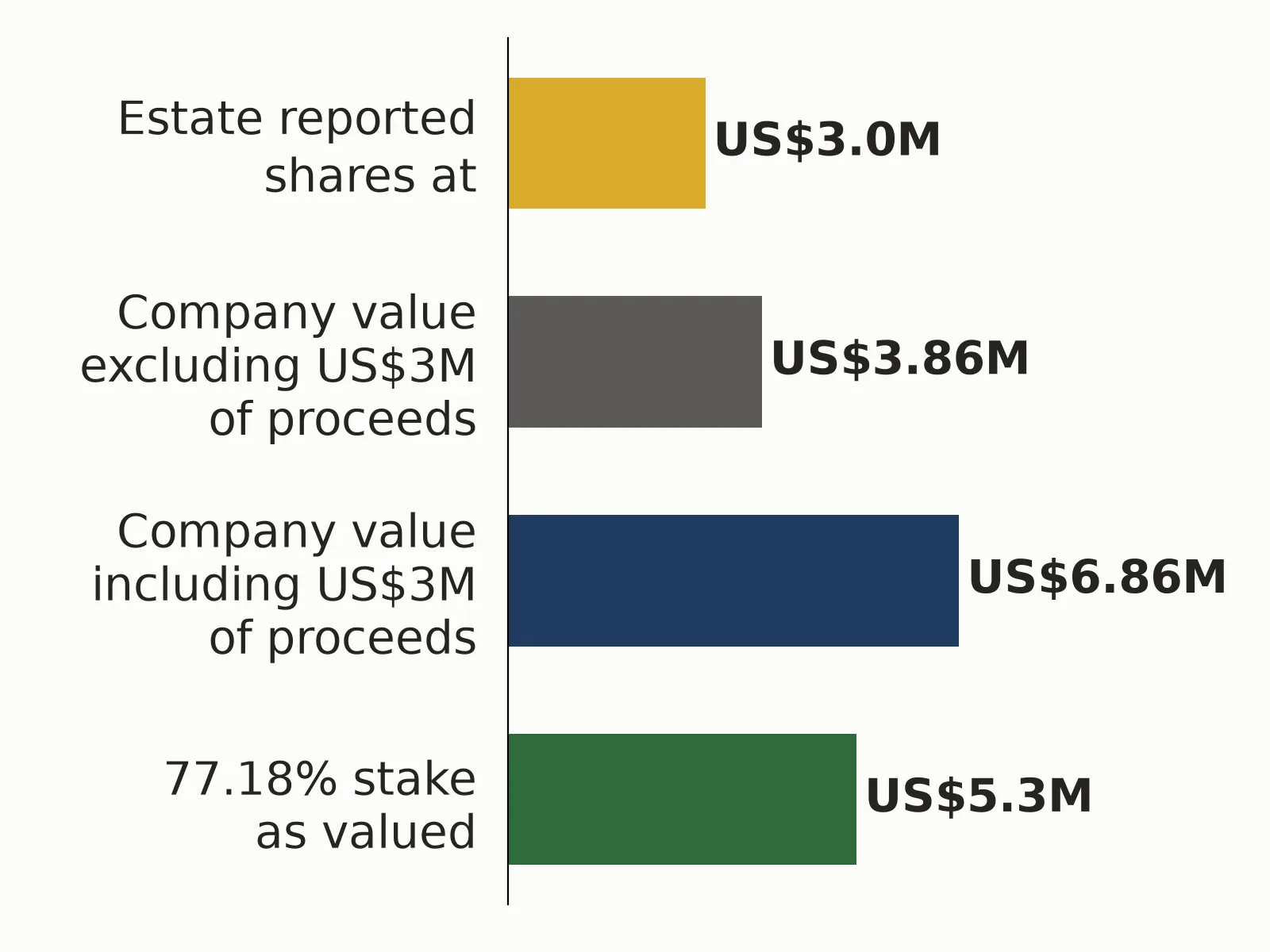
The company in Connelly held US$3.5 million of insurance on each of two brothers. Michael owned 77.18%. After he died, the company used US$3 million of the proceeds to redeem his shares, and his estate reported them at US$3 million. An accounting firm valued the company at US$3.86 million without the US$3 million of proceeds used for the redemption. The Internal Revenue Service (IRS) counted the US$3 million as well, which made the company worth US$6.86 million, and 77.18% of that is about US$5.3 million. The estate owed a further US$889,914, and the Court upheld that result.
Connelly pointed to the alternative: under a cross-purchase agreement the proceeds go straight to the surviving owner, not the company, which avoids the risk that they raise the value of the shares. Connelly also noted the drawbacks: each owner must keep paying premiums on the other, and such an arrangement has its own tax consequences.
Connelly has limits. It concerns US federal estate tax, which reaches only estates above a federal threshold, and the Court did not hold that a redemption obligation can never reduce a company's value. Connelly also said a price set by the agreement is ordinarily not dispositive for estate tax value.
For a US company-owned policy, also check 26 U.S.C. section 101(j) (2023 edition). It limits the tax-free amount of an employer-owned contract to the premiums and other amounts paid unless an exception applies, and the exceptions in paragraph (2) depend on written notice to the insured and written consent before the policy is issued. The rule's definition of an insured covers a US citizen or resident, which matters for a mixed Canada-US owner group.
Instalments and other funding
Life insurance pays only on death, so disability and departure need another source, and an agreement can allow payment over time. The agreement in Zeubear, as Western Larch describes it, required at least 50% in cash on closing with the balance by promissory note. A note should state the interest rate, the term, any security, and what happens on a missed payment. A seller can ask for limits on dividends or new debt until paid, and a buyer can ask for the right to prepay. Disability coverage, a reserve fund or a bank facility can fill gaps, but check that each is actually in place before relying on it.
What changes in a Canada-US buy-sell agreement?
A Canada-US buy-sell agreement has to work under two tax systems, so both the owner's home country and the company's place of incorporation matter. US income tax on a sale or redemption, and the position of US citizens who hold Canadian company shares, are separate questions for a US tax adviser.
Ontario and New York compared
Ontario and New York both limit a company's purchase of its own shares and give minority owners a court route. Ontario uses a liquidity test and an asset test, where New York uses an insolvency test plus a surplus requirement. Ontario owners can restrict the board by unanimous shareholder agreement, while New York needs a provision in the certificate of incorporation. The company's governing statute decides which rule applies.
| Point | Ontario | New York |
|---|---|---|
| Company buys own shares | Solvency tests, OBCA s. 30 | Solvent, from surplus, BCL s. 513 |
| Restricting the board | Unanimous shareholder agreement | Certificate of incorporation provision |
| Minority court remedy | Oppression, OBCA s. 248 | 20% petition, BCL s. 1104-a |
| Court-linked buyout | Court may order purchase | Election at fair value |
Canadian tax points
Canadian tax raises different questions from Connelly. These points all come from the federal Income Tax Act, and a tax adviser should confirm how each one applies to your structure:
- Death: Income Tax Act section 70(5) deems a taxpayer to have disposed of capital property at fair market value immediately before death, subject to exceptions such as section 70(6) on transfers to a spouse. A low contract price does not by itself set that figure.
- Redemption: under Income Tax Act section 84(3), when a corporation resident in Canada redeems shares, the amount paid above paid-up capital is a deemed dividend.
- Insurance in the company: the capital dividend account in Income Tax Act section 89(1) includes life insurance proceeds the corporation receives on a person's death, less the adjusted cost basis of the policyholder's interest in the policy immediately before the death (with exceptions). A private corporation can elect to pay out that account as a capital dividend, which section 83(2) of the same Act keeps out of the shareholder's income.
- Later losses: Income Tax Act section 112 can reduce a capital loss on a share by capital dividends received on it, so the order of the steps needs tax advice.
- US-resident owners: Income Tax Act section 212(2) applies a 25% tax on capital dividends paid to non-residents. The Canada Revenue Agency (CRA) says in its non-resident withholding guide that a bilateral tax treaty can lower that rate. A tax-free result for a Canadian holder may not carry over.
US estate tax for Canadian owners
A Canadian who owns shares in a US corporation can face US federal estate tax even without living in the United States. Under 26 U.S.C. section 2104(a) (2023 edition), stock held by a nonresident who is not a US citizen is treated as US property if a domestic corporation issued it. The IRS says this applies even if the certificates are held abroad, requires Form 706-NA if US-situated assets exceed US$60,000 at death, and tells executors to consult any applicable tax treaty. A cross-border owner group should run the death scenario in both countries before choosing a structure, with tax advisers on each side.
Buy-sell agreement drafting checklist
Use this checklist to test a new draft or an old agreement: each item is a point the document should settle without anyone needing to negotiate at the moment of crisis.
- Parties: all owners, the company, and any holding companies or trusts that actually hold the shares.
- Triggers: death, disability, departure, deadlock and breach, each defined.
- Obligation or option: who must buy, who may buy, and in what order.
- Price: the method, valuation date, accounting basis, discounts and dispute process.
- Update rule: a date by which any fixed price must be renewed, and what replaces it if it is not.
- Shotgun terms: who may fire it, when (for example, after a lock-in period), the notice form, election period, closing date and the result of silence.
- Funding: who owns each policy, who pays premiums, what happens to surplus proceeds, and whether the coverage still matches the value.
- Payment terms: cash on closing, the note, interest, security and covenants until paid.
- Solvency fallback: what happens if the company cannot legally pay.
- Tax review: a current opinion for each country where an owner lives or the company is incorporated.
- Closing mechanics: releases, guarantee replacements, resignations and a power of attorney so a closing can proceed without a reluctant party, as the closing in Western Larch did.
- Governing law and forum: which law applies, and where disputes go.
- New owners: a requirement that every new holder signs on.
How do you close a buyout?
A buyout of shares is a share purchase, so transfer documents, releases and consents follow the same logic as any stock purchase agreement. After closing, an Ontario corporation subject to OBCA section 140.2 must record in its register of individuals with significant control the day each person ceased to have that status, within 15 days after becoming aware of it. Section 140.2(8) exempts offering corporations and some others.
Frequently asked questions
What is the purpose of a buy-sell agreement?
The purpose of a buy-sell agreement is to decide in advance who can buy an owner's interest, when, at what price and with what money. It can give a departing owner or an estate a route to sell, and it can keep the business in the hands of the remaining owners.
What are the main types of buy-sell agreement?
The main types are the cross-purchase agreement, where the remaining owners buy, and the entity purchase agreement, where the company buys. Hybrid or wait-and-see versions can give the owners the first chance to buy and leave the company as the backstop. The right type depends on tax, solvency and who can pay.
Is a shotgun clause enforceable in Ontario?
Generally yes, if the offer complies with the clause. The Court of Appeal for Ontario held in Western Larch (2013), a partnership agreement case, that an offer must comply strictly, that strict compliance is not perfect compliance, and that commercially insignificant defects that damages can fully remedy will not defeat it. Much depends on the wording of the agreement.
Who should own the life insurance in a buy-sell agreement?
The right owner of life insurance in a buy-sell agreement depends on the tax result in each country. After Connelly v. United States (2024), company-owned insurance used for a redemption can raise a US estate's taxable value, while a cross-purchase sends proceeds to the surviving owner. In Canada, company-owned insurance can feed the capital dividend account. Canadian and US tax advisers should compare both before you sign.
What happens if there is no buy-sell agreement?
Without a buy-sell agreement, owners are left with negotiation and whatever the statute offers. In Ontario, a shareholder may seek an oppression remedy under section 248 of the Business Corporations Act or a winding-up under section 207. In New York, holders of 20% or more of the votes of a corporation with no listed or regularly quoted shares may petition under Business Corporation Law section 1104-a on grounds such as oppression.
Does a buy-sell agreement fix the value of shares for tax?
A buy-sell agreement does not fix tax value on its own. The Supreme Court of the United States said in Connelly v. United States (2024) that an agreed price is ordinarily not dispositive for federal estate tax value. In Canada, section 70(5) of the Income Tax Act deems a disposition at fair market value at death, subject to exceptions, so the contract price is not automatically the tax figure.
Can a Canadian owner of US shares face US estate tax?
Yes, a Canadian who is not a US citizen or resident can. Stock of a US corporation is treated as US-situated property for federal estate tax, and the Internal Revenue Service requires Form 706-NA if such assets exceed US$60,000 at death. A tax treaty may change the result, so executors should check it.
How often should a buy-sell agreement be reviewed?
Review a buy-sell agreement on a schedule, such as once a year, and after any change in owners, business value, insurance or an owner's country of residence. A fixed price that has gone stale, or insurance that no longer matches the value, can leave the owners with terms that no longer fit when the agreement applies.
Conclusion
A buy-sell agreement works when it answers the hard questions before anyone needs the answers: what triggers a sale, who buys, how the price is set and where the money comes from. Ontario courts require strict, though not perfect, compliance with a shotgun clause, New York courts have held owners to the price method they chose, and Connelly shows that the structure of the insurance can change a tax result. If your agreement is more than a few years old, read it against the checklist above.
How Mayo Law can help
Mayo Law is a cross-border firm with offices in Toronto and New York. Joseph Mayo is licensed in Ontario and New York, and our lawyers draft and review shareholders' agreements, operating agreements and buyout terms for owner-managed companies on both sides of the border. Our Toronto business law page describes that work, and we offer a paid one-hour consultation because a lawyer reviews your situation in depth.
Disclaimer
This guide is general information only and is not legal or tax advice. Reading it does not create a solicitor-client or attorney-client relationship. Laws and tax rules change, and the right structure depends on your facts, so speak with a qualified adviser before acting. Mayo Law provides legal services in Ontario and New York.