

Contents
- Quick answer
- Pre-seed vs seed: what is the difference?
- How much does each round usually raise?
- Which instrument fits each stage?
- Which securities exemptions apply in Ontario?
- Which US exemptions apply to each round?
- What changes in a cross-border round?
- What governance changes at seed?
- Frequently asked questions
- Conclusion
- How Mayo Law can help
- Disclaimer
Pre-seed vs seed looks like a question about round size, but the legal difference is bigger than the cheque. A pre-seed round is usually a stack of simple agreements for future equity (SAFEs) with no share price set. A seed round can be the first time a company sells a new class of shares, amends its articles and gives an investor a board seat. Both rounds are sales of securities, so each sale has to clear the rules where the investor lives, usually through an exemption. A raise that crosses the Canada-US border can trigger filings on both sides, which is why our international business lawyers review the investor list along with the term sheet.
This guide compares pre-seed vs seed funding from the legal side: what each round usually raises, which instruments fit, which exemptions and filings apply, and what changes in governance once a priced seed round closes. Rules are stated for Ontario, Canada federal, New York, Delaware and US federal law as of October 2026. Other provinces and states have their own versions, so check the rule where your investors are.
Quick answer
Pre-seed is the earliest outside money, usually raised on SAFEs or convertible notes with no share price. Seed is usually larger; small seed rounds often stay on SAFEs, and larger ones are usually priced sales of preferred shares. Both are securities sales that usually need an exemption in Ontario, the US or both, and a priced seed changes governance.
Pre-seed vs seed: what is the difference?
Pre-seed funds the work of proving an idea, while seed funds a product that has started to show demand, and a seed round is more likely to set a share price and change how the company is governed.
The labels come from the market, not from the law. Carta, the cap table platform, says it historically defined pre-seed as funding before a company's first priced round. It also notes that some companies now call an early priced round pre-seed, and that definitions differ on whether angel and friends-and-family money count. Securities exemption rules never ask what a round is called. They ask who is buying, how the company found them and what it is selling.
A seed round differs most when it is priced, although a real round can sit on either side of this pattern.
| Feature | Pre-seed | Seed |
|---|---|---|
| Company stage | Idea, prototype or early product | Working product, early traction |
| Typical investors | Friends and family, angels, accelerators | Angels, seed-stage venture funds |
| Usual instrument | SAFE, sometimes a note | SAFE, note or preferred shares |
| Share price set | No, not until conversion | Yes, in a priced round |
| Board seat for investor | None under the standard SAFE | Negotiated in a priced round |
Carta says pre-seed money is often used for early product development and company formation, while seed money is meant to build early traction and start selling. Both stages usually involve selling part of the company, or a right to part of it, so the same securities questions come up each time.
How much does each round usually raise?
Carta's guides put most pre-seed rounds between US$150,000 and US$1 million and typical seed rounds between US$500,000 and US$5 million.
Pre-seed numbers are harder to read than seed numbers because the money comes in as separate instruments. Carta's State of Pre-Seed report for the second quarter of 2026 counts US$3.19 billion raised by US-based startups on Carta across more than 11,500 SAFEs and convertible notes, an average of US$276,000 per instrument. That average is the highest in more than four years and is 27% above the same quarter a year earlier, and Carta expects the quarter's totals to be revised upward as more data comes in. It is the size of one instrument, not one round. Carta adds that few pre-seed deals exceed US$2.5 million, and those that do typically stack ten or more instruments.
At seed, Carta's seed funding guide cites its benchmarks for the second quarter of 2026: a median of US$4.5 million raised at a US$23.9 million post-money valuation (the company's value after the new money goes in), with median dilution of 19.4%. Those benchmarks cover US-headquartered companies and exclude convertible instruments, so that median describes equity rounds, not SAFE or note rounds. The dilution figure is a useful anchor when you model what a round costs the founders, and our guide to how equity dilution works walks through the math.
Canadian rounds run on different numbers. The Canadian Venture Capital and Private Equity Association (CVCA) reported for the first half of 2026 that seed financing fell to C$285 million across 82 deals, down 31% in dollars from a year earlier. That works out to an average of about C$3.5 million per deal (our calculation: C$285 million divided by 82). Carta prints its figures in dollars, which we read as US dollars, and they describe startups on its own platform, so the two sets of numbers do not compare directly. Treat all of them as reference points, not targets.
Which instrument fits each stage?
A SAFE is the default at pre-seed, a convertible note is a shrinking alternative, and priced preferred shares take over as seed rounds get larger.
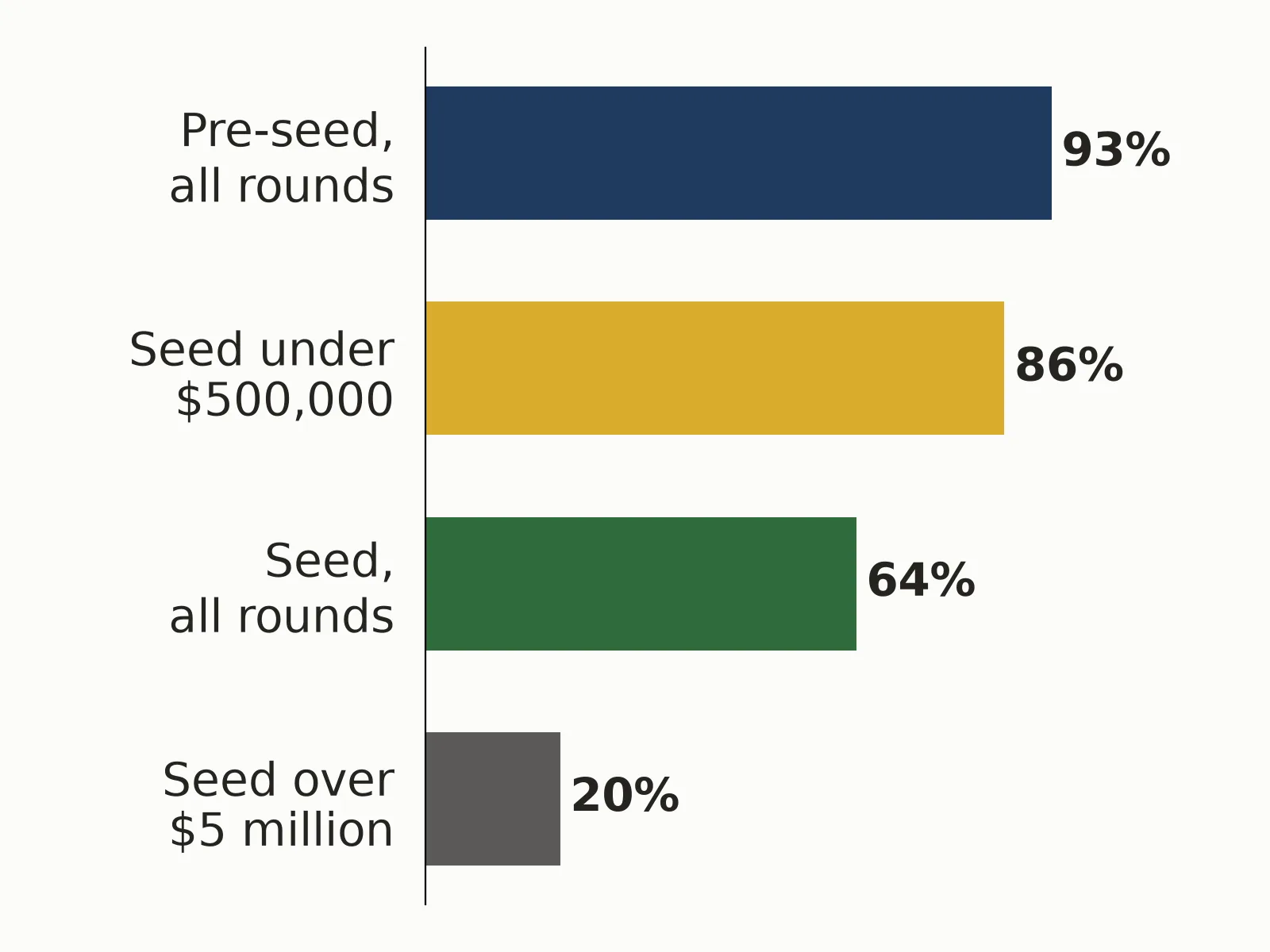
In the second quarter of 2026, Carta reports that 93% of pre-seed rounds were SAFEs, or 95% measured by capital raised, and that 91% of SAFEs on its platform were post-money. Seed is more mixed. Across the four quarters ending with the third quarter of 2024, Carta counted about 64% of seed rounds as SAFEs, 27% as priced equity and about 10% as convertible notes (Carta's rounded figures add to 101%). Size tracks the choice: in those same quarters, 86% of seed rounds under US$500,000 were SAFEs, while only 20% of seed deals above US$5 million were SAFEs and 70% were priced.
What does a SAFE give the investor?
A SAFE gives the investor a right to future shares, with no interest and no maturity date, and our guide to the SAFE vs convertible note choice covers the mechanics. Y Combinator publishes the standard forms, and they include a valuation cap version for companies formed in Canada, with an optional pro rata side letter. That letter gives the investor the right, not the obligation, to invest in a future priced round to keep its percentage ownership. Y Combinator's SAFE page tells users to consult a lawyer licensed in the relevant country before using those versions.
One clause catches pre-seed founders. In both the US and the Canadian post-money forms we reviewed, the investor states that it is an accredited investor, and the company may void the SAFE and return the money if the investor is not accredited at the time of an equity financing. A friend or relative who is not accredited cannot truthfully sign that wording, so a round with such a buyer needs the form changed or a different document.
What does a convertible note add?
A convertible note is debt that carries interest and a maturity date until it converts. Y Combinator notes that debt is repaid before any equity if the company is sold or wound down, and that a maturity date can force repayment or default. Carta says notes are now a small and shrinking share of pre-seed activity, and the CVCA's model documents include a secured convertible promissory note for Canadian deals.
What does a priced seed round involve?
In a priced seed round the company sells preferred shares at a set price per share, usually under a full set of documents. The CVCA says the National Venture Capital Association (NVCA) model documents are widely used in the US and increasingly used in Canadian venture deals, and it publishes Canadian versions. A term sheet usually comes first, and our guides to the NVCA term sheet and preferred stock explain what those terms mean.
A priced round replaces one short contract with a set of agreements and an amendment to the articles.
| Document | Pre-seed SAFE | Priced seed |
|---|---|---|
| Investment contract | SAFE or note | Share purchase agreement |
| Articles or charter | Usually unchanged | Amended for preferred shares |
| Investor rights | Optional pro rata side letter | Investors' rights agreement |
| Board and voting | No change | Voting agreement |
| Share transfers | Existing restrictions | First refusal and co-sale agreement |
Which securities exemptions apply in Ontario?
In Ontario, every sale of new shares, SAFEs or notes is a distribution that needs a prospectus or an exemption, and the private issuer, accredited investor, family and friends, and self-certified investor exemptions are the natural starting points for an early round.
The form of the instrument does not change whether it is a security. Ontario's Securities Act defines a security to include any document evidencing an option, subscription or other interest in a security, and any note or other evidence of indebtedness. The US definition in section 2(a)(1) of the Securities Act of 1933 covers any note and any investment contract. So a short SAFE calls for an exemption analysis, just as a preferred share purchase does.
Section 53(1) of the Securities Act (Ontario) bars a distribution without a prospectus, and the Act defines a distribution to include a trade in securities not previously issued. The exemptions sit in that Act and in National Instrument 45-106 Prospectus Exemptions (NI 45-106), published by the Ontario Securities Commission (OSC) in a consolidation current to December 4, 2025. The accredited investor, private issuer, family and friends, and minimum amount exemptions each require the buyer to purchase as principal, although for the accredited investor exemption NI 45-106 deems some buyers, such as a registered adviser acting for a fully managed account, to do so. All dollar amounts in this section are Canadian.
- Private issuer: section 73.4(2) of the Act and section 2.4 of NI 45-106. The company must not be a reporting issuer, its securities (other than non-convertible debt) must carry transfer restrictions in its constating documents or a security holders' agreement, and they can be held by no more than 50 people, not counting employees and former employees. It may sell to listed buyers, including founders, directors, officers, close personal friends, close business associates, existing security holders and accredited investors. It is not on the section 6.1 list of exemptions that require a report.
- Accredited investor: section 73.3(2) of the Act. An individual qualifies with financial assets over $1,000,000 net of related liabilities, net income before taxes over $200,000 in each of the two most recent calendar years ($300,000 with a spouse) and the same expected this year, or net assets of at least $5,000,000. An individual who qualifies on those tests must also sign a risk acknowledgement in the required form, at or before signing the purchase agreement, and the company keeps it for 8 years. The company files Form 45-106F1 within 10 days after the distribution.
- Family, friends and business associates: section 2.5 of NI 45-106. In Ontario, section 2.6.1 adds a risk acknowledgement signed by the purchaser, an executive officer other than the purchaser and, depending on the buyer, the director, executive officer, control person or founder who has the relationship with the purchaser, kept for 8 years. Form 45-106F1 is due within 10 days after the distribution.
- Self-certified investor: Ontario Instrument 45-510, an interim OSC order in effect from October 25, 2025 to April 25, 2027 unless extended. Among other conditions, the company's head office must be in Canada, and the buyer certifies qualifying experience or education, such as five years of relevant experience in the company's industry or sector, or an accredited MBA. Each buyer is capped at $50,000 per calendar year under the exemption, and the company files Form 45-106F1 no later than the 30th day after closing.
- Minimum amount: section 2.10 of NI 45-106, for a buyer that is not an individual and pays at least $150,000 in cash, with Form 45-106F1 due within 10 days after the distribution. It can suit a holding company that does not meet the accredited investor test, as long as it was not created or used solely to buy securities under the exemption.
The OSC says Form 45-106F1 is filed through the System for Electronic Data Analysis and Retrieval + (SEDAR+), with the applicable filing fees. Commissions need a separate check. Under the private issuer exemption, no commission or finder's fee may be paid to a director, officer, founder or control person, except on a sale to an accredited investor or, in Ontario, a self-certified investor buying under Instrument 45-510. The family and friends exemption has the same bar with no such exception. The OSC also notes that people who sell securities on the exempt market typically need to register as dealers, so a paid finder raises its own question.
Other provinces apply NI 45-106 with local differences. Saskatchewan, for example, has its own risk acknowledgement rule, and Instrument 45-510 is an Ontario order. A round with investors in several provinces has to be checked province by province.
Which US exemptions apply to each round?
The main federal routes are the same for both rounds: section 4(a)(2) of the Securities Act of 1933, which exempts transactions not involving a public offering, and Rule 506 of Regulation D, which sets conditions that are deemed to meet it.
The choice under Rule 506 turns on how the company finds investors. All dollar amounts in this section are US dollars.
- Rule 506(b): no general solicitation or advertising, and no more than 35 purchasers who are not accredited in any 90-calendar-day period. Accredited investors do not count toward the 35. Each non-accredited buyer must be financially sophisticated, alone or with a purchaser representative, and must receive the disclosure in Rule 502(b) a reasonable time before the sale.
- Rule 506(c): public promotion is allowed, but every purchaser must be accredited and the company must take reasonable steps to verify that status. In a no-action letter dated March 12, 2025, Securities and Exchange Commission (SEC) staff agreed that a high minimum investment is a relevant factor in verifying that status, in a case where it came with written representations from the buyer. A staff letter has no legal force and depends on its facts.
Under Rule 501(a), an individual is accredited with income over $200,000 in each of the two most recent years ($300,000 jointly with a spouse or spousal equivalent) and a reasonable expectation of the same this year, or net worth over $1,000,000 excluding the primary residence. The numbers resemble Ontario's, but the Ontario wealth tests count different things and the currency differs, so a buyer can pass one and fail the other.
A company relying on Rule 506 files a notice on Form D with the SEC no later than 15 calendar days after the first sale. A company relying on section 4(a)(2) alone has no Form D to file, but it also gives up covered-security treatment under state law. Under 15 U.S.C. 77r(b)(4)(F), securities sold under SEC rules issued under section 4(a)(2) are covered securities, so states cannot require registration but can require notice filings.
New York requires a notice filing. Its Attorney General's office says Rule 506 issuers file Form D through the Electronic Filing Depository (EFD), and Title 13 of New York's Codes, Rules and Regulations, Part 10, sets the deadline at 15 days after the first sale in or from New York State. The office lists fees of $300 for total offerings of $500,000 or less and $1,200 above that. Filings last four years and must then be renewed.
Can a founder pitch at a demo day?
Yes, if the event and the pitch stay within Rule 148. Under Rule 502(c), general solicitation includes a seminar or meeting whose attendees were invited by general solicitation. Rule 148 carves out a seminar or meeting with more than one issuer, sponsored by a college or university, a State or local government, a nonprofit, an angel investor group, an incubator or an accelerator. Among other conditions:
- No advertising for the event refers to a specific offering by the company.
- The sponsor gives no investment advice or recommendations and stays out of negotiations.
- The sponsor charges attendees no more than reasonable administrative fees and takes no compensation for introductions.
- The founder limits offering details to the fact of the offering, the type and amount of securities, the intended use of proceeds and the unsubscribed amount.
Go past that list on stage and a Rule 506(b) raise can be at risk.
What changes in a cross-border round?
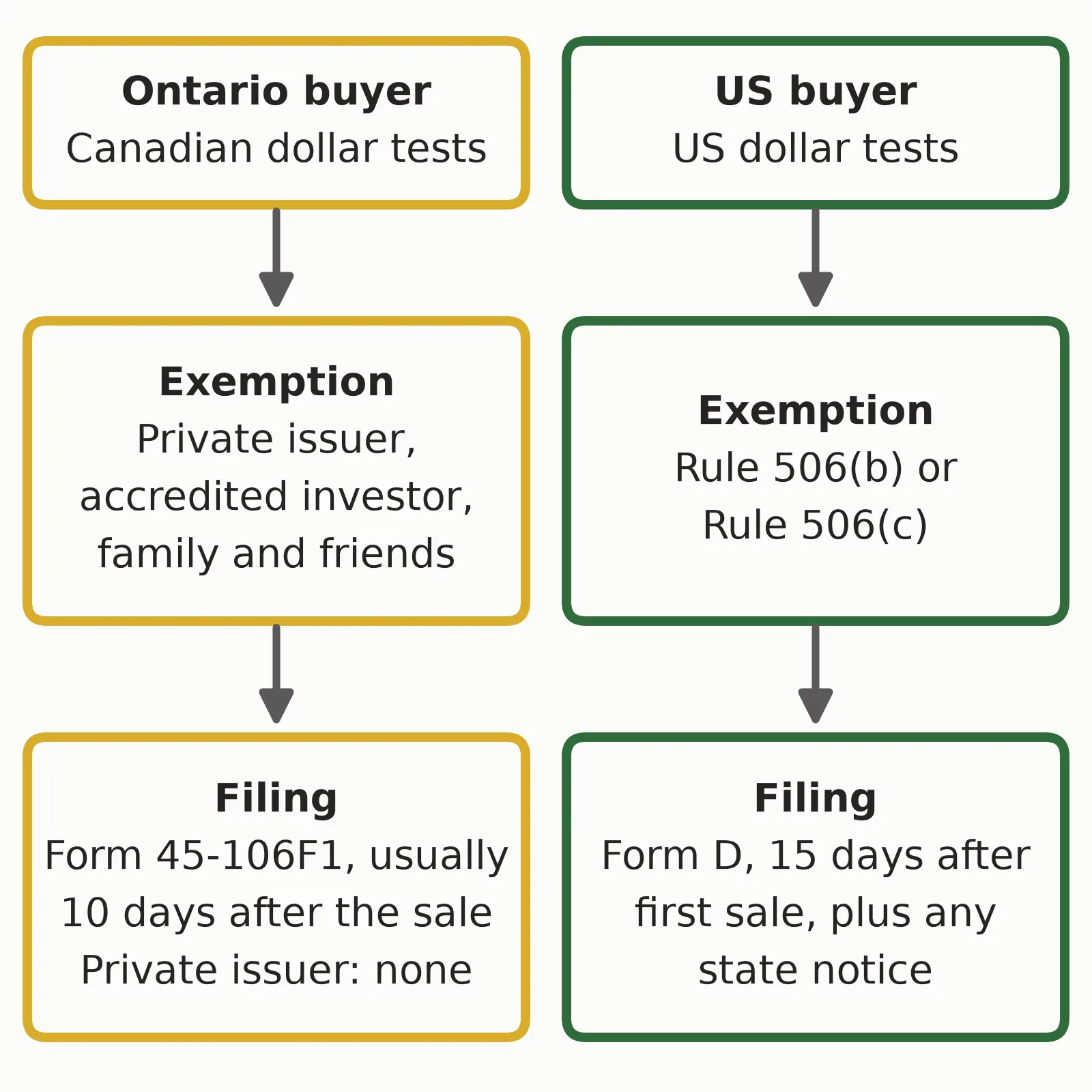
A cross-border round answers to the rules where the company sits and where each investor sits, so a single closing can need an Ontario report, a Form D and a New York notice.
- Ontario company, New York investor, US side: the sale needs a US exemption, such as Rule 506, plus a New York notice if Rule 506 is used and the sale is in or from New York State.
- Same sale, Ontario side, section 2.4: section 2.4 of OSC Rule 72-503 exempts a company that is not a reporting issuer in Canada when it sells its own securities to a person outside Canada, if it has materially complied with the foreign disclosure requirements or the sale is exempt from them. A company relying on section 2.4 files Form 72-503F through SEDAR+ on or before the tenth day after the distribution date.
- Same sale, Ontario side, Companion Policy: the OSC's Companion Policy says the OSC does not read the prospectus requirement as applying to a sale outside Canada made in compliance with the foreign law, if the securities come to rest outside Canada.
- Delaware company, Ontario investor: the OSC says prospectus exemptions are available to both Canadian and foreign companies, so the sale needs an Ontario exemption and, where one applies, a Form 45-106F1 in Ontario. The company also has to settle the US side, whether through Rule 506 or Regulation S, which covers offers and sales that occur outside the United States. The self-certified investor exemption is not available unless the head office is in Canada.
- Mixed round: investor questionnaires should test the Canadian definition for Canadian buyers and the Rule 501(a) definition for US buyers. Y Combinator's Canadian SAFE does this: it points to Rule 501 for an investor resident in the United States, and/or to applicable Canadian securities laws.
Ontario and US rules differ on the headcount limit, the filing, the deadline and the currency of the tests.
| Point | Ontario buyer | US buyer |
|---|---|---|
| Main exemptions | Private issuer, accredited investor | Rule 506(b), Rule 506(c) |
| Headcount limit | 50 owners (private issuer) | 35 non-accredited (506(b)) |
| Form after the sale | Form 45-106F1 usually; private issuer: none | Form D (Rule 506 only) |
| Deadline | 10 days after distribution; self-certified: 30 | 15 days after first sale |
| Currency of tests | Canadian dollars | US dollars |
Where the company should be incorporated is a separate decision that often comes up at this point. If US investors are asking for a Delaware company, our guide to the Delaware C corp sets out the trade-offs for Canadian founders.
What governance changes at seed?
A SAFE round usually leaves the board and the share structure alone, but a priced seed round usually amends the articles, creates preferred shares and adds contract rights over the board, information and future share sales.
Under the standard SAFE, the investor is not entitled to vote or to any rights of a shareholder until shares are issued. That changes on conversion or at a priced round, when the investor becomes a shareholder with whatever rights the new class carries.
How are the articles amended?
Unless the articles already provide for them, preferred shares have to be written into the company's articles first. Under the Business Corporations Act (Ontario), the rights of each class are set out in the articles (section 22(4)), an amendment can create a new class (section 168(1)(e)) and it needs a special resolution (section 168(5)). That means two-thirds of the votes cast at a meeting, or written consent from every shareholder entitled to vote. Holders of an existing class may also get a separate class vote under section 170. Federal corporations follow similar rules in sections 173 and 176 of the Canada Business Corporations Act.
In Delaware, section 151(a) of the General Corporation Law requires the rights of each class to be stated in the certificate of incorporation or an amendment, or in a board resolution the certificate authorizes. Section 242(b) calls for a board resolution and, as the general rule, a majority of the outstanding stock entitled to vote, and stockholders can usually act by written consent under section 228.
What happens to the board?
Directors still run the company after a priced round, but investors can gain a seat by contract. Directors manage or supervise the business in both places (section 115(1) of the Business Corporations Act (Ontario); Delaware section 141(a)). The NVCA model voting agreement has stockholders agree to vote for named directors, and its examples include a Preferred Director designated by a named investor. An investor's nominee is still a director. In Ontario, section 134(1) of the same Act requires every director to act honestly and in good faith with a view to the best interests of the corporation, so that duty runs to the company and not to the fund that made the nomination. The NVCA investors' rights agreement also offers a nonvoting observer seat.
What information and pro rata rights do investors get?
Under the NVCA model, each major investor, meaning a holder above a share threshold the parties set, gets financial statements, inspection rights and a right of first offer on new securities up to its pro rata amount. Those are contract rights. On pro rata rights, statute gives less: in Delaware, section 102(b)(3) says a stockholder has no preemptive right unless the certificate of incorporation expressly grants it. In Ontario, section 26 of the Business Corporations Act allows one only if the articles or a unanimous shareholder agreement provide it, and section 28 of the Canada Business Corporations Act requires a provision in the articles.
Do shareholder agreements and audit rules change?
A priced round can touch both. Ontario also offers a tool: under section 108(2) of the Business Corporations Act (Ontario), a written agreement among all shareholders can restrict the directors' powers, and section 108(5) gives a shareholder who is party to it a director's duties and liabilities to the extent of that restriction. The CVCA publishes a unanimous shareholders agreement based on the NVCA documents that combines their key provisions in one agreement. Whichever form is used, it is worth matching the terms against the shareholder agreement clauses founders already signed.
New investors can also affect a small housekeeping step. Under section 148 of the Business Corporations Act (Ontario), a corporation that is not an offering corporation skips the auditor requirements for a financial year only if all of the shareholders consent in writing for that year. Every new shareholder is one more signature.
What should be fixed before a priced round?
Fix the cap table, intellectual property, vesting and exemption record first, because investors check the record before they wire. Keep a current cap table that shows every SAFE and note on an as-converted basis. Make sure each founder and contractor has signed an intellectual property assignment, and settle founder vesting before a term sheet raises it. Then confirm that every earlier raise had an exemption and that its filing was made on time, because a later investor will ask.
Frequently asked questions
Is pre seed funding the same as friends and family money?
Not always. Friends and family are one common source of pre-seed money, but Carta also lists angel investors and accelerators, and some definitions treat those rounds separately. The exemption category matters more: a friend may qualify under Ontario's private issuer or family and friends exemption only if the relationship is close enough to fit its wording.
Seed vs pre seed: can a startup skip pre-seed?
Yes. Securities rules do not require a pre-seed round first, because both terms are market labels. A company with a working product and early traction can open with a seed round. Its first sale still has to fit the securities rules, usually through an exemption, plus any filing that exemption requires.
Does the pre-seed vs seed label change which exemption applies?
No. Ontario's exemptions turn on who buys and what the company is selling, and Rule 506 turns on who buys and how the company found them. A round called pre-seed and a round called seed use the same exemptions, so check each investor rather than the name on the round.
Do pre-seed rounds need securities filings?
Often, yes. In Ontario, a sale under the accredited investor or family and friends exemption needs Form 45-106F1 within 10 days after the distribution, while the private issuer exemption does not. In the US, a Rule 506 offering needs Form D within 15 calendar days after the first sale, and a sale in or from New York State adds its own notice.
Can a friend who is not accredited invest in a pre-seed round?
Sometimes. In Ontario, a close personal friend of a founder, director or executive officer can qualify under the private issuer or family and friends exemption. In the US, Rule 506(b) allows up to 35 sophisticated non-accredited purchasers in any 90 calendar days, with added disclosure. The standard SAFE's accredited investor statement would have to be changed first.
Does a SAFE investor get a board seat?
Not under the standard Y Combinator form. The form gives the holder no vote and no shareholder rights, including on the election of directors, until shares are issued. An investor can negotiate more in a side letter, and any board seat usually arrives with a priced round through a voting agreement.
When should a startup move from SAFEs to a priced seed round?
No law sets the point. In Carta's data for the four quarters ending with the third quarter of 2024, seed rounds under $500,000 were mostly SAFEs, while most seed deals above $5 million were priced (read as US dollars). Y Combinator says a priced round fits when a lead investor sets a firm valuation and wants equity with full terms, often with a board seat and other contractual rights, and it calls that typical for Series A and beyond. Under its standard form, a SAFE converts automatically when the company sells preferred shares at a fixed valuation.
Can a Canadian startup sell a SAFE to US investors?
Yes. Rule 506 applies to an issuer without limiting it to US companies, so an Ontario company can use it for US buyers and file Form D, plus any state notice that applies. On the Ontario side, the company may rely on section 2.4 of OSC Rule 72-503 and file Form 72-503F, or on the OSC Companion Policy's view of sales outside Canada. Y Combinator's Canadian SAFE points US residents to Rule 501.
Conclusion
Pre-seed usually means SAFEs, a short investor list and an exemption chosen buyer by buyer. A priced seed round adds a new share class, amended articles, investor rights and, where negotiated, a board seat. Both are securities sales, and a cross-border round has to clear the rules on each side, usually through an exemption. Keep the exemption and filing record from every round in one place.
How Mayo Law can help
Mayo Law works with founders and growing companies on both sides of the border from offices in Toronto and New York. Joseph Mayo, our principal attorney, is licensed in Ontario and New York, and our lawyers prepare SAFEs, convertible notes and priced round documents, and handle the Ontario and US securities filings that come with a raise. Our startup lawyer page explains how we work with founders. The first step is a paid one-hour consultation, because a lawyer reviews your round, your cap table and your investors' locations in depth.
Disclaimer
This article is for general information only and is not legal, tax or financial advice. Reading it does not create a solicitor-client or attorney-client relationship. Securities rules, thresholds and market data change, and the right structure depends on your company, your investors and where they are located. Mayo Law provides legal services in Ontario and New York.