

Contents
- Quick answer
- What is a Delaware C corp?
- Why Canadian founders hear about Delaware
- How to form a Delaware C corp
- What a Delaware C corp costs each year
- Can a Delaware C corp be a CCPC?
- Delaware flip or a US subsidiary?
- Founder stock and the 83(b) election
- Frequently asked questions
- Conclusion
- How Mayo Law can help
- Disclaimer
A Delaware C corp is a corporation formed under Delaware law and taxed under US federal law as a regular corporation. For a Canadian founder, the real question is not how to file the paperwork but what a Delaware company does to the Canadian side of the business: its tax status and its structure. We help founders with that decision through our cross-border business law practice, and this guide sets out the rules on both sides of the border, with links to the official sources.
Moving an existing Canadian company under a Delaware parent can end the Canadian company's status as a Canadian-controlled private corporation (CCPC). That trade-off, not the filing fee, is the decision to make before signing anything.
Quick answer
A Delaware C corp is a Delaware corporation taxed under the regular US federal corporate tax rules. Anyone, including a Canadian resident, can form one by filing a certificate of incorporation and keeping a Delaware registered agent. It costs little to start, but it cannot be a CCPC, so Canadian founders should plan the structure and tax effects first.
What is a Delaware C corp?
A Delaware C corp is a corporation incorporated under the Delaware General Corporation Law (Title 8, Chapter 1 of the Delaware Code) that pays US federal income tax as a regular corporation, separately from its shareholders. The full name is Delaware C corporation, and "C corp" is a tax label, not a different kind of company.
The Internal Revenue Service (IRS) explains the tax effect plainly on its page about forming a corporation (reviewed June 2026): the profit of a corporation is taxed to the corporation when earned, and shareholders are taxed again when profits are paid out as dividends. The IRS calls this a double tax. A C corporation files Form 1120, the US Corporation Income Tax Return, each year.
The "Delaware" part refers to the state under whose corporate statute the company is incorporated. A Delaware C corp's registered office need not be a place of its business, under section 131 of the Delaware General Corporation Law. Where the company actually operates matters for registration there (see Step 6 below).
A Canadian founder may compare it with a corporation under the Canada Business Corporations Act or Ontario's Business Corporations Act. Under subsection 89(1) of the federal Income Tax Act, a Delaware corporation is not a "Canadian corporation", and that affects most of the decisions in this guide. If you are still choosing between a corporation and a limited liability company (LLC) for a US business, our guides on choosing a US entity and an LLC or a corporation in New York cover that earlier step.
Why Canadian founders hear about Delaware
Founders hear about Delaware because of three features of its law, each stated in Delaware's own sources: a corporate statute that lets anyone incorporate without living in the state, a dedicated business court, and a filing system with published fees and fixed due dates.
- Open to non-residents: section 101 of Title 8 of the Delaware Code lets any person, partnership, association or corporation, alone or with others, form a corporation regardless of where they live or are incorporated.
- A dedicated business court: the Delaware Court of Chancery describes itself as "widely recognized as the nation's preeminent forum for the determination of disputes involving the internal affairs" of Delaware corporations and other business entities.
- A predictable filing system: the Division of Corporations publishes one fee schedule (revised August 1, 2026) and one franchise tax page, with fixed due dates and published amounts.
None of this means a Delaware corporation is right for every founder. If a US investor makes a Delaware C corp a condition of its term sheet, the question becomes how to get there with the least tax cost in Canada. If no investor is asking, a Canadian corporation may serve the business just as well, and it keeps Canadian tax benefits that a Delaware company cannot have. Our guide to the US venture term sheet explains the financing terms that may come with that request, and our comparison of a simple agreement for future equity (SAFE) and a convertible note covers the early financing instruments.
How to form a Delaware C corp
To form a Delaware C corp, you appoint a Delaware registered agent, file a certificate of incorporation with the Delaware Division of Corporations, and then organize the company and get a US federal tax number.
The Delaware General Corporation Law sets the minimum content of the certificate. Under section 102(a), it must state the corporation's name, with a word such as "corporation" or "company". It must also give the address of the registered office in Delaware and the registered agent's name, the nature of the business, the total number of shares the corporation may issue, and each incorporator's name and mailing address. Sections 131 and 132 require every corporation to have and maintain a registered office and a registered agent in Delaware. The agent can be the corporation itself, an individual resident in Delaware or a qualifying business entity, so a founder outside the state can meet the rule by hiring a business that acts as registered agent.
- Step 1: Choose a name that meets section 102(a) and is available in Delaware.
- Step 2: Appoint a registered agent (see above).
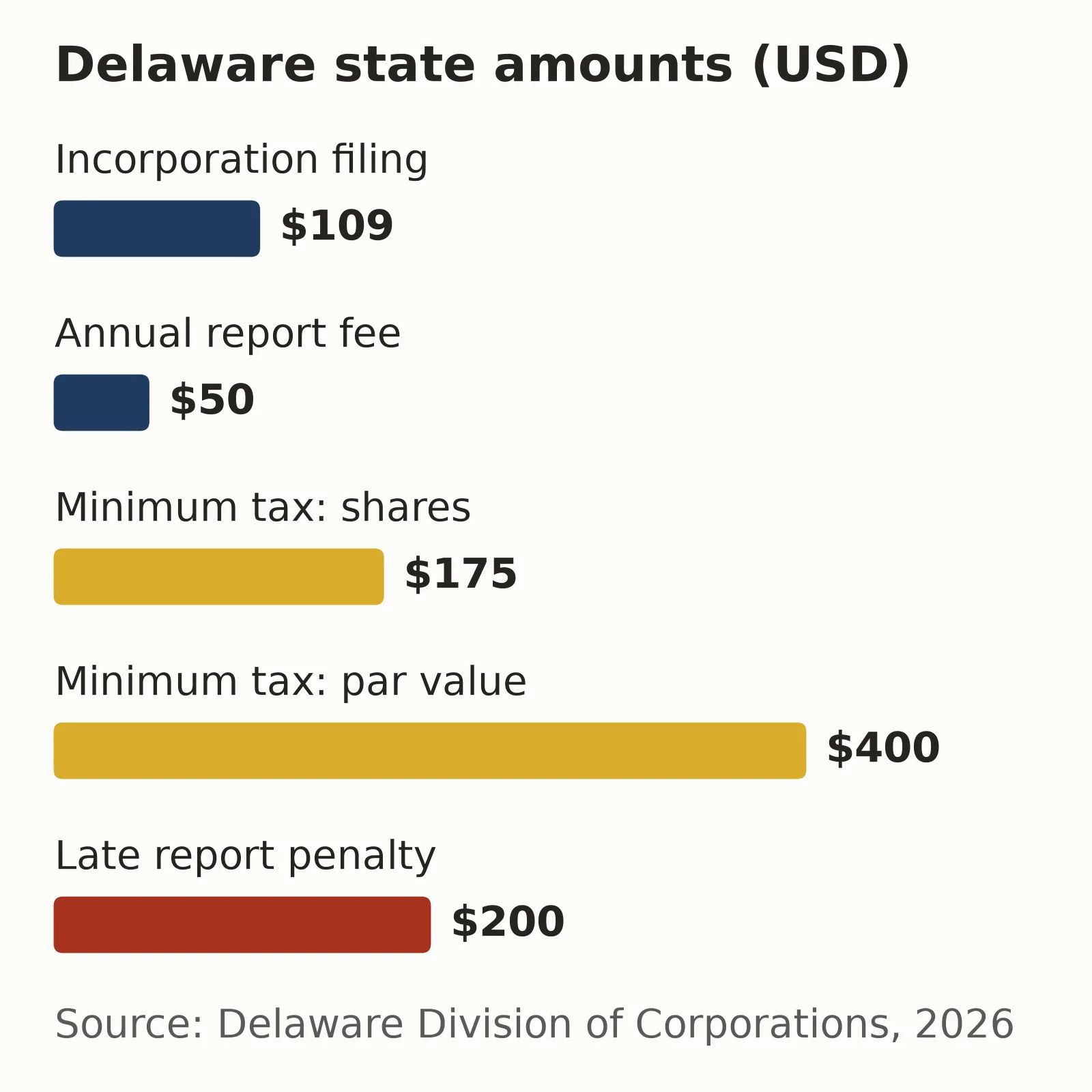
- Step 3: File the certificate of incorporation. The fee schedule revised August 1, 2026 lists $109 for a standard incorporation (the amount varies with the authorized stock and adds $9 per extra page), plus $50 for 24-hour handling or $100 for same-day handling, and $50 for each certified copy.
- Step 4: Organize the company and issue founder shares, as our explainer on the certificate of incorporation describes.
- Step 5: Get an Employer Identification Number (EIN). The IRS EIN page (updated October 2026) says that when the principal place of business is outside the US, you apply by phone, fax or mail; the online application needs the responsible party's Social Security number or individual taxpayer identification number.
- Step 6: Register where the company operates. For New York, see our guide to foreign qualification. Ontario's registry fee page lists an extra-provincial licence under the Extra-Provincial Corporations Act at $330 (as of October 2026). Our guide to extra-provincial registration in Ontario covers that side.
What a Delaware C corp costs each year
A Delaware C corp pays an annual report fee of $50 and a franchise tax of at least $175 each year, both due by March 1, with a $200 penalty and monthly interest if they are late. Registered agent fees and tax filings in other places are extra.
The Delaware Division of Corporations franchise tax page (read October 2026) gives these figures:
- Due date: the annual report and franchise tax must be received no later than March 1 of each year.
- Annual report fee: $50 for a non-exempt domestic corporation.
- Minimum franchise tax: $175 under the Authorized Shares method, or $400 under the Assumed Par Value Capital method.
- Maximum franchise tax: $200,000 under either method, or $250,000 for corporations classed as Large Corporate Filers.
- Late filing: a $200 penalty for not filing a completed annual report by March 1, and interest of 1.5% per month on unpaid tax.
The Delaware franchise tax for a given company depends on which method is used and on its share structure; the page gives a minimum for each method and one maximum, and $175 is the lower of the two minimums, not a typical bill. By our calculation from the published figures, the lowest possible Delaware state amounts to incorporate and make the first annual filing are $334: the $109 incorporation fee, the $50 annual report fee and the $175 minimum tax. That total excludes the registered agent, expedited handling and every tax outside Delaware.
Delaware's Division of Revenue adds a separate point: every domestic or foreign corporation doing business in Delaware, unless specifically exempt, files a Delaware corporate income tax return, at 8.7% of federal taxable income allocated and apportioned to Delaware. Whether a given company is doing business in Delaware is a fact question to check with a tax adviser.
Can a Delaware C corp be a CCPC?
No, a Delaware C corp cannot be a Canadian-controlled private corporation, because the Income Tax Act limits CCPC status to a "Canadian corporation", and a newly formed Delaware corporation does not meet that definition even if it is managed from Canada.
The rule comes from two definitions in the federal Income Tax Act (current to September 30, 2026). Subsection 125(7) defines a CCPC as a private corporation that is a Canadian corporation, other than one controlled, directly or indirectly in any manner whatever, by one or more non-resident persons or public corporations. Subsection 89(1) defines a Canadian corporation as one that is resident in Canada and was either incorporated in Canada or resident in Canada throughout the period since June 18, 1971. A newly formed Delaware corporation was not incorporated in Canada and has not been resident in Canada since June 18, 1971, so it cannot be a Canadian corporation.
CCPC status matters because several Canadian tax rules depend on it. At the federal level, the Canada Revenue Agency (CRA) states in its T2 guide (modified May 2026) that corporations that were CCPCs throughout the tax year may be able to claim the small business deduction, which reduces the federal Part I tax the corporation would otherwise pay. Ontario has its own version: the Ontario government's corporate income tax page (updated April 2026) says the Ontario small business deduction reduces the rate on the first $500,000 of active business income of CCPCs. A company that loses CCPC status loses access to both.
The CRA's page on the type of corporation (September 2026) also lists, in plain terms, that a CCPC must be a private corporation and must have no class of shares listed on a designated stock exchange, besides the non-resident control rule above. That control rule is the one a Delaware parent can trip, as the next section explains.
Delaware flip or a US subsidiary?
A Delaware flip puts a new Delaware corporation above an existing Canadian company as its parent, while a US subsidiary keeps the Canadian company as the parent and adds a Delaware company below it. The two structures can affect the Canadian company's CCPC status differently.
As we use the term in this guide, in a flip the founders and other shareholders exchange their shares of the Canadian company for shares of a new Delaware parent, so the Canadian company becomes a wholly owned subsidiary. If the Delaware parent is a non-resident of Canada, the Canadian company is then controlled by a non-resident person, and on the wording of subsection 125(7) it stops being a CCPC. In the subsidiary structure, the Canadian company owns the Delaware company, so the Canadian company's own CCPC status is not affected by the subsidiary's existence.
The share exchange itself also needs a tax plan. The general share-for-share rollover in subsection 85.1(1) of the Income Tax Act is written for shares issued by a purchaser that is a Canadian corporation, and the foreign version in subsection 85.1(5) deals with shares of a corporation resident outside Canada exchanged for shares of another such corporation. Neither, on its wording, describes Canadian shares exchanged for shares of a Delaware parent, so a flip is a reorganization to design with a Canadian tax adviser before any investor deadline.
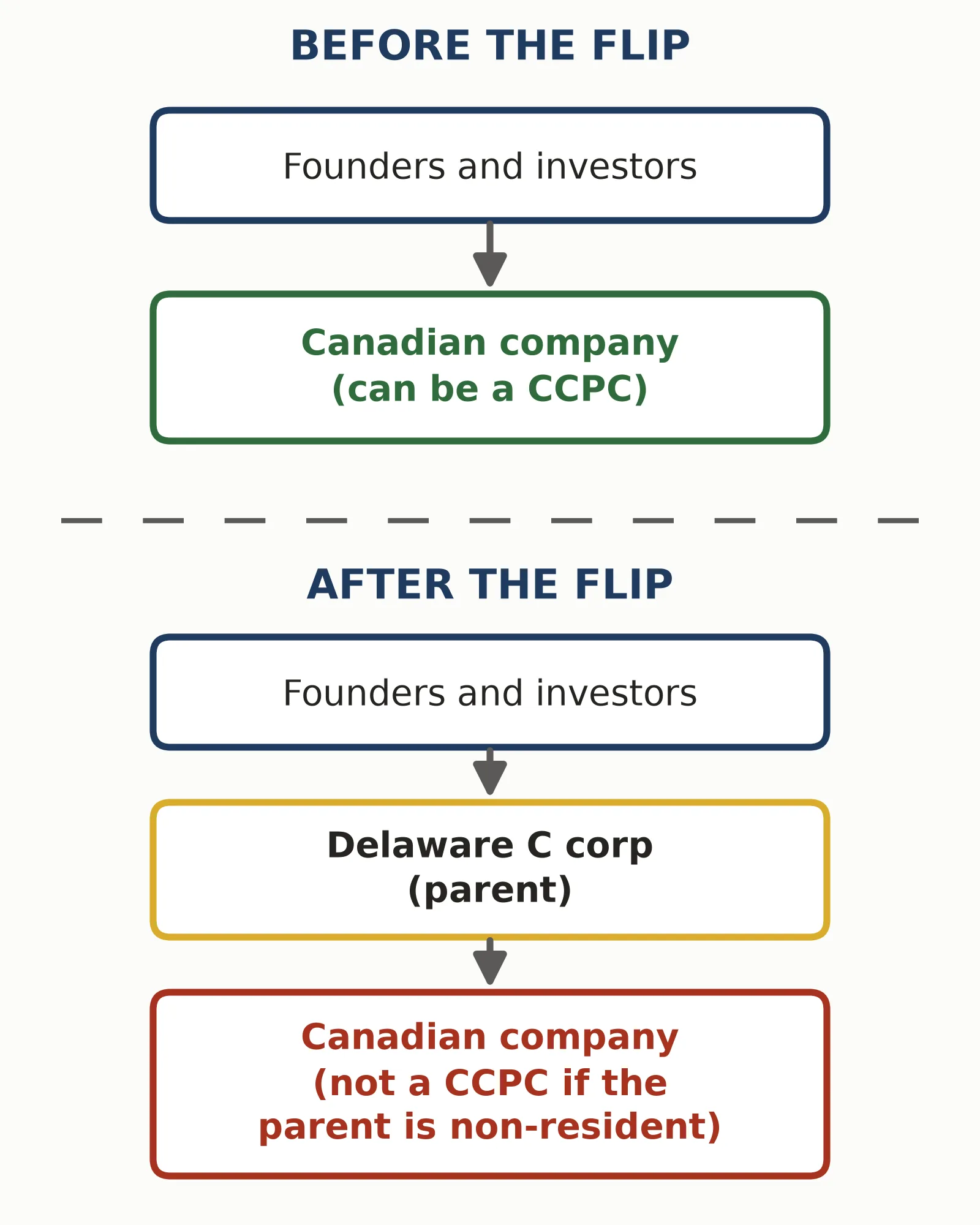
The table below compares the three choices on the CCPC point this guide has verified: only the flip puts the Canadian company's status at risk.
| Structure | Parent company | Canadian CCPC |
|---|---|---|
| Stay Canadian | Canadian company | Can be kept |
| Canadian parent, US subsidiary | Canadian company | Not affected by subsidiary |
| Delaware flip | Delaware C corp | Ends if parent is non-resident |
Founders who already run their Canadian business through a holding company have a further layer to plan, because the holding company would be one of the shareholders in the exchange. Our guide to the holding company in Canada explains how that structure is set up.
Founder stock and the 83(b) election
When a founder receives Delaware shares for services, US federal tax law lets the person who performs the services file an election under section 83(b) of the Internal Revenue Code, and the IRS form says the election must be filed no later than 30 days after the shares are transferred.
The IRS's Form 15620 (Rev. 4-2025), Section 83(b) Election, sets out the mechanics. The person who performs the services, such as an employee or an independent contractor, may make the election on Form 15620 or by a written statement that meets Treasury Regulation section 1.83-2. The election must be filed no later than 30 days after the date the property was transferred, with an extension to the next business day when the thirtieth day falls on a weekend or legal holiday. The person making it must give a copy to the person for whom the services are performed, and an 83(b) election may not be revoked except with the IRS's consent.
Whether a Canadian-resident founder benefits from the election depends on that founder's US tax position, which is a question for a cross-border tax adviser. The practical lesson is about timing: the 30-day window runs from the date the shares are transferred, so the deadline should be in view before the transfer, not after. Our guide on founder vesting explains vesting schedules and leaver terms in more depth.
Frequently asked questions
Can a Canadian form a Delaware C corp?
Yes. Section 101 of Title 8 of the Delaware Code allows any person, partnership, association or corporation, alone or with others, to form a Delaware corporation regardless of residence or place of incorporation. A Canadian founder can file the certificate of incorporation from Canada, provided the company appoints a Delaware registered agent as sections 131 and 132 require.
Does a Delaware C corp need an office in Delaware?
It needs a registered office and a registered agent in Delaware, not a place of business. Section 131 says the registered office may, but need not be, a place of the corporation's business in Delaware, and the registered office is the address of the registered agent. A founder based outside Delaware can meet the rule by hiring a business that acts as registered agent.
When are the Delaware annual report and franchise tax due?
Delaware's Division of Corporations says both must be received no later than March 1 of each year. The annual report fee is $50 for a non-exempt domestic corporation, and the minimum franchise tax is $175 or $400 depending on the method. A late report carries a $200 penalty, and unpaid tax accrues interest at 1.5% per month.
Can a Delaware C corp be a Canadian-controlled private corporation?
No. Subsection 125(7) of the Income Tax Act limits CCPC status to a Canadian corporation, and subsection 89(1) requires a Canadian corporation to be resident in Canada and either incorporated in Canada or resident in Canada continuously since June 18, 1971. A newly formed Delaware corporation cannot meet that definition, even if its directors manage it from Canada.
Does a Delaware flip end the Canadian company's CCPC status?
It can. After a flip, the Canadian company is owned by the Delaware parent. Subsection 125(7) excludes from the CCPC definition a corporation controlled, directly or indirectly, by one or more non-resident persons, so if the Delaware parent is not resident in Canada, the Canadian company stops qualifying. Residence of the parent is a fact question that needs tax advice.
How much does it cost to incorporate in Delaware?
Delaware's fee schedule revised August 1, 2026 lists $109 to file a standard certificate of incorporation, an amount that varies with the authorized stock and adds $9 for each extra page. Optional 24-hour handling costs $50 and same-day handling $100. Registered agent fees, legal fees and the annual franchise tax and report are extra.
Is the 83(b) election filed with the Delaware state government?
No. The 83(b) election is a US federal tax filing with the IRS, not a Delaware corporate filing. Form 15620 (Rev. 4-2025) says the election must be filed no later than 30 days after the shares are transferred, and that the person making it must give a copy to the person for whom the services are performed.
Conclusion
A Delaware C corp is simple to form and inexpensive to keep in Delaware: $109 to incorporate, then a $50 annual report and a franchise tax of at least $175 or $400 depending on the method, due by March 1. The harder decision for a Canadian founder sits on the Canadian side. A Delaware corporation cannot be a CCPC, a Delaware flip can end the Canadian company's CCPC status and its access to the federal and Ontario small business deductions, and the share exchange needs a tax plan of its own. With a Canadian parent and a US subsidiary, the Canadian company's CCPC status is not affected by the subsidiary's existence. Settle the structure, the tax plan and any 83(b) timing before the investor's closing date sets the pace.
How Mayo Law can help
Mayo Law is a cross-border law firm with offices in Toronto and New York, and Joseph Mayo is licensed in Ontario and New York. Our lawyers advise Canadian founders on whether a Delaware C corp fits their plans, on Delaware incorporation and organizational documents, and on how a flip or a US subsidiary affects the Canadian company, working alongside the founder's tax advisers. We offer a paid one-hour consultation, because a lawyer reviews your structure and documents in depth before giving advice. To book one, visit our startup lawyer page.
Disclaimer
This article is for general information only and is not legal or tax advice. Reading it does not create a solicitor-client or attorney-client relationship. Fees, tax rules and filing requirements change, so confirm current figures with the official sources named above and get advice on your own facts before acting. Mayo Law provides legal services in Ontario and New York.