

Contents
- Quick answer
- What is a liquidated damages clause?
- Liquidated damages vs penalty: why it matters
- How do Ontario courts test the clause?
- How do New York courts test the clause?
- How do Ontario and New York rules differ?
- Where do liquidated damages clauses appear?
- How do you draft a liquidated damages clause that holds up?
- Frequently asked questions
- Conclusion
- How Mayo Law can help
- Disclaimer
A liquidated damages clause fixes, when a contract is signed, the amount one party will pay if it commits a specified breach. Courts in Ontario and New York will enforce a liquidated damages clause that is a fair estimate of the likely loss, and will refuse to enforce one that works as a penalty. For a company that signs contracts on both sides of the border, the question is which test a court will apply and what the clause has to show to pass it, a common issue in cross-border business law.
This guide sets out the tests from the courts' own decisions: the Supreme Court of Canada and the Court of Appeal for Ontario on one side, and the New York Court of Appeals on the other. It compares them in one table and ends with a drafting checklist.
Quick answer
Under the traditional rule applied in Ontario, a liquidated damages clause is enforceable if the sum was a genuine pre-estimate of the loss. New York courts enforce a clause that bears a reasonable proportion to the probable loss where that loss was hard to estimate. A penalty is not enforced, and only proven damages are recovered.
What is a liquidated damages clause?
A liquidated damages clause is a contract term that sets, in advance, the money one party must pay the other if a specified breach happens, so the injured party does not have to prove the size of its actual loss. The New York Court of Appeals, in JMD Holding Corp. v. Congress Financial Corp. (2005), described liquidated damages as an estimate made by the parties when they sign of the injury a breach would cause.
The main advantage of a liquidated damages clause is certainty. Both sides know the price of the breach before it happens, and the injured party can claim that price without having to prove the size of its loss. The same clause is also called a liquidated damages provision or a stipulated remedy clause; the name in the contract does not decide whether it will be enforced, as the next section shows.
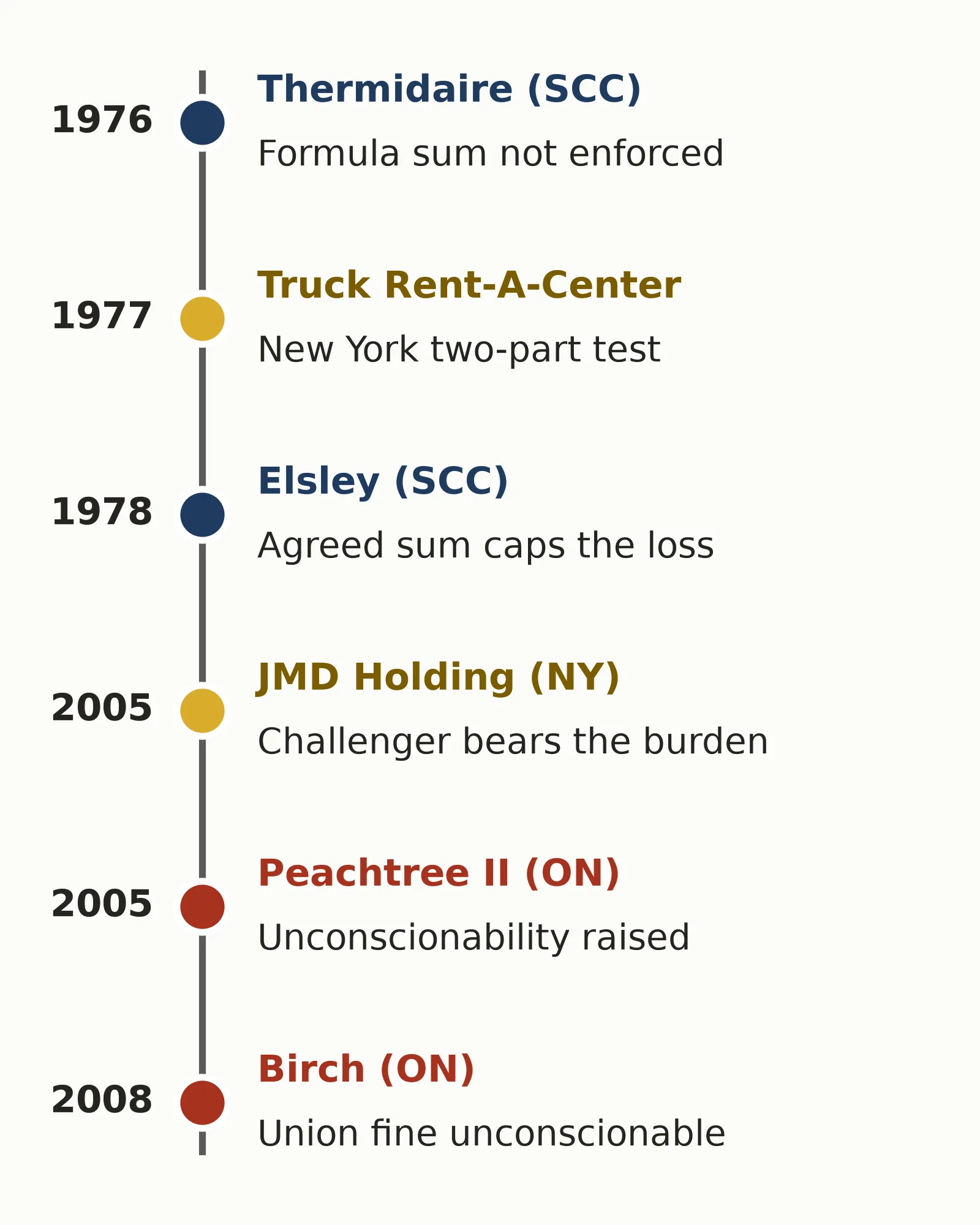
A sum can be a fixed amount or a formula. In H.F. Clarke Ltd. v. Thermidaire Corp. (1976), as the Supreme Court of Canada later described it, a distributorship agreement required the party in breach to pay the gross profit it made from selling competing products. In Elsley v. J.G. Collins Insurance Agencies (1978), an employment covenant simply set liquidated damages at $1,000.
A liquidated damages clause is one of several terms that allocate risk in a commercial contract. Separate guides cover limitation of liability clauses and entire agreement clauses.
Liquidated damages vs penalty: why it matters
The difference between liquidated damages and a penalty decides whether the agreed sum is paid at all. Courts in Ontario and New York enforce a sum that estimates the loss and refuse to enforce a sum that operates as a penalty. In the language of the decisions below, a penalty clause is a stipulated sum that is not a genuine pre-estimate of the loss (Ontario) or is plainly or grossly disproportionate to the probable loss (New York).
In Elsley, the Supreme Court of Canada explained why courts intervene. The power to strike down a penalty clause, the Court said, is "a blatant interference with freedom of contract" whose sole purpose is to relieve the party that must pay the sum from oppression. It has no place where there is no oppression.
The label does not settle the question. In Thermidaire, the agreement said the gross profit was payable "as liquidated damages", yet a majority of the Supreme Court of Canada held that the plaintiff could recover only its provable damages, not the formula amount. In New York, too, the outcome turns on law rather than wording: in JMD Holding, the Court of Appeals said that whether an early termination fee is an enforceable liquidation of damages or an unenforceable penalty is a question of law, decided with due regard to the nature of the contract and the circumstances.
The consequence of the penalty label is the same in both places in one respect. In JMD Holding, the Court of Appeals quoted the rule that if a clause is rejected as a penalty, "the recovery is limited to actual damages proven". Thermidaire reached the same result in Canada. The injured party keeps its claim, but it has to prove its loss like any other damages claimant.
How do Ontario courts test the clause?
Ontario courts start from the common law rule that a stipulated sum is enforceable only if it is a genuine pre-estimate of damages, a rule the Court of Appeal for Ontario recounted in Birch v. Union of Taxation Employees (2008) with the Supreme Court of Canada's decision in Elsley among its authorities.
Elsley adds a rule about losses that turn out to be larger than the agreed sum. The case arose from the 1956 sale of a general insurance business. The seller, Elsley, became the buyer's manager under an employment agreement with a five-year covenant not to compete after he left, and liquidated damages for its breach were set at $1,000. After 17 years he resigned and restarted his own general insurance business. The Supreme Court of Canada held that if the actual loss turns out to exceed the stipulated sum, the normal rules of contract allow recovery of only the agreed sum. The employer received an injunction, but its damages were capped at $1,000. The Court's headnote states the rule broadly: where the stipulated sum is less than the actual loss, the agreed sum is the maximum recoverable whether the sum is a penalty or a valid liquidated damages clause.
In Canada, a liquidated damages clause can work in two directions. It protects the party in breach from a sum that is out of proportion to the loss, and it can also cap the recovery of an injured party whose real loss proves larger than the number it chose.
The Ontario test for a liquidated damages clause has been questioned. As the Court of Appeal recounted in Birch, in Peachtree II Associates v. 857486 Ontario Ltd. (2005) Justice Sharpe agreed, in comments that did not decide the case, that there is "much to be said" for assessing both penalties and forfeitures under the doctrine of unconscionability. In Birch, a majority of the Court of Appeal upheld the application judge's conclusion that a fine in a union constitution was unconscionable and therefore unenforceable. It described unconscionability as a two-part analysis: an inequality of bargaining power and terms with a high degree of unfairness.
The Court in Birch also said its decision was not a general authority "sounding the death knell" for the rule against penalty clauses and, like Justice Sharpe, left the broader issue to another day. Because neither decision replaced the genuine pre-estimate rule, an Ontario liquidated damages clause can still be tested under that rule, and the reasons in both cases show that unconscionability may also be argued.
How do New York courts test the clause?
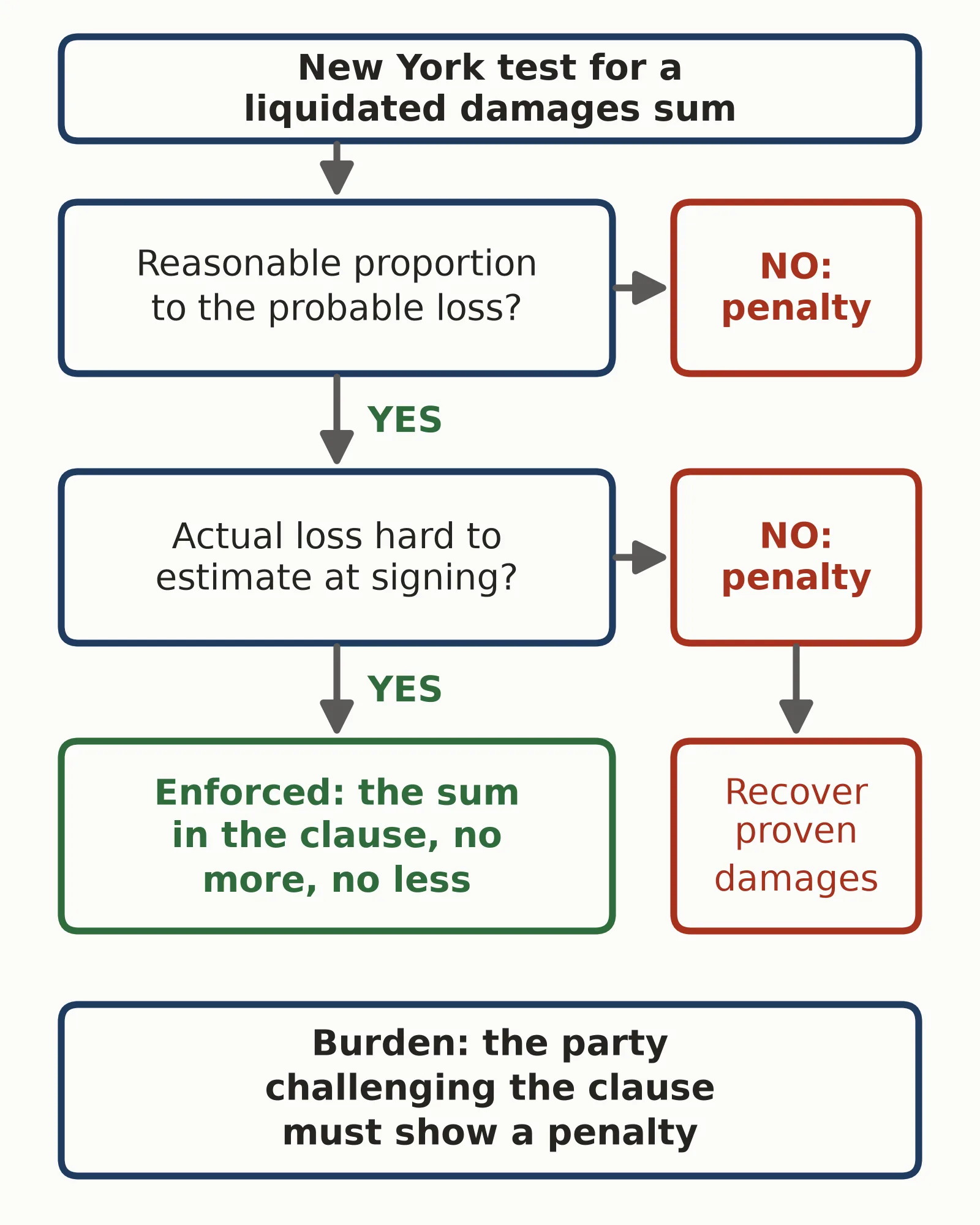
New York's Court of Appeals enforces a liquidated damages clause if the amount bears a reasonable proportion to the probable loss and the actual loss is incapable or difficult of precise estimation. An amount plainly or grossly disproportionate to the probable loss is a penalty, and New York courts will not enforce it.
New York's two-part liquidated damages test comes from Truck Rent-A-Center v. Puritan Farms 2nd (1977), and the Court of Appeals restated it in JMD Holding in 2005. JMD Holding adds three working rules:
- Burden: the party seeking to avoid the clause must show that it is in fact a penalty.
- Timing: the challenger must show either that the damages were readily ascertainable when the contract was signed, or that the sum is conspicuously disproportionate to the losses that could be foreseen then.
- Result: where the clause is upheld, the measure of damages is the sum in the clause, "no more, no less"; where it is rejected, recovery is limited to actual damages proven.
In JMD Holding itself, a borrower challenged a $600,000 early termination fee charged under a $40 million revolving loan agreement. The Court of Appeals held that the borrower had not met its burden of showing that the fee was an unenforceable penalty. The Court also cautioned generally against interfering with the agreements parties make.
For contracts for the sale of goods, New York's Uniform Commercial Code (UCC) has its own rule. Section 2-718 allows damages to be liquidated in the agreement at an amount that is reasonable in the light of the anticipated or actual harm caused by the breach, the difficulties of proof of loss, and the inconvenience or nonfeasibility of otherwise obtaining an adequate remedy, and states that a term fixing unreasonably large liquidated damages is void as a penalty.
How do Ontario and New York rules differ?
Both jurisdictions ask whether the agreed sum was an honest estimate of loss rather than a punishment. They differ in how the test is framed, in New York's express rule on the burden of proof, and in Canada's rule that the agreed sum caps a larger loss even where the clause is a penalty.
The table sets the main points side by side, from the decisions cited above.
| Question | Ontario | New York |
|---|---|---|
| Main test | Genuine pre-estimate | Reasonable proportion to loss |
| Second element | None stated | Loss hard to estimate |
| Other argument | Unconscionability | None stated |
| Burden of proof | Not addressed in these cases | Party challenging the clause |
| Clause upheld | Agreed sum, even if loss is larger | The sum, no more, no less |
| Clause is a penalty | Proven loss, up to the sum | Actual damages proven |
| Sale of goods | Not covered here | UCC section 2-718 |
| Key cases | Elsley; Birch | Truck Rent-A-Center; JMD Holding |
The burden of proof is a practical difference. In New York, the party trying to escape the agreed sum carries the burden of showing it is a penalty. The Ontario decisions cited here do not set out an equivalent burden rule.
Where do liquidated damages clauses appear?
The decisions in this guide show liquidated damages and penalty clauses in an employment covenant given on the sale of a business, a distribution agreement, a commercial loan, commercial contracts involving promissory notes and a union constitution, and New York's UCC has its own rule for contracts for the sale of goods.
- Sale of a business and employment: Elsley involved a $1,000 liquidated damages sum in the employment covenant the seller gave after selling his business to the employer. Covenants of this kind are discussed in our guides to non-solicitation agreements and breach of an employment contract.
- Distribution: Thermidaire used a gross-profit formula for selling competing products.
- Lending: JMD Holding concerned an early termination fee on a revolving loan.
- Commercial contracts: Peachtree II involved commercial agreements under which promissory notes were deemed paid in full on default.
- Goods: in New York, UCC section 2-718 governs liquidated damages in contracts for the sale of goods.
When the parties to one of these contracts sit in different places, the governing-law and forum terms can affect which test a court applies. Our guide to the forum selection clause explains how those terms work.
How do you draft a liquidated damages clause that holds up?
A liquidated damages clause is most likely to hold up when the record made at signing shows how the amount was estimated, the amount matches the breach it covers, and the clause aims to compensate rather than to punish. Those are the points Ontario and New York courts examine.
- Record the estimate: Ontario asks for a genuine pre-estimate. New York asks whether the loss was difficult to estimate precisely at signing and whether the sum was in reasonable proportion to the probable loss, so the record should show both how the figure was reached and why the loss was hard to measure exactly.
- Match the sum to the breach: New York compares the amount with the probable loss. A single large sum that also applies to a minor breach is harder to defend as a reasonable proportion of the loss.
- Do not rely on the label: the Supreme Court of Canada's decision in Thermidaire (1976) shows that calling a payment liquidated damages does not stop a court from treating it as a penalty.
- Check whether a cap suits you: under the Supreme Court of Canada's decision in Elsley (1978), an injured party in Canada may recover only the agreed sum even if its real loss is larger, and in New York an upheld clause gives the sum, no more, no less. If the loss could far exceed any fixed figure, a liquidated sum may not be the right tool.
- Consider bargaining power: the Court of Appeal for Ontario in Birch (2008) treats inequality of bargaining power combined with very unfair terms as unconscionable. A clause imposed on a much weaker party carries more risk in Ontario.
- For goods sold under New York law: test the amount against each factor in UCC section 2-718.
- Choose the governing law with the test in mind: the Ontario and New York tests differ, so the governing law chosen may matter.
A clause that survives these questions also has to fit the rest of the contract, including its termination, limitation of liability and dispute terms.
Frequently asked questions
Is a liquidated damages clause enforceable in Ontario?
Yes, if the sum was a genuine pre-estimate of damages under the common law rule recounted by the Court of Appeal for Ontario in Birch (2008). A sum that operates as a penalty is not enforced. The Court of Appeal has also signalled, without deciding the general question, that unconscionability may become the test.
What happens if a court decides the clause is a penalty?
The court does not enforce the agreed sum, and the injured party recovers only the damages it can prove. The Supreme Court of Canada reached that result in Thermidaire (1976), and the New York Court of Appeals stated the same rule in JMD Holding (2005).
Can I recover more than the liquidated amount if my loss is bigger?
In Canada, generally not. In Elsley (1978), the Supreme Court of Canada held that if the actual loss exceeds the stipulated sum, only the agreed sum is recoverable, and the employer's damages were capped at $1,000. In New York, an upheld clause gives the sum in the clause, no more and no less.
Who has to prove that a liquidated damages clause is a penalty in New York?
The party seeking to avoid the clause. In JMD Holding (2005), the Court of Appeals said that party must show either that the damages were readily ascertainable when the contract was signed or that the sum is conspicuously disproportionate to the losses that could be foreseen at that time.
Does calling a payment liquidated damages make it enforceable?
No. In Thermidaire, a distributorship agreement called a gross-profit payment liquidated damages, but a majority of the Supreme Court of Canada allowed only provable damages. In New York, whether a sum is liquidated damages or a penalty is a question of law decided on the contract and the circumstances.
Does New York have a statute on liquidated damages?
For contracts for the sale of goods, yes. New York's Uniform Commercial Code section 2-718 allows liquidated damages at an amount reasonable in light of the anticipated or actual harm, the difficulties of proof of loss and the inconvenience or nonfeasibility of otherwise obtaining an adequate remedy, and makes a term fixing unreasonably large liquidated damages void as a penalty. Outside the sale of goods, the decisions in this guide apply the court-made Truck Rent-A-Center test.
Can an employment contract contain a liquidated damages clause?
Yes. In Elsley, the employee's covenant not to compete set liquidated damages of $1,000, and the Supreme Court of Canada enforced the covenant with an injunction while capping damages at that sum. The covenant ran for five years after the employment ended, and the employee resigned after 17 years to restart his own general insurance business.
Conclusion
A liquidated damages clause gives both parties a known price for a breach, but only if a court accepts the number. Ontario still applies the genuine pre-estimate rule, although the Court of Appeal for Ontario has left open a move to unconscionability, and in Canada an agreed sum caps a larger loss whether or not the clause is a penalty. New York applies the two-part Truck Rent-A-Center test, puts the burden on the challenger and enforces an upheld sum exactly. A clause drafted with both tests in mind, and with a record of how its number was reached, is the one most likely to be paid.
How Mayo Law can help
Mayo Law advises businesses on contracts that cross the Canada-US border, from offices in Toronto and New York. Joseph Mayo, our principal attorney, is licensed in Ontario and New York, and our contract lawyers review and draft stipulated remedy clauses, limitation of liability terms and the governing-law provisions that decide which test applies. We offer a paid one-hour consultation, because a lawyer reviews your contract and the facts in depth before advising.
Disclaimer
This guide is for general information only and is not legal advice. Reading it does not create a solicitor-client or attorney-client relationship. Case law changes, and the effect of a clause depends on its wording, the contract as a whole and the facts. Mayo Law provides legal services in Ontario and New York.