

Contents
- Quick answer
- NDA vs confidentiality agreement: is there a difference?
- What do courts enforce in Ontario and New York?
- What must an NDA leave out?
- How long should an NDA last?
- What remedies apply if an NDA is breached?
- What changes in a Canada-US NDA?
- What should an NDA checklist cover?
- Frequently asked questions
- Conclusion
- How Mayo Law can help
- Disclaimer
A non-disclosure agreement (NDA) and a confidentiality agreement do the same job: one party promises to keep another party's information secret. So the NDA vs confidentiality agreement question is really about wording, not titles. If you are about to share pricing, customer lists or technical plans with a partner, buyer or contractor, what protects you is who is bound, what is covered, what is excluded and for how long. For a company dealing across the Canada-US border, those terms are part of cross-border business law, and the rules differ between Ontario and New York.
Statutes and court decisions are cited as of October 2026, and our contract lawyer page describes how we work on commercial agreements.
Quick answer
In practice, an NDA and a confidentiality agreement are the same contract: at least one party promises to keep information secret. The Canadian Intellectual Property Office (CIPO) treats the names as one. Courts in Ontario and New York start with the wording, so check who is bound, the definition, the exclusions, the term and the legal carve-outs.
NDA vs confidentiality agreement: is there a difference?
In practice, no: the two names describe the same kind of contract, whichever title it carries.
CIPO treats the two names as one contract. Its guidance describes a confidentiality agreement as "also known as a non-disclosure agreement", a contract between two or more parties in which at least one agrees to keep disclosed information secret. Legislation uses the words the same way. New York General Obligations Law section 5-336 is headed "Nondisclosure agreements" and speaks of a "condition of confidentiality". Ontario's Securities Act and a rule of the U.S. Securities and Exchange Commission (SEC) both say "confidentiality agreement", while Ontario's employment standards guide says "non-disclosure agreement". None of the sources cited in this guide attaches a different legal result to one title.
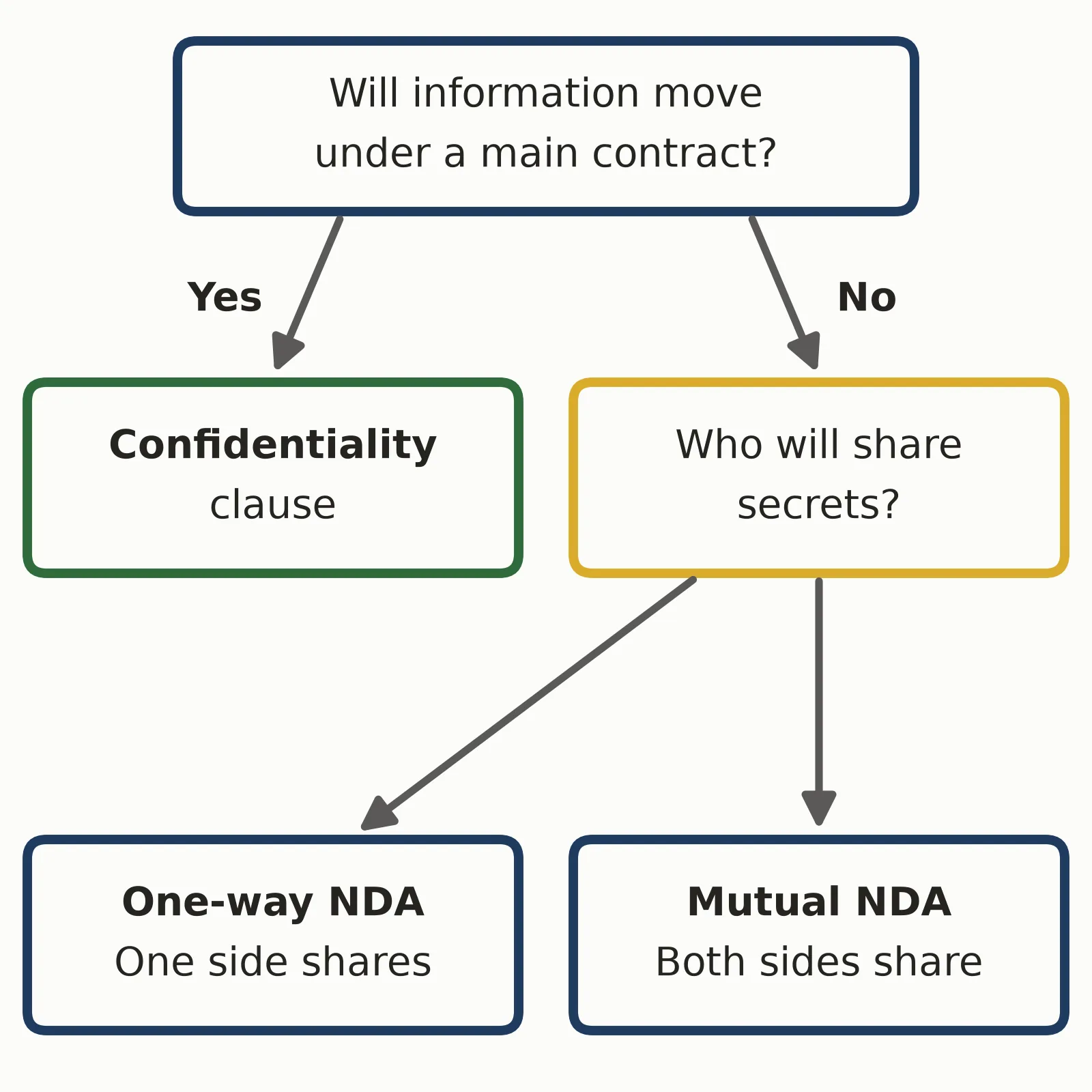
Some contract-software vendors tie the two names to one-way and mutual forms. That is a drafting habit, not a legal category. A document titled NDA can bind both sides, and one titled confidentiality agreement can bind only one. The choice that matters is between a standalone agreement and a clause, as the table below shows, and between one-way and mutual duties, as Figure 1 shows.
| Form | What it is | Usual fit |
|---|---|---|
| NDA | Standalone contract | Talks before a deal |
| Confidentiality agreement | Same contract, other name | Talks before a deal |
| Confidentiality clause | Section of a larger contract | Work under a signed contract |
Standalone agreement or confidentiality clause?
Use a standalone agreement when information will move before any main contract exists: a pitch to an investor, diligence by a buyer, early talks with a distributor. Use a confidentiality clause when the information moves under a contract you are signing anyway, such as an employment or services agreement. CIPO lists both tools side by side: non-disclosure or confidentiality agreements when you disclose business information, and confidentiality clauses in employment agreements.
An NDA and a later main contract can sit together. When talks under an NDA turn into a signed deal, check whether the final contract's entire agreement clause keeps the NDA or replaces it. If you are buying or selling a business, our guide to the letter of intent to purchase a business explains how confidentiality terms usually carry into that stage. A promise of confidentiality is also a different thing from legal privilege, which our guide to the privileged and confidential label explains.
Mutual NDA or one-way NDA?
A one-way NDA binds only the party receiving information. It suits an investor pitch, or a contractor who will see your systems but has nothing confidential to give you. A mutual NDA binds both sides, which suits merger talks, joint ventures and technology partnerships, where each side opens its books.
Pick the form that matches how information will actually flow. A mutual form can look balanced on paper, but if you are the main discloser, you are also accepting every restriction you ask of the other side. If you are mostly receiving, a one-way form written by the other party deserves a close look at the definition and the remedies, because those duties fall only on you.
What do courts enforce in Ontario and New York?
Courts in both places treat a confidentiality promise as a contract and read its words, and each also has a second route when the information is a trade secret or was given in confidence.
What do Ontario courts enforce?
Ontario courts read an NDA as a contract, and a breach of confidence claim can apply even where no agreement covers the information. The Supreme Court of Canada said in Sattva Capital Corp. v. Creston Moly Corp. that a decision-maker reads the contract as a whole, gives the words their ordinary and grammatical meaning, and considers the surrounding circumstances known to the parties when the contract was made. CIPO notes that Canada has no federal trade secrets act, so protection rests on court claims such as breach of contract or breach of confidence, with Quebec following civil law.
The test for breach of confidence is set out in the Supreme Court of Canada decision Lac Minerals Ltd. v. International Corona Resources Ltd. and has three elements: the information was confidential, it was communicated in confidence, and the recipient misused it. In that case a company shared private information during joint venture talks. Nobody raised confidentiality, yet the court still found a breach of confidence. You do not have to argue that a duty of confidence was implied if you hold a signed NDA.
Ontario employers need two more checks. Ontario's employment standards guide confirms that the Employment Standards Act, 2000 does not prohibit non-disclosure agreements, while adding that employees may have greater rights under the common law. The Act does prohibit non-compete agreements, with two exceptions, and the same guide says substance matters, not the words used, when deciding whether an agreement is a non-compete. So a clause titled NDA should not be drafted to do the work of a non-compete agreement in Ontario.
The timing of a new NDA matters too. In Holland v. Hostopia.com Inc., the Court of Appeal for Ontario held that a later employment agreement adding a new, material term needed fresh consideration, because a promise to perform an existing contract is not consideration. That case was about a termination clause, not confidentiality, but its reasoning is a good reason to give a current employee something new in exchange for a new NDA.
Serious misuse can also be criminal. Section 391 of the Criminal Code of Canada makes it an offence to knowingly obtain or communicate a trade secret by deceit, falsehood or other fraudulent means, with a maximum of 14 years on indictment. Its definition of a trade secret requires efforts that are reasonable under the circumstances to keep the information secret. CIPO lists NDAs alongside encryption, passwords and limits on access, a useful reminder that a signed form is one measure among several.
What do New York courts enforce?
New York courts enforce a clear written NDA by its plain meaning, and trade secret law gives a second route. A written agreement that is "complete, clear and unambiguous on its face must be enforced according to the plain meaning of its terms", a Court of Appeals rule the Appellate Division repeated in Altronix Corp. v. Central Machining Specialties, Inc. For trade secrets, the Court of Appeals in E.J. Brooks Co. v. Cambridge Security Seals quoted the two things a plaintiff must prove: it possessed a trade secret, and the defendant is using it in breach of an agreement, confidence or duty, or as a result of discovery by improper means. An NDA can supply the agreement.
U.S. federal law, not New York law, adds a separate claim. Under the Defend Trade Secrets Act (DTSA), the owner of a misappropriated trade secret can sue in U.S. federal court if the secret relates to a product or service used in, or intended for use in, interstate or foreign commerce. The DTSA definition in section 1839 of Title 18 of the United States Code (U.S.C.) requires that the owner took reasonable measures to keep the information secret.
What must an NDA leave out?
An NDA should exclude information that was never truly secret, and it must not block the reports and disclosures the law protects.
The usual exclusions cover information that is public, already known to the recipient, independently developed, or lawfully received from someone else, plus disclosures a court or regulator compels. Some follow the law's own limits. The DTSA definition says improper means does not include reverse engineering, independent derivation or other lawful means of acquisition, and section 391 of Canada's Criminal Code excludes independent development and reverse engineering. If reverse engineering worries you, deal with it expressly in the NDA.
A form reused for staff and contractors can run into several of the rules in this table.
| Rule | Where | Effect |
|---|---|---|
| SEC Rule 21F-17 | US federal | Cannot impede reports to SEC staff |
| Securities Act s. 121.6(4) | Ontario | Void if it blocks protected reports |
| 18 U.S.C. 1833(b) | US federal | Immunity notice for workers |
| Speak Out Act | US federal | Pre-dispute clauses unenforceable in covered disputes |
| General Obligations Law 5-336 | New York | Discrimination claim limits |
| Labor Law 194(4) | New York | Employers cannot ban wage talk |
- SEC reports: Rule 21F-17 says no person may impede an individual from communicating directly with SEC staff about a possible securities law violation, including by enforcing or threatening to enforce a confidentiality agreement. The rule has an exception for certain information tied to the legal representation of a client.
- Ontario securities reports: Section 121.6(4) of the Securities Act makes a provision in an agreement, "including a confidentiality agreement", void to the extent it stops a specified individual from giving protected information to the Ontario Securities Commission, a recognized self-regulatory organization or a law enforcement agency. Protected information is information about an act of the person or company the individual is employed by, is an officer or director of, or provides services to under contract, or of someone acting on its behalf, that has occurred, is ongoing or is about to occur and that the individual reasonably believes is contrary to Ontario securities law or a by-law or other regulatory instrument of a recognized self-regulatory organization. The same rule also voids terms that block co-operating, testifying or otherwise assisting, or expressing an intention to do so, in a related review, investigation, examination, inspection or proceeding. Specified individuals include employees, officers, directors and individuals providing services under contract.
- Trade secret whistleblowers: 18 U.S.C. section 1833(b) gives an individual immunity under any U.S. federal or state trade secret law for disclosing a trade secret in confidence to a government official or a lawyer solely to report or investigate a suspected violation of law, or in a sealed court filing. Employers must give notice of that immunity in any contract with an employee governing confidential information, or by a cross-reference to a policy document setting out its reporting policy, and "employee" includes contractors and consultants. Without the notice, an employer cannot win exemplary damages or attorney fees under the DTSA against that person. The notice rule applies to contracts entered into or updated after May 11, 2016.
- Sexual harassment and assault: Under the U.S. federal Speak Out Act, a nondisclosure clause agreed to before the dispute arises is not judicially enforceable in a sexual assault or sexual harassment dispute where the conduct is alleged to have violated federal, tribal or state law. The Act applies to claims filed on or after December 7, 2022, and it does not prohibit an employer and an employee from protecting trade secrets or proprietary information.
- New York discrimination claims: New York General Obligations Law section 5-336 lets an employer settle a discrimination, harassment or retaliation claim with confidentiality over the underlying facts only if that is the complainant's preference, with up to 21 days to consider and at least 7 days to revoke. In a contract made on or after January 1, 2020 with an employee, potential employee or independent contractor, a term preventing disclosure of facts about a future discrimination claim is void unless it gives a notice. The notice must say the person may still speak with law enforcement, the Equal Employment Opportunity Commission, the state division of human rights, the attorney general, a local human rights commission or their own attorney.
- New York wages: Labor Law section 194(4) says no employer shall prohibit an employee from asking about, discussing or disclosing wages, although a written policy may set reasonable limits on the time, place and manner of those discussions. A narrow exception can apply to staff who see other employees' wages as part of their job.
How long should an NDA last?
An NDA should last as long as the information stays valuable, which may mean a fixed period for ordinary business information and a longer duty for trade secrets.
Two periods need separate answers: how long disclosures are covered, and how long the duty of secrecy continues after that. A fixed end date can suit pricing or a project plan that will go stale.
A fixed end date is riskier for a trade secret. CIPO says trade secrets can potentially last forever, provided the information actually remains a secret, and that protection ends once the secret is out. If the duty stops after a few years, the other side may be free to use the information from that day, so consider a duty that runs for as long as the information stays secret. A very broad duty with no end date can invite its own argument, so keep that longer duty to what really needs it.
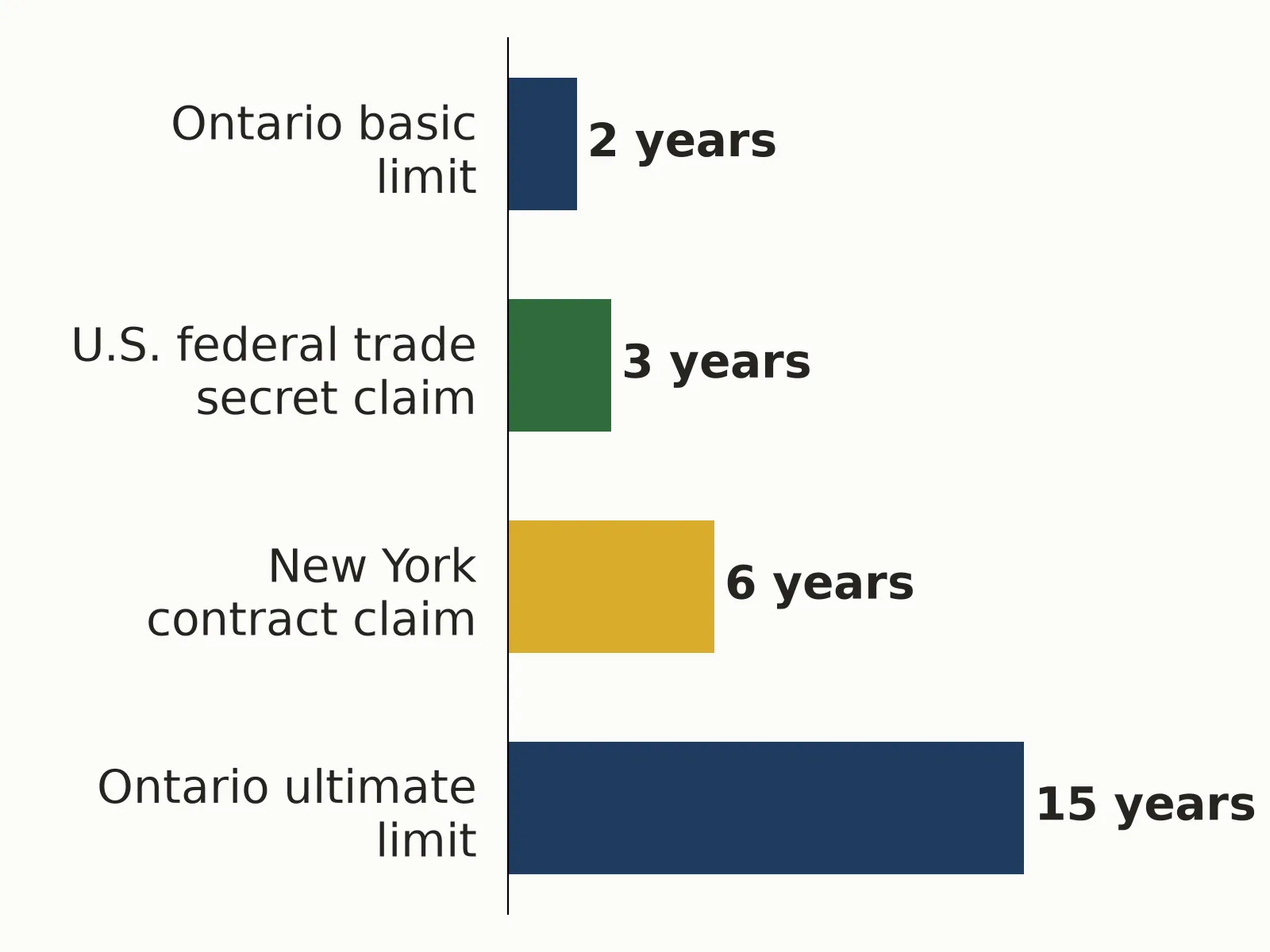
The deadline to sue is a separate clock, shown in Figure 2.
- Ontario basic period: 2 years from the day the claim was discovered, under the Limitations Act, 2002.
- Ontario ultimate period: 15 years from the act or omission, under the same Act. Parties to a business agreement can vary those periods within the limits of section 22.
- New York contract claim: 6 years for an action on a contractual obligation, under Civil Practice Law and Rules (CPLR) section 213(2).
- U.S. federal DTSA claim: 3 years after the misappropriation was discovered or should have been discovered with reasonable diligence, under 18 U.S.C. section 1836(d).
Other claims can carry other limits, so check the deadline for your own facts.
What remedies apply if an NDA is breached?
The main remedies are an urgent court order to stop further use or disclosure, and money for the loss the breach caused.
A secret's owner should move fast, because as CIPO puts it, "once your secret is out, it is impossible to make it secret again". The table compares the first steps in each court system.
| Point | Ontario | New York |
|---|---|---|
| Interim order | Where just or convenient | Preliminary injunction |
| Test | Serious question, irreparable harm, greater harm | Probable success, irreparable injury, equities |
| Security | Undertaking on damages | Undertaking fixed by the court |
| Money, confidence or trade secret | Breach of confidence: fits the facts | Trade secret: position restored, no more |
In Ontario, section 101 of the Courts of Justice Act lets a Superior Court judge grant an interlocutory injunction where it appears just or convenient. The test from RJR-MacDonald Inc. v. Canada (Attorney General) asks whether there is a serious question to be tried, whether the applicant would suffer irreparable harm, and which party would suffer greater harm. Under rule 40.03 of the Rules of Civil Procedure, the moving party undertakes to abide by any later damages order, unless the court orders otherwise.
In New York, CPLR section 6301 is the basis for a preliminary injunction, and the Court of Appeals in Nobu Next Door, LLC v. Fine Arts Housing, Inc. requires a probability of success on the merits, danger of irreparable injury and a balance of equities in the applicant's favour. CPLR rule 6312(b) requires an undertaking in an amount fixed by the court, with listed exceptions. In a U.S. federal DTSA claim, an injunction cannot prevent a person from entering an employment relationship.
An owner's delay can weigh against a permanent injunction. In Cadbury Schweppes Inc. v. FBI Foods Ltd., a manufacturer misused confidential recipe information obtained under a licence. The Supreme Court of Canada held that the trial judge was right to refuse a permanent injunction, noting that 11 years had passed since the competing product went into production, that the information was "nothing very special" and that it could have been replaced promptly had the owner objected in time. It left the owner with financial compensation, and it confirmed that courts can grant a remedy dictated by the facts of the case in a breach of confidence action.
Money for trade secret misuse depends on which law applies. In a New York common law trade secret case, the New York Court of Appeals in E.J. Brooks said compensatory damages must return the plaintiff, as nearly as possible, to the position it would have been in, and do no more, so the plaintiff cannot measure its damages by the costs the defendant avoided in place of its own losses. Keep records of what the breach cost you.
The U.S. federal DTSA is broader on trade secret claims: a court may award damages for actual loss and any unjust enrichment, or a reasonable royalty instead, plus exemplary damages of up to 2 times that amount for willful and malicious misappropriation, and attorney's fees in the cases the DTSA lists.
Some NDAs add a fixed sum for each breach. Whether that will stand is a question for our guide to the liquidated damages clause. New York also has a specific limit: under General Obligations Law section 5-336, a release of a claim based on unlawful discrimination, discriminatory harassment or retaliation is unenforceable if it makes the complainant pay liquidated damages for breaching a nondisclosure clause.
What changes in a Canada-US NDA?
A Canada-US NDA should name the governing law and the courts, and it should plan for enforcing an urgent order on the other side of the border.
A Canada-US NDA should settle governing law first. General Obligations Law section 5-1401 lets parties choose New York law, whether or not the contract bears a reasonable relation to New York, for a contract relating to a transaction covering at least $250,000. The statute says only "dollars", which we read as U.S. dollars. It does not apply to contracts for labor or personal services.
Section 5-1402 opens New York courts to a suit against a foreign corporation or non-resident where New York law was chosen under section 5-1401, the transaction covers at least $1 million on the same reading, and that party agreed to New York jurisdiction.
A standalone NDA signed before any deal may state no transaction value, so do not assume those sections apply. Each section says it does not limit or affect choice clauses in other contracts, but you would then be relying on something other than the statute. Our guide to the forum selection clause covers the court choice in more depth.
Plan for enforcement as well, because money judgments cross the border more easily than injunctions. In Beals v. Saldanha, the Supreme Court of Canada applied the real and substantial connection test to foreign judgments and upheld enforcement of a Florida money judgment against Ontario defendants. In Pro Swing Inc. v. Elta Golf Inc., the Supreme Court of Canada said the time was ripe to change the old rule against enforcing foreign non-monetary judgments. It still refused to enforce the U.S. orders before it, and it said that if injunctive relief is to be enforced, its territorial scope has to be specific and clear.
For a Canadian judgment going to New York, CPLR Article 53 applies to a foreign country judgment to the extent it grants or denies a sum of money, so it does not cover an Ontario injunction.
The practical answer is to draft for the place where the recipient and the information actually are. An NDA between a New York company and an Ontario distributor can let either party seek urgent relief in the courts of the recipient's home jurisdiction, whatever court it names for the main dispute. Our guide to trade secret misappropriation looks at how the same facts play out differently on each side of the border.
What should an NDA checklist cover?
An NDA checklist should confirm the parties, the information, the permitted use, the exclusions, the term, the return of material and the remedies before anyone shares a document.
- Parties: the correct legal entities, plus any affiliates that will see the information.
- Direction: one-way or mutual, matched to who will really disclose.
- Purpose: the specific deal or project the information may be used for, and no other use.
- Definition: what counts as confidential, and whether oral disclosures and unmarked documents are included.
- Recipients: which employees and advisers may see the information, and who answers for them.
- Exclusions: public, already known, independently developed, lawfully received and legally compelled information.
- Legal carve-outs: the SEC, Ontario securities, DTSA notice and New York wording, for any staff or contractor form.
- Term: the disclosure period, how long the duty survives, and a longer duty for trade secrets.
- Return or destruction: what happens to documents and copies when talks end.
- Remedies: urgent court relief, and any fixed sum you have tested against the rules on liquidated damages.
- Governing law and courts: named, with urgent relief allowed where the recipient is located.
- Related protection: an NDA alone may not stop solicitation or transfer ownership, so consider a non-solicitation agreement or an intellectual property assignment agreement where you need one.
- Timing: signed before anything is shared, as CIPO advises.
Frequently asked questions
Is an NDA the same as a confidentiality agreement?
In practice, yes. The Canadian Intellectual Property Office describes a confidentiality agreement as also known as a non-disclosure agreement, and none of the Ontario, New York or U.S. federal sources cited in this guide attaches a different result to either title. What changes the outcome is the wording: who is bound, what is covered, and for how long.
Is a mutual NDA better than a one-way NDA?
Neither form suits every deal. A one-way NDA fits when only one side will disclose, such as a founder pitching an investor. A mutual NDA fits when both sides will disclose, such as merger talks. If you are the main discloser, a mutual form also binds you, so read its limits as a recipient would.
Can a confidentiality clause replace an NDA?
Often, yes. Once a main contract is signed and information moves under it, a clause can do the job of a separate agreement. A standalone agreement is still useful for talks before any main contract exists. If you have both, check whether the final contract's entire agreement wording keeps or replaces the earlier NDA.
Is an NDA in Ontario enforceable?
Generally yes, as a contract: a court reads it as a whole and in context. Ontario's employment standards guide confirms that the Employment Standards Act, 2000 does not prohibit non-disclosure agreements, and it adds that employees may have greater rights at common law. A new NDA signed during employment raises the question of fresh consideration.
Can an NDA stop someone reporting to a regulator?
Not for protected reports. U.S. Securities and Exchange Commission Rule 21F-17 bars enforcing a confidentiality agreement to impede direct communication with its staff about a possible securities law violation, with an exception for certain client representation information. Ontario's Securities Act voids agreement terms that block protected reports to the Ontario Securities Commission, a recognized self-regulatory organization or a law enforcement agency.
How long does an NDA last?
An NDA lasts as long as its wording says, and no single period applies. A fixed period can suit ordinary business information, while a trade secret may need a duty that runs as long as the information stays secret. The deadline to sue is separate: a basic 2 years from discovery in Ontario, and 6 years for a New York contract claim. Other claims can carry other limits.
What happens if someone breaks an NDA?
The injured party can ask a court for an urgent order to stop further use or disclosure, and for money for the loss caused. In Ontario, an applicant for an interim order must show a serious question to be tried, irreparable harm and that it would suffer the greater harm, and it undertakes on damages unless the court orders otherwise. In New York, it must show probable success, irreparable injury and a balance of equities in its favour, and it must give an undertaking, with listed exceptions. The result depends on the evidence.
Does an NDA stop someone from competing with me?
Not by itself. An NDA limits the use and disclosure of information. As a rule it does not bar someone from working in a field or approaching your customers, and Ontario's employment standards guide treats non-compete, non-solicit and non-disclosure agreements as separate tools. That guide also looks at substance, not words, when deciding whether an agreement is a non-compete.
Conclusion
The NDA vs confidentiality agreement question has a short answer: the title does little, and the terms do the work. Choose a standalone agreement or a clause based on timing, and a mutual or one-way form based on how information will flow. Then check the definition, the exclusions, the legal carve-outs and the term. For a Canada-US relationship, name the governing law and courts, and think about where an urgent order would actually have to be enforced.
How Mayo Law can help
Mayo Law is a cross-border firm with offices in Toronto and New York, and Joseph Mayo is licensed in Ontario and New York. Our lawyers draft, review and negotiate NDAs and confidentiality terms for businesses on both sides of the border. If you want a lawyer to go through your draft, we offer a paid one-hour consultation, because a lawyer reviews your documents and situation in depth. You can start through our commercial contract practice.
Disclaimer
This guide is for general information only and is not legal advice. Reading it does not create a solicitor-client or attorney-client relationship. Laws and government guidance change, and the right terms depend on your facts and the governing law of your contract. Mayo Law provides legal services in Ontario and New York.