

Contents
- Quick answer
- What is a master service agreement?
- MSA vs SOW: how do the documents fit together?
- Which clauses matter most in a master service agreement?
- What changes in a Canada-US master service agreement?
- How do Ontario and New York rules compare?
- Master service agreement checklist
- Frequently asked questions
- Conclusion
- How Mayo Law can help
- Disclaimer
A master service agreement (MSA) is the contract two businesses sign once so they do not have to renegotiate liability, payment, ownership and termination every time new work starts. Each project then runs under a short statement of work (SOW). For a company buying or selling services across the Canada-US border, those master terms are part of cross-border business law, and the answers differ between Ontario and New York.
Below, you will see how an MSA and a SOW fit together, which clauses decide who pays when a project goes wrong, and what changes when one party is in Canada and the other in the United States. A checklist for reviewing a draft follows. Statutes and court decisions are cited as of October 2026, and our contract lawyer page describes how we work on commercial agreements.
Quick answer
A master service agreement is a framework contract that sets the standing legal terms between a service provider and a client, while each statement of work sets the scope, price and dates for one project. Focus your review on liability caps, indemnities, intellectual property, payment, termination, governing law and, for Canada-US deals, currency and tax withholding.
What is a master service agreement?
A master service agreement is a contract that sets the terms for future work between two businesses, usually without committing either one to a specific project. You will also see it called a master services agreement or a framework agreement. The label matters less than what the document does.
It suits repeat relationships: software and IT vendors, marketing agencies, consultants, staffing suppliers and maintenance contractors. Once the MSA is signed, a new project needs only a short SOW, because the legal terms are already settled. That saves negotiation time, and it keeps risk terms consistent across projects, which a string of one-off purchase orders rarely does.
Whether an MSA commits anyone to spend money depends on its wording. Many state no minimum, so the obligation to pay appears only when a SOW is signed. If a supplier is counting on a volume, or a client on reserved capacity or exclusivity, the MSA has to say so. For a single short project, one services agreement may be all you need.
MSA vs SOW: how do the documents fit together?
The MSA holds the terms that stay the same across projects, and the SOW holds the terms that change with each project. The table below shows the usual split.
| Point | MSA | SOW |
|---|---|---|
| Purpose | Standing legal terms | One project's details |
| Signed | Once | For each project |
| Typical content | Liability, ownership, payment | Scope, price, dates |
| How it changes | Formal amendment | Change order |
| Lifespan | Multi-year or renewing | Ends with the project |
A service level agreement (SLA) is a third element. It sets measurable service standards, such as response times and uptime, and usually sits as a schedule to the MSA or a SOW. It does not replace either one.
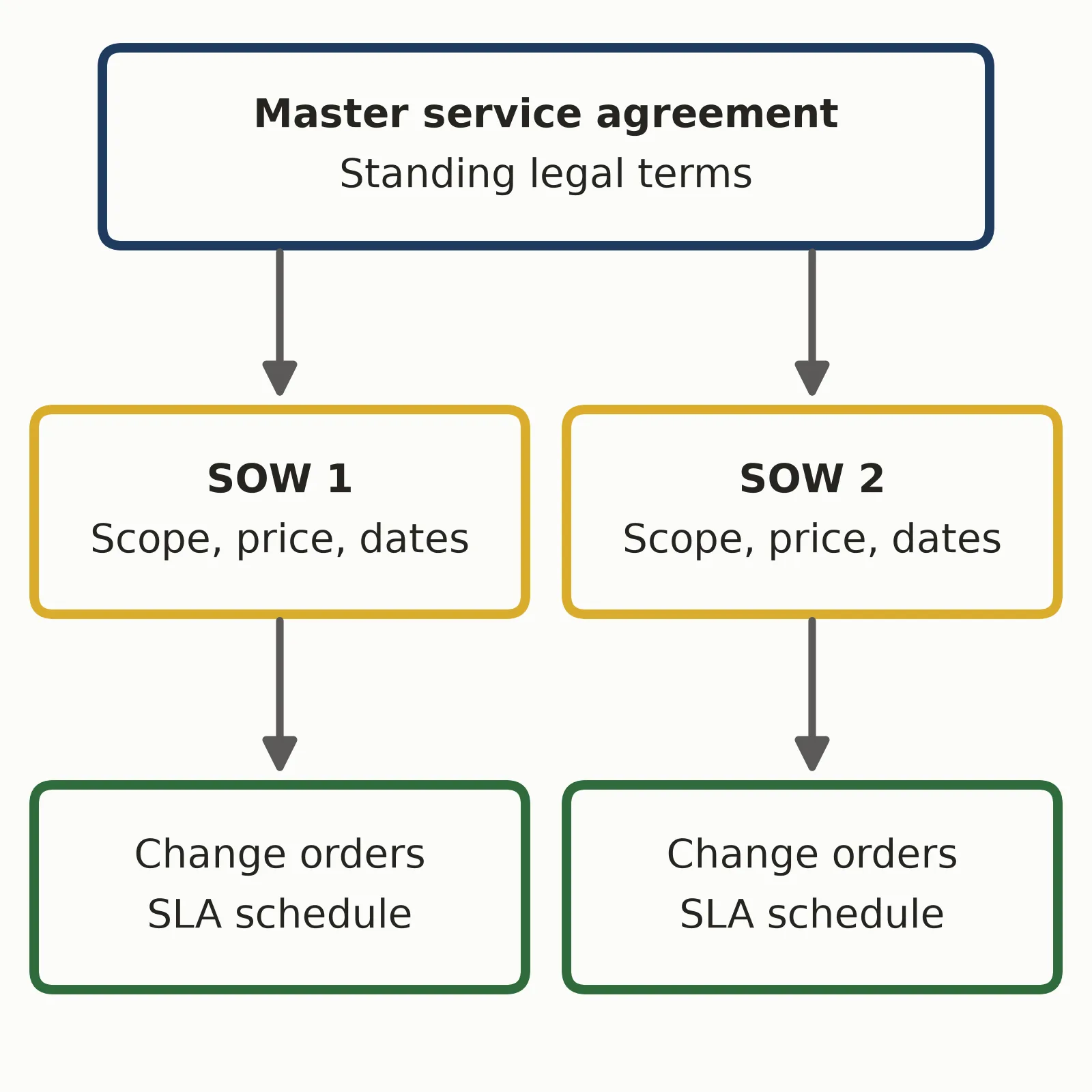
An order of precedence clause says which document wins if the MSA and a SOW conflict. A client may want the MSA to win, so that a project manager cannot lift a liability cap in a SOW by accident. A supplier may prefer the SOW to win on commercial terms. Either can work, but the document should say which, and it should line up with any entire agreement clause in the MSA.
Which clauses matter most in a master service agreement?
The clauses that matter most are the ones that decide who pays and who owns the work when a project fails: scope and change control, payment, intellectual property, confidentiality, liability and exit.
Scope and change orders
Scope disputes usually begin when work grows through email. The fix is a rule that extra work needs a signed change order before it is billed. In New York, General Obligations Law section 15-301 supports that rule if the MSA also says it cannot be changed orally. A written agreement with that wording cannot be changed by an unperformed (executory) agreement unless the change is in writing. It must also be signed by the party against whom enforcement of the change is sought.
Fees, invoicing and payment
State the payment period, what counts as a valid invoice, how a disputed amount is handled, whether late amounts carry interest, which expenses are reimbursed and whether rates can rise during the term.
If the supplier is a one-person contractor, check New York's Freelance Isn't Free Act (General Business Law sections 1410 to 1412). It covers services worth US$800 or more, alone or added to contracts between the same parties in the previous 120 days, and requires a written contract. If the contract does not specify a payment date or a way to set one, the fee is due no later than 30 days after the services are completed.
Intellectual property
Do not assume the client owns what it pays for. Under Canada's Copyright Act, section 13(3) gives the employer first ownership of a work made by an employee in the course of employment, unless they agree otherwise, but a contractor is outside that rule. An assignment is valid only if it is in writing and signed by the owner of the right (section 13(4)). Moral rights cannot be assigned at all, only waived (section 14.1), so an MSA covering Canadian copyright should include both the assignment and the moral rights waiver.
US federal law has its own trap. Under 17 U.S.C. section 101, a commissioned work is a work made for hire only if it falls within listed categories and the parties agree in a signed writing, so the phrase alone does not capture contractor work outside those categories. A transfer of copyright by agreement must be in writing and signed by the owner or the owner's authorized agent (17 U.S.C. section 204). The safer MSA says the work is made for hire where the law allows and assigns it otherwise. Decide also who keeps pre-existing tools and what licence the client gets to them. Our guide to the intellectual property assignment agreement goes through the wording.
Confidentiality and data
The MSA should define confidential information, set how long the duty lasts after the contract ends and say what happens to the information at exit. If the supplier will handle personal information or client data, add the security standard, breach notice timing and where the data may be stored.
Indemnity and limitation of liability
An indemnity moves the cost of a loss, often a third-party claim, from one party to the other, and a liability cap limits what can be recovered. Read them together: an uncapped indemnity can undo a cap. Check what the cap is measured against (for example, fees paid in the previous 12 months), which losses are excluded and which claims sit outside the cap.
Courts in the two countries test exclusion and limitation clauses differently. In Canada, the framework comes from Tercon Contractors v British Columbia, 2010 SCC 4, where the Supreme Court of Canada asked three questions. Does the clause apply on its wording? Was it unconscionable when the contract was made? Should it still be refused because of an overriding public policy?
In New York, the Court of Appeals held in Matter of Part 60 Put-Back Litigation (2020), 36 NY3d 342, that the rule against immunizing grossly negligent conduct has a narrow reach in a pure breach of contract case. There it applies only to exculpatory clauses or provisions limiting liability to a nominal sum. Our guide to limitations of liability covers both in more depth.
If the MSA sets service credits or fixed sums for delay, test them as well. Our guide to the liquidated damages clause explains when a fixed sum becomes an unenforceable penalty.
Term, termination and exit
Set the initial term, any automatic renewal, the notice needed to stop it, the right to terminate for cause with a cure period, and any right to terminate for convenience. Then say what happens to open SOWs, final payment, transition help and the return of data, and list the clauses that survive.
In Canada, a right to walk away does not permit misleading the other side. The Supreme Court of Canada held in Bhasin v Hrynew, 2014 SCC 71, that parties must not lie or knowingly mislead each other about matters directly linked to performance. They are not free to exclude this duty, though they may relax its requirements in some contexts if they respect its minimum core. In C.M. Callow Inc. v Zollinger, 2020 SCC 45, an appeal from Ontario, condominium corporations could end a maintenance contract on ten days' notice for any reason, but the Court decided that even an allowed termination has to be done honestly.
What changes in a Canada-US master service agreement?
A cross-border master service agreement needs four extra decisions: which law and courts apply, which currency is owed, who bears tax withheld at source, and how a win would be enforced in the other country.
Governing law and forum
Name one governing law and one forum, or an arbitration clause, for the whole relationship, and do not let SOWs change them. New York makes its law available by statute: General Obligations Law section 5-1401 lets parties to a transaction covering at least US$250,000 in the aggregate choose New York law even if the deal has no reasonable relation to the state, but it does not apply to a contract for labor or personal services. Section 5-1402 opens the New York courts for a contract that chose New York law under section 5-1401, covers at least US$1 million and has the foreign party submit to their jurisdiction.
Two cautions apply to an MSA. A services deal should not assume General Obligations Law section 5-1401 covers it, and because section 5-1402 depends on a section 5-1401 choice, that caution reaches it too. An MSA with no committed spend may also make the dollar amount hard to show. Section 5-1401 does not limit a choice-of-law clause in any other contract, so a clause outside the section is not void for that reason.
On the Canadian side, the Supreme Court of Canada held in Z.I. Pompey Industrie v ECU-Line, 2003 SCC 27, a Federal Court bill of lading case, that a stay to enforce a forum selection clause must be granted unless the plaintiff shows sufficiently strong reasons against it. Our guide to the forum selection clause compares how US and Canadian courts treat forum selection clauses.
Currency
Name the currency of every amount, including the liability cap: a cap of "$500,000" means very different things in the two countries. If a dispute reaches court, an Ontario order on a foreign currency obligation requires payment in Canadian dollars, under section 121 of the Courts of Justice Act. The conversion uses a bank's rate on the first quoting day before the creditor receives payment, though the court may pick another day if that rate would be inequitable. An Ontario court gives effect to a manner of conversion set out in the obligation itself, so it is worth stating one.
In New York, a court enters judgment in the foreign currency of the obligation and converts it to US dollars at the rate on the date of entry, under section 27 of the Judiciary Law.
Withholding tax
A 15% Canadian withholding can apply to fees paid to a non-resident for work done in Canada, so the MSA should say where work happens and who bears any tax withheld. The Canada Revenue Agency (CRA) states that Regulation 105 of the Income Tax Regulations requires the withholding for services provided in Canada. Services performed outside Canada are not caught, but a fee covering work in both places needs a reasonable allocation, clearly expressed in the contract or related documents. A payer who fails to withhold is liable for the amount with interest and penalties, whether or not the payer is resident in Canada. A US supplier sending staff to an Ontario site should plan for this, or ask the CRA about a waiver.
On the US side, the Internal Revenue Service (IRS) says the place where personal services are performed generally determines the source of personal service income, regardless of where the contract was made or who pays. The IRS also says most types of US source income received by a foreign person are subject to 30% tax, and that a lower rate or exemption may apply under the tax code or a treaty. Form W-8BEN-E is the IRS certificate of status for foreign entities. How these rules apply to a supplier's fees depends on the facts, so confirm your position with a tax adviser before signing.
Enforcing a judgment or award
Enforcement depends on where the other party's assets are, because a win usually has to be enforced there. In Beals v Saldanha, 2003 SCC 72, the Supreme Court of Canada applied the real and substantial connection test to foreign judgments and upheld enforcement in Ontario of a Florida judgment, provided no defence barred it. In New York, Civil Practice Law and Rules (CPLR) Article 53 requires courts to recognize a foreign country money judgment as conclusive between the parties, subject to the article's exceptions. For arbitration, Canada and the United States are both parties to the New York Convention on the recognition and enforcement of foreign arbitral awards, according to the status table kept by the United Nations Commission on International Trade Law.
How do Ontario and New York rules compare?
Ontario and New York differ most on how long you have to sue on a contract, and they also apply different tests to exclusion clauses and foreign currency judgments. The table sets the main points side by side, as of October 2026, with the copyright row coming from federal law.
| Point | Ontario or Canada | New York or US |
|---|---|---|
| Deadline to sue on contract | 2 years from discovery | 6 years from accrual, most contracts |
| Shortening that deadline | Allowed in business agreements | Allowed by written agreement |
| Liability clause test | Tercon three questions | Gross negligence: exculpatory or nominal clauses |
| Currency of the order | Canadian dollars | Converted to US dollars |
| Foreign money judgment | Real and substantial connection | CPLR Article 53 |
| Contractor's copyright | Signed assignment plus moral rights waiver | Signed transfer or work for hire |
The time limits differ the most. Ontario's Limitations Act, 2002 bars a proceeding after the second anniversary of the day the claim was discovered (section 4), with an ultimate limit at the 15th anniversary of the act or omission (section 15). New York's CPLR section 213(2) gives six years for an action on a contractual obligation, outside the listed exceptions such as sale of goods claims, counted from when the cause of action accrued (CPLR section 203). The two periods can start on different days.
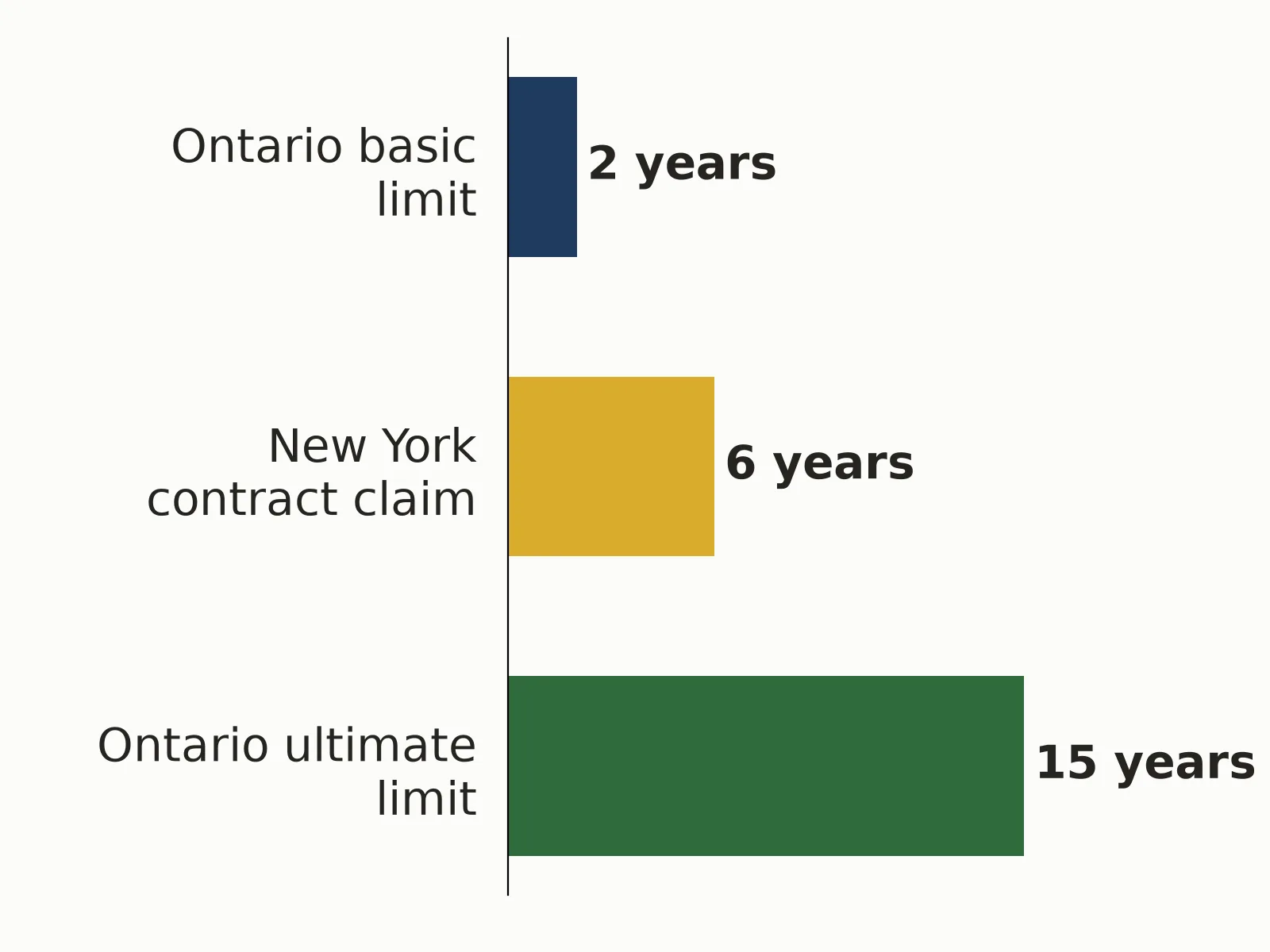
Both places allow a shorter period by agreement. In Ontario, section 22 of the Limitations Act, 2002 lets a business agreement vary or exclude the basic period, and varying includes shortening it. CPLR section 201 allows a shorter time by written agreement. Any MSA clause on this should state the period and the event that starts it.
Master service agreement checklist
Use this master service agreement checklist to review a draft from either side of the table, whether you are the client or the supplier.
- Parties: the correct legal entities on both sides, and whether affiliates may sign SOWs.
- Commitment: any minimum spend, reserved capacity or exclusivity.
- Precedence: which document wins if the MSA, a SOW and a schedule conflict.
- Scope control: a signed change order before extra work is billed.
- Fees: currency, payment period, disputed invoices, late interest and rate changes.
- Tax: who bears withholding, where work is done and how fees are allocated.
- Ownership: a signed assignment, a moral rights waiver and a licence to pre-existing tools.
- Confidentiality and data: definition, duration, security standard, data location and breach notice.
- Liability: the cap, its currency, excluded losses and claims outside the cap.
- Indemnities: who covers what, and whether they sit under the cap.
- Insurance: the coverage the supplier must hold, if any.
- Term and exit: renewal notice, cure periods, open SOWs, transition and return of data.
- Disputes: governing law, forum or arbitration, and any change to the time limit to sue.
- Enforcement: where the other party's assets are.
- Survival: which clauses continue after the contract ends.
If you are comparing several vendor forms, our overview of contract review services explains what a legal review covers.
Frequently asked questions
What is the difference between an MSA and a SOW?
A master service agreement (MSA) sets the standing legal terms for a relationship, such as liability, ownership, payment rules and termination. A statement of work (SOW) describes one project under those terms, including its scope, price, deliverables and dates. You normally sign one MSA and a new SOW for each project.
Is a master service agreement the same as a master services agreement?
Yes, in practice, the two names describe the same kind of document, and the plural is simply a drafting preference. What counts is the wording of the contract, so read what the document says rather than relying on its title.
What is the difference between an MSA and an SLA?
An MSA sets the legal framework for the relationship. A service level agreement sets measurable service standards, such as uptime or response times, and often the credits owed when they are missed. It is usually a schedule to the master agreement or a statement of work rather than a stand-alone contract.
Does a master service agreement commit you to buying anything?
An MSA with no minimum commitment does not by itself commit you to buying anything. Many set terms only, so the obligation to pay arises when a statement of work is signed. Some do contain minimum spends or exclusivity, so read the term and fee clauses first.
Can an Ontario company choose New York law for an MSA?
It depends on the contract. New York General Obligations Law section 5-1401 allows the choice for a transaction of at least US$250,000 in the aggregate, with no reasonable relation needed, but it excludes contracts for labor or personal services, and an agreement with no committed spend may make the amount hard to show. Clauses outside the section are not limited by it.
Can an MSA shorten the time to sue?
Yes, an MSA can shorten the time to sue in both places. Ontario's Limitations Act, 2002 lets a business agreement vary or exclude the basic two-year period, and New York's Civil Practice Law and Rules section 201 allows a shorter time by written agreement. State the new period and the event that starts it.
Does a Canadian client withhold tax when paying a US supplier?
Whether a Canadian client withholds depends on where the work is done. The Canada Revenue Agency says a 15% withholding applies to fees paid to a non-resident for services provided in Canada, and services performed outside Canada are not caught. Mixed work needs a reasonable allocation. Waivers may be available, so confirm your position with a tax adviser.
Who owns the work a contractor creates under an MSA?
A contractor's work does not automatically belong to the client. Copyright generally needs a written, signed assignment under Canada's Copyright Act, and a written, signed transfer under US law unless the work qualifies as a work made for hire. Moral rights in Canada can only be waived, so address them separately.
Conclusion
A master service agreement sets the terms every later SOW relies on, so the wording matters more than its length suggests. Pay closest attention to the order of precedence, the ownership wording and the liability cap, because those clauses leave the least room for argument once written clearly. For a Canada-US deal, make four more decisions before the first SOW: governing law and forum, currency, withholding and enforcement.
How Mayo Law can help
Mayo Law is a cross-border firm with offices in Toronto and New York, and Joseph Mayo is licensed in Ontario and New York. Our lawyers draft, review and negotiate MSAs and statements of work for clients and suppliers on both sides of the border. If you want a lawyer to go through your draft, we offer a paid one-hour consultation, because a lawyer reviews your documents and situation in depth. You can start through our commercial contract practice.
Disclaimer
This guide is for general information only and is not legal or tax advice. Reading it does not create a solicitor-client or attorney-client relationship. Laws and government guidance change, and the right terms depend on your facts and the governing law of your contract. Mayo Law provides legal services in Ontario and New York.