

Contents
- Quick answer
- What is an indemnification clause?
- Indemnify, defend and hold harmless: what differs?
- How do Ontario and New York courts read the clause?
- What indemnities does New York refuse to enforce?
- When does the time limit run on an indemnity claim?
- How do caps and baskets limit an indemnity?
- How should a claim run under an indemnification clause?
- Frequently asked questions
- Conclusion
- How Mayo Law can help
- Disclaimer
An indemnification clause decides who pays when a contract goes wrong and a third party sends a claim. For a small or mid-sized business signing a supply, services or software-as-a-service contract, it can carry more risk than the price term. Ontario and New York also read these clauses differently, which matters if your deal crosses the border. Our contract lawyers and our cross-border business law team review this wording for companies in both places.
This guide explains the moving parts of the clause, sets out how Ontario and New York courts treat it, and shows what caps, baskets and notice terms do to the money. Cases and statutes are stated as of November 2026.
Quick answer
An indemnification clause is a promise by one party to cover stated losses of the other, usually third-party claims. Ontario reads it as a whole, and the Supreme Court of Canada said covering your own negligence needs the clearest terms. New York construes it strictly, and its building-contract statute voids indemnity for your own negligence causing injury or property damage.
What is an indemnification clause?
An indemnification clause, also called an indemnity clause, is a contract term in which one party, the indemnitor, agrees to cover defined losses of the other party, the indemnitee. It answers a simple question before anything goes wrong: if a claim arrives, whose money pays for it?
Without a clause, the law supplies its own answer. Under section 1 of Ontario's Negligence Act, people found at fault for the same damage contribute in the degree of their fault, "in the absence of any contract express or implied". A contract is how the parties write a different split.
A general indemnification clause usually names four things: who is protected, which losses are covered, what event starts the promise, and what limits apply. Each of those can be negotiated, and each can change who pays.
Indemnification clause example
This short sample indemnification provision shows the parts in plain language. It is an illustration for discussion, with an invented amount, not a template to copy into a contract:
"Supplier shall indemnify and hold harmless Customer from all losses, including reasonable legal fees, arising from any third-party claim to the extent caused by Supplier's negligence or breach of this Agreement. Customer shall give prompt written notice of the claim, and Supplier may assume the defense with counsel of its choice. Supplier's total liability under this section shall not exceed $500,000."
- Third-party claim: this keeps the promise to outside claims. It does not plainly reach a dispute between Supplier and Customer.
- To the extent caused by: this ties payment to the share Supplier caused, so Customer keeps the cost of the rest.
- Reasonable legal fees: fees are named. A clause that stays silent invites a dispute about them.
- Notice and defense: these set the process and suggest the clause is aimed at outside claims, a point that mattered in the Needham case discussed below.
- The cap: this sets the ceiling, and the words "under this section" answer whether the indemnity has its own limit.
Indemnify, defend and hold harmless: what differs?
The three verbs can do different jobs: indemnify pays a loss, defend handles the claim, and hold harmless takes its meaning from the contract. Indemnify means paying a covered loss. Defend means responding to the claim or funding that response. Hold harmless often sits beside indemnify, so the particular contract has to settle what it adds.
In Capital Sewer Servicing Inc. v. Crosslinx Transit Solutions Constructors, 2022 ONCA 10, a subcontract required the subcontractor to "indemnify and hold harmless" the contractor. The application judge read those words to include a duty to defend the contractor against claims by property owners. The Court of Appeal for Ontario found that reading was not unreasonable and deferred to it.
Capital Sewer was a ruling on one contract under a deferential standard, and the court said the meaning of "hold harmless" for a claim brought by the contractor itself was not before it. So do not rely on a label. If you want a defense obligation, say so. If you do not intend one, say that too.
Some commercial contracts use all three verbs. The mutual indemnity quoted in Sanofi Pasteur Limited v. UPS SCS, Inc., 2015 ONCA 88 said each party "shall indemnify, defend and hold harmless" the other.
One-way or mutual indemnity?
A one-way indemnity protects only one side, while a mutual indemnification clause has each party cover losses tied to its own conduct. The Sanofi Pasteur clause is mutual: "Each Party" gave the promise, limited to "third party" claims "to the extent caused by" that party's negligent acts or omissions.
Mutual wording is not automatically balanced. A supplier's exposure may be product injury or intellectual property infringement, while a customer's may be limited to how it used the product. Compare what each side could realistically face. Where ownership of work is part of the risk, read the indemnity together with any intellectual property assignment agreement in the deal.
How do Ontario and New York courts read the clause?
Ontario starts from ordinary contract interpretation and New York starts from strict construction, so New York can give a narrower result, particularly on legal fees between the parties. The table compares four points, and the cases and statutes behind it follow.
| Issue | Ontario | New York |
|---|---|---|
| Starting point | Whole contract, ordinary words, context | Strict reading of the promise |
| Your own negligence | Clearest terms needed | Void for injury or damage in building work |
| Legal fees between the parties | Depends on the wording | Must be unmistakably clear |
| Time to sue | Two years, presumed from service | Six years for contract actions |
Ontario. The Supreme Court of Canada said in Sattva Capital Corp. v. Creston Moly Corp., 2014 SCC 53 that a decision-maker must "read the contract as a whole, giving the words used their ordinary and grammatical meaning, consistent with the surrounding circumstances known to the parties at the time of formation of the contract".
On negligence, the Supreme Court of Canada said in an appeal from Ontario, Consumers' Gas v. Peterborough, 1981 CanLII 66 (SCC), that protection against your own negligence would need "an indemnity clause spelling out this obligation on the other party in the clearest terms".
In Ontario, wording can be drafted to reach claims between the parties. In the contract in Capital Sewer, "Claims" were defined to include those brought or incurred by the contractor or by third parties, with legal costs "on a solicitor and client full indemnity basis". The court also awarded the contractor its appeal costs on a full indemnity basis under the clause.
New York. In Needham & Co., LLC v UpHealth Holdings, Inc., 2023 NY Slip Op 00376, the Appellate Division, First Department, applied the Court of Appeals' decision in Hooper Assoc. v AGS Computers, 74 NY2d 487 (1989). As stated in Needham, a contract imposing an indemnity, where no other legal duty exists, "must be strictly construed", and the intention must be "unmistakably clear from the language of the promise".
The court affirmed the dismissal of a claim for attorney's fees incurred in litigation between the parties, noting that provisions on notice and assuming the defense "would make little sense in an intraparty claim".
If you want a New York clause to cover fees in a dispute with the other party, name those disputes expressly. A clause built around third-party claims would not do that.
Which law applies in a cross-border contract?
Start with the governing law clause, which affects whether Ontario or New York rules apply, and settle it together with the indemnity. Under New York General Obligations Law section 5-1401, parties to a transaction of at least US$250,000 may choose New York law whether or not the contract bears a reasonable relation to the state, with exceptions that include contracts for labor or personal services.
Time limits need separate attention. Section 23 of Ontario's Limitations Act, 2002 treats limitations law as substantive for conflict-of-laws purposes. So check the time limit under the law you choose, not only the court you might use. Our guide to the forum selection clause covers the related choice of court.
What indemnities does New York refuse to enforce?
New York voids indemnity for a party's own negligence causing bodily injury or property damage in contracts for building work, and its public policy also bars indemnity for intentionally caused injury. These are New York rules, so do not assume they apply to an Ontario contract.
General Obligations Law section 5-322.1 applies to contracts relating to the "construction, alteration, repair or maintenance of a building, structure, appurtenances and appliances". A promise to indemnify or hold harmless the indemnitee against bodily injury or property damage caused by the indemnitee's negligence, "whether such negligence be in whole or in part", is "void and unenforceable". The section does not affect the validity of an insurance contract issued by an admitted insurer.
A partly negligent contractor is not always shut out. In Brooks v Judlau Contr., Inc., 11 NY3d 204 (2008), the clause used the words "to the fullest extent permitted by law". The Court of Appeals held that a general contractor at fault in part could enforce the indemnity for the share attributable to its subcontractor, because the clause did not cover the contractor's own negligence.
The Appellate Division, Second Department, restated the point in Travers v Briarcliff Manor Invs., LLC, 2026 NY Slip Op 02689: the "fullest extent" wording allows partial indemnity for damages not caused by the indemnitee's own negligence.
Two neighboring sections of the General Obligations Law also matter. Section 5-321 voids lease terms exempting a lessor from liability for its own negligence in operating or maintaining the premises. Section 5-323 does the same for contractors exempting themselves for negligence in construction, maintenance and repair work on real property. Check both against your lease or service contract.
The Court of Appeals in J.P. Morgan Sec. Inc. v Vigilant Ins. Co., 21 NY3d 324 (2013) quoted its earlier statement that indemnity agreements are unenforceable on public policy grounds "only to the extent that they purport to indemnify a party for damages flowing from the intentional causation of injury".
When does the time limit run on an indemnity claim?
In Ontario, if you are the party seeking indemnity, plan on two years presumed to run from the day the first alleged wrongdoer is served, not from the day you settle or pay. In New York, start from the six-year period for actions on a contractual obligation.
Ontario. The Limitations Act, 2002 sets a basic two-year period in section 4. Section 18 deems the day the first alleged wrongdoer was served with the claim to be the day of the act or omission behind a claim for contribution and indemnity. It applies "whether the right to contribution and indemnity arises in respect of a tort or otherwise".
Canaccord Capital Corporation v. Roscoe, 2013 ONCA 378 shows that section 18 reaches a claim on a contract indemnity. An employer relied on a contract indemnity and sued within two years of settling the underlying claim. The Court of Appeal for Ontario held that the claim's being "grounded in contract has no bearing" on whether section 18 applies, and it dismissed the action as barred.
Service starts a presumption, not a fixed deadline. In Mega International Commercial Bank (Canada) v. Yung, 2018 ONCA 429, the court said the claim is barred two years after service unless the party proves it was not discovered and could not have been discovered through due diligence. Do not plan around that exception.
Section 22 also lets the parties to a business agreement, meaning one with no consumer party, vary or exclude the basic period, so a contract can address timing directly.
New York. Civil Practice Law and Rules section 213(2) gives six years for an action on a contractual obligation or liability. The section does not mention indemnity by name and does not say when the period starts, so confirm both points for your contract.
How do caps and baskets limit an indemnity?
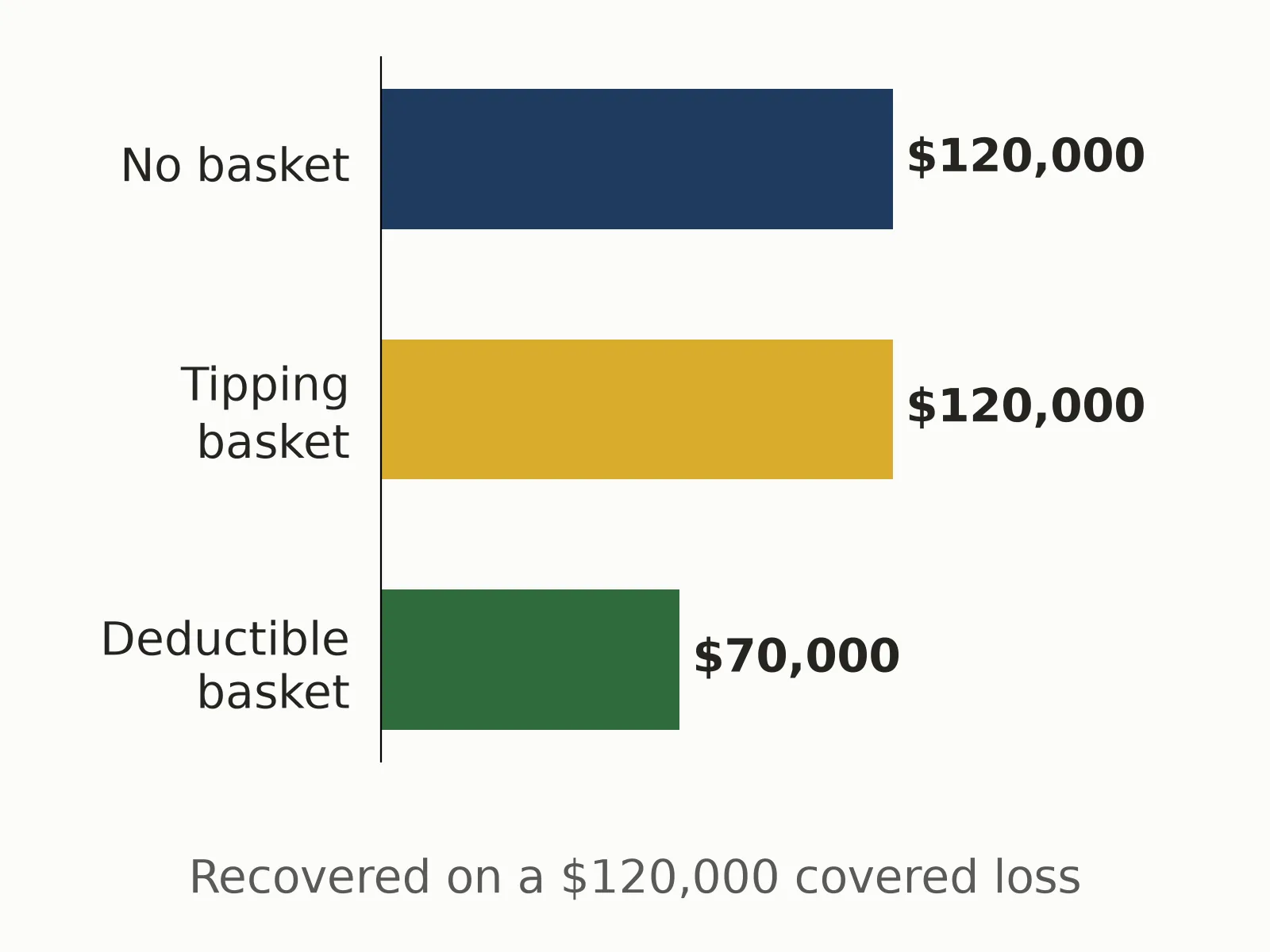
A cap sets the most the indemnitor can owe, while a basket sets a threshold that covered losses must pass before any payment is due. A tipping basket then typically pays from the first dollar, and a deductible basket typically pays only the excess over the threshold.
Assume a $50,000 basket and a $200,000 cap, in any currency, with figures chosen only to show the arithmetic:
- $40,000 loss: below the basket, so both types pay $0.
- $120,000 loss: a tipping basket pays $120,000, and a deductible basket pays $70,000.
- $300,000 loss: both types stop at the $200,000 cap. The indemnitee bears the remaining $100,000.
You will meet baskets in sale-of-business deals, where they sit beside the seller's other limits. Our guide to stock purchase agreements covers that setting.
The cap and the indemnity must be read together. Our guide to the limitation of liability clause explains the cap itself. The question to answer here is whether the indemnity sits inside that cap or outside it, because an uncapped indemnity can undo the limit the parties negotiated. Our master service agreement guide shows where those terms usually sit in a services contract.
How should a claim run under an indemnification clause?
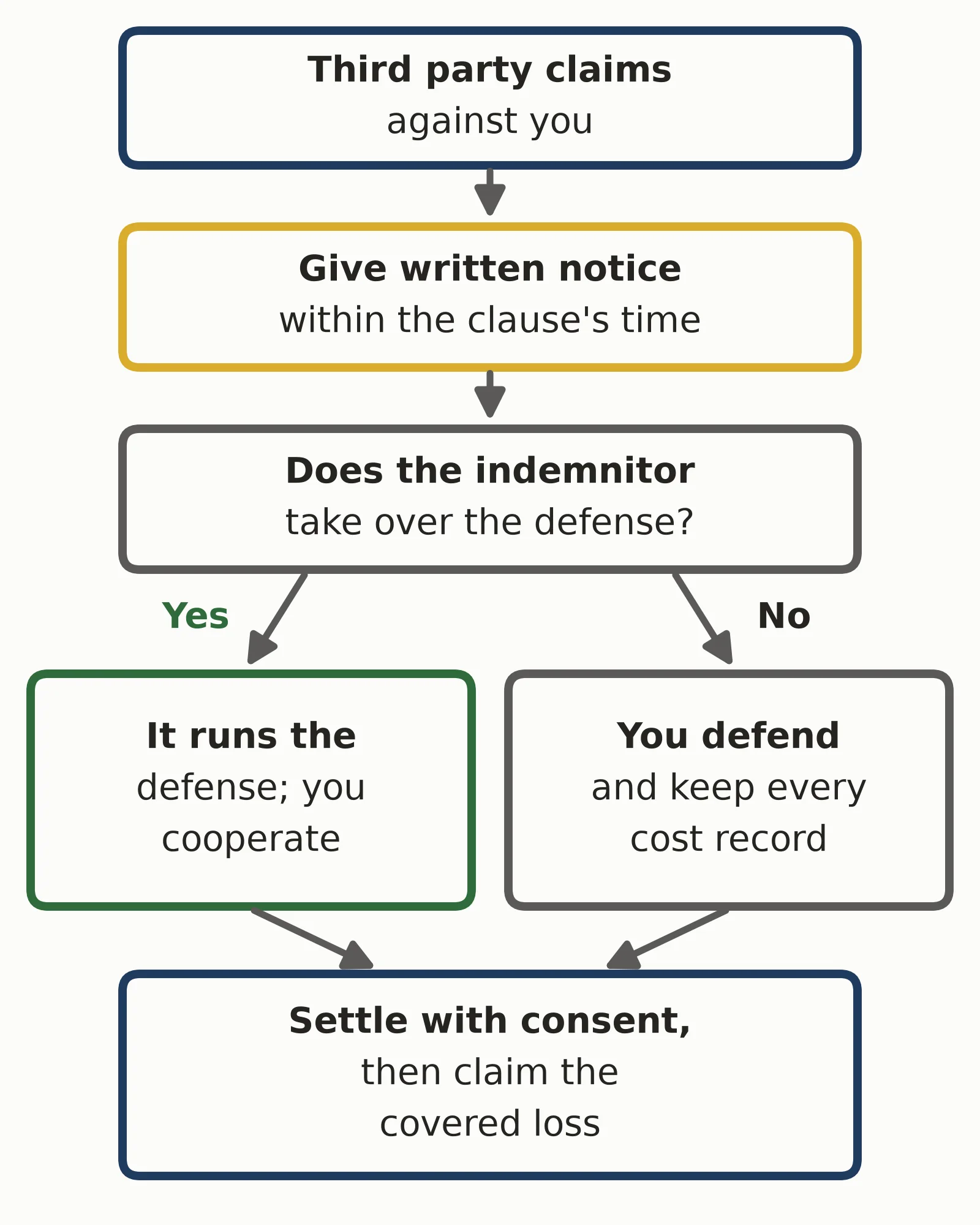
A workable clause sets out each step from the first demand to the end of the claim: notice, control of the defense, settlement approval and the claim for the covered loss. Each of those steps can turn into a dispute, so write them down before you need them.
- Step 1: a third party claims against you.
- Step 2: give written notice within the clause's time.
- Step 3: either the indemnitor takes over the defense and you cooperate, or you defend and keep every cost record.
- Step 4: settle with consent, then claim the covered loss.
You also need proof that the loss falls within the promise. In McDowell v. St. Lawrence Parks Commission, 2015 ONCA 755, an indemnity reached claims "in any way based upon, occasioned by or attributable to" the concessionaire's conduct. The claim still failed because the trial judge found the concessionaire's alleged failure was not shown to be connected to the events behind the claim, and the Court of Appeal for Ontario saw no error.
Indemnification clause drafting checklist
Use this checklist before you sign:
- Parties: name who is protected, including affiliates, directors and employees if intended.
- Trigger: state whether the promise covers third-party claims only or also claims between the parties.
- Fault: state how shared fault is handled, and deal expressly with the indemnitee's own negligence.
- Losses: list legal fees, fines, settlements and any excluded loss types.
- Defense: say who defends, who picks counsel and who pays.
- Notice: set a time limit and say what happens if notice is late.
- Settlement: require consent, and say whether it can be unreasonably withheld.
- Limits: state the cap, any basket, and whether the indemnity sits outside the general cap.
- Insurance: check the promise against the coverage actually held.
- Survival: say how long the promise lasts after the contract ends.
- Law and time: align the governing law, the court and any contractual limitation period.
Frequently asked questions
What is the purpose of an indemnification clause?
Its purpose is to decide in advance who bears a defined loss, usually a claim by a third party connected to the contract. Without one, the parties fall back on the general law, such as fault-based contribution under Ontario's Negligence Act, which may not match the deal they intended.
Does an indemnification clause cover my own negligence?
Only if the wording and the governing law allow it. The Supreme Court of Canada, in Consumers' Gas v. Peterborough, an Ontario appeal, said such protection would need the clearest terms. New York's General Obligations Law section 5-322.1 voids it for bodily injury or property damage in contracts for building work, whether the negligence is whole or partial, though partial indemnity for others' fault can survive.
How does an indemnification clause differ from a limitation of liability?
An indemnity moves a loss from one party to the other, and a limitation of liability restricts how much a party can be made to pay. They interact directly, because an indemnity placed outside the cap can create exposure far greater than the cap the parties believed they had agreed.
Can I recover legal fees under an indemnity?
That depends on the wording. In New York, fees in a dispute between the contracting parties require language making that intent unmistakably clear, as Needham & Co., LLC v UpHealth Holdings, Inc. shows. In Ontario, the contract in Capital Sewer Servicing Inc. v. Crosslinx Transit Solutions Constructors covered legal costs on a full indemnity basis, and the contractor recovered its appeal costs on that basis.
Does an indemnity end when the contract ends?
That depends on the contract, so do not leave it to inference. State whether the promise survives termination and for how long. The clause in McDowell v. St. Lawrence Parks Commission said its obligations survive termination or expiry. Remember that a survival period in the contract does not by itself answer the separate limitation question under Ontario or New York law.
Does insurance replace an indemnity?
No, insurance does not replace an indemnity, and the two can pull apart. In Capital Sewer Servicing Inc. v. Crosslinx Transit Solutions Constructors, the subcontractor argued that insurance terms in the contract narrowed its indemnity. The application judge read the contract otherwise, and the Court of Appeal for Ontario left that reading in place as reasonable. Check the clause against the actual policy, because a promise you make may reach beyond what your coverage pays.
Should a small business accept a one-way indemnity?
Sometimes, but price the risk first. A one-way promise in a supply, services or software contract may be acceptable where your exposure is narrow, capped and insured. It deserves more scrutiny where it is uncapped, covers the other side's negligence, or adds a duty to defend. You can ask for mutual wording or a fault-based limit.
Conclusion
An indemnification clause is short, but it decides who pays when a covered claim arrives. Choose its trigger, verbs, limits and time rules on purpose. Then read it against the governing law, because Ontario and New York start from different rules.
How Mayo Law can help
Mayo Law advises businesses on cross-border contracts from offices in Toronto and New York, and Joseph Mayo is licensed in Ontario and New York. Our contract lawyers can review an indemnity before you sign and explain how it works with your caps, insurance and governing law. We offer a paid one-hour consultation, because a lawyer reviews your situation in depth.
Disclaimer
This article is for general information only and is not legal advice. Reading it does not create a solicitor-client or attorney-client relationship. Laws change and results depend on your contract and facts, so speak with a lawyer about your situation. Mayo Law provides legal services in Ontario and New York.