

Contents
- Quick answer
- Does New York require an LLC operating agreement?
- What if a New York LLC has no operating agreement?
- What should a New York LLC operating agreement cover?
- What can an operating agreement not change?
- Does a single-member LLC need one in New York?
- What should Canadian members watch for?
- How do you adopt and update the agreement?
- Frequently asked questions
- Conclusion
- How Mayo Law can help
- Disclaimer
A New York LLC operating agreement is the written contract that sets out who owns a limited liability company (LLC), who runs it, how money moves and what happens when an owner leaves. New York's Limited Liability Company Law says members "shall adopt" one, yet the agreement never goes to the state. For a Canadian founder, it belongs early on any cross-border business law checklist, because the statute's default rules fill many gaps, and you may not want them.
This guide covers what section 417 requires, the default rules that apply when an agreement is silent, the clauses that matter, the limits the law sets, and the points Canadian members should raise before signing. Statutes and court decisions are cited as of October 2026. Our incorporation lawyer page describes how we work with founders forming a company.
Quick answer
New York requires a written LLC operating agreement: section 417 of the Limited Liability Company Law says members "shall adopt" one, and it may be entered into up to 90 days after the articles are filed. It is not filed with the state. Where it is silent, any statutory default on that topic applies. The law states no penalty.
Does New York require an LLC operating agreement?
Yes: section 417(a) of the Limited Liability Company Law says the members of a limited liability company "shall adopt a written operating agreement," and the New York Department of State says members "are required to adopt" one.
The same Department of State page says the law "is silent on the consequences of not adopting an Operating Agreement." So the duty is real, but the statute states no penalty for it. The practical cost shows up later, when the owners disagree and the default rules decide.
Timing comes from section 417(c): the agreement may be entered into before, at the time of, or within 90 days after the articles of organization are filed. It can take effect on formation or on a later date it sets, but never before the company is formed. Under section 203(d), formation happens when the articles are filed, or on a later date stated in the articles that is no more than 60 days after filing.
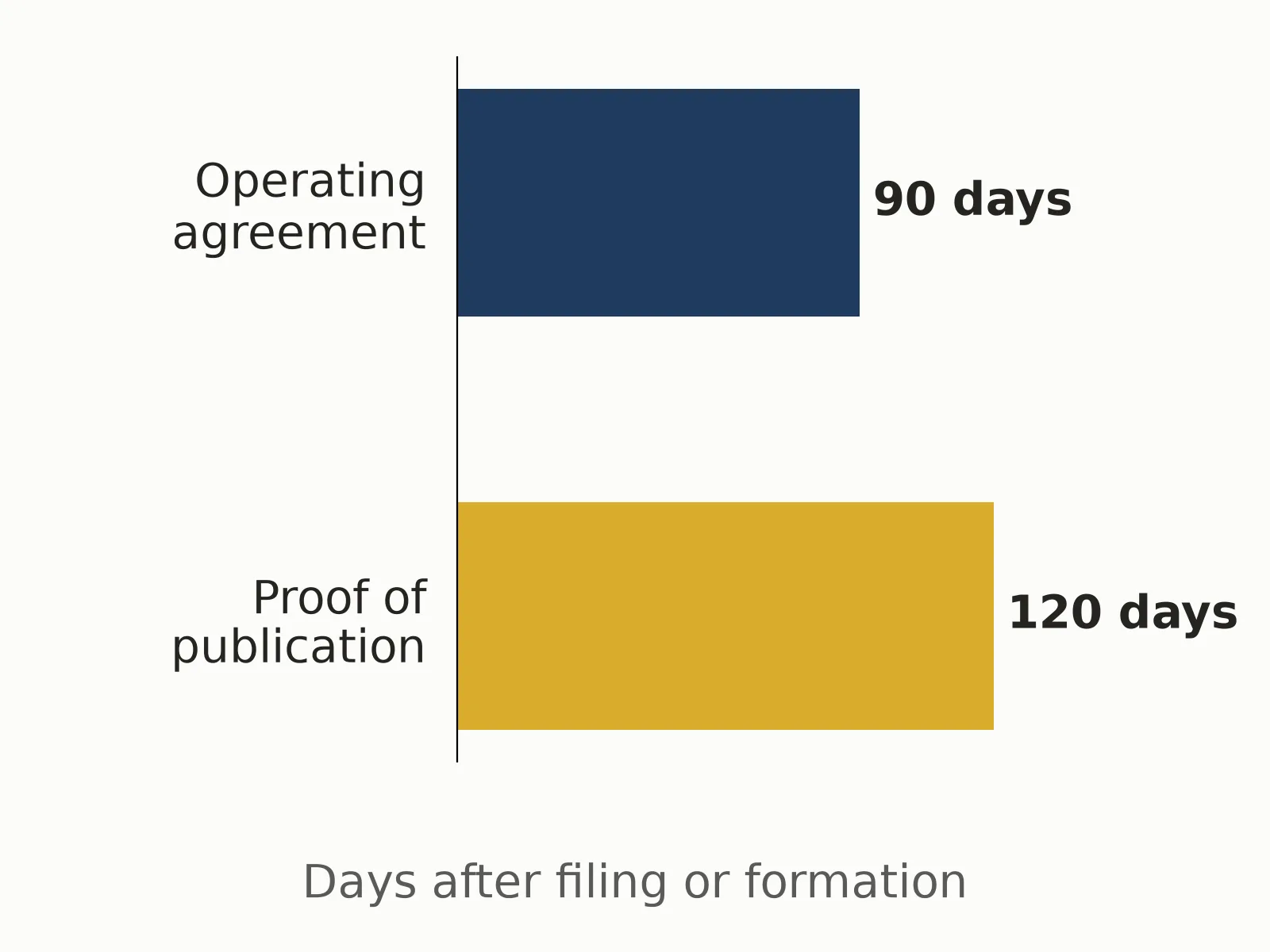
The agreement must be written, because section 102(u) defines an operating agreement as "any written agreement of the members" about the company's business and the conduct of its affairs. It is not filed with the Department of State, which calls it "an internal document of the LLC," and section 1102(a)(4) requires the company to keep a copy, with any amendments, in its records. Publication is a separate duty: under section 206(a), proof must be filed within 120 days of formation or the company's authority to do business is suspended, as our guide to starting a business in New York explains.
What if a New York LLC has no operating agreement?
The company still exists, but the default rules in the Limited Liability Company Law then decide profit shares, votes, transfers and exits, and those rules may not match what the owners agreed in conversation.
The Appellate Division, Second Department, put it plainly in Matter of 1545 Ocean Ave., LLC, 72 AD3d 121 (2010): where an operating agreement does not address a topic, a limited liability company "is bound by the default requirements set forth in the Limited Liability Company Law." The table below shows defaults that can surprise owners: each one applies only when the agreement does not say otherwise.
| Issue | Default rule | Section |
|---|---|---|
| Profits and losses | By value of contributions | 503 |
| Distributions | By value of contributions | 504 |
| Member voting power | By share of current profits | 402(a) |
| Admitting a new member | Majority in interest | 402(c) |
| Debt outside ordinary course | Majority in interest | 402(c) |
| Sale of substantially all assets | Majority in interest | 402(d) |
| Voluntary dissolution | Majority in interest | 402(d), 701(a) |
| Buyer of an interest | Money rights only | 603(a) |
| Member withdrawal | No right before winding up | 606(a) |
Older LLCs may be governed by earlier text: sections 402(g), 606(b) and 701(c) keep prior versions for companies formed before those subdivisions took effect, so check the formation date.
Without a signed agreement, the default rules can undo a handshake deal. Take an illustrative company whose two founders say they are "50/50" but sign nothing, and whose records show one contributed US$90,000 and the other US$10,000. Under section 503 and section 504, profits, losses and distributions follow the value of contributions, so the split is 90% and 10%. Under section 402(a), votes follow the share of current profits, so the larger contributor also holds 90% of the votes.
A true 50/50 split has a different problem: deadlock. By default, section 102(o) treats a "majority in interest" as members holding more than half of current profits, so two equal owners who disagree cannot pass a decision that needs one. Court may not solve it. The company in 1545 Ocean Ave. had an operating agreement with no specific dissolution terms, and the court would not import dissolution grounds from the corporate and partnership statutes. It held that a member seeking dissolution under section 702 must establish, in the context of the operating agreement or articles, one of two things. Either management is "unable or unwilling to reasonably permit or promote the stated purpose of the entity to be realized or achieved," or continuing is "financially unfeasible." The court called dissolution "a drastic remedy" and, on the facts of that case, reversed the order granting it, with two justices dissenting in part.
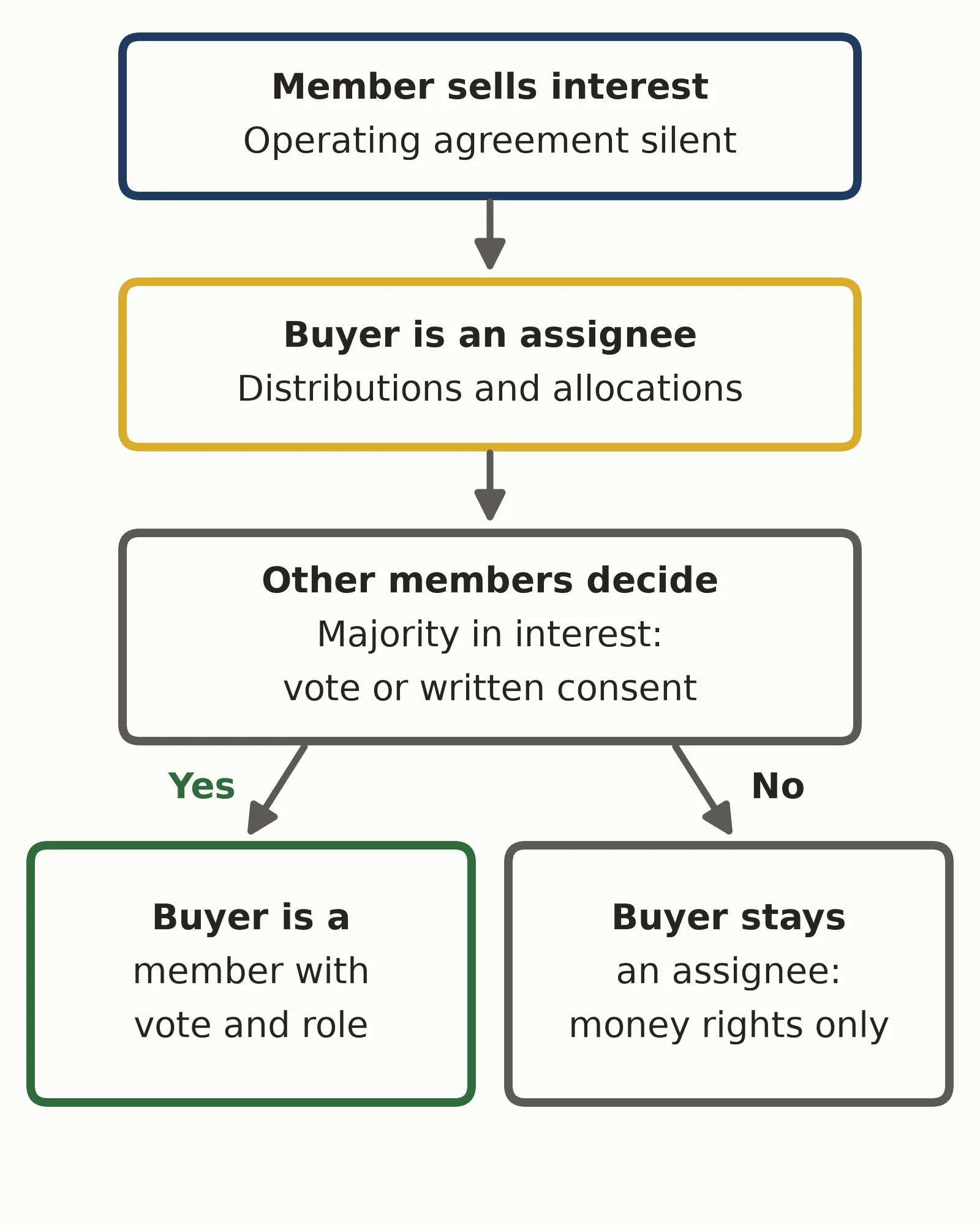
Exits also catch owners out. Unless the agreement says otherwise, a member can assign an interest, but the buyer receives only the distributions and allocations, not a vote or a role in management, under section 603(a). Figure 2 shows the path. On the same default terms, a member who assigns everything stops being a member, and the buyer becomes one only with the vote or written consent of at least a majority in interest of the other members under section 604(a). Also by default, a member's death does not dissolve the company unless a majority in interest of the remaining members votes or agrees to dissolve within 180 days, under section 701(b).
What should a New York LLC operating agreement cover?
A New York LLC operating agreement should cover ownership and money, control, exits and protections, because those are the areas where the statute's defaults apply unless the members write their own terms.
Ownership and money
- Members and contributions: name each member and record what each put in and each share of profits and losses. Section 1102(a)(2) requires the company to keep that information anyway.
- Further capital: say whether members can be asked for more money and what happens on a default. Under section 502(a), a member is otherwise bound to perform an enforceable promise to contribute, even after death or disability.
- Allocations and distributions: set out the split if it differs from contributions. Under section 507, a member's right to distributions before withdrawal or dissolution depends on what the agreement specifies, so state when money comes out.
Control
- Who manages: members manage unless the articles of organization provide for managers, under section 401(a). The agreement must not conflict with the articles.
- Voting: list the decisions that need more than a simple majority, such as new debt, new members or a sale.
- Deadlock: give two equal owners a way forward, such as mediation followed by a buyout.
- Related-party deals: section 411(d) lets the agreement add restrictions on contracts between the company and its managers.
Exits
- Transfers: decide whether a member can sell, to whom, and whether the others have first rights.
- Buyouts: set the triggers, the price method and the funding. Our guide to the buy-sell agreement walks through those choices.
- Withdrawal: a member may withdraw only as the agreement provides under section 606(a), so a right to leave has to be written in.
- Dissolution: section 701(a) lets the agreement name a time or events that end the company, and section 704 sets the order of payment on winding up.
Protections
- Liability and indemnity: section 417(a) allows limits on manager liability, and section 420 lets the company indemnify members and managers, within the limits below.
- Information: section 1102(b) lets members inspect records for a purpose reasonably related to their interest, subject to reasonable standards in the agreement. Section 1102(c) allows confidentiality terms for items such as trade secrets.
- Disputes: choose the governing law and court with care. Our guide to the forum selection clause explains how that wording works.
What can an operating agreement not change?
An operating agreement cannot contain terms inconsistent with the law or the articles of organization, and several sections of the New York Limited Liability Company Law set limits that careful drafting does not remove.
- Manager liability: section 417(a) bars any limit on liability for bad faith, intentional misconduct, a knowing violation of law, a personal gain the manager was not entitled to, or a distribution barred by section 508(a) and not made in line with section 409, as established by a judgment or other final adjudication. It also bars a limit on liability for acts before the provision was adopted.
- Indemnification: section 420 bars indemnity where a judgment or other final adjudication establishes bad faith, active and deliberate dishonesty material to the claim, or an improper personal gain.
- Distributions: section 508(a) bars a distribution to the extent that liabilities, with some exclusions, would then exceed the fair market value of the assets.
- Quorum: section 404(b) lets the agreement change the quorum, but not below one-third in interest of the members entitled to vote.
- Special voting terms: section 402(e) says a provision requiring a stated percentage cannot be amended without at least that percentage.
- Personal liability for wages: section 609(c) makes the ten members with the largest ownership percentages jointly and severally liable for wages owed to employees, subject to its notice and timing rules. It applies despite the general liability shield in section 609(a), so in a company with ten or fewer members, every member is in that group.
Does a single-member LLC need one in New York?
Yes: section 417 makes no exception for a one-owner company, so the sole owner of a single member LLC in New York should sign an agreement too.
Section 102(m) defines an LLC as an organization of one or more persons, and section 203(c) requires at least one member at formation. The strongest practical reason is succession. Under section 701(a)(4), a company with no members is dissolved unless, within 180 days or another period the agreement sets, the last member's legal representative agrees in writing to continue it and to be admitted, or to have an assignee admitted. The agreement can also change that rule. Section 608 lets an executor exercise a deceased member's rights to settle the estate. An agreement that names who steps in can save a family from working that out under a deadline.
What should Canadian members watch for?
Canadians can be members of a New York LLC, but the agreement should reflect how two tax systems view the company, where its records sit and where a dissolution case goes.
- Who can be a member: the Department of State says a member may be an individual, a corporation, a partnership, another LLC or any other legal entity, and the definition of "person" in section 102(w) does not mention citizenship or residence.
- Ownership and immigration: section 601 treats a membership interest as personal property. Whether a member may work in the US is a separate question, covered in our guide on whether a Canadian can own a business in the US.
- US tax classification: the Internal Revenue Service (IRS) treats a domestic LLC with at least two members as a partnership for federal income tax purposes, and a one-member LLC as disregarded for income tax purposes, unless it elects corporate treatment on Form 8832. A one-member LLC is still a separate entity for employment tax and certain excise taxes.
- Foreign partners: the IRS says a partnership with income effectively connected with a US trade or business must pay a withholding tax on the part allocable to its foreign partners, so a distribution clause should allow for that.
- Sole foreign owner: the Form 5472 instructions (December 2024 revision) treat a domestic disregarded entity wholly owned by a foreign person as a corporation for that form, and set a US$25,000 penalty for failing to file.
- Canadian tax view: a worked example in the Canada Revenue Agency (CRA) archived Technical News No. 44 involves a US LLC "treated as a corporation for Canadian tax purposes but as fiscally transparent for US tax purposes."
- Treaty status: the CRA Circular IC75-6 says payments for services in Canada of US LLCs "are not normally entitled to treaty exemption," and that a US LLC that has not elected corporate treatment "will not be a resident of the U.S. for purposes of the Convention," meaning the Canada-US tax treaty. Have a cross-border tax adviser review the allocation and distribution clauses before signing.
- Records: section 1102(a) says the required records "may, but need not, be maintained in this state," so a Toronto-based company can keep them there.
- Dissolution court: section 702 sends an application to the supreme court in the judicial district where the company's office is located, and section 203(e)(2) requires that office to be in a New York county.
Canadians used to Ontario corporations should note that the operating agreement does the work of several documents at once, including much of what a shareholder agreement and by-laws do. If a Canadian company wants to operate in New York itself, without a new LLC, the filing is a different one, explained in our guide to foreign qualification.
How do you adopt and update the agreement?
Settle the terms first, write them down, have the members sign within the 90-day window, keep the signed copy in the company's records, and amend it the way the agreement itself says.
- Step 1: Confirm an LLC is the right vehicle. Our comparison of an LLC vs corporation in New York sets out the trade-offs.
- Step 2: Agree the business terms before filing, because the articles must say if managers will run the company (section 401(a)) and the agreement cannot conflict with the articles (section 417(a)). The articles of organization cost US$200 to file with the New York Department of State as of October 2026.
- Step 3: Sign the agreement, and state its effective date, before the 90 days run out.
- Step 4: Keep the signed copy and every amendment in the company's records, as section 1102(a)(4) requires.
- Step 5: Amend it as it provides. If it says nothing, section 402(c) calls for a majority in interest. Section 417(b) adds a default rule that, without the written consent of each member adversely affected, an amendment cannot increase that member's contribution obligations or alter tax allocations or the way distributions are computed.
The agreement stays private, but the company still has public filings to keep up, including the New York biennial statement required by section 301(e).
Frequently asked questions
Is a NY LLC operating agreement public?
No. The New York Department of State describes the operating agreement as an internal document of the LLC that is not filed with it. The company keeps a copy in its own records under section 1102(a)(4) of the Limited Liability Company Law, and members can inspect it under section 1102(b), subject to any reasonable standards the agreement sets.
Can a New York operating agreement be oral?
New York's statute calls for a written agreement. Section 102(u) of the Limited Liability Company Law defines an operating agreement as a written agreement of the members, and section 417(a) tells members to adopt a written one. An unwritten understanding leaves owners arguing about what was said, while the default rules in the statute remain the fixed reference point.
Does an operating agreement have to be notarized?
Not under the statute. Neither section 102(u) nor section 417 of the Limited Liability Company Law mentions notarization. They call for a written agreement of the members, and the New York Department of State does not receive a copy. A bank, buyer or other third party may ask for notarization for its own purposes, so check that party's requirements.
What if we missed the 90-day window?
Neither the statute nor the New York Department of State names a penalty for a late agreement. Section 417(c) of the Limited Liability Company Law sets the window, and the Department says the law is silent on what follows from having none. Until an agreement covers a topic, any default rule on that topic applies, so there is little reason to wait.
Do LLC managers have to be members?
No. Section 102(p) of the Limited Liability Company Law defines a manager as a person designated by the members to manage the company as the operating agreement provides, and it does not require that person to be a member. Under section 401(a), though, management by managers applies only if the articles of organization provide for it.
How is an operating agreement different from articles of organization?
Articles of organization are filed with the New York Department of State and form the company under section 203 of the Limited Liability Company Law. The operating agreement is the private contract among the members about the business and its affairs. Under section 417(a), its terms must not be inconsistent with the law or with the articles.
Can a Canadian be the only member of a New York LLC?
Yes. Section 102(m) of the Limited Liability Company Law allows an LLC of one person, and the definition of person in section 102(w) includes natural persons and corporations without mentioning citizenship or residence. US tax filings can follow from that structure, including Form 5472 where a foreign person wholly owns a disregarded domestic entity.
Do you need a lawyer to prepare one?
The New York Department of State says there is no requirement to use a lawyer when forming an LLC, while noting that operating agreements create legally enforceable rights and responsibilities and that anyone forming an LLC should consider using one. A template cannot know the owners' deal or how the default rules affect it.
Conclusion
A New York LLC operating agreement is required in writing, sits outside the public record and decides most of what the statute would otherwise decide for you. Sign it within the 90-day window, make sure it does not conflict with the articles, and spend the most time on money, control and exits. Canadian members should add the tax, records and forum questions before anyone signs.
How Mayo Law can help
Mayo Law is a cross-border firm with offices in Toronto and New York, and Joseph Mayo is licensed in Ontario and New York. Our lawyers form New York companies and draft operating agreements for owners on both sides of the border. If you want a lawyer to go through your structure or draft, we offer a paid one-hour consultation, because a lawyer reviews your documents and situation in depth. You can start through our incorporation practice.
Disclaimer
This guide is for general information only and is not legal or tax advice. Reading it does not create a solicitor-client or attorney-client relationship. Laws and government guidance change, and the right terms depend on your facts. Mayo Law provides legal services in Ontario and New York.