

Contents
- Quick answer
- What is a governing law clause?
- Governing law vs forum selection vs arbitration seat
- How does Ontario treat a governing law clause?
- How does New York treat a choice of New York law?
- Which rules override the chosen law?
- Does the chosen law set the deadline to sue?
- How do you choose between Ontario and New York law?
- Frequently asked questions
- Conclusion
- How Mayo Law can help
- Disclaimer
A governing law clause names the legal system whose rules decide a contract's validity, meaning, performance and enforcement. For a business signing across the Canada-US border, the choice between Ontario and New York law matters. It affects the deadline to sue, the statutes that apply and how far a court will respect the clause. Our cross-border business lawyers review this term in supply, services, licensing and purchase agreements as part of our contract drafting and review work.
This guide explains what the clause does and does not do, how Ontario and New York each treat the parties' choice, which rules apply whatever the contract says, and how to choose and draft the wording. Statutes and court decisions are cited as of November 2026.
Quick answer
Governing law is the legal system a contract names to decide its validity, meaning, performance and enforcement. Ontario courts ordinarily apply it if the choice is bona fide, legal and not against public policy. New York General Obligations Law section 5-1401 lets parties to most transactions of at least $250,000 choose New York law without any New York link.
What is a governing law clause?
A governing law clause is the contract term that names the legal system whose rules decide the validity, meaning, performance and enforcement of the agreement. It is also called a choice of law clause or a governing law provision. It does not, by itself, choose the court that will hear a dispute.
The wording is short. The franchise agreement in 405341 Ontario Limited v. Midas Canada Inc., a 2010 decision of the Court of Appeal for Ontario, said: "This Agreement, including all matters relating to the validity, construction, performance, and enforcement thereof, shall be governed by the laws of the Province of Ontario." Those four subjects are the core of what the chosen law controls.
The choice matters because the two legal systems can give different answers on the same facts. Three differences covered in this guide show the point:
- Time limits: Ontario's basic limitation period is two years from discovery, and New York's general period for a contract claim is six years.
- Mandatory statutes: Ontario's franchise and employment standards statutes apply despite a contrary clause, and New York's choice of law statute leaves some contracts out.
- Deal size: New York sets dollar thresholds of $250,000 and $1 million in its choice of law and choice of forum statutes, and the Ontario test has no dollar element.
What happens if a contract has no clause?
Without a clause, a court chooses the law by its own conflict of laws test, which adds a dispute about the rules to the dispute about the contract. In Ontario, the court asks which jurisdiction has "the closest and most real connection" to the contract. Lilydale Cooperative Limited v. Meyn Canada Inc. is a 2015 decision of the Court of Appeal for Ontario. It listed the four criteria typically used: the nature and subject matter of the contract, the place of performance, the place of contracting, and the residence and domicile of the parties.
Lilydale shows the cost of leaving the term out. In January 2006 an Alberta buyer sued a seller that operated in Ontario. The question of which province's law applied was still before the Court of Appeal in April 2015, nine years later (our calculation from the dates in the decision). The answer decided whether the claim was out of time, because the decision records Alberta's ultimate limitation period as 10 years and Ontario's as 15. The contract claim survived only because Ontario law applied to it. The court noted that the seller "could have inserted a choice of law clause in its contract".
The New York Court of Appeals has described the approach used in that state's contract cases. In 2138747 Ontario, Inc. v. Samsung C&T Corp. (2018) it referred to the "grouping of contacts" or "center of gravity" approach used in contract cases. In IRB-Brasil Resseguros, S.A. v. Inepar Investments, S.A. (2012) it described a conflicts analysis that applies the law of the jurisdiction with "the most significant relationship to the transaction and the parties".
Governing law vs forum selection vs arbitration seat
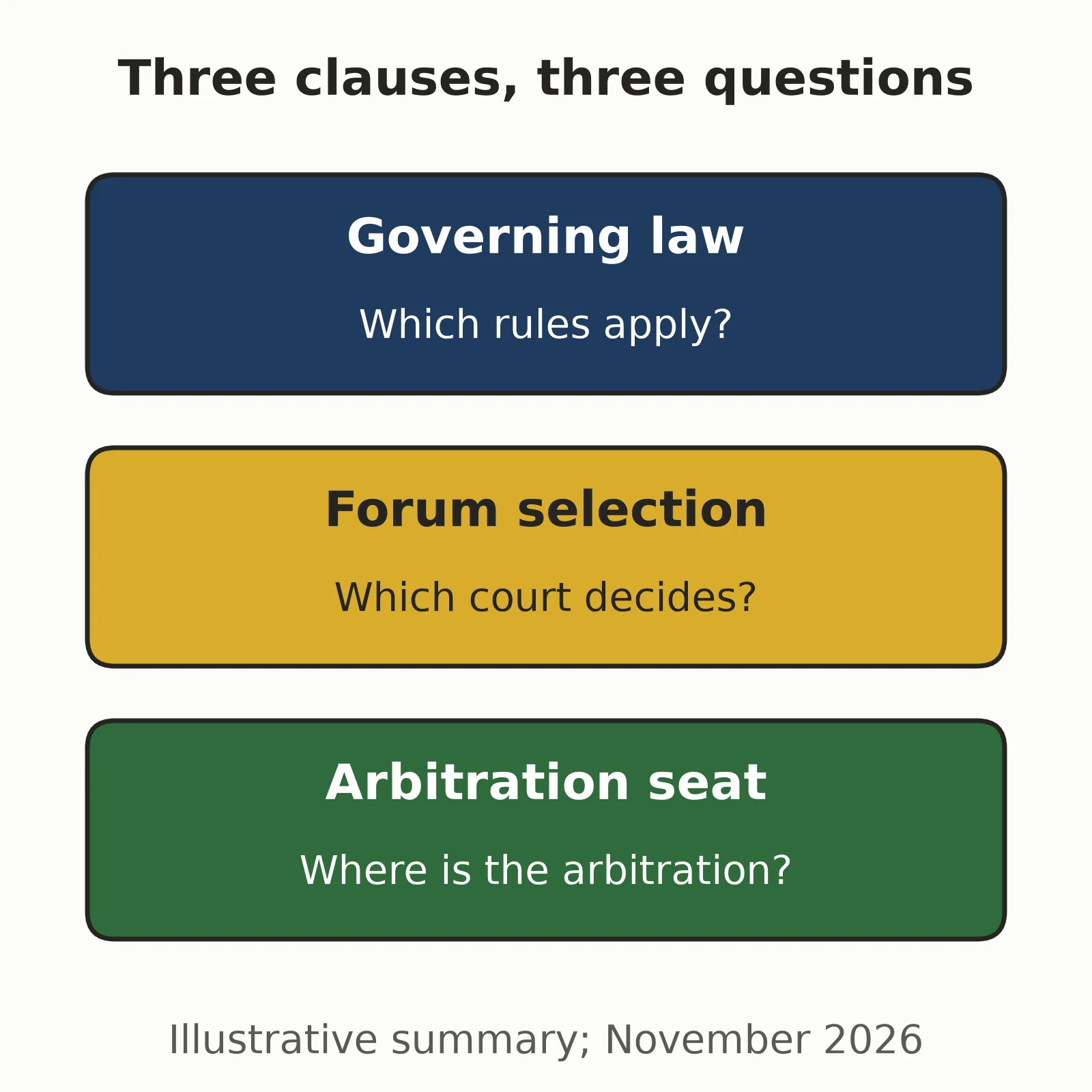
Governing law decides which rules apply, a forum selection clause decides which court hears the dispute, and an arbitration seat is the place of arbitration the parties agree on. A contract can point each one at a different place, and table 1 shows the three side by side.
| Clause | Question answered | Typical wording |
|---|---|---|
| Governing law | Which rules apply? | "governed by the laws of Ontario" |
| Forum selection | Which court decides? | "the courts of New York" |
| Arbitration seat | Where is the arbitration? | "seated in Toronto, Ontario" |
The law treats these as separate choices. New York has one statute for choice of law (General Obligations Law section 5-1401) and another for choice of forum (section 5-1402). In Ontario, the International Commercial Arbitration Act, 2017 gives the Model Law on International Commercial Arbitration (the Model Law) the force of law. The Model Law deals with the place of arbitration in Article 20 and with the rules applicable to the substance of the dispute in Article 28. Under Article 28, an arbitral tribunal decides the dispute under the rules of law the parties chose. A reference to the law of a state is read as its substantive law and not its conflict of laws rules, unless the parties say otherwise.
The choices do not have to match, because a court in one place can apply the law of another. In Lilydale, an Ontario court applied Alberta law to the buyer's tort claim and Ontario law to its contract claim. Many contracts still combine the first two choices in a single governing law and jurisdiction clause. The Facebook terms of use that the Supreme Court of Canada examined in Douez v. Facebook, Inc., 2017 SCC 33, required claims to be resolved exclusively in a state or federal court located in Santa Clara County and added that "the laws of the State of California will govern". Our guide to the forum selection clause covers the court side of that pairing, and our guide to arbitration in Canada covers the arbitration side.
How does Ontario treat a governing law clause?
In Ontario, the law the parties chose ordinarily governs their contract, provided the choice is bona fide and legal and no public policy reason stands against it. The Court of Appeal for Ontario accepted that statement of the rule in the 2010 Midas franchise case.
In Midas, the agreement chose Ontario law, some franchisees operated in other provinces, and the franchisor argued that Ontario's franchise statute could not reach them. The court upheld the motion judge's conclusion that, by choosing Ontario law, the parties intended their rights and duties to be the same as if the franchises operated in Ontario. It accepted the statement, quoted from the respondent's factum, that the chosen law governs "provided the choice is bona fide and legal, and there is no reason for avoiding the choice on the ground of public policy". It also observed that the parties' choice "often bears no relationship to where the contract is to be carried out".
Three of the seven judges of the Supreme Court of Canada who heard Douez v. Facebook, Inc. in 2017 described the general position in the same terms. Their joint reasons say that common law courts will generally give effect to choice of law clauses "as long as they are bona fide, legal and not contrary to public policy", citing the 1939 Privy Council decision in Vita Food Products, Inc. v. Unus Shipping Co. The same passage adds that, even when a choice of law clause is generally enforceable, local laws may still apply to a dispute if the local forum intends such laws to be mandatory and not avoidable through the clause. The section below on overriding rules covers two Ontario statutes that restrict contracting out: the Arthur Wishart Act (Franchise Disclosure), 2000 and the Employment Standards Act, 2000.
Douez was an appeal from British Columbia about a forum selection clause, which a majority of the court held unenforceable. The joint reasons state that they do not decide which body of law will apply, so the passage describes the general rule and is not a ruling on a choice of law clause. The test is judge-made common law.
How does New York treat a choice of New York law?
New York enforces a choice of its own law by statute for most transactions of at least $250,000. Under General Obligations Law section 5-1401, the parties to a contract relating to a transaction covering in the aggregate not less than $250,000 may agree that New York law governs their rights and duties, whether or not the contract bears a reasonable relation to the state.
The statute says "dollars" and names no currency; as a New York statute it is read in this guide as US dollars. Section 5-1401 does not apply to three kinds of contract:
- a contract for labor or personal services;
- a contract relating to a transaction for personal, family or household services;
- a contract to the extent that section 1-301(c) of New York's Uniform Commercial Code (UCC) provides otherwise.
Section 5-1401 expressly includes a transaction otherwise covered by subsection (a) of UCC section 1-301, the UCC section on the parties' power to choose the applicable law. Under UCC section 1-301(a), except as otherwise provided in that section, when a transaction bears a reasonable relation to New York and also to another state or nation, the parties may agree that the law of either governs, so long as none of the parties is a consumer and a resident of New York. Where a consumer is a resident of New York, the section says New York law applies.
The New York Court of Appeals explained the statute's purpose in IRB-Brasil Resseguros, S.A. v. Inepar Investments, S.A., decided December 18, 2012. The Legislature passed section 5-1401 in 1984 to allow parties without New York contacts to choose New York law. In that case a Brazilian corporation sued on a guarantee that a Brazilian power company had given for notes issued by a Uruguayan corporation. The court held that New York substantive law governed with no conflict of laws analysis, and that the guarantee's clause did not need to exclude New York's conflict of laws principles expressly.
Outside the statute, which means smaller deals and the excluded contracts, section 5-1401(2) says the statute does not limit the enforcement of a choice of law provision in any other contract. In Ministers and Missionaries Benefit Board v. Snow, decided December 15, 2015, the opinion of the Court of Appeals began from "the basic premises that courts will generally enforce choice-of-law clauses and that contracts should be interpreted so as to effectuate the parties' intent". The court held that New York courts should not engage in any conflicts analysis where the parties include a choice of law provision in their contract, even if the contract does not fall within section 5-1401. It also held that the chosen state's substantive law is to be applied unless the parties expressly indicate otherwise. This guide does not go further into New York's case law on choices made outside the statute.
What do the $250,000 and $1 million thresholds do?
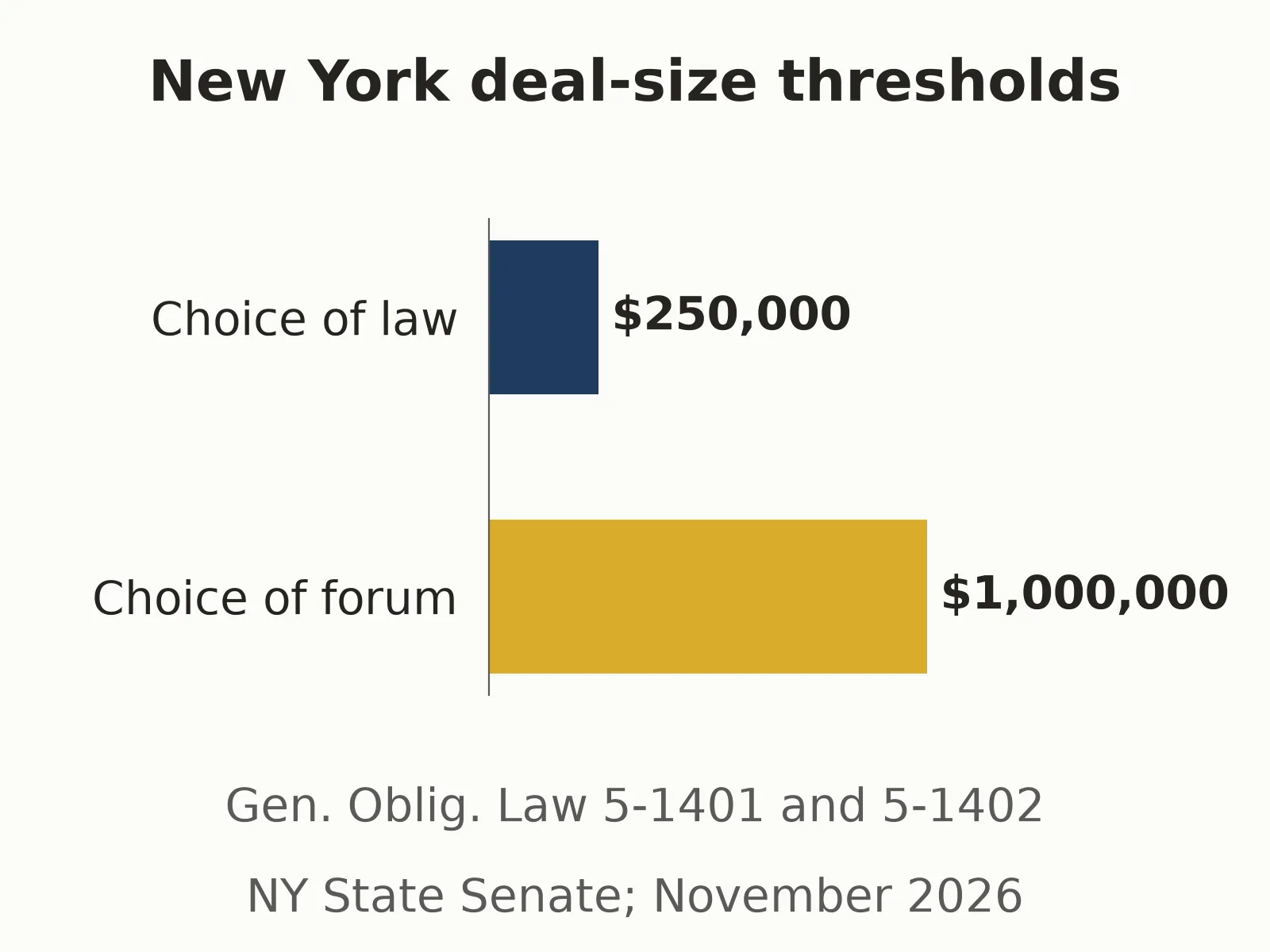
The $250,000 figure is the minimum transaction size for choosing New York law under section 5-1401 without a reasonable relation to the state, and $1 million is the minimum for section 5-1402, the choice of forum statute. Section 5-1402 lets a person sue a foreign corporation or a non-resident in New York's courts where three things are true: the contract chose New York law under section 5-1401, it relates to a transaction covering in the aggregate not less than $1 million, and the other party agreed in it to submit to the jurisdiction of New York's courts. The forum threshold is four times the choice of law threshold (calculated: $1,000,000 divided by $250,000), as figure 2 shows. Where section 5-1402 applies and the parties agreed that New York law governs, Rule 327(b) of New York's Civil Practice Law and Rules (CPLR) says the court shall not stay or dismiss the action on the ground of inconvenient forum.
These are New York rules, and this guide does not state the rule for any other US state.
Which rules override the chosen law?
Mandatory statutes can apply despite the clause, and in Ontario a choice can be avoided on the ground of public policy. Table 2 lists four rules from the statutes cited in this guide that limit or change how the parties' choice works.
| Rule | Jurisdiction | Effect on the clause |
|---|---|---|
| Arthur Wishart Act, section 10 | Ontario | Void for claims under the Act |
| Employment Standards Act, section 5 | Ontario | No contracting out of standards |
| Section 5-1401 exclusions | New York | Labor, personal, household services contracts excluded |
| UCC section 1-301(a) | New York | New York law for resident consumers |
Franchise agreements. Section 10 of Ontario's Arthur Wishart Act (Franchise Disclosure), 2000 says that any provision in a franchise agreement "purporting to restrict the application of the law of Ontario or to restrict jurisdiction or venue to a forum outside Ontario is void with respect to a claim otherwise enforceable under this Act in Ontario". A clause choosing New York law therefore does not remove a franchisee's claims under that Act that are enforceable in Ontario. Section 11 makes void any waiver or release by a franchisee of a right given under the Act.
Employment. Under section 3(1) of Ontario's Employment Standards Act, 2000, the employment standards apply where the employee's work is to be performed in Ontario, subject to listed exceptions. Section 5(1) says, subject to an exception for a greater contractual or statutory benefit, that no employer or employee shall contract out of or waive an employment standard, and that any such contracting out or waiver is void.
The Supreme Court of Canada dealt with a foreign law clause in an Ontario work relationship in Uber Technologies Inc. v. Heller, 2020 SCC 16, an appeal from Ontario. A standard form driver agreement was governed by the laws of the Netherlands and required mediation and arbitration in the Netherlands, with the place of arbitration in Amsterdam and up-front fees of US$14,500. The court held the arbitration clause unconscionable and invalid. As a further example of an arbitration agreement whose validity might never be decided if a court stepped aside, it named "a foreign choice of law clause that circumvents mandatory local policy, such as a clause that would prevent an arbitrator from giving effect to the protections in Ontario employment law".
Does the international sale of goods convention apply?
It can. Ontario's International Sales Conventions Act gives the United Nations Convention on Contracts for the International Sale of Goods (CISG) the force of law in Ontario. Under Article 1 of the Convention, it applies to contracts of sale of goods between parties whose places of business are in different Contracting States. The status table kept by the United Nations Commission on International Trade Law (UNCITRAL), read in November 2026, lists the Convention as in force for Canada since May 1, 1992 and for the United States since January 1, 1988.
Section 6 of the Ontario Act lets the parties exclude the Convention by expressly providing in the contract that it does not apply, or otherwise in accordance with the Convention's own terms. A clause that only says "the laws of Ontario" has no such express words, and this guide does not state how a court would treat it under the Convention's own terms. Parties who want Ontario's domestic sale of goods rules should say so in the contract.
Does the chosen law set the deadline to sue?
Not always: Ontario treats limitation periods as substantive law, so they follow the law that governs the claim, while New York treats them as procedural and applies its own time rules to cases in its courts. The difference can end a claim, as the Ontario claimant in 2138747 Ontario, Inc. v. Samsung C&T Corp. found in New York in 2018.
In Ontario, section 23 of the Limitations Act, 2002 says that, for the purpose of applying the rules regarding conflict of laws, the limitations law of Ontario or any other jurisdiction is substantive law. Lilydale shows the same link between the governing law and the time limit: the claim was in time under Ontario law and out of time under Alberta law. The basic period under section 4 is two years from the day the claim was discovered, and section 15 sets an ultimate period of 15 years from the act or omission.
New York's general period for an action on a contract is six years under CPLR section 213(2), subject to the exceptions that subdivision lists, which include article 2 of the UCC. In 2138747 Ontario, Inc. v. Samsung C&T Corp., the Court of Appeals said that choice of law provisions typically apply only to substantive issues and that statutes of limitations are considered procedural. That brings in CPLR section 202, known as the borrowing statute. Under it, an action on a claim that accrued outside New York cannot be started after the time limited by the laws of either New York or the place where the claim accrued, except where the claim accrued in favor of a New York resident.
In that case, decided June 12, 2018, an Ontario renewable energy developer had signed a non-disclosure agreement (NDA) in September 2008. The NDA was to be "governed by, construed and enforced in accordance with the laws of the State of New York" and gave courts in New York exclusive jurisdiction. The claims accrued in Ontario on September 26, 2009. An Ontario corporation that had taken an assignment of them sued in New York in October 2014, about five years later (our calculation). That was inside New York's six years and outside Ontario's two. The Court of Appeals held that the borrowing statute applied, and the claims were dismissed as out of time.
Ontario lets business parties plan for this. Under section 22(5) of the Limitations Act, 2002, a limitation period other than the ultimate period may be varied or excluded by a business agreement made on or after October 19, 2006, and a business agreement is one in which none of the parties is a consumer. An Ontario-law contract between businesses can therefore state its own claim period. This guide does not cover New York's rules on contractual limitation periods; our guide to warranties and representations compares the two time limits for claims on a false statement.
How do you choose between Ontario and New York law?
Choose by looking at where the contract is performed, where a claim would be brought, the size and type of the deal and the statutes that apply either way, then make the forum and time-limit terms fit. Table 3 compares the two systems on the points covered above.
| Point | Ontario | New York |
|---|---|---|
| Test for the choice | Bona fide, legal, public policy | Statute; courts generally enforce |
| Dollar threshold | Not part of the test | $250,000 (law), $1 million (forum) |
| Contract with no clause | Closest and most real connection | Described as center of gravity |
| Contract claim period | 2 years from discovery (basic) | 6 years (general period) |
| Limitation periods are | Substantive law | Procedural law |
A drafting checklist for a cross-border contract follows from those points:
- Check that every document names the same law. That includes each order form and statement of work, as our guide to the master service agreement explains for services deals.
- Check the New York statute before relying on it. Confirm that the transaction covers at least $250,000 and that the contract is not one of the three kinds section 5-1401 leaves out (labor or personal services; personal, family or household services; the UCC section 1-301(c) cases). Below that amount, or for those contracts, the statute does not apply, although it leaves the enforcement of other choice of law provisions untouched.
- Pair the law with the forum. Decide the court or the arbitration seat at the same time, and keep the $1 million threshold in section 5-1402 in mind if you want the statutory right to sue a non-resident in New York's courts.
- Check which time limit applies. Where a claim accrues in Ontario, New York's borrowing statute can hold a claimant who is not a New York resident to Ontario's two-year period, as in Samsung, so do not assume a New York clause brings New York's six years with it. An Ontario-law contract between businesses can state its own claim period under section 22(5) of the Limitations Act, 2002.
- Say whether the sales convention applies. For goods, exclude the CISG in express words if you want domestic sale of goods law.
- Check the mandatory statutes. Where the Arthur Wishart Act or the Employment Standards Act, 2000 applies, read the contract against the sections described above, because those rights cannot be waived by agreement.
- Read the clause with the rest of the contract. The chosen law also controls how an entire agreement clause and an indemnification clause are read.
An illustrative clause for an Ontario-law supply contract might read: "This Agreement and any dispute arising out of or relating to it are governed by the laws of the Province of Ontario and the federal laws of Canada applicable in Ontario, without regard to conflict of laws rules. The United Nations Convention on Contracts for the International Sale of Goods does not apply to this Agreement." It is a sample that shows the parts, not wording to copy into a contract without advice.
The closing words about conflict of laws are not required in New York. IRB-Brasil held that parties need not expressly exclude conflict of laws principles to get New York substantive law, and the guarantee the court ruled on had no such words. The clauses in Douez and Heller carried words of that kind.
Frequently asked questions
What is governing law in a contract?
Governing law in a contract is the legal system the contract names to decide its validity, meaning, performance and enforcement. A typical clause says the agreement "shall be governed by the laws of the Province of Ontario" or of the State of New York. It answers which rules apply, not which court hears the case.
Is governing law the same as jurisdiction?
No. Governing law decides which rules apply to the contract, and jurisdiction, also called forum selection, decides which court hears the dispute. New York has separate statutes for the two choices, sections 5-1401 and 5-1402 of the General Obligations Law. A court in one place can apply the law of another, so the two choices need not match.
What happens if a contract has no governing law clause?
A court chooses the law. In Ontario the test is which jurisdiction has the closest and most real connection to the contract, judged by its subject matter, the place of performance, the place of contracting and where the parties are based. The New York Court of Appeals has described a center of gravity, or grouping of contacts, approach in contract cases. Either way, the choice is left to the court.
Can parties with no link to New York choose New York law?
Yes, for a transaction covering at least $250,000. New York General Obligations Law section 5-1401 allows the choice whether or not the contract bears a reasonable relation to the state, except for contracts for labor or personal services, for personal, family or household services, and to the extent UCC section 1-301(c) provides otherwise. Below that amount the statute does not apply, but it says it does not limit the enforcement of a choice of law provision in any other contract.
Does the chosen law decide the limitation period?
It depends on the court. Ontario's Limitations Act, 2002 treats limitations law as substantive, so the period follows the law that governs the claim. New York treats limitation periods as procedural and applies its borrowing statute. In 2138747 Ontario, Inc. v. Samsung C&T Corp. in 2018, that statute held an Ontario claimant whose claims accrued in Ontario to Ontario's two-year period, despite a New York clause.
Can a clause avoid Ontario franchise or employment rules?
Not where those statutes apply. Section 10 of the Arthur Wishart Act makes void any franchise agreement term that purports to restrict the application of Ontario law to a claim enforceable under that Act in Ontario. Section 5 of the Employment Standards Act, 2000 makes any contracting out of an employment standard void, and the standards apply, subject to listed exceptions, where the work is to be performed in Ontario.
Does choosing Ontario law exclude the sale of goods convention?
A clause that names only the laws of Ontario contains no express exclusion. The United Nations Convention on Contracts for the International Sale of Goods (CISG) has the force of law in Ontario, and Ontario's International Sales Conventions Act lets parties exclude it by expressly providing in the contract that it does not apply, or otherwise under the Convention's own terms. This guide does not state how a court would treat a bare choice of Ontario law under those terms, so add express words if you want domestic law.
Are the words "without regard to conflict of laws" needed?
Not in New York. The Court of Appeals held in IRB-Brasil in 2012 that parties need not expressly exclude conflict of laws principles for New York substantive law to apply. In an Ontario international arbitration, Article 28 of the Model Law on International Commercial Arbitration reads a reference to a state's law as its substantive law unless the parties say otherwise. The clauses in Douez v. Facebook and Uber Technologies Inc. v. Heller included such words anyway.
Conclusion
A governing law clause is one sentence, but it sets the rules for every other sentence in the contract. Ontario courts ordinarily apply a choice that is bona fide, legal and consistent with public policy, and New York's statute permits a choice of its own law for transactions of at least $250,000 outside the excluded contracts. Both keep some rules beyond the reach of the clause, and the two treat limitation periods differently enough to end a claim. Choose the law together with the forum and say in the contract whether the sales convention applies. In an Ontario-law contract between businesses, the claim period can be written in as well.
How Mayo Law can help
Mayo Law advises businesses on contracts governed by Ontario or New York law, with offices in Toronto and New York. Joseph Mayo is licensed in both jurisdictions. Our lawyers draft and negotiate governing law, forum and arbitration terms in supply, services, licensing and purchase agreements, and review existing contracts when a dispute raises the question of which rules apply. We offer a paid one-hour consultation, because a lawyer reviews the agreement and the facts in depth. Our contract lawyer page describes the service, and our international business practice handles deals that touch both countries.
Disclaimer
This guide is for general information only and is not legal advice. Reading it does not create a solicitor-client or attorney-client relationship. Statutes and court decisions are summarized as of November 2026 and may change; the rules that apply to a contract depend on its wording, its chosen law and the facts. Mayo Law provides legal services in Ontario and New York.