

Contents
- Quick answer
- How to dissolve an LLC in NY: what are the stages?
- Who has to approve the dissolution?
- How do you wind up a New York LLC?
- How do you file articles of dissolution in NY?
- Which tax returns and accounts must be closed?
- How is dissolving a New York corporation different?
- How does Ontario compare for a Canadian owner?
- Frequently asked questions
- Conclusion
- How Mayo Law can help
- Disclaimer
Closing a company takes more than stopping work. This guide explains how to dissolve an LLC in NY, step by step: the members' decision, the winding up, the articles of dissolution and the final tax filings, with the path for a New York corporation beside it. An LLC is a limited liability company. It is written with Canadian owners in mind: people who set up a New York company through our cross-border business law practice or with an incorporation lawyer and who now want to close it without leaving loose ends.
The New York rules below come from the state's Limited Liability Company Law, its Business Corporation Law (BCL), the New York Department of State and the New York State Department of Taxation and Finance, as those sources read in November 2026. Other states, and Ontario, do it differently, and one section near the end sets Ontario beside New York.
Quick answer
To dissolve a New York LLC, the members approve the dissolution under the operating agreement or by a majority in interest, wind up, pay creditors, file articles of dissolution with the Department of State within 90 days after dissolution and the start of winding up, and file final tax returns. The $60 filing needs no Tax Department consent.
How to dissolve an LLC in NY: what are the stages?
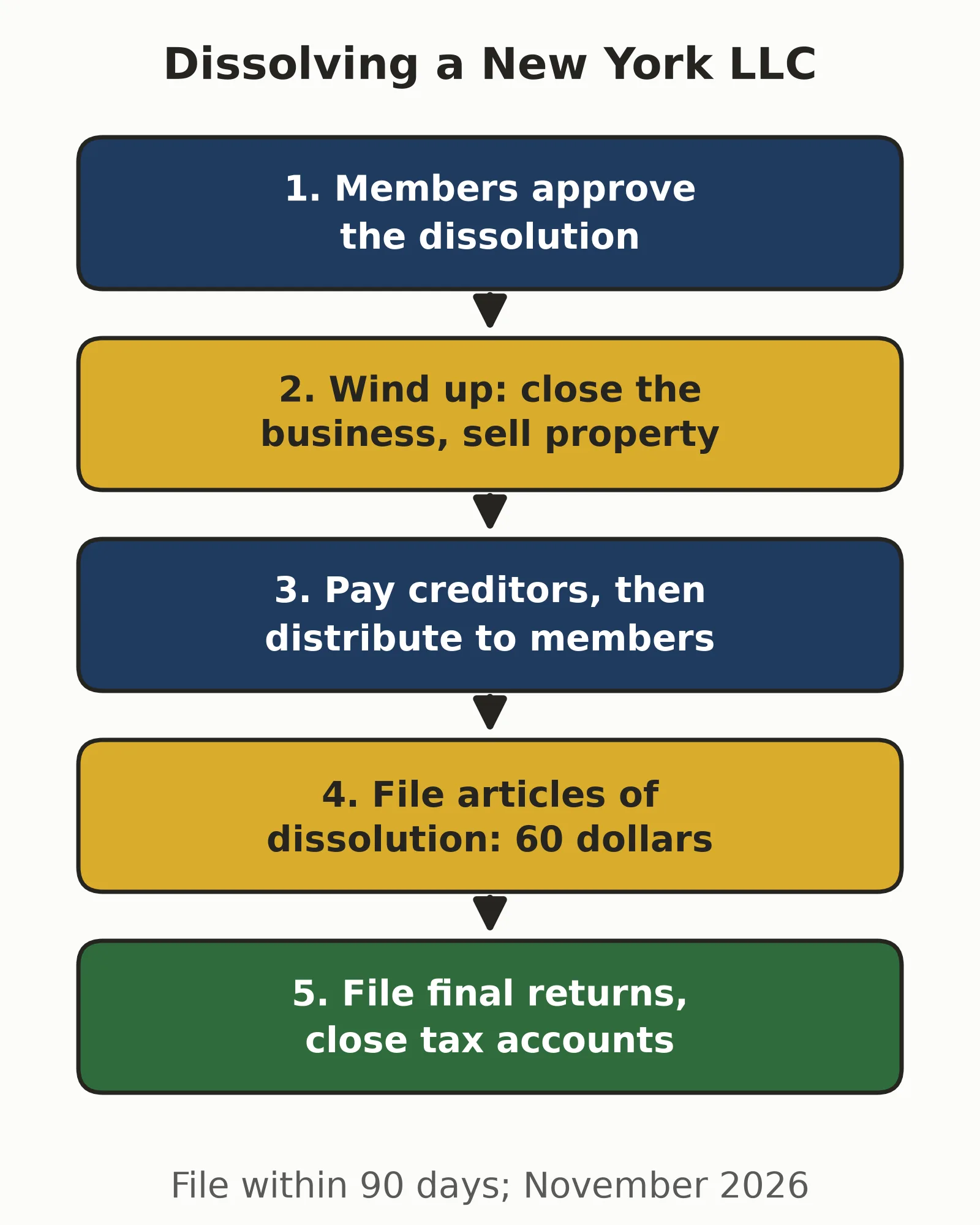
Dissolving a New York LLC means ending the company in three legal stages: an event of dissolution, the winding up of its affairs, and the filing of articles of dissolution, which cancels the articles of organization. In practice the work falls into five steps: the members' approval, the winding up, the payment of creditors and distributions to members, the articles of dissolution, and the final tax returns. The first stage is set by section 701 of the Limited Liability Company Law. It says an LLC is dissolved, and its affairs must be wound up, on the first of these to occur:
- the latest date for dissolution stated in the articles of organization, or the time set in the operating agreement (if neither sets one, the LLC has perpetual existence);
- an event that the operating agreement names as a dissolution event;
- the vote or written consent of at least a majority in interest of the members, subject to any greater or lesser percentage the operating agreement requires;
- a time when the LLC has no members, unless the legal representative of the last member agrees in writing, within 180 days or the period in the operating agreement, to continue it;
- a decree of judicial dissolution under section 702.
A planned closing by the members' decision uses the third route, and Figure 1 shows the five steps on that route. Filing the articles of dissolution is the last, public stage. Under section 705(b), the cancellation of the articles of organization takes effect when the articles of dissolution are filed, and section 705(c) says that cancellation does not affect the liability of the members during the winding up and termination. Section 701(c) adds a caution for older companies: an LLC whose original articles of organization were filed before that subdivision took effect stays under the earlier version of the section unless its operating agreement says otherwise, so the owners of an older LLC should check which version applies.
Who has to approve the dissolution?
Unless the operating agreement sets a different percentage, section 701(a)(3) requires the vote or written consent of at least a majority in interest of the members or, where there is more than one class or group of members, of each class or group. So the first document to read is the operating agreement. It may require a higher or lower percentage, name its own dissolution events, or set out who carries out the winding up. Our guide to the New York LLC operating agreement explains what that document usually covers.
Section 701(a)(3) accepts either a members' vote or a written consent. Keep the record of whichever is used, because the articles of dissolution must state the event giving rise to the filing.
A member leaving does not, by itself, end the company. Under section 701(b), unless the operating agreement provides otherwise, the death, retirement, resignation, expulsion, bankruptcy or dissolution of a member does not dissolve the LLC. The company continues unless, within 180 days of that event, a majority in interest of the remaining members vote or agree in writing to dissolve it. Section 701(a)(5) also lists a decree of judicial dissolution under section 702, a separate court process this guide does not cover. Owners of a general partnership, not an LLC, should read our guide to partnership dissolution instead.
How do you wind up a New York LLC?
Winding up means settling the LLC's business: under section 703, the members, unless the operating agreement provides otherwise, close the business, dispose of its property, discharge its liabilities and distribute whatever remains. Section 703(b) lets the people winding up do those things in the company's name, and also prosecute and defend lawsuits for it. On cause shown, the Supreme Court in the judicial district where the LLC has its office may wind up the company's affairs on a member's application and may appoint a receiver or liquidating trustee.
Section 704 then fixes the order in which the assets go out:
- First priority: creditors, including members who are creditors, to the extent permitted by law, either by payment or by setting up adequate reserves;
- Second priority: except as the operating agreement provides, members and former members who are owed distributions under sections 507 or 509;
- Third priority: except as the operating agreement provides, members, first for the return of their contributions that have not already been returned, and then for their membership interests, in the proportions in which they share distributions.
Creditors come first. That order is the reason a careful winding up starts with a full list of what the company owes, including leases, loans, taxes and amounts owed to the members themselves.
How do you file articles of dissolution in NY?
Articles of dissolution are filed with the New York Department of State, Division of Corporations, online or on paper, with a $60 statutory fee, within 90 days following the dissolution and the commencement of winding up. That deadline is in section 705(a), and the Department of State repeats it on its page for articles of dissolution of domestic limited liability companies. The 90-day clock under section 705(a) starts at the dissolution and the start of winding up, not at the filing of a tax return or the closing of a bank account.
Section 705(a) requires the articles of dissolution to set out:
- the name of the LLC and, if it has been changed, the name under which it was formed;
- the date its articles of organization were filed;
- the event giving rise to the filing of the articles of dissolution;
- any other information the people filing decide to include.
The Department of State adds a practical warning: the name of the LLC and the filing date of its articles of organization must exactly match the Department's records, and both should be checked on its website before filing. Every New York State LLC dissolution filing is handled by the Department's Division of Corporations. Paper filings go to the Division at One Commerce Plaza, 99 Washington Avenue, Albany, NY 12231. For online filings, the Department says that within minutes of filing the filer receives an email filing acknowledgement with the filing receipt attached as a PDF.
What does the filing cost?
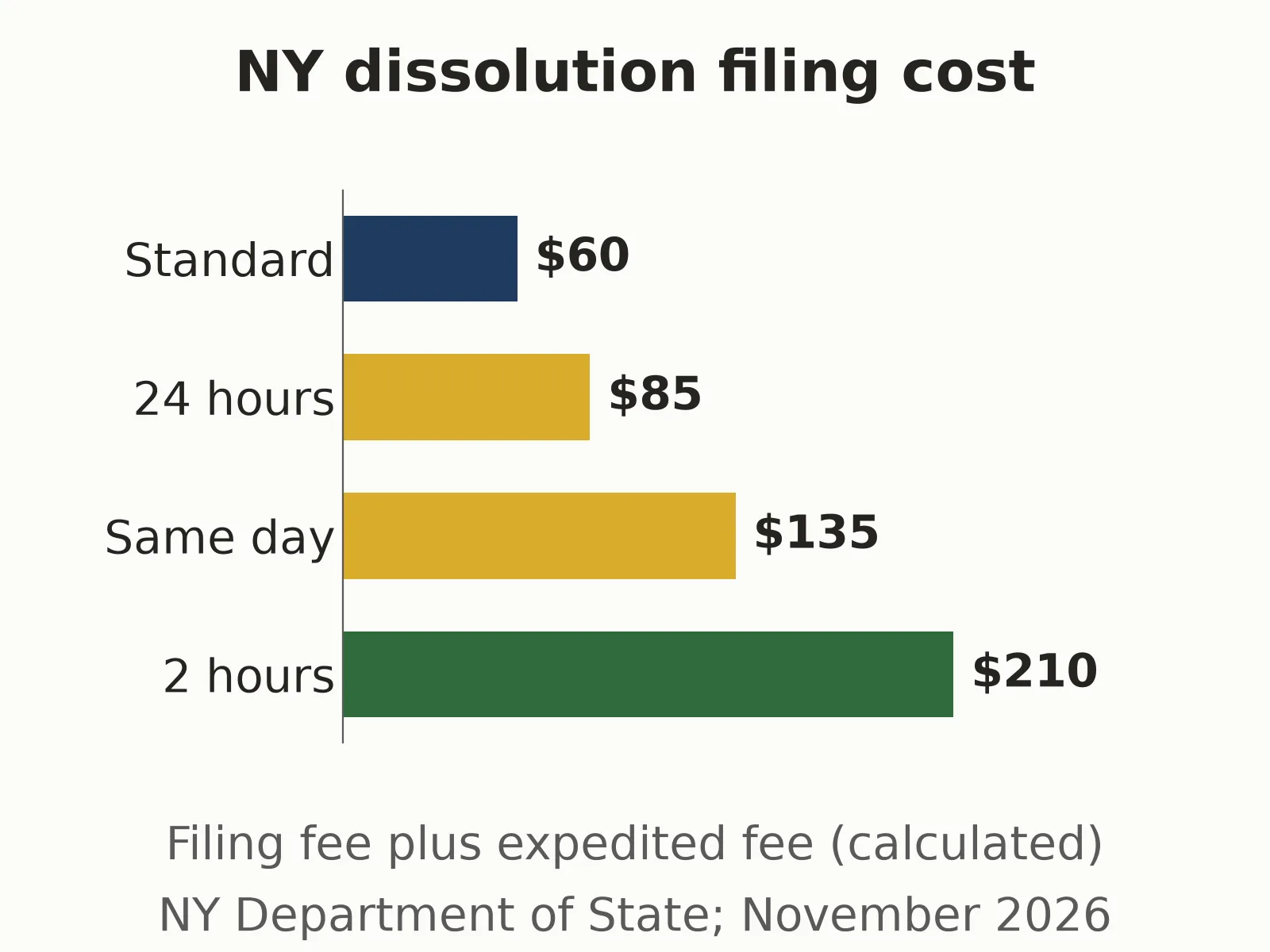
The filing fee is $60, and expedited handling is optional. As of November 2026 the Department of State lists three expedited services, each an additional, non-refundable fee per document: $25 for processing within 24 hours, $75 for processing the same day, and $150 for processing within 2 hours. The totals in the table are our arithmetic: the $60 filing fee plus the added fee. All of these are New York State fees, in US dollars.
| Service | Added fee | Total with filing |
|---|---|---|
| Standard filing | $0 | $60 |
| Within 24 hours | $25 | $85 |
| Same day | $75 | $135 |
| Within 2 hours | $150 | $210 |
Which tax returns and accounts must be closed?
A New York LLC does not need the New York Tax Department's consent to dissolve, but it still has tax filings to finish: New York's annual filing fee form and a final sales tax return where they apply, and its final federal returns. On the consent point the New York State Department of Taxation and Finance is direct. Its page on the voluntary dissolution of a New York corporation (updated December 12, 2025) states that written consent from the Tax Department is not required for limited liability companies. The filings below are separate from that question.
- New York annual filing fee: the Tax Department says Form IT-204-LL must be filed every year by an LLC that is a disregarded entity for federal income tax purposes, or that must file a New York partnership return, when it has income, gain, loss or deduction from New York sources in that tax year. The fee is $25 for a disregarded LLC. For an LLC taxed as a partnership it runs from $25 to $4,500, based on New York source gross income for the preceding tax year. An LLC with no income, gain, loss or deduction from New York sources in the year should not file the form, whether or not it is dormant.
- New York sales tax: Tax Bulletin ST-265 (updated June 13, 2014) says a business that closes must file a final sales tax return within 20 days after it ceases operations. Once the final return is processed, the Tax Department inactivates the sales tax account and the Certificate of Authority is no longer valid.
- Federal income tax: on its page on limited liability companies (reviewed October 10, 2026), the Internal Revenue Service (IRS) treats a domestic LLC with two or more members as a partnership, and a single-member LLC as disregarded, unless the LLC files Form 8832 and elects to be taxed as a corporation. On its closing a business page (reviewed July 21, 2026), the IRS says a partnership must file Form 1065 for the year the business closes, and a corporation must file Form 1120 for that year and Form 966 if it adopts a resolution or plan to dissolve.
- Employees and contractors: the same IRS page calls for a final Form 941 or Form 944 for the quarter in which the last wages are paid, a Form W-2 for each employee, and Form 1099-NEC to report payments to contractors for services in the closing year, where the payments reach the IRS reporting threshold.
- Employer identification number (EIN): to cancel the EIN and close the IRS business account, the IRS asks for a letter giving the legal name of the business, the EIN, the business address and the reason for closing. It adds that it cannot close the account until all necessary returns are filed and all taxes owed are paid.
Which federal forms apply depends on how the LLC is taxed, so the list above is a map, not a tax plan. A US accountant should confirm the final returns for the company and for each member.
How is dissolving a New York corporation different?
A New York business corporation dissolves by filing a certificate of dissolution under section 1003 of the Business Corporation Law, and unlike an LLC it cannot file until the Tax Department has given its written consent. Four differences matter most.
The vote. Under BCL section 1001, dissolution is authorized at a meeting of shareholders. A majority of the votes of all outstanding shares entitled to vote is enough for a corporation whose certificate of incorporation expressly says so, or one incorporated after section 1001(b) took effect. Other corporations need two-thirds of those votes. Section 1002 allows a certificate of incorporation to provide its own route.
The tax consent. BCL section 1004(a) bars the Department of State from filing the certificate unless the consent of the state Department of Taxation and Finance is attached. The Tax Department describes a three-step process: obtain its written consent (Form TR-960, Consent to Dissolution of a Corporation), prepare the certificate of dissolution, and file with the Department of State. To give consent it checks that the corporation has filed all its returns, including a final corporation tax return marked "Final", and has paid all its taxes. A corporation that has done business in New York City and incurred tax liability to the city also needs the consent of the city's Commissioner of Finance under section 1004(b).
The filing. The certificate must give the corporation's name, the date its certificate of incorporation was filed, the name and address of each officer and director, a statement that the corporation elects to dissolve, and the manner in which the dissolution was authorized. The fee is $60, according to the Department of State's page on the certificate of dissolution for domestic business corporations, which also offers the same three expedited options.
The order of events. The corporation is dissolved on the day the Department of State files the certificate, and the Department says the law does not allow any other effective date. Winding up follows. Section 1005 says that after dissolution the corporation carries on no business except to wind up its affairs, and section 1006 lets it keep functioning for that purpose, including suing and being sued in its own name. An LLC runs the other way round: it is dissolved and starts winding up first, then files within the 90-day period.
A corporation that simply stops filing does not escape this. The Tax Department says that if a New York corporation does not file franchise tax returns or pay franchise taxes for two or more years, the Secretary of State may dissolve it by proclamation, and that a corporation dissolved by proclamation must keep filing returns and paying taxes or fees until it is reinstated or completes a voluntary dissolution. Owners still deciding between the two entity types can compare them in our guide on an LLC versus a corporation in New York.
How does Ontario compare for a Canadian owner?
Ontario follows the corporation pattern, not the LLC pattern: an Ontario business corporation files articles of dissolution under Ontario's Business Corporations Act, pays a $25 fee and needs the consent of Ontario's Ministry of Finance. Ontario's page on service times and fees (updated September 29, 2026) lists a dissolution at $25, with a service standard of 2 business days online and 15 business days by mail. It also says that dissolutions require consent from the Ministry of Finance, which provides it electronically within 30 business days of receiving the request from the Ontario Business Registry. Our guide to articles of dissolution in Ontario covers that process in full.
The table sets the three filings side by side. Of the three, only a New York LLC files without a consent from a tax or finance department. Each fee is the one its own government lists, so read the New York and Ontario columns separately.
| Item | NY LLC | NY corporation | Ontario corporation |
|---|---|---|---|
| Document filed | Articles of dissolution | Certificate of dissolution | Articles of dissolution |
| Filed with | NY Department of State | NY Department of State | Government of Ontario |
| Government fee | $60 | $60 | $25 |
| Consent needed | None | Tax Department | Ministry of Finance |
A Canadian resident who owns the New York company has a second set of questions at home. The Canada Revenue Agency (CRA) lists its foreign reporting forms on one page (dated April 9, 2026), including Form T1134 for information returns relating to foreign affiliates and Form T1135, the foreign income verification statement. Whether either form, or a gain or loss on the wind-up, has to be reported for the closing year depends on the owner's own facts. That is a question for a Canadian tax adviser, and this guide does not give tax advice. Canadians at an earlier stage can start with our guide on whether a Canadian can own a business in the US.
Frequently asked questions
How much does it cost to dissolve an LLC in NY?
The New York Department of State charges a $60 filing fee for articles of dissolution, as of November 2026. Expedited handling is optional and adds $25 for processing within 24 hours, $75 for the same day or $150 for processing within 2 hours, so the filing costs between $60 and $210. Accounting and legal fees, and any taxes owed, are separate.
How long do you have to file articles of dissolution in New York?
Section 705(a) of the Limited Liability Company Law requires articles of dissolution to be filed within 90 days following the dissolution and the commencement of winding up of the LLC. The period therefore runs from the dissolution event and the start of winding up, not from the day the business stopped trading or filed its last tax return.
Does a New York LLC need tax clearance to dissolve?
No. The New York State Department of Taxation and Finance states that written consent from the Tax Department is not required for limited liability companies. A New York business corporation is different: the Department of State will not file its certificate of dissolution without that consent attached. The LLC still has tax filings to complete, such as a final sales tax return if it is registered for sales tax, and its final federal returns.
Can you dissolve a New York LLC online?
Yes. The New York Department of State says online filing of articles of dissolution is available through its website, and that within minutes of filing the filer receives an email filing acknowledgement with the filing receipt attached as a PDF. Paper filings are still accepted by the Division of Corporations in Albany with the same $60 fee.
What happens to the LLC's debts when it dissolves?
Debts are dealt with during the winding up. Section 704 of New York's Limited Liability Company Law puts creditors first, by payment or by adequate reserves, before any distribution to members. Section 705(c) adds that cancelling the articles of organization does not affect the liability of the members during the period of winding up and termination.
Does a member leaving dissolve a New York LLC?
Not by itself. Under section 701(b) of New York's Limited Liability Company Law, unless the operating agreement provides otherwise, a member's death, retirement, resignation, expulsion, bankruptcy or dissolution does not dissolve the LLC. The company continues unless a majority in interest of the remaining members vote or agree in writing to dissolve it within 180 days after the event.
What if a New York corporation never files for dissolution?
The New York Tax Department says that if a corporation does not file franchise tax returns or pay franchise taxes for two or more years, the Secretary of State may dissolve it by proclamation. A corporation dissolved that way must continue to file returns and pay taxes or fees until it is reinstated or completes the voluntary dissolution process.
Conclusion
In outline, that is how to dissolve an LLC in NY. A New York LLC dissolution follows the order set out above. The members approve the dissolution, by a majority in interest under section 701 unless the operating agreement sets another percentage. The people in charge wind up the business and pay creditors before members under sections 703 and 704. The articles of dissolution, with the $60 fee, go to the Department of State within 90 days following the dissolution and the start of winding up. The final tax filings close the file. A corporation takes a different road, because New York will not accept its certificate of dissolution without the Tax Department's consent. Canadian owners should also check what the closing means on the Canadian side before the last distribution is made.
How Mayo Law can help
Mayo Law advises business owners on both sides of the Canada and US border, with offices in Toronto and New York. Joseph Mayo is licensed in Ontario and New York, so Mayo Law can look at a New York dissolution and its Ontario counterpart together. We review the operating agreement or by-laws, prepare the members' or shareholders' approval and the dissolution filing, and work alongside your accountants on the tax filings. Mayo Law offers a paid one-hour consultation, because a lawyer reviews your situation in depth. You can learn more on our cross-border business law and incorporation lawyer pages.
Disclaimer
This guide is for general information only. It is not legal or tax advice, and reading it does not create a solicitor-client or attorney-client relationship. Laws, fees and forms change, and the right steps depend on your company's documents and facts. Mayo Law provides legal services in Ontario and New York.