

Contents
- Quick answer
- What are warranties and representations?
- Warranty vs representation: what differs?
- What are the remedies for a false statement?
- Representations vs warranties in a sale of goods
- How long do the statements survive?
- How do knowledge qualifiers and schedules work?
- How do they connect to indemnification?
- Frequently asked questions
- Conclusion
- How Mayo Law can help
- Disclaimer
Warranties and representations are the statements of fact that one side of a deal makes to the other, and they decide who bears the loss when a statement turns out to be untrue. They are a central section of share and asset purchase agreements, and a shorter version sits in supply, licensing and services contracts. For a company that signs contracts on both sides of the border, the wording matters twice, because Ontario and New York differ on parts of the claim and on the time limit. Our cross-border business lawyers negotiate these clauses for buyers, sellers and suppliers in both places.
This guide explains what each word means, what a buyer can claim when a statement is false, how long the statements last after closing, and how knowledge qualifiers, disclosure schedules and indemnities change the result. Statutes and court decisions are cited as of November 2026.
Quick answer
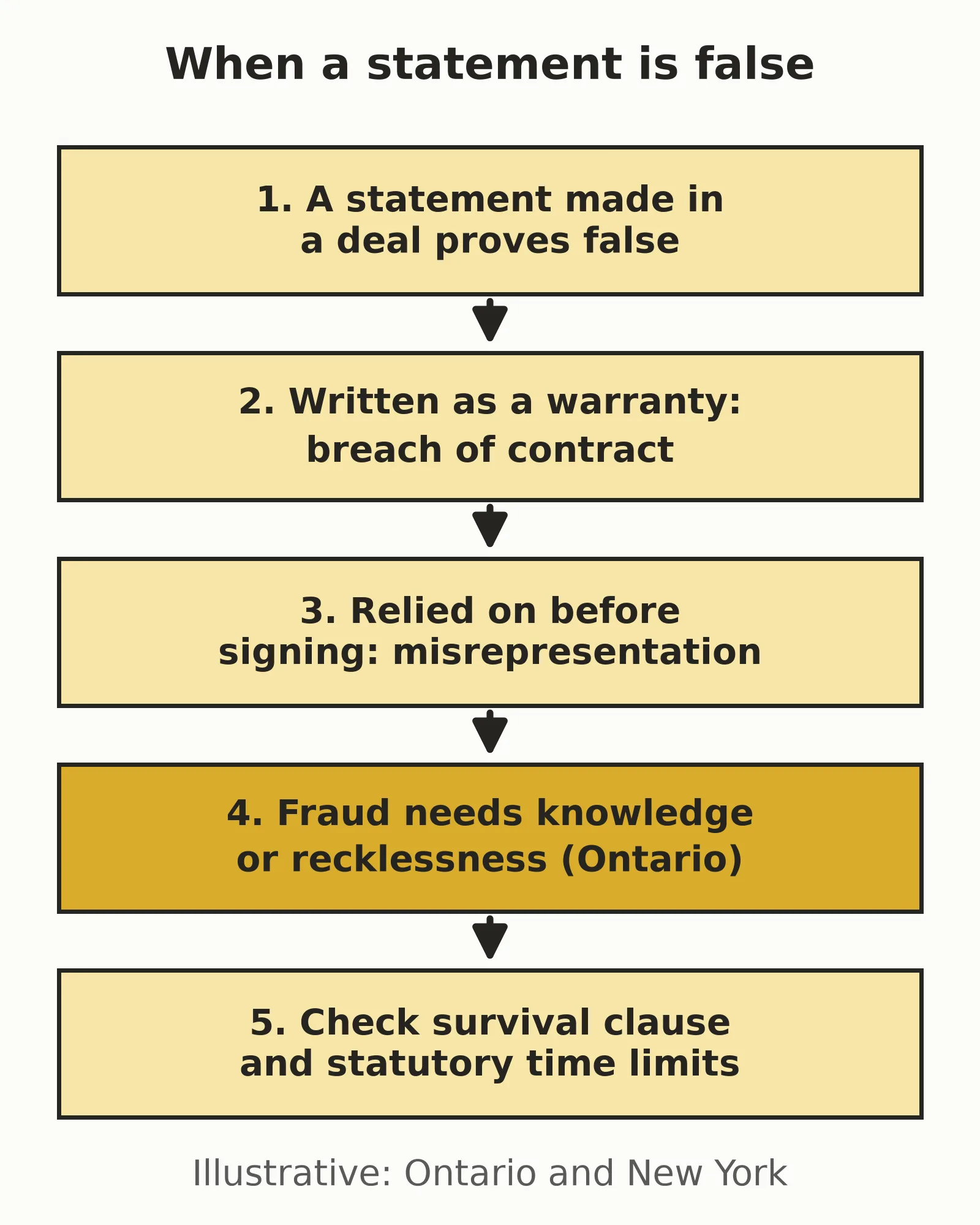
A representation is a statement of fact that induces the other party to sign, and a warranty is a contract promise that the statement is true. A false warranty is a breach of contract. A false representation can support a misrepresentation claim, and fraud requires knowledge that the statement was false or, in Ontario, recklessness.
What are warranties and representations?
Warranties and representations are two labels for statements about the business, the goods or the party itself. A representation asserts a fact to persuade the other side to contract, and a warranty is a term of the contract promising that the fact is true. Most commercial agreements use both words together ("the Seller represents and warrants that"), so the same sentence does both jobs.
The statements usually cover a set list of subjects. In a purchase of a business, which usually follows a letter of intent, they deal with ownership of the shares or assets, the accuracy of the financial statements, taxes, employees, material contracts, intellectual property, litigation and compliance with law. In a supply or services contract they are shorter: authority to sign, title to the goods, quality and compliance with specifications. Our guide to stock purchase agreements shows where the section sits in a share deal and how due diligence feeds it.
Three related terms are worth separating early:
- Representation: a statement of past or present fact, made before or at signing, that the other side relies on in deciding to sign.
- Warranty: a term of the contract. Ontario's Sale of Goods Act defines a warranty in a sale of goods as an agreement "collateral to the main purpose of the contract, the breach of which gives rise to a claim for damages but not to a right to reject the goods and treat the contract as repudiated" (section 1(1)).
- Covenant: a promise about future conduct, such as running the business in the ordinary course until closing. A covenant is performed or broken later; a representation or warranty is true or false on the date it is given.
Labels do not settle the question in Ontario. Under section 12(2) of the Sale of Goods Act (e-Laws currency date November 10, 2026), whether a stipulation is a condition or a warranty "depends in each case on the construction of the contract, and a stipulation may be a condition, though called a warranty in the contract". New York's Uniform Commercial Code (UCC) takes a similar view of form for goods: under UCC section 2-313, a seller creates an express warranty without using "formal words such as 'warrant' or 'guarantee'".
Warranty vs representation: what differs?
The difference is the kind of claim each one supports. A warranty is enforced as a term of the contract, while a representation that induced the contract can also be pursued as a misrepresentation, a claim outside the contract with its own elements. The table sets out the contrast before the detail.
| Point | Representation | Warranty |
|---|---|---|
| What it is | Statement of fact | Contract promise |
| Typical claim | Misrepresentation | Breach of contract |
| Maker's knowledge | Fraud: knowledge; in Ontario also recklessness | Not an element |
Reliance is an element of fraud in both places. In Ontario, the Supreme Court of Canada summarized civil fraud in Bruno Appliance and Furniture, Inc. v. Hryniak, 2014 SCC 8, an Ontario appeal, as four elements: a false representation made by the defendant, some level of knowledge of the falsehood (through knowledge or recklessness), the false representation caused the plaintiff to act, and the plaintiff's actions resulted in a loss. In New York, the Court of Appeals stated the elements of common-law fraud in Ambac Assurance Corp. v. Countrywide Home Loans, Inc. (2018) as a misrepresentation or material omission of fact that was false and known to be false, made to induce the other party to rely on it, justifiable reliance, and injury. The court called justifiable reliance a "fundamental precept" of a fraud claim.
A breach of warranty claim rests on the contract term itself. For goods, New York's UCC section 2-313 says an affirmation of fact or promise that relates to the goods and "becomes part of the basis of the bargain" creates an express warranty that the goods will conform to it. A statement of the seller's opinion, or of the value of the goods, does not.
What are the remedies for a false statement?
For goods, the remedy for a false warranty is damages under each jurisdiction's sales statute, and the remedy for a false representation depends on whether the claim is framed as fraud, as negligent misrepresentation or as breach of the contract term that repeats it. Each route has its own test.
Breach of warranty
For a sale of goods, both jurisdictions put the measure of damages in a statute. In Ontario, section 51 of the Sale of Goods Act says a buyer facing a breach of warranty may not reject the goods for that reason alone, but may set the breach up against the price or sue for damages. The measure is "the estimated loss directly and naturally resulting in the ordinary course of events from the breach", and for a warranty of quality it is presumed to be the difference between the value of the goods at delivery and the value they would have had if they had answered to the warranty.
New York's rule is close. Under UCC section 2-714, the measure of damages for breach of warranty is the difference, at the time and place of acceptance, between the value of the goods accepted and the value they would have had if they had been as warranted, "unless special circumstances show proximate damages of a different amount".
Those two statutes apply to goods. This guide does not set out the case law on damages for a warranty in a share purchase or a services contract; in practice the contract itself usually spells out the remedy through an indemnity.
Misrepresentation
Fraud carries the most demanding test, because Bruno Appliance in Ontario and Ambac in New York both require knowledge of the falsehood (in Ontario, knowledge or recklessness). Negligent misrepresentation is the middle ground in Ontario. In Deloitte & Touche v. Livent Inc. (Receiver of), 2017 SCC 63, also an Ontario appeal, the Supreme Court of Canada said that in cases of pure economic loss from negligent misrepresentation two factors are determinative in the proximity analysis that grounds a duty of care: the defendant's undertaking and the plaintiff's reliance. Where a party gives a representation in circumstances that invite reasonable reliance, it becomes obligated to take reasonable care, and reliance that falls outside the scope of the undertaking falls outside the duty.
This guide does not cover rescission, the remedy of setting a contract aside. Whether it is available for a particular misrepresentation turns on case law and facts that need advice on the specific deal.
Remedies the contract takes away
Parties often narrow these remedies in the contract. New York's UCC section 2-719 lets a sale agreement limit or alter the measure of damages, and a remedy that is "expressly agreed to be exclusive" becomes the sole remedy, unless it fails of its essential purpose. In Ambac, the Court of Appeals enforced a sole remedy clause between sophisticated parties and held that a plaintiff cannot avoid such a clause by re-characterizing its claims for breach of representations and warranties. In Ontario, section 53 of the Sale of Goods Act allows a right, duty or liability that would arise by implication of law to be "negatived or varied by express agreement". Our guide to limitations of liability covers caps and exclusions in more depth.
Representations vs warranties in a sale of goods
In a sale of goods the line between representations and warranties narrows, because New York's statute turns a seller's affirmations of fact into express warranties and both statutes add terms that the parties never wrote down. That is one reason a warranty in contracts for goods works differently from the negotiated statements in a share deal. Each jurisdiction has its own list.
- Ontario, implied terms: section 13 of the Sale of Goods Act implies a condition that the seller has the right to sell, a warranty of quiet possession and a warranty that the goods are free from undisclosed charges. Section 15 implies conditions of fitness for a purpose the buyer made known and of merchantable quality where goods are bought by description from a seller who deals in them.
- Ontario, express terms: under section 15, an express warranty or condition does not negative one implied by the Act unless it is inconsistent with it.
- New York, express warranties: UCC section 2-313 creates them from any affirmation of fact, promise, description, sample or model that becomes part of the basis of the bargain.
- New York, implied warranty: UCC section 2-314 implies a warranty that goods are merchantable where the seller is a merchant in goods of that kind, unless it is excluded or modified.
- New York, disclaimers: under UCC section 2-316, wording that excludes the implied warranty of merchantability must mention merchantability and, in a writing, be conspicuous. Expressions such as "as is" or "with all faults" exclude implied warranties unless the circumstances indicate otherwise.
The practical point for a supplier is that a warranty in contract wording is only part of the picture. An Ontario or New York buyer of goods may hold statutory warranties as well. Removing them takes an express agreement, a course of dealing or a binding usage in Ontario (section 53), and wording that meets the UCC's tests in New York.
How long do the statements survive?
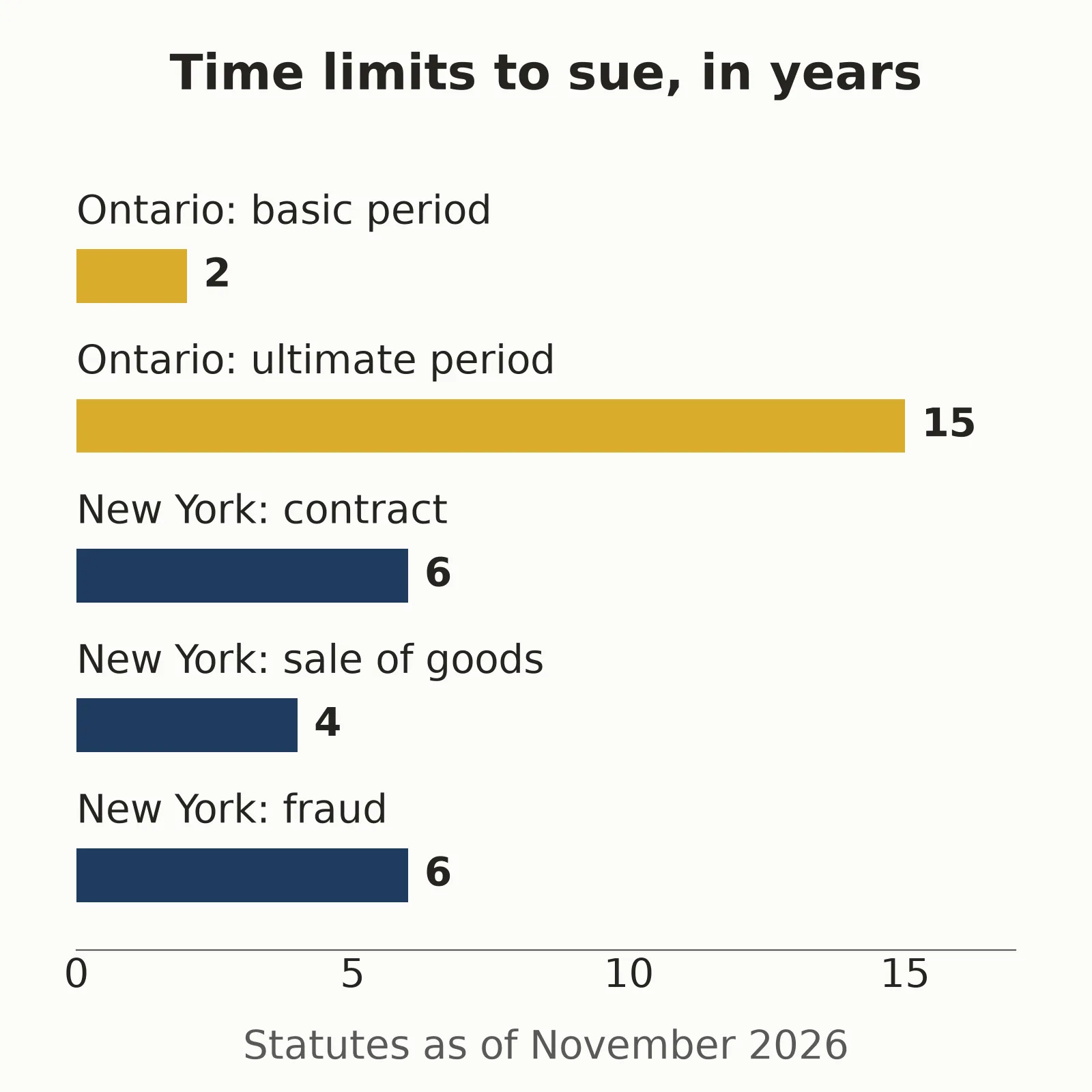
How long warranties and representations last depends on the survival clause and on each jurisdiction's limitation statute: Ontario generally allows two years from discovery of the claim, and New York allows six years from the breach for most contract claims. The statutes differ on when the clock starts and on what the parties may change.
| Point | Ontario | New York |
|---|---|---|
| Contract claim | 2 years from discovery | 6 years from breach |
| Fraud claim | 2 years from discovery | 6 years, or 2 from discovery |
| Shorter by agreement | Yes, business agreements | Yes, in writing |
| Longer by agreement | Yes, with conditions | Not before a claim accrues |
Ontario
Section 4 of the Limitations Act, 2002 (e-Laws currency date November 10, 2026) bars a proceeding after the second anniversary of the day the claim was discovered. Under section 5, a claim is discovered when the person knew, or reasonably ought to have known, of the loss, its cause, who caused it and that a proceeding would be an appropriate way to remedy it. A person is presumed to have known those things on the day of the act or omission unless the contrary is proved. Section 15 adds an ultimate limit: no proceeding after the 15th anniversary of the act or omission.
Section 22 says a limitation period applies despite any agreement to vary or exclude it, with exceptions. The one that matters for commercial deals is section 22(5): in a business agreement, meaning one where no party is a consumer under the Consumer Protection Act, 2002, the two-year period may be varied or excluded by an agreement made on or after October 19, 2006, and "vary" includes extend, shorten and suspend. The 15-year period may be varied in a business agreement, but it may be suspended or extended only once the claim has been discovered. Whether a particular survival clause actually varies the period depends on its wording.
New York
Under section 213 of the Civil Practice Law and Rules (CPLR), an action on a contractual obligation must be started within six years, and an action based on fraud within the greater of six years from accrual or two years from the time the plaintiff discovered the fraud or could with reasonable diligence have discovered it. Contracts for the sale of goods have their own rule in UCC section 2-725: four years after the cause of action accrues, and a breach of warranty occurs when tender of delivery is made unless the warranty explicitly extends to future performance. The original agreement may reduce that period to not less than one year but may not extend it.
The New York clock for a false statement starts early. In ACE Securities Corp. v. DB Structured Products, Inc. (2015), the Court of Appeals held that where representations and warranties concern the characteristics of their subject as of the date they are made, "they are breached, if at all, on that date", so the six-year period ran from the signing of the contract and not from a later refusal to repurchase. The court added that parties may agree to a separate obligation whose breach does not arise until a future date.
New York lets parties shorten the period but not stretch it in advance. CPLR section 201 requires an action to be started within the statutory time unless "a shorter time is prescribed by written agreement" and says no court shall extend the time limited by law. Under General Obligations Law section 17-103, a promise to extend a contract limitation period is effective if it is made after the cause of action has accrued, in a signed writing. In Deutsche Bank National Trust Co. v. Flagstar Capital Markets Corp. (2018), the Court of Appeals held that a contract clause meant to delay the start of the limitation period for breach of representations and warranties was inconsistent with New York law and public policy.
A worked example
The dates below are illustrative. Suppose a share purchase closes on January 15, 2027, the seller's statements are given as of that date, and the buyer discovers on March 1, 2028 that one of them was false.
- New York law, no survival clause: a contract claim would have to be started by January 15, 2033, six years from the date the statement was made.
- Ontario law, no survival clause: the basic period would end on March 1, 2030, the second anniversary of discovery, and the ultimate period would end on January 15, 2042.
- Either law, 18-month survival clause: if the clause validly sets the time for claims, the deadline moves to July 15, 2028, which leaves this buyer about four and a half months after discovery.
The example shows why the governing law clause and the survival clause are read together. Ontario's Limitations Act, 2002 says that, for conflict of laws purposes, the limitations law of Ontario or any other jurisdiction is substantive law (section 23), which is one reason the governing law clause matters for timing as well as for meaning.
How do knowledge qualifiers and schedules work?
Knowledge qualifiers, materiality qualifiers and disclosure schedules are drafting tools that narrow what warranties and representations promise, and each one moves risk from the party giving the statement back to the party receiving it. They are negotiated clause by clause.
- Knowledge qualifier: the statement is limited to what the giver knows ("to the Seller's knowledge, no claim is threatened"). Agreements usually define whose knowledge counts and whether it includes what those people ought to have known after reasonable inquiry.
- Materiality qualifier: the statement is true "in all material respects", or is breached only where the result would be material to the business. Buyers often ask that these words be read out when losses are calculated, so the qualifier is not counted twice.
- Disclosure schedule: a list of exceptions attached to the agreement. It is drafted so that a fact disclosed against a statement is an exception to that statement. Sellers want general disclosure of everything in the data room; buyers want each exception tied to a specific section.
- Buyer's own knowledge: some agreements say the buyer may claim even if it knew of the problem before closing, and others say it may not. Fraud requires that the false statement caused the plaintiff to act (Ontario) or was justifiably relied on (New York), so what the buyer knew can matter to a misrepresentation claim.
- Timing: statements are usually given at signing and repeated at closing. The date matters for the New York limitation period, because under the ACE decision a statement about facts as of a date is breached, if at all, on that date.
These tools interact with the entire agreement clause, which is the usual place where a contract deals with statements made in emails, pitch decks and meetings that never reached the final document.
How do they connect to indemnification?
The indemnity is the payment mechanism for a breach of the reps and warranties: the statements define what was promised, and the indemnification clause defines who pays, how much, for how long and through what process. One without the other leaves a gap.
A typical purchase agreement links warranties and representations to the indemnity in four ways. The indemnity covers losses "arising from any breach of the representations and warranties". The survival clause sets the period in which an indemnity claim may be made. Caps, baskets and deductibles limit the amount. And an exclusive remedy clause often says the indemnity is the only route for a breach, with a carve-out for fraud. In Ambac, the New York Court of Appeals enforced a sole remedy clause between sophisticated parties. Our guide to the indemnification clause explains how Ontario and New York courts read those terms, including when the time limit on an indemnity claim starts.
Both sides of a business purchase negotiate these points. For a seller, the targets are short survival, a low cap, an exclusive remedy and wide disclosure. For a buyer, they are longer survival for the fundamental statements (title, authority, taxes), a fraud carve-out and the right to claim regardless of what diligence revealed. A contract lawyer who works under both systems can test each clause against the Ontario and New York limitation rules before the deal is signed.
Frequently asked questions
Are warranties and representations the same thing?
No. A representation is a statement of fact made to induce the other party to enter the contract, and a warranty is a term of the contract promising that a fact is true. Contracts usually combine them in one phrase, and a false statement may support a breach of contract claim and, where its elements are met, a misrepresentation claim.
Why do contracts say "represents and warrants"?
The two words describe two kinds of claim. A warranty is a term of the contract, so a false warranty is claimed as a breach of contract. A representation that induced the deal may also support a misrepresentation claim, which has its own elements such as reliance and, for fraud, knowledge that the statement was false (or recklessness, in Ontario). The words alone do not decide the outcome: for goods, Ontario's Sale of Goods Act and New York's UCC section 2-313 both look past the label.
What happens if a warranty in a contract is breached?
A breach of warranty is a breach of contract. For goods, Ontario's Sale of Goods Act (section 51) presumes, for a warranty of quality, that the loss is the difference between the value of the goods at delivery and the value they would have had if they had answered to the warranty. New York's UCC (section 2-714) uses a similar difference in value unless special circumstances show damages of a different amount. Many commercial contracts replace or limit that remedy with an indemnity.
How long do representations and warranties last after closing?
That depends on the survival clause and on the limitation statute of the governing law. As of November 2026, Ontario's basic limitation period is two years from discovery, with a 15-year ultimate period, and New York allows six years from breach for most contract claims and four years for the sale of goods. A written commercial contract can shorten those periods in both places, within limits such as New York's one-year floor for sales of goods.
Can a survival clause extend the time to sue in New York?
Not in advance. CPLR section 201 allows a shorter time by written agreement and says no court shall extend the time limited by law. General Obligations Law section 17-103 gives effect to a signed promise to extend that is made after the cause of action has accrued. In its 2018 Flagstar decision, the Court of Appeals held that a clause meant to delay the start of the limitation period for breach of representations and warranties was inconsistent with New York law and public policy.
Does a buyer have to prove reliance on a false statement?
For fraud, yes in substance, in both jurisdictions. The Supreme Court of Canada lists as an element that the false representation caused the plaintiff to act, and the New York Court of Appeals requires justifiable reliance. A claim for breach of warranty is a contract claim: for goods, New York's UCC section 2-313 asks whether the affirmation of fact became part of the basis of the bargain.
Do "as is" words remove warranties in a sale of goods?
In New York, UCC section 2-316 says expressions such as "as is" or "with all faults" exclude implied warranties unless the circumstances indicate otherwise, and a disclaimer of merchantability must mention merchantability and, in a writing, be conspicuous. In Ontario, section 53 of the Sale of Goods Act lets implied terms be negatived or varied by express agreement.
Conclusion
Warranties and representations look like boilerplate, but they allocate risk in a commercial deal. The wording of each statement shapes the kind of claim, the remedy clause shapes what a breach is worth, and the survival clause shapes how long the exposure lasts. Ontario starts its two-year clock at discovery and lets business parties vary it; New York starts its six-year clock on the date of a statement about facts as of that date, and lets parties shorten the period but not postpone it. A contract that crosses the border has to work under both sets of rules.
How Mayo Law can help
Mayo Law advises buyers, sellers and suppliers on contracts governed by Ontario or New York law, with offices in Toronto and New York. Joseph Mayo is licensed in both jurisdictions. Our lawyers draft and negotiate representations and warranties, disclosure schedules, survival periods and indemnities in share and asset purchase agreements and in supply, licensing and services contracts, and review existing agreements when a statement has proved untrue. We offer a paid one-hour consultation, because a lawyer reviews the agreement and the facts in depth. Our contract lawyer page describes the service, and our international business practice handles deals that touch both countries.
Disclaimer
This guide is for general information only and is not legal advice. Reading it does not create a solicitor-client or attorney-client relationship. Statutes and court decisions are summarized as of November 2026 and may change; the rules that apply to a contract depend on its wording, its governing law and the facts. Mayo Law provides legal services in Ontario and New York.