

Contents
- Quick answer
- What is partnership dissolution?
- What causes the dissolution of a partnership?
- How do you dissolve a partnership step by step?
- Who gets paid first in a winding up?
- What notice do third parties need?
- What goes in a partnership dissolution agreement?
- Can the business continue after a partner leaves?
- Frequently asked questions
- Conclusion
- How Mayo Law can help
- Disclaimer
Partnership dissolution is the legal step that changes the partners' relationship and starts the winding up of the business. In Ontario the rules sit in the Partnerships Act, and in New York they sit in Article 6 of the Partnership Law. Both statutes let partners set their own terms on many points, and both supply default rules when the agreement is silent or was never written down. The two sets of rules are close but not identical, so in a cross-border business matter it matters which law governs the partnership.
This guide covers general partnerships. It explains how to dissolve a partnership: what triggers a dissolution, the steps to wind up, the order in which creditors and partners are paid, the notice third parties need and what a dissolution agreement should record. The section numbers below reflect the Ontario and New York statutes as of November 10, 2026. Limited partnerships and limited liability partnerships are outside this guide.
Quick answer
In Ontario and New York, a general partnership is dissolved when its term ends, when a partner ends it by notice (Ontario) or express will (New York) and no term was fixed, on a partner's death, insolvency (Ontario) or bankruptcy (New York), or by court order. Most Ontario causes yield to the partners' agreement. Winding up follows.
What is partnership dissolution?
Partnership dissolution is the change in the partners' relationship that happens when a partner stops being associated in carrying on the business, and it starts the winding up instead of ending the firm on the spot. That is how section 60 of New York's Partnership Law defines it: the change in the relation of the partners caused by any partner ceasing to be associated in the carrying on, as distinguished from the winding up, of the business. Section 61 adds that on dissolution the partnership is not terminated but continues until the winding up of partnership affairs is completed.
Section 38 of Ontario's Partnerships Act likewise keeps the partners' authority alive for the winding up. After the dissolution of a partnership, each partner's authority to bind the firm, and the partners' other rights and obligations, continue so far as is necessary to wind up the affairs of the partnership and to complete transactions begun but unfinished at the time of the dissolution, but not otherwise.
In Ontario and New York, a partnership dissolution has three separate moments. Dissolution is the event. Winding up a partnership is the process of finishing open work, collecting what is owed, selling assets and paying debts. The end comes only when the winding up is complete, which is how section 61 of the New York Partnership Law puts it.
Dissolution does not wipe out what partners already owe. Under section 10 of the Ontario Act, every partner in a firm is liable jointly with the other partners for all debts and obligations of the firm incurred while that person is a partner. Section 67 of the New York statute says the dissolution of the partnership does not of itself discharge the existing liability of any partner.
What causes the dissolution of a partnership?
In Ontario and New York, a general partnership is dissolved by the end of its term or project, by one partner's notice or express will when no term was fixed, by a partner's death, insolvency or bankruptcy, by an event that makes the business unlawful, or by a court order. The table shows where each cause sits in the Ontario Act and in section 62 of the New York Partnership Law.
| Cause | Ontario | New York |
|---|---|---|
| Fixed term ends | Section 32(a) | Section 62(1)(a) |
| Single project ends | Section 32(b) | Section 62(1)(a) |
| No fixed term | Notice, section 32(c) | Express will, section 62(1)(b) |
| Death of a partner | Section 33(1) | Section 62(4) |
| Insolvency or bankruptcy | Section 33(1) | Section 62(5) |
| Unlawful business | Section 34 | Section 62(3) |
| Court order | Section 35 | Section 63 |
In Ontario, sections 32 and 33 apply "subject to any agreement between the partners". That wording matters most for death and insolvency. Without a clause that says otherwise, section 33 provides that every partnership is dissolved as regards all the partners by the death or insolvency of a partner. Section 34 of the Ontario Act is different: an event that makes the business unlawful dissolves the partnership "in every case".
Where an Ontario partnership has no fixed term, section 32(c) lets a partner dissolve it by giving the others notice of the intention to dissolve. The partnership is dissolved from the date mentioned in the notice, or, if no date is mentioned, from the date the notice is communicated. Under section 26 of the Ontario Act, where the partnership was originally constituted by deed, a notice in writing signed by the partner giving it is sufficient.
Section 62 of the New York Partnership Law lists three further causes. Section 62(1)(c) lists dissolution by the express will of all the partners who have not assigned their interests or suffered them to be charged for their separate debts. Section 62(1)(d) lists the expulsion of a partner in good faith under a power in the partnership agreement. Section 62(2) recognizes that a partner can dissolve by express will at any time even in contravention of the agreement, where no other provision of the section permits the dissolution. A New York partner who dissolves in contravention of the agreement faces a claim: under section 69, the other partners have a right to damages for breach of the agreement.
When can a court dissolve a partnership?
In Ontario and New York, a court can dissolve a partnership on a partner's application when a statutory ground is shown. The grounds in section 35 of the Ontario Partnerships Act and section 63 of the New York Partnership Law are close to each other:
- Incapacity: a partner is found incapable as defined in Ontario's Substitute Decisions Act, 1992, or in New York is declared incompetent in a judicial proceeding or shown to be of unsound mind.
- Inability to perform: a partner becomes incapable of performing that partner's part of the partnership contract. Ontario's wording requires this to be permanent.
- Harmful conduct: a partner is guilty of conduct that is calculated to (Ontario) or tends to (New York) prejudicially affect the carrying on of the business.
- Breach of the agreement: a partner wilfully or persistently breaches the partnership agreement, or behaves so that it is not reasonably practicable to carry on the business in partnership with that partner.
- Losses: the business of the partnership can only be carried on at a loss.
- Fairness: circumstances make it just and equitable (Ontario) or equitable (New York) to dissolve.
In Ontario, the incapacity ground aside, the grounds based on a partner's inability, conduct or breach are available only against a partner other than the partner suing.
How do you dissolve a partnership step by step?
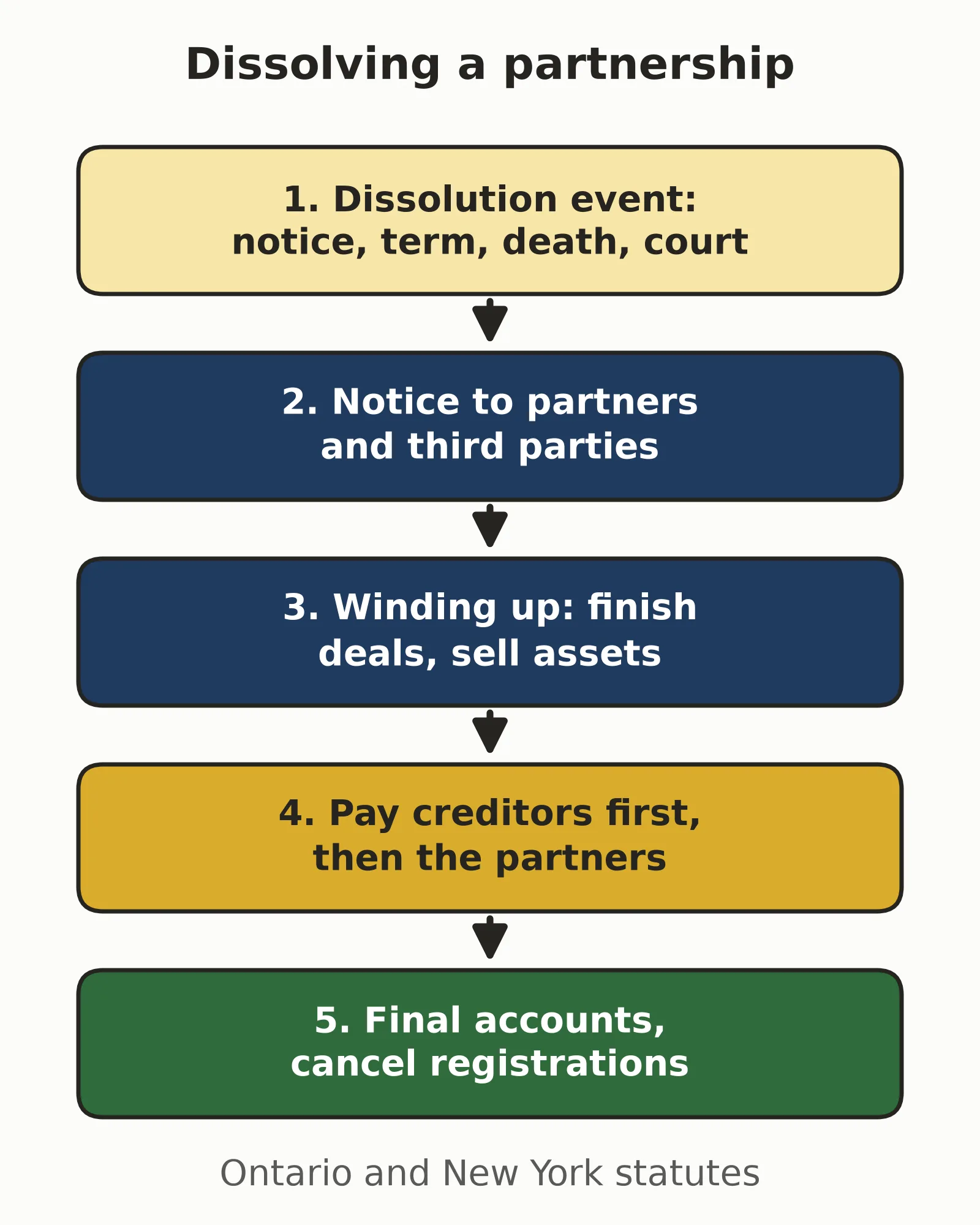
To dissolve a partnership, read the agreement, trigger the dissolution the way the agreement or the statute allows, tell the people who deal with the firm, wind up the business, pay everyone in the statutory order, and then close the registrations and tax accounts. Each step below names the rule behind it.
- Step 1: Read the partnership agreement. The Ontario Partnerships Act and the New York Partnership Law both defer to it on many points. Ontario's rules on term, notice, death and insolvency, and on the final accounts, apply "subject to any agreement", and New York's distribution rules apply "subject to any agreement to the contrary". A clause on notice periods, buyouts or valuation usually decides more than the statute does.
- Step 2: Trigger the dissolution properly. Where the default rule is notice, put the notice in writing, state the date of dissolution and keep proof of when it reached each partner. In Ontario that date controls under section 32(c).
- Step 3: Tell third parties. Give direct notice to creditors, customers, suppliers, landlords and lenders, and publish a notice of the partnership dissolution for everyone else. The notice section below explains why this protects each partner.
- Step 4: Wind up the business. Finish open contracts, collect receivables and sell assets. In Ontario, section 38 continues each partner's authority for that purpose only. In New York, section 68 gives the right to wind up to the partners who have not wrongfully dissolved the partnership, unless otherwise agreed. In both places a partner can ask a court to take over the winding up: section 39 in Ontario, and section 68, upon cause shown, in New York.
- Step 5: Pay debts and settle the accounts. Outside creditors come first. The payment section below sets out the order and a worked example.
- Step 6: Update or cancel registrations. In Ontario that means the firm name registration under the Business Names Act. In New York it means the business certificate filed with the county clerk.
- Step 7: File the final tax returns. For United States federal tax, the Internal Revenue Service (IRS) says a partnership must file Form 1065 for the year it closes, check the "final return" box, and check the "final K-1" box on each Schedule K-1. The IRS closing checklist, last reviewed on July 21, 2026, also lists Form 4797 for sales of business property, Form 8594 if the business is sold, and cancelling the employer identification number (EIN). Canadian, state and provincial tax filings are a separate subject outside this guide.
In Ontario, partners still owe each other candour during the winding up. Section 28 of the Ontario Act binds partners to render true accounts and full information of all things affecting the partnership to any partner or the partner's legal representatives.
Who gets paid first in a winding up?
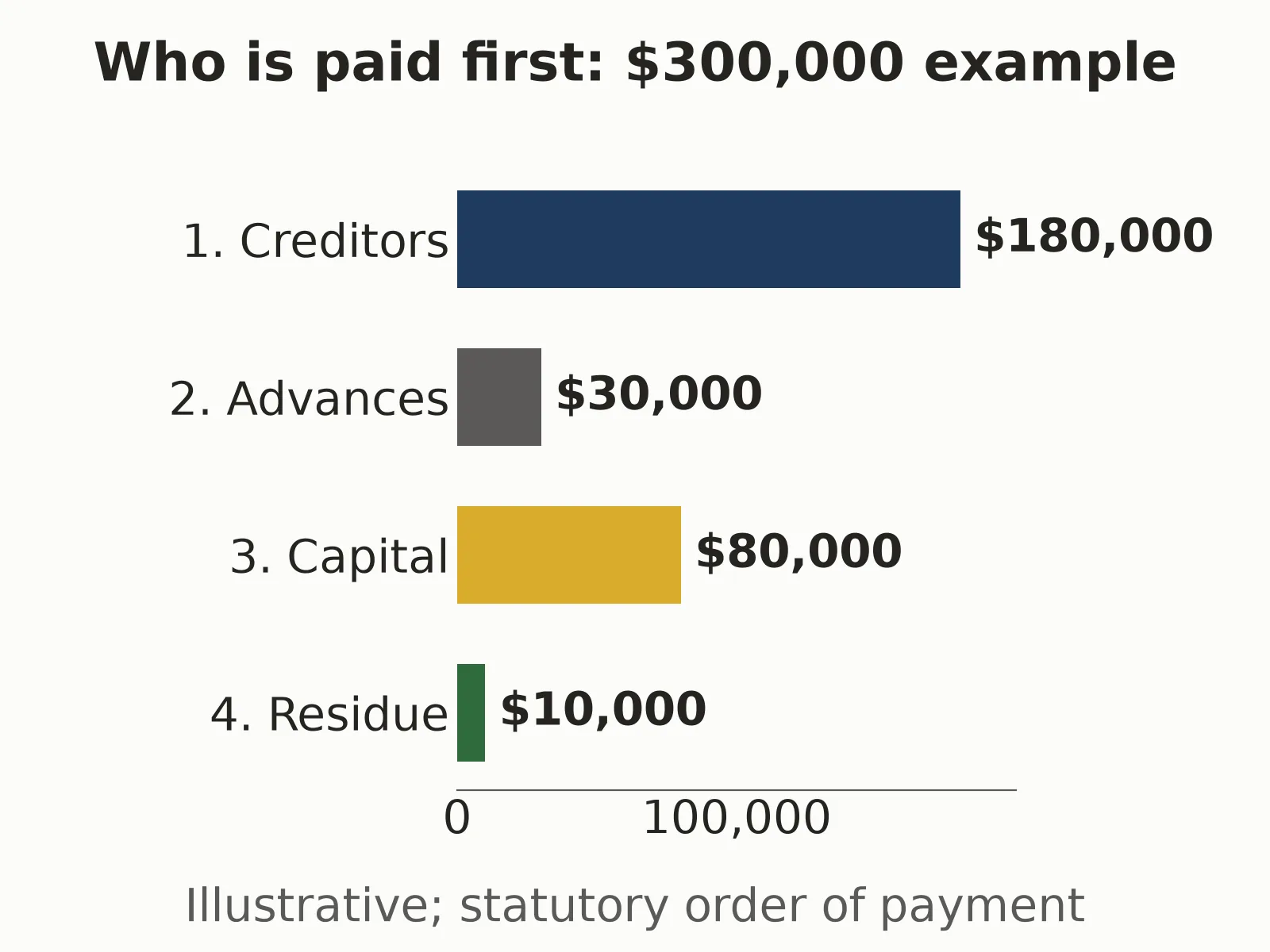
By default in Ontario and New York, outside creditors are paid first, then amounts the firm owes partners apart from capital and profits, then the partners' capital, and last what is left for the partners as profits. Section 44 of the Ontario Act and section 71 of the New York Partnership Law set four parallel ranks, and both let the partners agree on something different between themselves. Ontario calls the second rank advances and divides the final residue in the proportion in which profits are divisible.
| Rank | Ontario, section 44 | New York, section 71 |
|---|---|---|
| 1 | Creditors who are not partners | Creditors other than partners |
| 2 | Partners' advances | Partners' non-capital claims |
| 3 | Partners' capital | Partners' capital |
| 4 | Residue, by profit share | Partners' profits |
A worked example
Take an illustrative two-partner firm that shares profits equally. After the assets are sold, the firm holds $300,000. It owes $180,000 to outside creditors. Partner A lent the firm $30,000 in addition to her capital. Partner A's capital is $50,000 and Partner B's is $30,000, which makes $80,000 of capital in total.
- Rank 1: $180,000 goes to outside creditors, leaving $120,000.
- Rank 2: $30,000 repays Partner A's advance, leaving $90,000.
- Rank 3: $80,000 returns the partners' capital, leaving $10,000.
- Rank 4: the $10,000 residue is split equally, $5,000 each.
Partner A receives $85,000 in total ($30,000 plus $50,000 plus $5,000) and Partner B receives $35,000 ($30,000 plus $5,000). Together with the $180,000 paid to creditors, that accounts for the full $300,000.
What if the money runs out?
In Ontario and New York, if a general partnership's assets do not cover its debts, the partners make up the difference. In Ontario, section 44 says losses, including losses and deficiencies of capital, are paid first out of profits, next out of capital, and lastly, if necessary, by the partners individually in the proportion in which they were entitled to share profits. In New York, section 71 requires the partners to contribute the amount necessary to satisfy the liabilities, and if any, but not all, of the partners are insolvent or, not being subject to process, refuse to contribute, the others contribute their share and, in the relative proportions in which they share the profits, the additional amount.
That is the practical risk in an Ontario or New York general partnership dissolution: a creditor who is not paid in full out of the firm's assets is not limited to those assets.
What notice do third parties need?
Until third parties have notice of the dissolution, a partner can still be bound by new dealings in the firm's name, so the Ontario Partnerships Act and the New York Partnership Law both reward clear notice: direct notice to people who already dealt with the firm, and a published notice for everyone else.
In Ontario, section 36 says a person who deals with a firm after a change in its constitution is entitled to treat all apparent members of the old firm as still being members until that person has notice of the change. An advertisement in The Ontario Gazette is notice to persons who had no dealings with the firm before the dissolution or change. Section 37 lets any partner publicly give notice of the dissolution and require the other partners to concur in the acts needed to do so.
In New York, section 66 draws a similar line. After dissolution a partner can still bind the partnership, by a transaction that would have bound it had there been no dissolution, to someone who had extended credit to it before the dissolution and had no knowledge or notice of the dissolution. A person who had not extended credit, but knew of the partnership and had no knowledge or notice of the dissolution, is in the same position unless the fact of dissolution was advertised in a newspaper of general circulation in each place where the partnership business was regularly carried on.
Business name registrations
Ontario's Business Names Act requires persons associated in partnership to register the firm name, by all of the partners, unless the name is composed of the partners' names. When registered information changes, section 4 of the Business Names Act requires an amended registration within fifteen days after the change, and it directs the Registrar to cancel a registration if the registrant requests the cancellation. According to Ontario's business registration page, updated on September 28, 2026, partnerships can cancel or dissolve online through the Ontario Business Registry. Our guide to business name registration in Ontario explains how those registrations work.
In New York, section 130 of the General Business Law requires people who conduct business as members of a partnership to file a certificate, naming all the partners, with the clerk of each county in which the business is conducted, subject to the exceptions the section lists. An amended certificate is due within thirty days after a change in the facts. If the business is discontinued, a certificate of discontinuance may be filed with the county clerk who holds the original certificate, executed by a majority of the persons named in the original or last amended certificate.
What goes in a partnership dissolution agreement?
A partnership dissolution agreement records the date of dissolution, who winds up the business, how debts are paid, how assets and any surplus are divided, and what the partners promise each other afterwards. The same document is sometimes called a dissolution of partnership agreement or a partner dissolution agreement. A practical checklist:
- Effective date: the date of dissolution, matching any notice already given.
- Winding up: who carries it out, what they may sign, and what needs every partner's consent.
- Assets: a list of assets, how each is sold or transferred, and who may buy.
- Debts: a list of creditors, the order of payment, and which creditors have agreed to release a partner.
- Final accounts: advances, capital and profit shares, and any agreed change to the statutory order.
- Notices: who sends direct notices, who places the published notice, and who files the registration changes.
- Promises between partners: releases, indemnities for unknown debts, confidentiality and any limits on competing.
- Records and tax: who keeps the books and who files the final returns.
- Disputes: the governing law and how disagreements are resolved.
In New York, an agreement between the partners alone does not release a partner from a creditor's claim. Section 67 of the New York Partnership Law says a partner is discharged from an existing liability by an agreement to that effect between the partner, the partnership creditor and the person or partnership continuing the business. The partners can promise to indemnify one another, but that is a promise between the partners. In Ontario, section 10 of the Partnerships Act makes every partner jointly liable for the firm's debts and obligations incurred while that person is a partner.
Indemnities deserve care in any dissolution of a partnership, because they decide who bears a debt that surfaces later. Our guide to the indemnification clause covers how those promises are drafted, and our contract lawyers review dissolution agreements before they are signed.
Can the business continue after a partner leaves?
In Ontario and New York, yes: if the agreement allows it or the partners agree, the remaining partners can carry on the business and pay out the departing partner instead of liquidating, and both partnership statutes protect the outgoing partner until the accounts are settled.
In Ontario, section 42 deals with partners who carry on the business with the firm's capital or assets without a final settlement of accounts. In the absence of an agreement to the contrary, the outgoing partner or the estate has a choice. One option is the share of the profits made since the dissolution that the court finds attributable to the use of that partner's share of the assets. The other is interest at 5 per cent per annum on the amount of that share. Section 43 makes the amount due to the outgoing partner a debt accruing at the date of the dissolution or death, subject to any agreement. Where the partnership contract gives the continuing partners an option to buy the outgoing partner's interest and they exercise it properly, section 42 of the Ontario Act ends the claim to any further share of profits.
In New York, section 73 gives a retiring partner, or a deceased partner's legal representative, unless otherwise agreed, the right to have the value of the interest ascertained at the date of dissolution. That person receives the amount as an ordinary creditor, with interest or, at that person's option, the profits attributable to the use of the interest. In the cases it lists, section 72 of the New York Partnership Law keeps creditors of the dissolved partnership as creditors of the person or partnership that continues the business.
New York also addresses the partner who dissolves in breach of the agreement. Under section 69, the partners who did not cause the dissolution wrongfully may continue the business in the same name for the agreed term if they all wish to. They must pay the departing partner the value of the interest, less damages, or secure the payment by a bond approved by the court, and indemnify that partner against partnership liabilities. The value of the goodwill of the business is not considered in that valuation. Sections 32 to 44 of the Ontario Act contain no matching rule, which leaves the point to the partnership agreement and the general law.
A buyout clause agreed in advance avoids most of this. Our guide to the buy-sell agreement explains how partners and shareholders set a price and a process before anyone leaves. If the plan is to move the business into a corporation instead, the guide to Ontario business structures compares the options, and for corporations see our guide to articles of dissolution in Ontario.
Frequently asked questions
Is partnership dissolution the same as winding up?
No. Dissolution is the event that changes the partners' relationship, and winding up is the process that follows. Section 61 of the New York Partnership Law says the partnership continues until the winding up of partnership affairs is completed. Section 38 of the Ontario Partnerships Act continues each partner's authority only so far as is necessary to wind up and to complete unfinished transactions.
Can one partner dissolve a partnership without the others?
Often, yes. Where an Ontario partnership has no fixed term, section 32 lets a partner dissolve it by giving notice to the others, subject to any agreement between the partners. In New York, section 62 lets any partner dissolve by express will when no definite term or particular undertaking is specified. A New York partner who dissolves in contravention of the agreement is exposed to damages under section 69.
Are partners still liable for debts after a dissolution?
Yes, for debts that arose while they were partners. Section 67 of the New York statute says dissolution does not of itself discharge the existing liability of any partner. Section 10 of the Ontario Act makes every partner jointly liable for the debts and obligations of the firm incurred while that person is a partner. In New York, section 67 makes a partner's discharge depend on an agreement that includes the creditor.
Does a partnership dissolve when a partner dies?
Under both statutes, yes. Section 33 of the Ontario Act says every partnership is dissolved as regards all the partners by the death or insolvency of a partner, subject to any agreement between the partners. Section 62 of the New York Partnership Law lists the death of any partner as a cause of dissolution. Many partnership agreements include a continuation or buyout clause to deal with a partner's death.
Is a written partnership dissolution agreement required?
Neither the dissolution sections of the Ontario Partnerships Act, sections 32 to 44, nor Article 6 of the New York Partnership Law makes a written dissolution agreement a condition of dissolving. A written agreement is still the usual way to fix the date, the division of assets, responsibility for debts and the promises between the partners, and to prove them later.
Who gets paid first when a partnership is wound up?
In Ontario and New York, creditors who are not partners are paid first by default. Next come amounts the firm owes partners other than capital, which Ontario calls advances, then the partners' capital. Last comes any residue, which section 44 of the Ontario Act divides in the proportion in which profits are divisible and section 71 of the New York Partnership Law ranks as amounts owing to partners in respect of profits. Both sections apply subject to any agreement.
How does the public learn that a partnership was dissolved?
Through a published notice and the public registers. In Ontario, an advertisement in The Ontario Gazette is notice to people who had no earlier dealings with the firm, and the firm name registration can be cancelled. In New York, the dissolution can be advertised in a newspaper of general circulation where the business was carried on, and a certificate of discontinuance can be filed with the county clerk.
Conclusion
A partnership dissolution has a legal order to it: the triggering event, notice to partners and third parties, the winding up, payment in the statutory ranks, and the final accounts and filings. Ontario and New York follow the same broad pattern and differ in the details, including how notice is published, what a departing partner can claim and what happens when a partner dissolves in breach of the agreement. The partnership agreement can change most of the defaults, so it is the first document to read. Existing debts survive the dissolution, which is why creditor releases and indemnities between partners deserve as much attention as the split of assets.
How Mayo Law can help
Mayo Law advises business owners on both sides of the border from offices in Toronto and New York. Joseph Mayo is licensed in Ontario and New York, so Mayo Law can review a partnership agreement, a dissolution notice or a draft dissolution agreement under either law, including for partnerships with partners or creditors in both places. Our business lawyers in Toronto and our international business team handle partnership dissolution, partner exits and buyouts. We offer a paid one-hour consultation, because a lawyer reviews the agreement and the facts in depth before giving a view.
Disclaimer
This guide is for general information only and is not legal advice. Reading it does not create a solicitor-client or attorney-client relationship. Partnership rules depend on the agreement, the facts and the governing law, and statutes change. Speak with a licensed lawyer about your own situation. Mayo Law provides legal services in Ontario and New York.