

Contents
- Quick answer
- What is a corporate minute book?
- What records must an Ontario corporation keep?
- Where and in what form can the records be kept?
- Who can inspect the minute book?
- What do buyers, lenders and auditors check?
- How do you bring a minute book up to date?
- How do New York and Delaware compare?
- Frequently asked questions
- Conclusion
- How Mayo Law can help
- Disclaimer
A corporate minute book is the set of records that is an Ontario corporation's own evidence of who owns it, who directs it and what its directors and shareholders have decided. Ontario's Business Corporations Act (OBCA) does not use the words "minute book," but it lists the records a corporation governed by that Act must prepare and maintain, says where they must be kept and says who may read them. The question usually reaches our business law team and our incorporation lawyers when a sale, a loan or an audit is already under way. This guide sets out the statutory list as it reads in November 2026, and a checklist for catching up.
Quick answer
Under sections 140 and 141 of Ontario's Business Corporations Act (OBCA), a corporation keeps eight kinds of record: articles and by-laws, shareholder and director minutes and resolutions, registers of directors, securities, ownership interests in land in Ontario and, unless exempt, individuals with significant control, and accounting records. Any form is allowed if the records are guarded against falsification and readable.
What is a corporate minute book?
A corporate minute book is the working name for the corporate records that sections 140 and 141 of the OBCA require a corporation to prepare and maintain, kept together so that a director, shareholder, creditor or buyer can read the corporation's legal history in one place.
The name comes from the binder in which lawyers traditionally filed minutes of meetings. The binder itself has no legal status. What the statute cares about is the records inside it, and section 139(1) says that a required record "may be kept in any form." That makes content and accuracy the test of a minute book. Ontario's Act does not ask for paper.
The minute book is also different from the public record. The articles are filed with the province and the Ontario annual return keeps the public register current, but by-laws, resolutions, share registers and minutes are internal records of the corporation.
What records must an Ontario corporation keep?
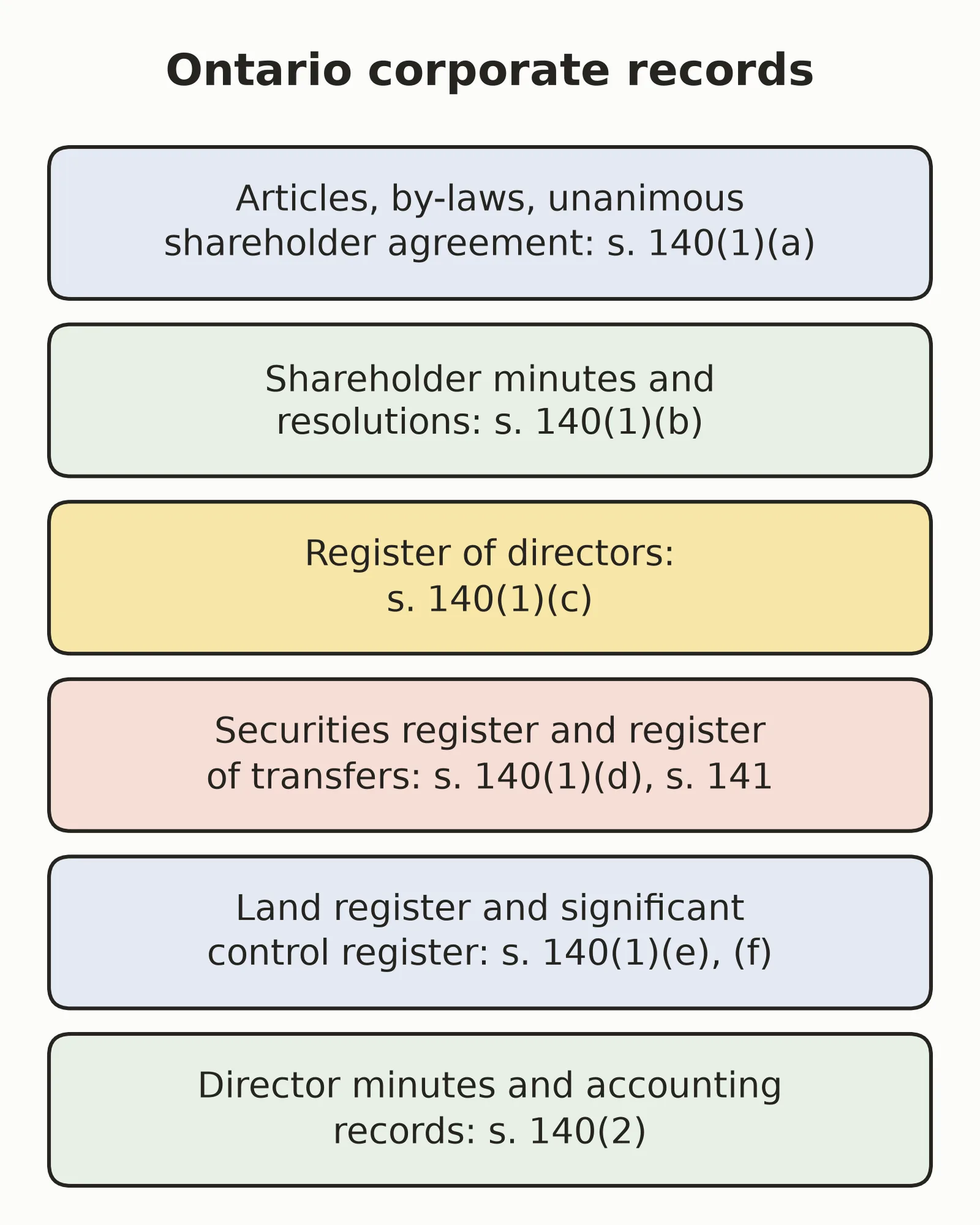
Section 140 of the OBCA requires eight kinds of record: the articles, by-laws and any unanimous shareholder agreement; shareholder minutes and resolutions; registers of directors, of securities, of land in Ontario and of individuals with significant control; director minutes and resolutions; and adequate accounting records.
The text is in the Business Corporations Act on Ontario's e-Laws site (currency date November 24, 2026). Subsection (1) lists six records. Shareholders and creditors may examine five of them, because section 145(1) excludes the register of individuals with significant control. Subsection (2) lists two more, and sections 144 and 145 open those to directors but not to shareholders and creditors.
Under section 140(1), a corporation "shall prepare and maintain" the following:
- Constating documents: the articles and the by-laws and all amendments to them, and a copy of any unanimous shareholder agreement known to the directors.
- Shareholder decisions: minutes of meetings and resolutions of shareholders.
- Register of directors: the names and residence addresses of all persons who are or have been directors, an e-mail address if one is provided, and the dates on which each became or ceased to be a director.
- Securities register: a register that complies with section 141.
- Land register: a register of ownership interests in land that complies with section 140.1.
- Significant control register: a register of individuals with significant control over the corporation that complies with section 140.2.
Section 140(2) adds two more: "adequate accounting records," and records containing minutes of meetings and resolutions of the directors and of any committee of directors. Section 140 lists no register of officers.
The securities register
Section 141(1) says the securities register records the securities the corporation has issued in registered form. For each class or series it shows the names, alphabetically arranged, of persons who are or have been registered as shareholders within six years, their addresses while holders, and the number and class of shares registered in each name. It also shows the date and particulars of the issue of each security. Section 141(2) requires a register of transfers that sets out every transfer and its date. In our experience these two registers are the corporate records a buyer reads first, because they are the corporation's own evidence of who holds its shares.
The land register
Under section 140.1, the register of ownership interests in land in Ontario must identify each property and show the date the corporation acquired it and, if applicable, the date it disposed of it. Copies of deeds, transfers or similar documents that show the municipal address, the property identifier number, the legal description or the assessment roll number are kept with it.
The register of individuals with significant control
Section 1.1 of the OBCA says who these individuals are. They include an individual who is the registered holder or beneficial owner of, or has direct or indirect control or direction over, shares that carry 25 per cent or more of the voting rights or equal 25 per cent or more of all outstanding shares by fair market value, and an individual with direct or indirect influence that, if exercised, would result in control in fact.
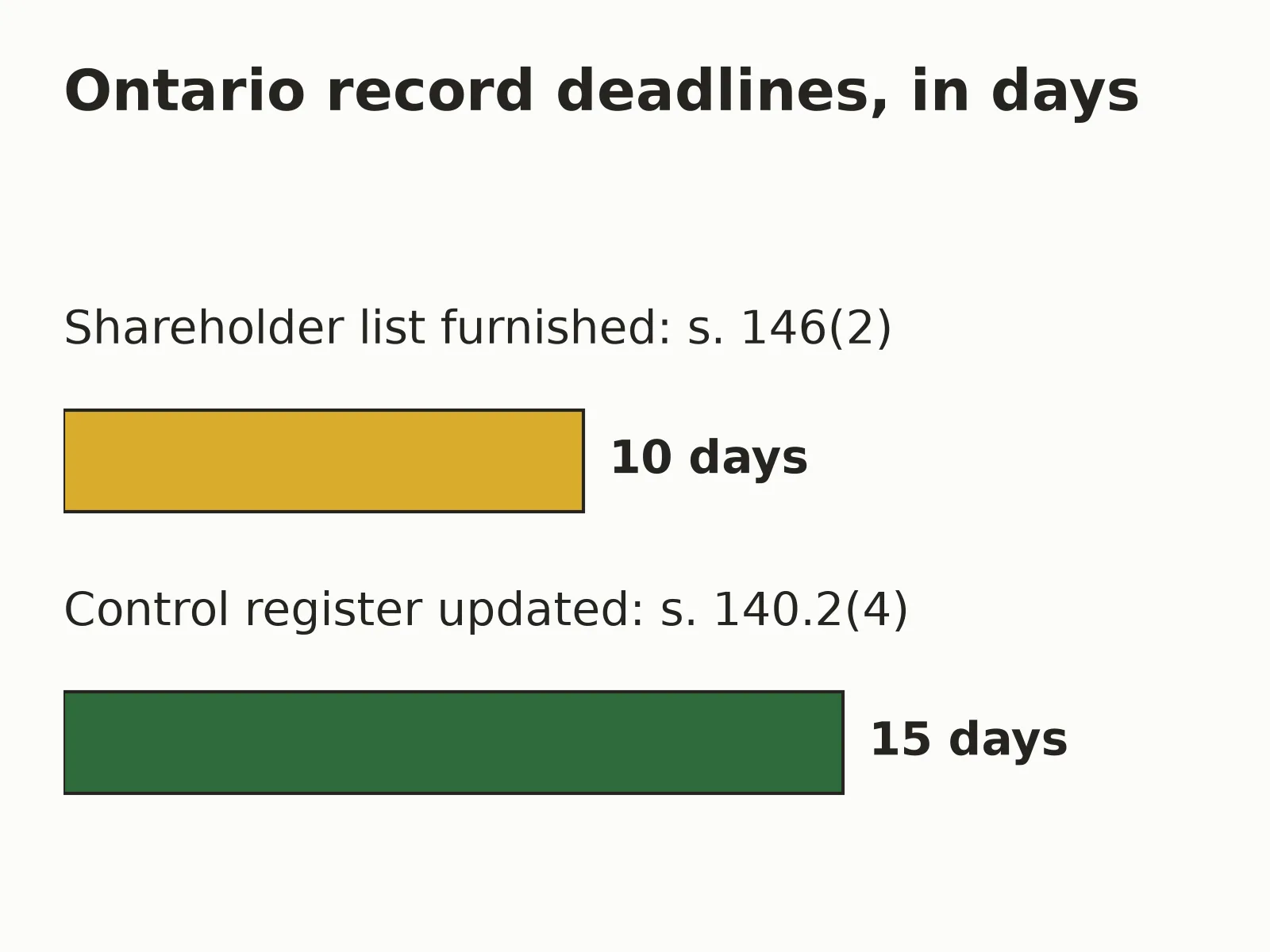
Section 140.2(1) requires the register to show, for each such individual, the name, date of birth and latest known address, the jurisdiction of residence for tax purposes, the day the individual became or ceased to be an individual with significant control, a description of how the individual has that control, and "a description of each step taken" to keep the register accurate. The corporation must take reasonable steps at least once in each financial year to confirm the register is accurate, complete and up to date, and must record new information within 15 days after becoming aware of it. Under section 140.2(8), the section does not apply to an offering corporation, a corporation that offers its securities to the public and is subject to a provincial securities statute, a corporation whose shares are listed on a designated stock exchange, a wholly-owned subsidiary of any of those, or a member of a prescribed class. Our Ontario incorporation checklist covers this register as part of organizing a new corporation.
Accounting records and the six-year rule
Section 140(2) says accounting records need only be retained for six years from the end of the last fiscal period to which they relate, provided the retention requirements of any taxing authority have been satisfied. The Canada Revenue Agency (CRA) states on its record-keeping pages, read in November 2026, that records and supporting documents must generally be kept for six years from the end of the last tax year they relate to.
Where and in what form can the records be kept?
Under sections 140 and 144 of the OBCA, the records are kept at the registered office or at another place in Ontario designated by the directors, except the land register, which stays at the registered office, and section 139 allows any form if the records are guarded against falsification and can be produced in readable form.
The location rule is in sections 140(1), 143(1) and 144(1). Section 144(3) then allows a corporation to keep the records at a place other than the registered office "if the records are available for inspection during regular office hours at the registered office by means of any technology." That subsection excepts "the register mentioned in clause 140 (1) (e)," the land register, which section 140.1(1) requires the corporation to maintain at its registered office.
The form rule is in section 139. Subsection (1) allows any form. Subsection (2) attaches two duties: the corporation must "take adequate precautions, appropriate to the means used, for guarding against the risk of falsifying the information recorded," and must be able to make the information available "in an accurate and intelligible form within a reasonable time" to any person lawfully entitled to examine the records. In our view a cloud folder can meet that test, and a folder that anyone can edit without a trace is harder to defend.
Who can inspect the minute book?
Under sections 144 and 145 of the OBCA, any director may examine all of the section 140 and 141 records, while shareholders and creditors may examine the section 140(1) records other than the significant control register during the corporation's usual business hours and take extracts free of charge.
The rights are set out in sections 144 to 146:
- Directors: under section 144(1), the records mentioned in sections 140 and 141 are open to examination by any director during normal business hours. That includes the director minutes and the accounting records.
- Shareholders and creditors: under section 145(1), registered holders of shares, beneficial owners of shares and creditors, and their agents and legal representatives, may examine the section 140(1) records, other than the significant control register, and may take extracts from them free of charge.
- Copies for shareholders: under section 145(2), a registered holder or beneficial owner of shares is entitled on request, without charge, to one copy of the articles, the by-laws and any unanimous shareholder agreement.
- Shareholder lists: under section 146(1), registered holders, beneficial owners of shares and creditors, and their agents and legal representatives, may require a basic list of registered shareholders on payment of a reasonable fee and on sending a statutory declaration. Section 146(2) says the list must be furnished not more than ten days after the corporation receives the declaration.
- Remote access: section 144(1.1) says the corporation "may, but is not required to," permit a director to examine the records remotely by means of any technology, and section 145(1.1) says the same for a person examining the records in clauses 140(1)(a) to (e).
Section 145(1) refers only to the records in subsection 140(1), so it does not give shareholders and creditors the director minutes or the accounting records, which are in subsection 140(2). The significant control register has its own access rule: section 140.3 lets police, tax officials and listed regulatory bodies request it, and the corporation must respond within the time period specified in the request.
The Act backs these rules with offences. Under section 258(1), a person who without reasonable cause contravenes section 145 (clause (f)), or fails to comply with any provision of the Act (clause (j)), is liable to a fine of not more than $2,000 or imprisonment for not more than one year, or both, and a body corporate to a fine of not more than $25,000. The significant control register has separate offences in section 258.1. A corporation that without reasonable cause contravenes section 140.2 or 140.3 is liable to a fine of not more than $5,000 (subsections (1) and (2)). A director or officer who knowingly authorizes, permits or acquiesces in the contravention is liable to a fine of not more than $200,000 or imprisonment for not more than six months, or both (subsection (4)). As amounts in an Ontario statute, these are Canadian dollars.
What do buyers, lenders and auditors check?
A buyer, lender or auditor reads the corporate minute book for three things its records are meant to show: who owns the shares, who the directors are and have been, and which decisions the shareholders and directors approved.
In our experience the same gaps come up in most reviews, and each one maps to a record in section 140 or 141:
- Share history: the securities register and the register of transfers do not account for every issue and transfer since incorporation.
- Director history: the register of directors does not match the people named in the public record, or the dates on which directors ceased to hold office are missing.
- By-laws: the by-laws, or an amendment to them, cannot be found. Our guide to company by-laws explains how they are adopted.
- Gaps in decisions: there are years with no shareholder or director minutes or resolutions at all.
- Amendments: the articles on file with the province were changed, but the approving resolution is not in the book. Our guide to articles of amendment in Ontario covers that approval.
- Land and control registers: the land register and the register of individuals with significant control were never opened.
In our experience the other side wants to see that each gap was addressed, and how, before closing.
How do you bring a minute book up to date?
You bring a corporate minute book up to date by rebuilding the record in order: first establish what the public record and the share history show, then prepare the missing registers and resolutions, and have the current directors and shareholders approve what can properly be approved now.
In our practice a catch-up usually runs in these steps. The order matters, because later steps rely on the share and director history fixed in the earlier ones.
- Step 1: collect the articles, every certificate and articles of amendment, and a current search of the corporation in the province's public record.
- Step 2: rebuild the securities register and the register of transfers from incorporation to today, using share certificates, subscription records, agreements and tax filings.
- Step 3: rebuild the register of directors with start and end dates and addresses, and compare it with the public record.
- Step 4: locate the by-laws and the resolutions that approved them, and file every amendment with them.
- Step 5: prepare the shareholder and director resolutions needed to approve or ratify past decisions, dated when they are actually signed and stating the period they cover.
- Step 6: open the land register and the register of individuals with significant control. Section 140.2(1)(f) requires that register to include "a description of each step taken" in the yearly review that section 140.2(3) requires.
- Step 7: decide where the records live, who may edit them and how a director, shareholder or creditor will be given access.
One caution applies to every step. Section 139(4) prohibits recording information in a record, or assisting in recording it, knowing it to be untrue. A catch-up records what happened and ratifies what can be ratified. It does not create minutes of meetings that were never held. If the history cannot be rebuilt from documents, resolve that legal question before anything is signed. Our guide on incorporating in Ontario lists the post-incorporation records that should have existed.
How do New York and Delaware compare?
New York requires minutes and a record of shareholders, Delaware's statute defines the stock ledger and the books and records a stockholder may inspect, and both allow electronic records and tie an owner's inspection to a purpose, which section 145 of Ontario's Act does not state.
In New York, section 624(a) of the Business Corporation Law (BCL) requires each corporation to keep correct and complete books and records of account, minutes of the proceedings of its shareholders, board and executive committee, and a record of shareholders showing names, addresses, the number and class of shares held and the dates they became owners of record. The records may be in written form or in any other form capable of being converted into written form within a reasonable time. Under section 624(b), a person who has been a shareholder of record may examine the shareholder minutes and the record of shareholders on at least five days' written demand, for a purpose reasonably related to the person's interest as a shareholder.
In Delaware, the provisions are in the General Corporation Law (DGCL, in title 8 of the Delaware Code), read on the Delaware Code site in November 2026. Section 219(c) defines the stock ledger as the record of the names of all stockholders of record, their addresses and shares, and all issuances and transfers of stock. Section 224 says records, "including its stock ledger, books of account, and minute books," may be kept on any information storage device or electronic network, provided they can be converted into clearly legible paper form within a reasonable time.
Section 220 governs inspection. Section 220(a)(1) defines "books and records" as a list that includes the certificate of incorporation, the bylaws, minutes of stockholder meetings and signed stockholder consents for the three years before the demand, minutes of board and committee meetings, and annual financial statements for the three years before the demand. Under section 220(b)(1), a stockholder may, on written demand under oath, inspect the stock ledger, a list of stockholders and the other books and records for any proper purpose, which section 220(a)(2) defines as a purpose reasonably related to the person's interest as a stockholder. Section 220(b)(2) adds that a stockholder may inspect books and records only if the demand is made in good faith and for a proper purpose, describes the purpose and the records sought with reasonable particularity, and seeks records specifically related to that purpose.
For a group with an Ontario company and a New York or Delaware company, the practical differences are the purpose test for owners and the access Ontario gives to creditors.
| Point | Ontario | New York | Delaware |
|---|---|---|---|
| Sections read | OBCA 139 to 145 | BCL 624 | DGCL 219, 220, 224 |
| Electronic records | Any form, with safeguards | If convertible | If convertible |
| Purpose test for owners | None in 145 | Yes | Yes |
| Creditor access | Yes, section 145 | Not in 624 | Not in 220 |
The entries describe only the sections named in the first row, as read in November 2026.
Frequently asked questions
Is a corporate minute book required by law in Ontario?
The term itself is not in the statute, but the records are. Section 140 of Ontario's Business Corporations Act says a corporation shall prepare and maintain its articles, by-laws, minutes, resolutions and registers, and section 258 makes failing to comply with the Act without reasonable cause an offence. The minute book is simply those required records kept together.
Can an Ontario corporation keep its minute book electronically?
Yes. Section 139(1) of Ontario's Business Corporations Act says a record the Act requires may be kept in any form. The corporation must take adequate precautions against falsification and must be able to make the information available in an accurate and intelligible form within a reasonable time to anyone lawfully entitled to examine it.
Where must the minute book be kept?
Under Ontario's Business Corporations Act, at the registered office or at another place in Ontario designated by the directors. Section 144(3) also allows records to be kept elsewhere if they are available for inspection at the registered office during regular office hours by means of any technology. The register of ownership interests in land is the exception and stays at the registered office.
Can a shareholder demand to see the minute book?
Under section 145(1) of Ontario's Business Corporations Act, a shareholder can examine the records listed in section 140(1), other than the register of individuals with significant control, during usual business hours and take extracts free of charge. That covers the articles, by-laws and any unanimous shareholder agreement, shareholder minutes and resolutions, the register of directors, the securities register and the land register. Section 145(1) does not reach the director minutes or accounting records in section 140(2).
How long must an Ontario corporation keep its records?
Ontario's Business Corporations Act states three periods in the sections read for this guide. Accounting records need only be retained for six years from the end of the last fiscal period they relate to, once any taxing authority's requirements are satisfied (section 140(2)). The securities register shows persons who are or have been shareholders within six years (section 141). Personal information of a former individual with significant control is disposed of within one year after the sixth anniversary of the day the individual ceased to be one, unless a longer period applies (section 140.2(6)). Sections 140 and 141 state no end date for the other records.
What happens if the minute book is incomplete when the business is sold?
In practice a buyer relies on the registers and resolutions to confirm ownership and authority, so gaps usually have to be repaired or disclosed before closing. Repair means rebuilding the registers from source documents and having current directors and shareholders approve what can properly be approved now. The sections of the Business Corporations Act described in this guide do not themselves set a consequence for a sale.
Does a federal corporation in Ontario follow the same rules?
The sections described in this guide are in Ontario's Business Corporations Act. The Canada Business Corporations Act (CBCA) has its own records provisions. Section 20 of the CBCA requires records containing the articles and by-laws, any unanimous shareholder agreement, minutes of meetings and resolutions of shareholders and a securities register, and section 21.1 requires a register of individuals with significant control (Justice Laws site, current to November 12, 2026). This guide does not compare the two statutes further.
Conclusion
The corporate minute book is the corporation's own evidence of who owns it, who directs it and what they decided. Ontario's statute is specific about its contents: eight kinds of record in section 140, with detailed rules for the securities, land and significant control registers. It allows any form, prohibits false entries and gives directors, shareholders and creditors defined rights to read the records. If yours has gaps, rebuild the share and director history first, add the land and significant control registers, and document the catch-up honestly, before a buyer or lender asks.
How Mayo Law can help
Mayo Law is a cross-border firm with offices in Toronto and New York, and Joseph Mayo is licensed in Ontario and New York. Our lawyers set up minute books for new Ontario corporations, review and rebuild incomplete ones before a sale, financing or audit, and keep the Ontario and New York records of companies in the same group consistent with each other and with the group's other US records. We offer a paid one-hour consultation, paid because a lawyer reviews your records and your share history in depth. You can start from our incorporation lawyer page or our international business law page.
Disclaimer
This guide is general information, current as of November 2026, and is not legal advice. Reading it does not create a solicitor-client or attorney-client relationship. Statutes change, and the right answer depends on your corporation's own records and history. Mayo Law provides legal services in Ontario and New York.