

Contents
- Quick answer
- What is startup equity, and who holds it?
- How do founders split startup equity?
- How do vesting and cliffs protect the split?
- What is an option pool, and who gets grants from it?
- Ontario, federal or Delaware: which instruments apply?
- How is employee equity taxed in Canada and the US?
- Which equity steps do founders most often leave undone?
- Frequently asked questions
- Conclusion
- How Mayo Law can help
- Disclaimer
Startup equity is ownership of the company, held as issued shares or as rights to acquire shares. Who gets how much is a business decision, but the instrument that delivers each piece is a legal one, and it changes with the statute the company is formed under. Our startup lawyers work with founders on both sides of the border as part of our international business law practice. This guide sets Ontario, federal Canadian and Delaware corporate law side by side for the founder split, vesting, the option pool and grants to advisors and early employees, and then sets out the Canadian and US tax rules separately. The statutes and agency pages were read on official sources in November 2026. The United States Code text is the 2023 edition published on govinfo.gov.
Quick answer
Startup equity is ownership of the company, held as issued shares or as rights to acquire shares. Founders usually hold shares and employees usually hold options. In an Ontario corporation, shares may be issued to such persons and for such consideration as the directors may determine, and a share must be fully paid before it is issued.
What is startup equity, and who holds it?
Startup equity is ownership of the company, held as issued shares or as rights to acquire shares, and in our experience it sits with four groups: founders, employees, advisors and investors. Holding equity in a startup means holding one of those instruments, and the form matters more than the percentage on a slide.
This is the pattern we see most often. It is our observation, not a legal rule:
- Founders: shares issued at the start, usually common shares.
- Employees: options to buy shares later at a set price, granted from a reserved pool.
- Advisors: a smaller grant of options or shares for defined help.
- Investors: shares of a separate class, or instruments that convert into shares.
The working record that lists all of them is the capitalization table. Our guide on what a cap table is explains how to read one and which statutory register sits behind it. Investor instruments have their own guides: our comparison of the simple agreement for future equity (SAFE) and the convertible note, SAFE vs convertible note, covers early money, and common stock vs preferred stock covers the share classes investors ask for.
Ontario's Business Corporations Act (OBCA) says that where a corporation has only one class of shares, the holders' rights "are equal in all respects" and include the right to vote at all meetings of shareholders and the right to receive the remaining property of the corporation upon dissolution (section 22(3), read on e-Laws, currency date November 24, 2026). For federal corporations, section 24(3) of the Canada Business Corporations Act (CBCA, current to November 12, 2026) also says the rights "are equal in all respects" and lists three: to vote, "to receive any dividend declared by the corporation" and to receive the remaining property on dissolution. Under OBCA section 22(4) and CBCA section 24(4), the articles may provide for more than one class of shares, and if they do, the rights, privileges, restrictions and conditions of each class "shall be set out therein."
How do founders split startup equity?
No formula appears in the statutes read for this guide: in Ontario and federal corporations, shares may be issued "to such persons and for such consideration as the directors may determine," and in Delaware stock may be issued as set forth in a resolution of the board of directors.
The Ontario wording is in OBCA section 23(1): "Subject to the articles, the by-laws, any unanimous shareholder agreement and section 26, shares may be issued at such time and to such persons and for such consideration as the directors may determine." CBCA section 25(1) is worded almost identically for federal corporations.
Both Acts then set a floor on payment. OBCA section 23(3) reads: "A share shall not be issued until the consideration for the share is fully paid in money or in property or past service that is not less in value than the fair equivalent of the money that the corporation would have received if the share had been issued for money." CBCA section 25(3) has the same test, with "past services." Each list is money, property and past service.
The Delaware General Corporation Law (DGCL) is worded differently. Under section 152(a), "The board of directors may authorize capital stock to be issued for consideration consisting of cash, any tangible or intangible property or any benefit to the corporation, or any combination thereof," and stock may be issued "in the numbers, at the times and for the consideration as set forth in a resolution of the board of directors." Section 161 adds that the directors may issue additional shares "up to the amount authorized in its certificate of incorporation." Under section 153(a), shares with par value may be issued for consideration "having a value not less than the par value of the shares so issued" (Title 8, Chapter 1, Subchapter V, read November 2026).
The founder equity split itself turns on commercial questions: who brought the idea, who works full time, who put in cash, and who carries the risk if the company stalls. In our practice, three steps then give the answer legal form:
- Pay for the shares: in an Ontario or federal corporation, the consideration is fully paid in money, property or past service before the share is issued.
- Have the directors decide: the directors determine the persons and the consideration, and in Delaware the board does so by resolution.
- Write the rules down: a shareholders agreement covers votes, transfers and exits. Under OBCA section 108(2), a written agreement among all the shareholders may also restrict the directors' powers.
Our guide to the shareholders agreement clauses that prevent founder disputes goes through that document clause by clause.
How do vesting and cliffs protect the split?
Vesting makes a founder or employee earn equity over time, and a cliff is the first date on which any of it is earned, so a person who leaves early does not keep a full stake. Our full guide is founder vesting, which covers schedules, cliffs, acceleration, the Canadian buyback structure and the US election under section 83(b) of the Internal Revenue Code.
The short version: the sections of the OBCA, the CBCA and the DGCL read for this guide set no vesting schedule. The schedule is a contract term, found in the share purchase agreement, the option agreement or the shareholders agreement. Delaware does say when a transfer restriction binds a holder. Under section 202(a) of the DGCL, a written restriction on the transfer of a security, "if permitted by this section and noted conspicuously on the certificate or certificates representing the security or securities so restricted or, in the case of uncertificated shares, contained in the notice or notices given pursuant to § 151(f) of this title, may be enforced against the holder of the restricted security" (Subchapter VI).
What is an option pool, and who gets grants from it?
An option pool is a number of shares a company sets aside for future option grants to employees and advisors, and the corporate statutes say how options are issued: by the corporation in Ontario and federally, and as set forth in a board resolution in Delaware.
In Ontario, OBCA section 27(1) says a corporation "may issue warrants as evidence of conversion privileges or options or rights to acquire securities of the corporation, and shall set out the conditions thereof" in certificates or in separate documents. Section 27(3) adds a reserve: where the corporation has granted options to acquire its shares "and where the articles limit the number of authorized shares, the corporation shall reserve and continue to reserve sufficient authorized shares to meet the exercise of such conversion privileges, options and rights." For federal corporations, CBCA section 29(1) gives a similar power to issue "certificates, warrants or other evidences of conversion privileges, options or rights to acquire securities of the corporation," with the conditions set out in them.
In Delaware, section 157(a) of the DGCL says every corporation may, subject to its certificate of incorporation, "create and issue" rights or options entitling the holders to acquire its stock. Section 157(b) says they may be issued "in the numbers, at the times and for the consideration as set forth in a resolution of the board of directors."
Here is an illustrative example, with numbers chosen only to show the arithmetic and not as a norm. Two founders hold 500,000 shares each, 1,000,000 in total. The company reserves a pool of 111,111 options. By the usual convention, which our cap table guide explains, the pool is counted in the fully diluted total. By our calculation, that total becomes 1,111,111, so each founder's share falls from 50 percent to 45 percent and the pool represents 10 percent.
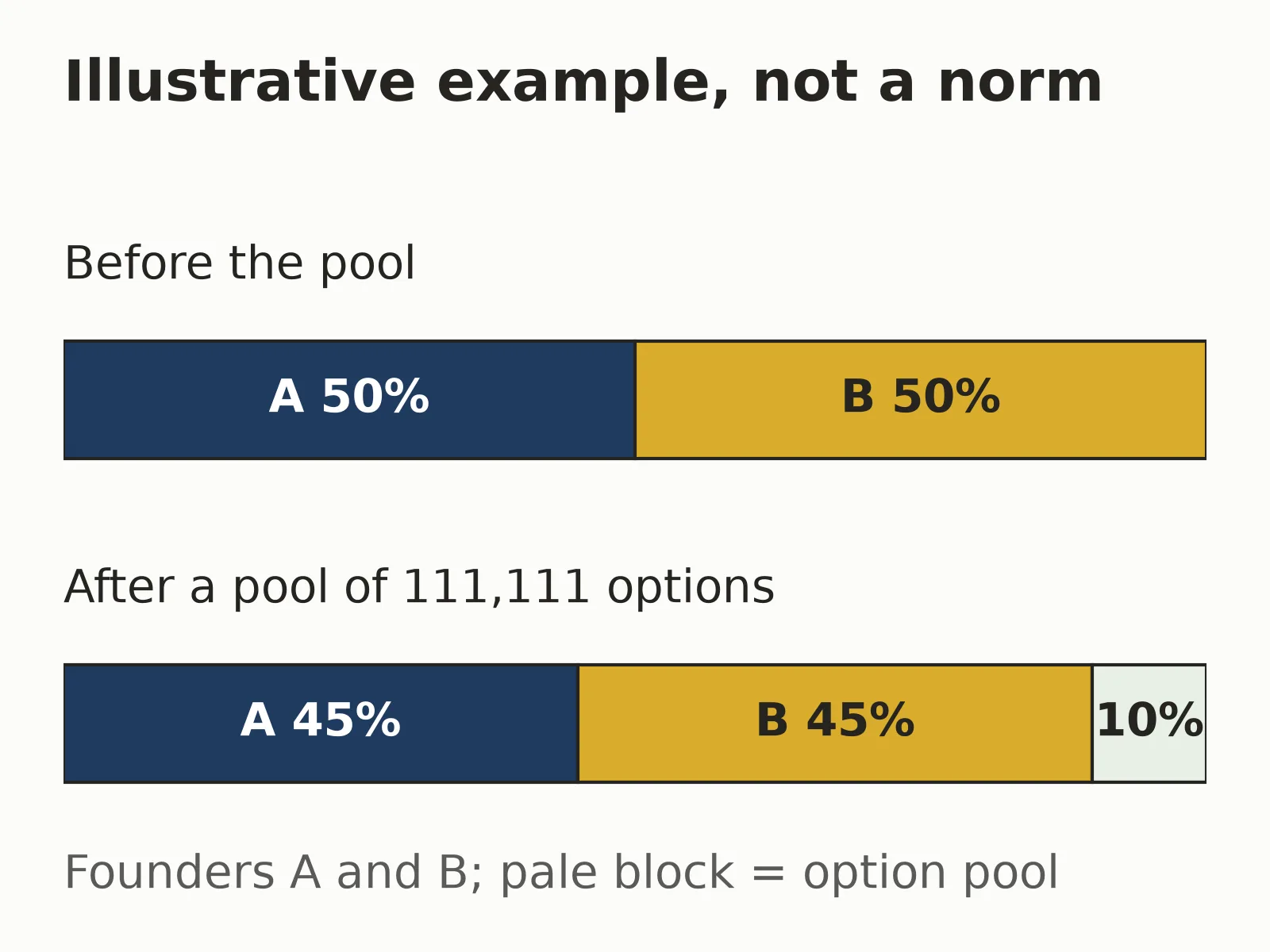
That shift in startup equity is dilution. Our guide on what equity dilution is works through later financing rounds.
Early employees
In our experience, options are the usual form of startup equity compensation for employees. An option agreement typically sets an exercise price, a vesting schedule and an expiry date. Those are terms of the agreement, not requirements of the corporate statutes read for this guide. What the statutes do say is narrower. In Delaware, section 157(b) of the DGCL provides that the terms on which shares may be acquired on exercise, including the time and the consideration, "shall be as stated in the certificate of incorporation, or in a resolution of the board of directors." In Ontario and federally, the corporation "shall set out the conditions" of the option in a certificate or other document. Our guide to stock options at a startup explains the plan documents and what an employee should ask.
Advisors
An advisor's grant is issued under the same corporate sections, but the tax category can differ. In the Internal Revenue Code, section 422(b) defines an incentive stock option (ISO) as an option granted to an individual "for any reason connected with his employment by a corporation," and section 422(a)(2) requires that the individual was an employee from the grant of the option until three months before exercise. The Internal Revenue Service (IRS) says in Topic no. 427 that options granted neither under an employee stock purchase plan nor under an ISO plan are nonstatutory stock options. In Canada, section 7 of the Income Tax Act speaks of securities that a company has agreed to sell or issue "to an employee." Whether an advisor is an employee is a question of fact, and this guide does not cover how an independent advisor's grant is taxed.
Ontario, federal or Delaware: which instruments apply?
An Ontario or federal corporation issues shares without par value under its articles, and a Delaware corporation issues stock with or without par value under its certificate of incorporation. The table sets the three corporate statutes side by side for each equity decision.
| Equity decision | Ontario (OBCA) | Federal (CBCA) | Delaware (DGCL) |
|---|---|---|---|
| Par value | None | None | With or without |
| Who issues shares | Directors determine | Directors determine | Board resolution |
| Paying for shares | Money, property, past service | Money, property, past services | Cash, property, any benefit |
| Share classes | Rights in the articles | Rights in the articles | Certificate or board resolution |
| Series of a class | Articles, or directors if authorized | Articles, or directors if authorized | Certificate or board resolution |
| Options | Corporation may issue, s. 27 | Corporation may issue, s. 29 | Board resolution, s. 157 |
The rows come from sections quoted in this guide: par value from OBCA section 22(1), CBCA section 24(1) and DGCL section 151(a); issuance and payment from OBCA section 23, CBCA section 25 and DGCL section 152; classes and series from OBCA sections 22(4) and 25(1), CBCA sections 24(4) and 27(1) and DGCL section 151(a); options from OBCA section 27, CBCA section 29 and DGCL section 157. Read together, they work as a startup equity checklist for a cross-border company.
On par value, OBCA section 22(1) and CBCA section 24(1) both say shares "shall be without nominal or par value." Section 151(a) of the DGCL lets a corporation issue classes of stock "with par value or stock without par value," and section 102(a)(4) requires the certificate of incorporation to state the number of authorized shares and "the par value of each of such shares, or a statement that all such shares are to be without par value" (the first subchapter of Title 8, Chapter 1).
On classes and series, the Ontario and federal Acts put the rights of each class in the articles. For series within a class, OBCA section 25(1) and CBCA section 27(1) let the articles fix the terms of each series or authorize the directors to fix them. In Delaware, section 151(a) says the powers and rights of a class or series are those "stated and expressed in the certificate of incorporation or of any amendment thereto, or in the resolution or resolutions providing for the issue of such stock adopted by the board of directors pursuant to authority expressly vested in it by the provisions of its certificate of incorporation."
In our experience, many cross-border startups split their startup equity work across both kinds of company: a Delaware parent and a Canadian operating subsidiary, or the reverse. Our guide to the Delaware C corp explains the first structure. The table is about corporate law only. Tax is a separate system, set out under its own heading in this guide.
How is employee equity taxed in Canada and the US?
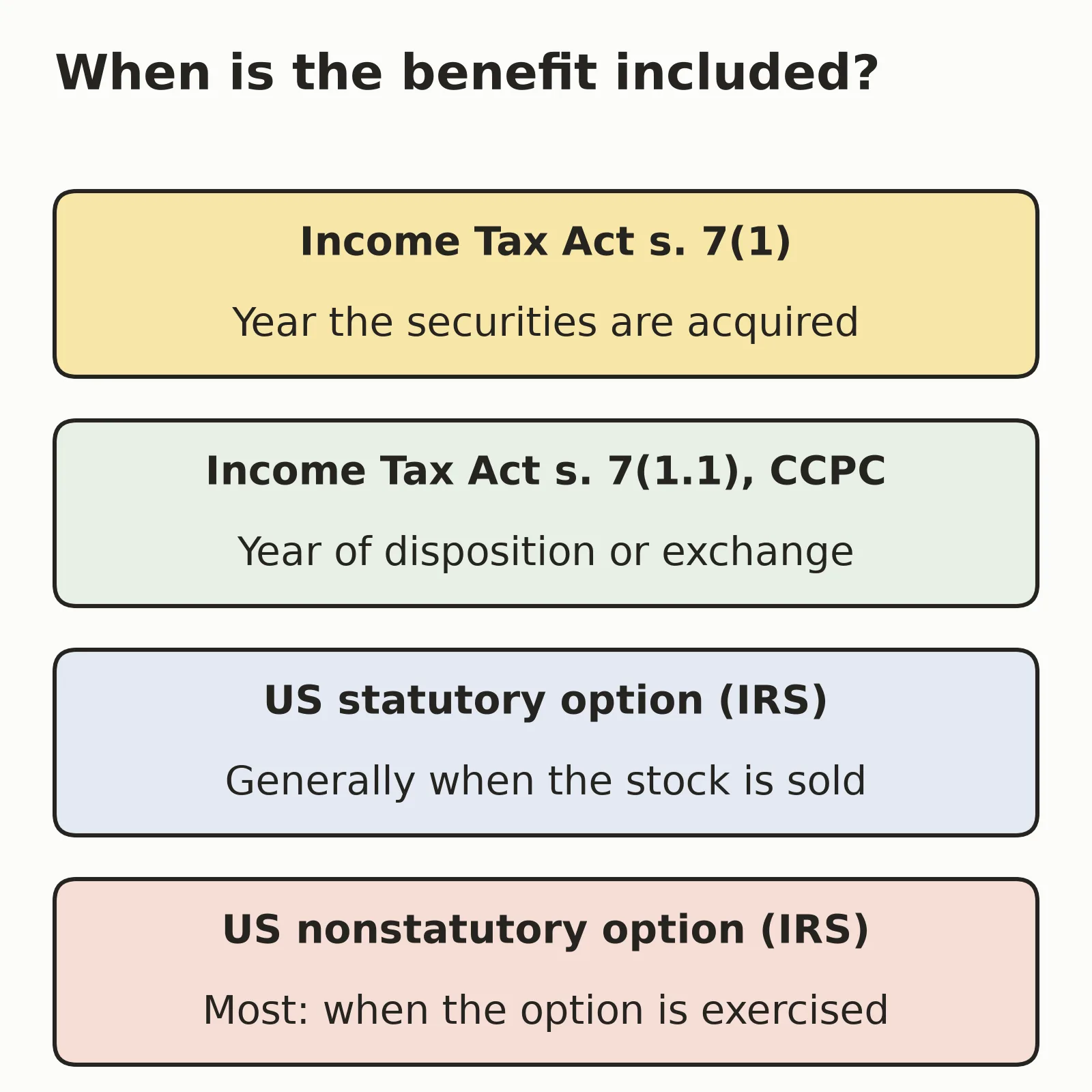
The Income Tax Act and the Internal Revenue Code each state when an employee's option benefit is included in income: in the year the securities are acquired or, for certain shares, disposed of under section 7 of the Income Tax Act, and at exercise or at sale as IRS Topic no. 427 describes for US options.
Canada: the Income Tax Act
Under section 7(1) of the Income Tax Act (current to November 12, 2026), if an employee has acquired securities under an agreement with a qualifying person, a benefit equal to the amount by which "the value of the securities at the time the employee acquired them" exceeds the amount paid "is deemed to have been received, in the taxation year in which the employee acquired the securities, by the employee because of the employee's employment."
Section 7(1.1) of the Income Tax Act changes the year in one case. It applies where "a Canadian-controlled private corporation" (CCPC) "has agreed to sell or issue a share of the capital stock of the corporation" to an employee "and at the time immediately after the agreement was made the employee was dealing at arm's length with" the corporation. In that case, the reference to "the taxation year in which the employee acquired the securities" is read as "the taxation year in which the employee disposed of or exchanged the securities." The Canada Revenue Agency (CRA) restates both timings on its Employee security (stock) options page (modified March 26, 2026).
Two deductions in section 110 of the Income Tax Act can reduce the benefit. Paragraph 110(1)(d) allows "an amount equal to 1/2 of the amount of the benefit deemed by subsection 7(1)" when its conditions are met. Paragraph 110(1)(d.1) allows one half where the taxpayer "is deemed, under paragraph 7(1)(a) by virtue of subsection 7(1.1), to have received a benefit," "has not disposed of the share (otherwise than as a consequence of the taxpayer's death) or exchanged the share within two years after the date the taxpayer acquired it," and has not deducted an amount under paragraph 110(1)(d) for that benefit.
The CRA's Employee security (stock) options page also describes a limit. In the CRA's words, for "a non-CCPC or mutual fund trust which has, or part of a consolidated group that has, revenues of more than $500 million," the security options eligible for the security options deduction "are limited by a $200,000 annual vesting limit for options granted on or after July 1, 2021."
CCPC is a defined term. Subsection 125(7) of the Income Tax Act defines it, in part, as "a private corporation that is a Canadian corporation other than (a) a corporation controlled, directly or indirectly in any manner whatever, by one or more non-resident persons, by one or more public corporations (other than a prescribed venture capital corporation)," by certain other corporations, "or by any combination of them." A corporation controlled in that way by non-resident persons is therefore outside the definition. Subsection 89(1) defines a "Canadian corporation" as one that is resident in Canada and was incorporated in Canada, or has been resident in Canada throughout the period that began on June 18, 1971.
United States: the Internal Revenue Code and the IRS
The IRS divides options into two types in Topic no. 427, Stock options (last reviewed September 24, 2026): "Options granted under an employee stock purchase plan or an incentive stock option (ISO) plan are statutory stock options. Stock options that are granted neither under an employee stock purchase plan nor an ISO plan are nonstatutory stock options."
For a statutory option, IRS Topic no. 427 says "you generally don't include any amount in your gross income when you receive or exercise the option. However, you may be subject to alternative minimum tax in the year you exercise an ISO." It continues: "You have taxable income or deductible loss when you sell the stock you bought by exercising the option," and "if you don't meet special holding period requirements, you'll have to treat income from the sale as ordinary income."
For a nonstatutory option, IRS Topic no. 427 says the timing "depends on whether the fair market value of the option can be readily determined." It adds that most nonstatutory options do not have a readily determinable fair market value, and for those "there's no taxable event when the option is granted but you must include in income the fair market value of the stock received on exercise, less the amount paid, when you exercise the option."
Section 422 of the Internal Revenue Code (2023 edition) sets the ISO conditions. They include:
- Plan: the option is granted under a plan that states the number of shares and the eligible employees and is approved by the stockholders within 12 months before or after its adoption.
- Price: the option price is not less than the fair market value of the stock when the option is granted.
- Term: the option is not exercisable more than 10 years after it is granted.
- Ownership: when the option is granted, the individual does not own stock with more than 10 percent of the total combined voting power of all classes of stock of the employer corporation or of its parent or subsidiary.
- Holding: no disposition within 2 years from the grant of the option nor within 1 year after the share is transferred.
- Limit: to the extent the stock for which ISOs first become exercisable in a calendar year exceeds $100,000 in fair market value, the excess options are treated as options that are not ISOs.
Shares that vest are covered by section 83 of the Internal Revenue Code (2023 edition). Under section 83(a), when property is transferred in connection with the performance of services, the excess of its fair market value over the amount paid is included in gross income at the first time the rights in the property "are transferable or are not subject to a substantial risk of forfeiture, whichever occurs earlier." Section 83(b) provides an election to include, for the year of transfer, the excess of the fair market value at the time of transfer over the amount paid. The election "shall be made not later than 30 days after the date of such transfer" and "may not be revoked except with the consent of the Secretary."
These are general rules on the taxation of startup equity as the sources state them, not advice on a specific plan or person.
Which equity steps do founders most often leave undone?
In our experience, the steps most often left undone are the directors' decision, the payment for the shares, the share reserve behind the options and the securities register, and the corporate statutes quoted in this guide speak to each one.
- The directors' decision: in Ontario and federal corporations, shares are issued to such persons and for such consideration "as the directors may determine." In Delaware, stock is issued "as set forth in a resolution of the board of directors."
- Payment for the shares: an Ontario or federal share "shall not be issued until the consideration for the share is fully paid in money or in property or past service."
- The reserve behind the options: where an Ontario corporation's articles limit the number of authorized shares, OBCA section 27(3) requires it to reserve sufficient authorized shares to meet the exercise of the options it has granted.
- The securities register: OBCA section 141(1) requires an Ontario corporation to prepare and maintain a securities register recording the securities it has issued. Keeping the cap table consistent with that register is good practice, not a statutory test.
Frequently asked questions
What is startup equity in simple terms?
Startup equity is ownership of the company, held as issued shares or as rights to acquire shares. In our experience, founders usually hold shares from the first day, employees usually hold options that vest over time, and investors hold a separate class of shares or instruments that convert into shares.
Is there a legal rule for how founders split equity?
No formula appears in the Ontario, federal or Delaware statutes read for this guide. In Ontario and federal corporations, shares may be issued to such persons and for such consideration as the directors may determine. In Delaware, stock may be issued as set forth in a resolution of the board of directors. Each statute then sets rules on the consideration for shares.
Can a founder receive shares for future work?
In an Ontario or federal corporation, a share shall not be issued until the consideration is fully paid in money or in property or past service, at not less than the fair equivalent of the money the corporation would have received. In Delaware, section 152 says the board may authorize stock for consideration consisting of cash, any tangible or intangible property or any benefit to the corporation. This guide does not interpret how either wording applies to future work.
What is an option pool?
An option pool is a number of shares a company sets aside for future option grants to employees and advisors. By the usual convention it is counted in the fully diluted share total. Where an Ontario corporation's articles limit the number of authorized shares, the corporation must reserve sufficient authorized shares to meet the exercise of the options it has granted.
When are employee stock options taxed in Canada?
Under section 7(1) of the Income Tax Act, the benefit is deemed received in the taxation year in which the employee acquired the securities. Where section 7(1.1) applies to shares of a Canadian-controlled private corporation and an arm's-length employee, that year is read as the year the employee disposed of or exchanged the securities. A deduction of one half can apply when its conditions are met.
What is the 83(b) election deadline?
Section 83(b) of the Internal Revenue Code says the election shall be made not later than 30 days after the date of the transfer. The election is to include in gross income, for the year of transfer, the fair market value of the property at that time, less any amount paid. The statute says it may not be revoked except with the consent of the Secretary.
Can advisors receive incentive stock options?
Section 422 of the Internal Revenue Code defines an incentive stock option as an option granted to an individual for a reason connected with employment by the corporation, and requires that the individual was an employee from the grant until three months before exercise. IRS Topic no. 427 calls options granted neither under an employee stock purchase plan nor an ISO plan nonstatutory stock options.
Conclusion
Startup equity rests on a short set of documents. The corporate statute sets the instruments: shares without par value and rights set out in the articles for an Ontario or federal corporation, and stock issued by board resolution under the certificate of incorporation in Delaware. The founders agree the split, the directors determine the issuance, and the shares are paid for. Vesting is added by contract. Options come from a reserved pool, and the Income Tax Act and the Internal Revenue Code each set their own timing for the benefit. The percentages are the founders' call. The paperwork is what an investor, a buyer or a tax authority reads.
How Mayo Law can help
Mayo Law is a cross-border firm with offices in Toronto and New York, and Joseph Mayo is licensed in Ontario and New York. Our lawyers work with founders on share issuances, shareholders agreements, vesting terms and option plans for Canadian and US companies, and on structures that use both. We offer a paid one-hour consultation, paid because a lawyer reviews your corporate records and your plans in depth. Start from our startup lawyer page.
Disclaimer
This guide is general information, current as of November 2026, and is not legal or tax advice. Reading it does not create a solicitor-client or attorney-client relationship. Corporate and tax rules change, and the right structure depends on your facts. Mayo Law provides legal services in Ontario and New York.