

Contents
- Quick answer
- What is a founders agreement, and is it binding?
- What does a founders agreement example look like?
- How does the example handle roles and decisions?
- What happens when a founder leaves?
- Where do the terms go after incorporation?
- What should you check before signing?
- Frequently asked questions
- Conclusion
- How Mayo Law can help
- Disclaimer
A founders agreement is the contract co-founders sign with each other, usually before a company exists, to settle who owns what, who does what and what happens if someone leaves. This guide walks through a founders agreement example, clause by clause, with the statutes behind the clauses. It then shows where each term goes once you incorporate in Ontario, federally in Canada or in Delaware. Our startup lawyers review these agreements as part of the firm's international business law practice.
The example is an illustration. The founders are invented, the sample wording was written for this guide, and it is not a template to copy. The statutes and the Internal Revenue Service (IRS) publication cited here were read on official sources in November 2026.
Quick answer
A founders agreement is a written contract among co-founders that records the equity split, vesting, intellectual property assignment, roles, decision rules, deadlock steps and leaver terms. It is usually signed before incorporation, by the founders as individuals. After incorporation, its terms are normally moved into company documents such as a shareholder agreement.
What is a founders agreement, and is it binding?
A founders agreement is a contract among the co-founders as individuals, and it is meant to bind each of them personally from the day they sign, whether or not a company exists yet. It is also called a co-founder agreement or a founders contract. Whether a particular document can be enforced depends on the contract law of the place whose law governs it, a choice our guide to governing law clauses explains.
Where the founders sign before incorporating, the company is not a party, because it does not exist yet. That gap matters in Ontario for two reasons, and both come from statutes, not from the agreement.
The first Ontario risk for unincorporated co-founders is an unintended partnership under the Partnerships Act. Section 2 of Ontario's Partnerships Act says: "Partnership is the relation that subsists between persons carrying on a business in common with a view to profit". Section 3 sets out rules for deciding whether a partnership exists. Co-founders who are already selling or signing contracts together may meet that definition before they incorporate. If they do, section 6 makes every partner "an agent of the firm and of the other partners for the purpose of the business of the partnership". Under section 10(1), every partner "is liable jointly with the other partners for all debts and obligations of the firm incurred while the person is a partner". Section 10(2) treats limited liability partnerships differently.
The second Ontario risk is personal liability on a contract signed for a company that is not yet formed. Under section 21(1) of the Ontario Business Corporations Act (OBCA), "a person who enters into an oral or written contract in the name of or on behalf of a corporation before it comes into existence is personally bound by the contract and is entitled to the benefits thereof." Section 21(2) lets the corporation adopt the contract "within a reasonable time after it comes into existence", and the person who signed then stops being bound, subject to a court order under section 21(3). Section 21(4) allows the contract itself to say the person is not bound.
Section 14 of the Canada Business Corporations Act (CBCA) has a similar rule for a federal corporation, with adoption, a court application and an express exemption, but it speaks only of "a written contract". Both Acts were read as current in November 2026: e-Laws showed a currency date of November 25, 2026, and the Justice Laws site showed the CBCA as current to November 12, 2026.
The example below is built around those two risks. It sets a date to incorporate, and it has each founder promise not to sign for the group before then without the others' consent.
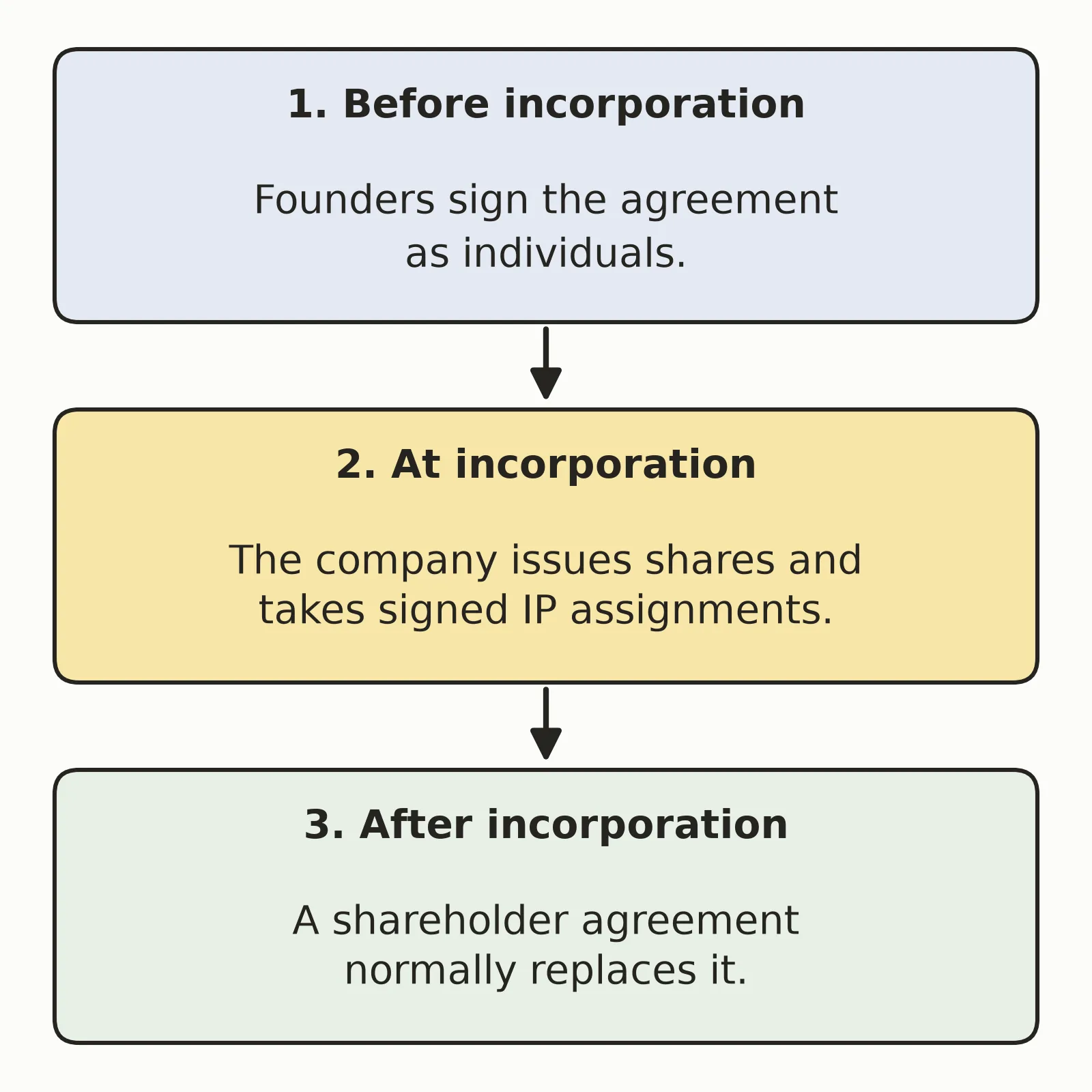
Figure 1 shows the three stages this guide follows. Before incorporation, the founders sign the agreement as individuals, and it is meant to bind them personally. At incorporation, the company issues shares and takes signed intellectual property (IP) assignments. After incorporation, a shareholder agreement or, in Delaware, stock purchase agreements normally replace it.
What does a founders agreement example look like?
The founders agreement example in this guide has nine clauses: parties and project, equity split, vesting, intellectual property, roles, decisions, deadlock, leaver terms, and confidentiality with restrictive covenants. Three invented founders use it. Amira leads product, Ben leads engineering and Chloe leads sales. They are building logistics software under the working name Project Harbour, and they have not incorporated.
Each clause below gives sample wording in italics, then what the clause does and what to check. Clauses 1 to 4 cover the parties and ownership.
Clause 1: Parties, project and incorporation
Sample wording: "Amira, Ben and Chloe (the Founders) are developing Project Harbour. They will incorporate a company to own and operate it (the Company) within 90 days of signing. Until then, no Founder will sign a contract, borrow money or hire anyone for the Project without the written consent of the other two. Any contract a Founder signs for the Company before incorporation, with that consent, will state whether the Founder is personally bound."
This clause of the founders agreement names the people bound and describes the project in enough detail that the later IP clause has something to attach to. The 90-day deadline and the consent rule are aimed at the partnership and pre-incorporation points above. The last sentence uses OBCA section 21(4), which lets a pre-incorporation contract say expressly that the person who signs is not bound. The clause does not choose the jurisdiction of incorporation, and the example leaves that for the founders to settle with advice. Our guide on how to incorporate a business in Ontario covers the provincial and federal routes.
Clause 2: Equity split
Sample wording: "On incorporation the Founders will cause the Company to issue 4,800,000 common shares: 2,160,000 to Amira, 1,920,000 to Ben and 720,000 to Chloe, each paying the same price per share."
A founders agreement cannot issue shares. Only the corporation can, which is why the sample wording says the founders "will cause the Company to issue" them. The example split is 45%, 40% and 15%. The table shows each founder's share count and what has vested at the 12-month point under clause 3.
| Founder | Split | Shares | Vested, month 12 |
|---|---|---|---|
| Amira | 45% | 2,160,000 | 540,000 |
| Ben | 40% | 1,920,000 | 480,000 |
| Chloe | 15% | 720,000 | 180,000 |
| Total | 100% | 4,800,000 | 1,200,000 |
In Ontario, OBCA section 23(1) says shares may be issued "at such time and to such persons and for such consideration as the directors may determine", subject to the articles, the by-laws, any unanimous shareholder agreement and section 26. Section 23(3) adds that a share "shall not be issued until the consideration for the share is fully paid in money or in property or past service". CBCA section 25(3) uses almost the same words. Both lists name money, property and past service. Neither names future service, which is why the example has each founder pay a price per share.
How to arrive at the percentages is a business question. Our startup equity guide covers the split, the option pool and the Ontario, federal and Delaware share rules in detail.
Clause 3: Vesting and the cliff
Sample wording: "Each Founder's shares vest over 48 months from the date of this agreement: 25% on the first anniversary and the balance in equal monthly instalments. Unvested shares are subject to the buyback in clause 8."
Founder vesting means a founder earns shares over time by continuing to work on the project. In the example, the company may buy back unvested shares at the price the founder paid. Here each founder vests 1/48 of their shares for each month of work, with nothing vested until month 12. That is 45,000 shares a month for Amira, 40,000 for Ben and 15,000 for Chloe. By our calculation, each founder is 0% vested before month 12, 25% vested at month 12, 50% at month 24, 75% at month 36 and 100% at month 48.
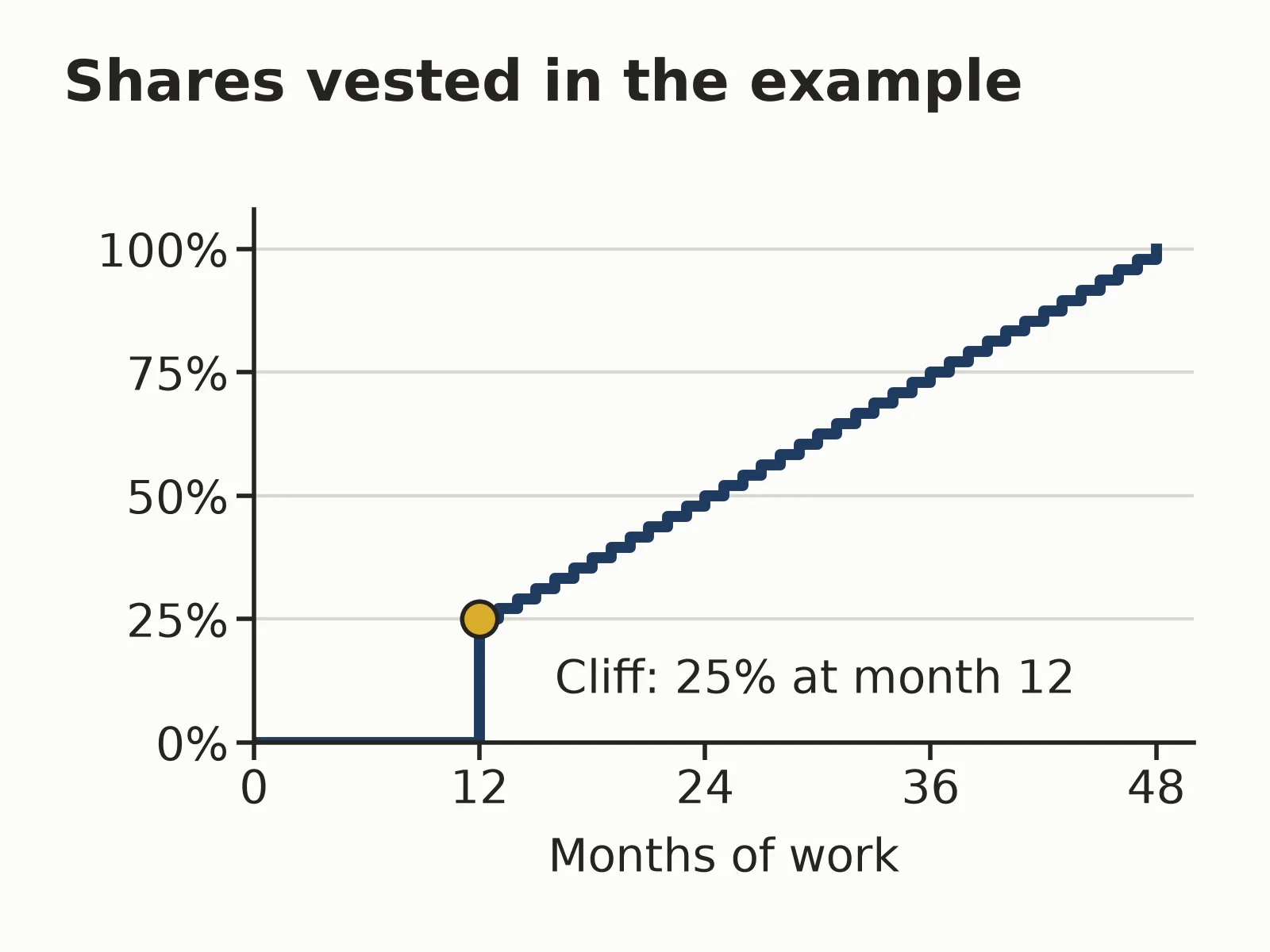
The numbers are an example, not a rule. Vesting here runs from signing, before the shares exist, so the share documents signed at incorporation need to carry the same start date. The clause can also say whether vesting speeds up on a sale of the company. Our guide to founder vesting covers cliffs, acceleration and the Canadian buyback structure.
Clause 4: Intellectual property
Sample wording: "Each Founder will assign to the Company, by a signed written assignment delivered on incorporation, all intellectual property the Founder has created or creates for the Project, and will waive moral rights in that work in favour of the Company. Pre-existing work listed in Schedule A is excluded."
The IP clause of the example founders agreement promises a signed assignment on incorporation and does not rely on the agreement alone, because the Canadian Copyright Act and Title 17 of the United States Code (17 U.S.C.) both require a transfer of copyright to be in writing and signed by the owner.
In Canada, section 13(4) of the Copyright Act says "no assignment or grant is valid unless it is in writing signed by the owner of the right". Section 13(3) makes an employer the first owner of the copyright, absent an agreement to the contrary, where the author "was in the employment of some other person under a contract of service or apprenticeship" and made the work in the course of that employment. A founder writing code before incorporation has no company to be employed by. Section 14.1(2) says "Moral rights may not be assigned but may be waived in whole or in part", and section 14.1(3) says an assignment of copyright is not by itself a waiver. That is why the sample wording has a separate waiver.
In the United States, 17 U.S.C. section 201(a) says copyright "vests initially in the author or authors of the work", and section 204(a) says a transfer "is not valid unless an instrument of conveyance, or a note or memorandum of the transfer, is in writing and signed by the owner of the rights conveyed" (Chapter 2 of Title 17, U.S. Copyright Office). The "work made for hire" rule in section 201(b) covers a work prepared by an employee within the scope of employment, and certain commissioned works where a signed writing says so, as defined in section 101 (Chapter 1 of Title 17).
Patents and trademarks have their own rules, which this guide does not cover. Our guide to the intellectual property assignment agreement covers the assignment document itself.
How does the example handle roles and decisions?
The example gives each founder a named area and a time commitment, lists the decisions that need all three founders, and sets a mediation and arbitration path for the matters they cannot agree on. Clauses 5 to 7 hold those terms.
Clause 5: Roles and time commitment
Sample wording: "Amira leads product and will serve as chief executive officer. Ben leads engineering. Chloe leads sales and will work at least 20 hours a week on the Project for the first six months and full time after that. A Founder needs the others' written consent for outside paid work."
Titles and hours look informal, but two other clauses depend on them. Vesting in clause 3 runs only while a founder is working on the project, so "working" needs a definition. And in Ontario, the title a founder holds bears on whether a non-compete can apply to that founder as an employee, as clause 9 explains.
Clause 6: Decisions and reserved matters
Sample wording: "Each Founder decides day-to-day matters in that Founder's area. These matters need all three Founders: issuing or promising equity, spending or borrowing above the limit in Schedule B, licensing or assigning Project IP, admitting a new founder, and selling the business. Any other matter is decided by Founders holding a majority of the shares in clause 2."
With a 45%, 40% and 15% split, no founder has a majority alone, and any two founders together do: 85%, 60% or 55%. So the unanimous list is what protects each founder, including Chloe, the smallest holder.
Before incorporation, the reserved-matters clause of a founders agreement is only a contract among the founders. After incorporation the default changes, because the statutes give management to the directors. OBCA section 115(1) says "Subject to any unanimous shareholder agreement, the directors shall manage or supervise the management of the business and affairs of a corporation", and CBCA section 102(1) says the same.
To carry the reserved matters into an Ontario or federal corporation, the statutes provide for a written agreement among all the shareholders. OBCA section 108(2) and CBCA section 146(1) allow such an agreement to restrict the directors' powers "in whole or in part". The trade-off: under OBCA section 108(5), shareholders who take over those powers also take on the directors' duties and liabilities to the same extent.
Delaware starts from the same default with a different exception. Section 141(a) of the Delaware General Corporation Law (DGCL) says the business "shall be managed by or under the direction of a board of directors, except as may be otherwise provided in this chapter or in its certificate of incorporation" (Subchapter IV). Section 218(c) lets two or more stockholders agree in a signed writing on how their shares will be voted (Subchapter VII). Our guide to the shareholder agreement vs bylaws explains which document governs what.
Clause 7: Deadlock
Sample wording: "If the Founders cannot agree on a matter that needs all three within 15 days, they will meet with a mediator. If the matter is still unresolved 30 days later, any Founder may refer it to arbitration in Toronto."
Deadlock in this example arises mainly on the unanimous list, since any two founders carry every other vote. The steps and the day counts are choices, not legal requirements. Ontario's statute expressly supports the arbitration step once a company exists: OBCA section 108(6)(b) says a unanimous shareholder agreement may provide that a matter the shareholders cannot resolve "may be referred to arbitration under such procedures and conditions as are specified in the unanimous shareholder agreement".
What happens when a founder leaves?
When a founder leaves, the example lets the company buy back the unvested shares at the price paid, sets separate terms for a founder removed for cause, and keeps a confidentiality promise and a 12-month non-solicitation promise in place. Clauses 8 and 9 hold those terms.
Clause 8: Leaver terms
Sample wording: "If a Founder stops working on the Project for any reason, the Company may buy back the Founder's unvested shares at the price paid. If the Founder is removed for Cause, as defined in Schedule C, the Company may also buy the vested shares at fair value set by an independent valuator."
Under 48-month vesting with a 12-month cliff, a founder who leaves at month 18 has vested 18 of 48 months, or 37.5%. For Chloe's 720,000 shares, by our calculation, that is 270,000 vested shares, which she keeps, and 450,000 unvested shares, which the company may buy back.
The words that carry the weight are "Cause" and "fair value". Each needs a definition the founders have read. Our guide to shareholders agreement clauses covers good leaver and bad leaver terms, transfer restrictions and buy-sell mechanisms.
Where leaver terms restrict transfers of Delaware shares, there is a notice step. Under DGCL section 202(a), a written restriction on the transfer of a security may be enforced against the holder if it is permitted by that section and "noted conspicuously on the certificate or certificates representing the security", or, for uncertificated shares, contained in the notice the section names (Subchapter VI).
Clause 9: Confidentiality and restrictive covenants
Sample wording: "Each Founder will keep Project information confidential. For 12 months after leaving, a Founder will not solicit the Company's employees or its customers."
The example founders agreement has no non-compete, and in Ontario that is deliberate. Section 67.2(1) of the Employment Standards Act, 2000 (ESA) says "No employer shall enter into an employment contract or other agreement with an employee that is, or that includes, a non-compete agreement", and section 67.2(2) makes such an agreement void. Once the company exists and employs a founder, that rule applies to the founder as an employee.
There are two exceptions. Section 67.2(4) says the ban "does not apply with respect to an employee who is an executive". Section 67.2(5) defines an executive as a person who holds the office of chief executive officer, president or one of the other chief officer positions it lists, "or holds any other chief executive position". Section 67.2(3) covers a seller of a business who becomes the buyer's employee. In the example, Amira's title falls within the executive definition. Ben and Chloe hold no listed office in clause 5. Our guide to the non-compete agreement in Ontario covers the ban in full.
Where do the terms go after incorporation?
After incorporation, the terms of a founders agreement are normally moved into company-level documents, because the company was never a party to the original. In an Ontario or federal corporation that is mainly a shareholder agreement. In a Delaware corporation it is mainly stock purchase agreements, with the certificate of incorporation or a voting agreement for decision rules.
The table maps the example's terms to the document that usually carries each one. It describes common practice, not a statutory requirement, and the right set depends on the company.
| Term | Ontario or federal | Delaware |
|---|---|---|
| Equity split | Share subscriptions | Stock purchase agreements |
| Vesting and buyback | Shareholder agreement | Stock purchase agreements |
| IP | Signed assignments | Signed assignments |
| Reserved matters | Unanimous shareholder agreement | Certificate or voting agreement |
| Leaver terms | Shareholder agreement | Stock purchase agreements |
The statutes behind the Ontario and federal column are OBCA sections 23, 108 and 115 and CBCA sections 25, 102 and 146, quoted above. Behind the Delaware column are DGCL sections 141(a), 202(a) and 218(c). Our startup equity guide sets the three statutes side by side for share issuances and options, and our guide to 12 shareholders agreement clauses covers the document that takes over.
IRS Publication 525 (2025) describes a choice under section 83(b) of the Internal Revenue Code to include restricted property in income for the year of transfer. It says: "You can make the choice by filing a written statement or Form 15620, with the Internal Revenue Service Center where you file your return. You must file this statement no later than 30 days after the date the property was transferred." This guide states that United States tax point only as the IRS does. Whether the choice suits a founder who receives shares subject to vesting is a question for a US tax adviser.
What should you check before signing?
Before signing, check that the document names a date to incorporate, defines every term a buyback depends on, and matches what the founders have told each other in conversation. The list below runs through the example's clauses and then adds three general points.
- Incorporation date: a deadline, and a rule that no founder signs for the group before it.
- Share numbers: counts as well as percentages, and the price each founder pays.
- Vesting start: the date vesting runs from, and credit for work already done, if any.
- IP schedule: the pre-existing work each founder keeps, listed by name.
- Working: what counts as working on the project, in hours or duties.
- Reserved matters: the short list that needs every founder, and the dollar limit.
- Cause and fair value: written definitions, and who values the shares.
- Money: who pays early expenses and how they are repaid once the company exists.
- Changes: that the agreement can be amended only in writing signed by all founders.
- Replacement: that it ends when the shareholder agreement or stock purchase agreements are signed.
Frequently asked questions
What is a founders agreement in simple terms?
A founders agreement is a written contract among the people starting a business together. It records the equity split, vesting, who owns the intellectual property, each founder's role, how decisions are made and what happens if a founder leaves. It is usually signed before the company is incorporated, and the founders sign it as individuals.
Is a founders agreement legally binding?
Yes, it is meant to bind each founder personally from the day they sign, as a contract among individuals. Whether a particular one can be enforced depends on the contract law that governs it. Where it is signed before incorporation, the company is not a party, so the terms are normally restated afterwards in company-level documents.
When should co-founders sign a founders agreement?
Before they build much together, and before they incorporate. In Ontario, people "carrying on a business in common with a view to profit" fit the Partnerships Act definition of a partnership, and in an ordinary partnership the partners are jointly liable for the firm's debts. An agreement with an incorporation deadline and a consent rule for signing is aimed at that period.
Is a founders agreement the same as a shareholder agreement?
No. A founders agreement is usually signed by the founders before the company exists. A shareholder agreement is signed by shareholders of an existing corporation, and under OBCA section 108(2) or CBCA section 146(1) a written agreement among all the shareholders can restrict the directors' powers. The second document normally replaces the first.
Can a founders agreement assign IP to a company that does not exist yet?
The example does not rely on that. Each founder promises to sign a written assignment when the company is incorporated. Canada's Copyright Act says an assignment is not valid unless it is in writing signed by the owner, and 17 U.S.C. section 204(a) requires a signed writing for a transfer in the United States.
What happens to unvested shares when a founder leaves?
That depends on the leaver clause. In the example, the company may buy back unvested shares at the price the founder paid. A founder holding 720,000 shares who leaves at month 18 of a 48-month term has vested 270,000 shares, and the other 450,000 are open to buyback.
Can a founders agreement include a non-compete in Ontario?
Once the company employs a founder, generally not, unless the founder is an executive. Ontario's Employment Standards Act, 2000 bars an employer from entering into a non-compete agreement with an employee and makes it void. The ban does not apply to an executive, such as a chief executive officer or president, or in the sale-of-business case the section describes.
Conclusion
A founders agreement does its work in the months before a company exists. It puts the split, the vesting terms, the IP promise and the exit rules in writing while the founders still agree. The example shows how many clauses lean on a statute: partnership and pre-incorporation rules in Ontario, the writing requirement for copyright in Canada and the United States, the directors' default power under the OBCA, the CBCA and the DGCL, and Ontario's non-compete ban. Once the company is formed, its terms normally move into the shareholder agreement or the stock purchase agreements.
How Mayo Law can help
Mayo Law is a cross-border firm with offices in Toronto and New York, and Joseph Mayo is licensed in Ontario and New York. Our lawyers draft and review founders agreements, incorporate Ontario and federal companies, and prepare the shareholder agreements and IP assignments that follow. We offer a paid one-hour consultation, paid because a lawyer reviews your draft and your plans in depth. Start from our startup lawyer page or our incorporation lawyer page.
Disclaimer
This guide is general information, current as of November 2026, and is not legal or tax advice. The example is an illustration and not a template. Reading this guide does not create a solicitor-client or attorney-client relationship. Statutes change, and the right terms depend on your facts. Mayo Law provides legal services in Ontario and New York.