

Contents
- Quick answer
- What does EB-3 timing mean for a Canadian employee?
- How long does PERM take as of October 31, 2026?
- How long does the I-140 stage take?
- Where is the EB-3 priority date cut-off?
- How long does the final green card step take?
- What should an employer plan for at each stage?
- What can slow an EB-3 case down?
- Frequently asked questions
- Conclusion
- How Mayo Law can help
- Disclaimer
EB-3 processing time is not one number. An employment-based third preference (EB-3) case runs through four stages: the Department of Labor's prevailing wage and labor certification steps, the Form I-140 petition, the wait for a visa number, and the Form I-485 or consular step. Mayo Law's business immigration lawyers plan these cases backwards from the date the employee's current status runs out. This guide gives the latest official figure for each stage, with its as-of date, starting with what applies to an employer sponsoring a Canadian employee on TN, L-1B or H-1B status.
Quick answer
EB-3 processing time runs through four stages. As of October 31, 2026, the Department of Labor's analyst review averaged 300, 315 and 360 calendar days over 30, 90 and 180 days. The November 2026 Visa Bulletin set the EB-3 final action date for all areas not listed at June 15, 2024 and the date for filing at August 1, 2024.
What does EB-3 timing mean for a Canadian employee?
For an employee born in Canada, EB-3 timing turns on the Visa Bulletin column headed "All Chargeability Areas Except Those Listed" and on the employee's current status, because the H-1B and L-1 regulations expressly allow a green card process alongside the status and the TN regulation requires temporary entry.
Applicants born in Canada read the first column
Immigrant visas are counted against a person's place of birth, not citizenship. The State Department regulation says an immigrant "shall be charged to the numerical limitation for the foreign state or dependent area of birth," unless an exception applies (22 CFR 42.12(a), in the Code of Federal Regulations (CFR)). The Visa Bulletin for November 2026 names four oversubscribed chargeability areas: China-mainland born, India, Mexico and the Philippines. Canada is not among them, so an applicant born in Canada reads the column headed "All Chargeability Areas Except Those Listed," which this guide calls the first column. A Canadian citizen who was born in one of the four listed areas is generally charged to that area instead.
One exception matters to couples. If necessary to prevent the separation of husband and wife, an immigrant spouse "may be charged to a foreign state to which a spouse is chargeable if accompanying or following to join the spouse" (22 CFR 42.12(c)). The bulletin adds that spouses and children of preference immigrants "are entitled to the same status, and the same order of consideration, if accompanying or following to join the principal."
TN, L-1B and H-1B treat a pending green card differently
The employee has to stay in valid status while the stages run, and the three common statuses do not treat immigrant intent alike:
- H-1B: the approval of a labor certification or the filing of a preference petition "shall not be a basis for denying" an H-1B petition, extension or admission (8 CFR 214.2(h)(16)(i)).
- L-1B: an L-1 worker may come temporarily and "at the same time, lawfully seek to become a permanent resident of the United States provided he or she intends to depart voluntarily at the end of his or her authorized stay" (8 CFR 214.2(l)(16)). Time is the constraint: five years in a specialized knowledge capacity is the limit (8 CFR 214.2(l)(12)(i)).
- TN: the TN regulation defines temporary entry as "entry without the intent to establish permanent residence," and the person "must satisfy the inspecting immigration officer that the proposed stay is temporary" (8 CFR 214.6(b)). The USCIS Policy Manual, Volume 2, Part P, Chapter 2 (current as of November 20, 2026) repeats that definition for the United States-Mexico-Canada Agreement (USMCA) category. Neither text has a provision like the H-1B and L-1 paragraphs quoted in this list.
That difference is why the order and timing of filings matter for a TN professional. The FAQ "Can a Canadian on TN get a green card through employment" in our employment green card guide deals with that question, and our TN visa guide for Canadians explains the status itself.
What the employer controls
The employer runs the first stage and should watch one date: the priority date. For a petition accompanied by a labor certification, the priority date is "the date the labor certification application was accepted for processing by any office of the Department of Labor" (8 CFR 204.5(d)). So the place in the visa line is fixed while the first stage is still running, and the stages overlap in that sense.
How long does PERM take as of October 31, 2026?
As of October 31, 2026, the Department of Labor (DOL) reported that labor certification determinations at analyst review averaged 300 calendar days over the last 30 days, 315 over the last 90 days and 360 over the last 180 days.
A permanent labor certification, which the DOL abbreviates as PERM, "allows an employer to hire a foreign worker to work permanently in the United States," in the words of the DOL's PERM program page. The DOL's Office of Foreign Labor Certification (OFLC) publishes its queues on the processing times page of flag.dol.gov, updated at the end of the first work week of each month. Those averages are figures for the cases decided in each period, not a range for one case. The steps before the petition are:
- Step 1, prevailing wage determination: the employer must request a prevailing wage determination (20 CFR 656.40(a)). As of October 31, 2026, the PERM wage queue was processing requests filed in August 2026 in the column the DOL labels OEWS and requests filed in July 2026 in the column it labels Non-OEWS. The determination is valid for no less than 90 days and no more than one year (20 CFR 656.40(c)).
- Step 2, recruitment: for professional occupations, the mandatory steps include a job order placed for 30 days, and they "must be conducted at least 30 days, but no more than 180 days, before the filing of the application" (20 CFR 656.17(e)(1)(i)).
- Step 3, the application: the employer files the Application for Permanent Employment Certification, ETA Form 9089 (20 CFR 656.17(a)), which then waits for analyst review at the averages given in this section.
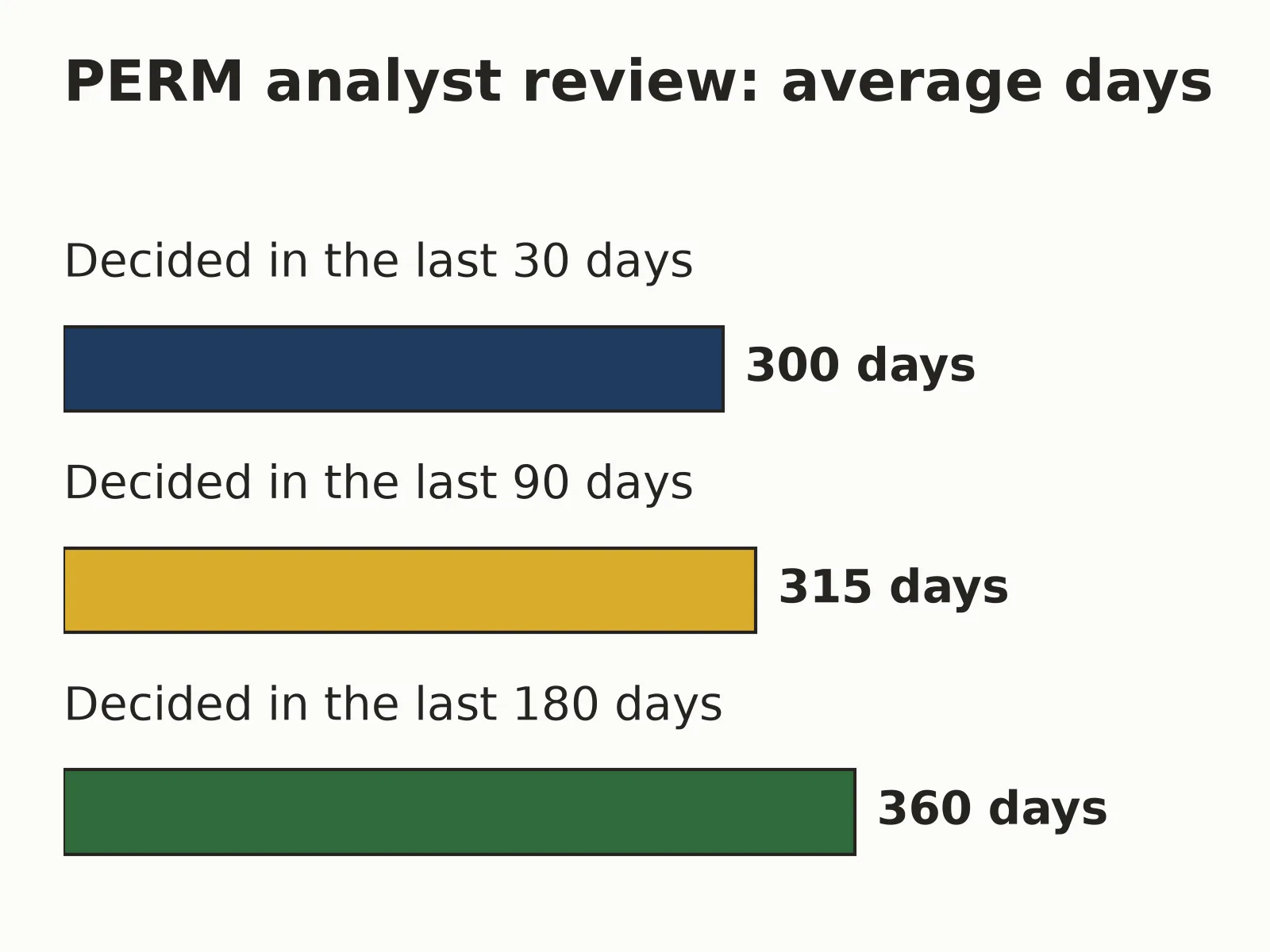
These DOL queues are the first block of EB-3 processing time. The DOL publishes no average for audited cases: its page says the averages for the audit and supervised recruitment queues "are not presented due to the significantly small percentage those cases represent." A certification also has a shelf life. It expires if it is not filed in support of a Form I-140 petition within 180 calendar days of the date the DOL granted it (20 CFR 656.30(b)(1)).
How long does the I-140 stage take?
With premium processing, U.S. Citizenship and Immigration Services (USCIS) guarantees that it will take adjudicative action on a Form I-140 within 15 business days for most classifications, or it refunds the premium processing fee.
The USCIS premium processing page (last updated November 10, 2026) gives 15 business days "for most classifications" and 45 business days for the "multinational executive and manager" and "national interest waiver" classifications of Form I-140. The page lists the possible actions as an approval notice, a denial notice, a notice of intent to deny, a request for evidence or the opening of an investigation, so the guarantee is of action, not of approval.
For petitions without premium processing, one published USCIS figure exists, and it is not specific to EB-3. The USCIS quarterly report for all form types, fiscal year 2026, quarter 3, in the agency's immigration and citizenship data library, gives a median of 3.9 months for Form I-140 petitions completed between April 1 and June 30, 2026. That median is for the form as a whole, so it is not an EB-3 figure. The USCIS website lists a Check Case Processing Times tool, and that is the place to read the current figure on the day of filing.
Where is the EB-3 priority date cut-off?
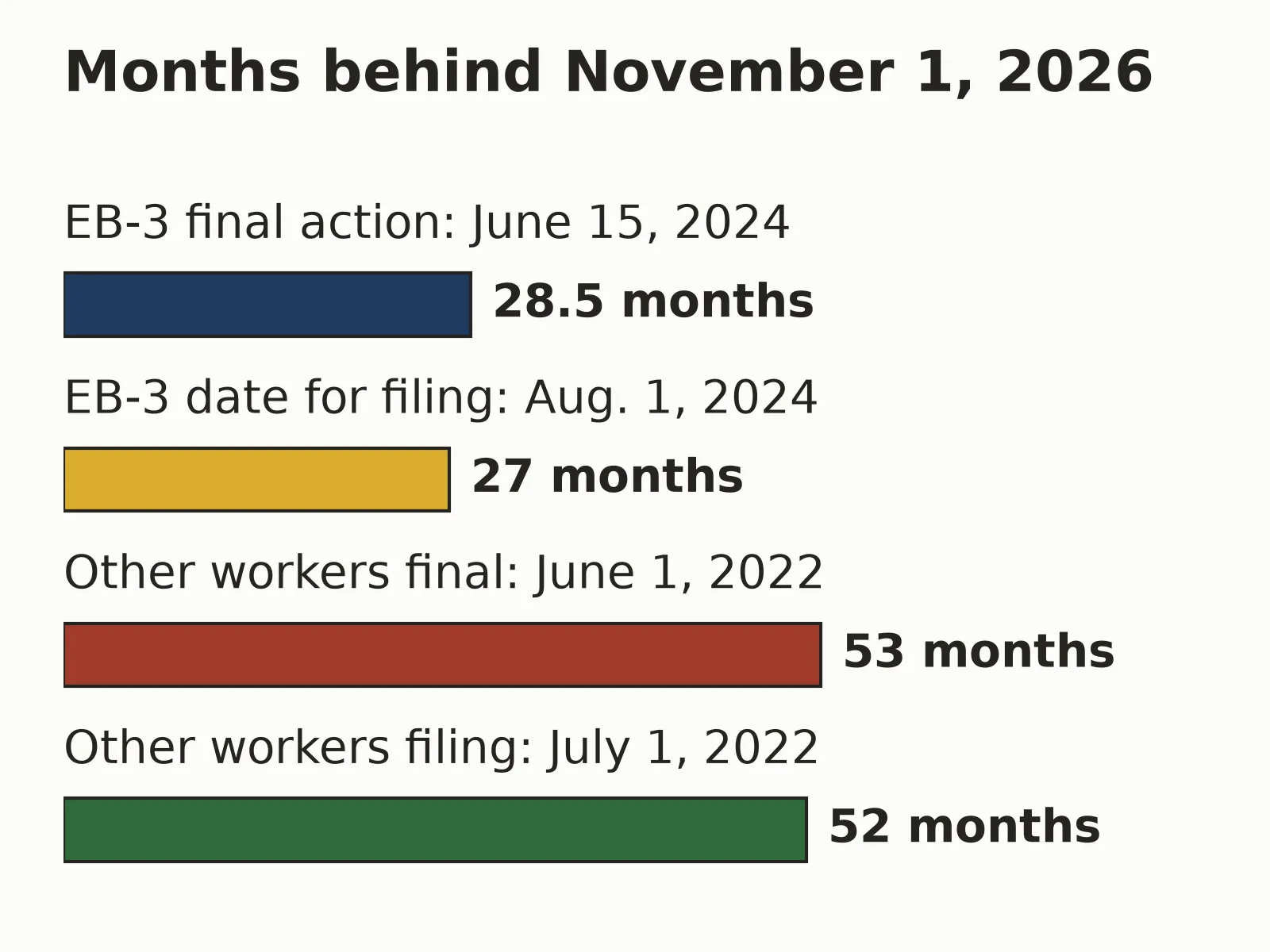
In the State Department's Visa Bulletin for November 2026, the EB-3 final action date in the first column, which covers applicants born in Canada, was June 15, 2024, and the date for filing was August 1, 2024.
The Visa Bulletin for November 2026 has two charts. A final action date controls when a visa number can be issued. A date for filing comes earlier and controls when an applicant may submit documents. The first-column entries for the third preference were:
| Category | Final action date | Date for filing |
|---|---|---|
| EB-3 skilled and professional | June 15, 2024 | August 1, 2024 |
| EB-3 other workers | June 1, 2022 | July 1, 2022 |
USCIS decides each month which chart applicants inside the United States use. Its page Adjustment of Status Filing Charts from the Visa Bulletin (last updated November 27, 2026) says that for all employment-based preference categories applicants must use the Dates for Filing chart in the Visa Bulletin for November 2026, and it says the same for the Visa Bulletin for December 2026.
By our calculation, on November 1, 2026 the two skilled and professional dates sat 28.5 and 27 months in the past, and the two other-worker dates 53 and 52 months; these gaps are arithmetic on one month's chart, not a wait estimate, because the bulletin provides for a final action date to retrogress, meaning move backwards. A labor certification application accepted for processing in November 2026 takes a priority date later than all four dates.
The limits behind those dates are statutory, and the bulletin reports them. It puts the worldwide employment-based level at no less than 140,000 a year, gives the third preference 28.6 percent of that level with no more than 10,000 for other workers, and reports the per-country limit that the statute prescribes, 7 percent of the family and employment preference totals, as 25,620. The bulletin lists a separate second preference for "Members of the Professions Holding Advanced Degrees or Persons of Exceptional Ability," which our EB-2 NIW guide covers.
How long does the final green card step take?
For employment-based Form I-485 applications that USCIS completed between April 1 and June 30, 2026, the median was 6 months across all employment categories, according to the USCIS quarterly report for fiscal year 2026, quarter 3.
That figure is not specific to EB-3. An employee inside the United States may file the adjustment application together with the Form I-140 or afterwards, but only if approval of the petition "would make a visa immediately available" at the time of filing (8 CFR 245.2(a)(2)(i)(B)). That is the second way the stages overlap. Against the August 1, 2024 date for filing in the November 2026 bulletin, a priority date set in November 2026 does not meet that test.
The USCIS consular processing page (last updated July 20, 2023) describes the other path: a person outside the United States "may apply at a U.S. Department of State consulate abroad for an immigrant visa." A visa number for that path is subject to the same final action dates. Our guide on how long the green card process takes compares the family and employment paths as a whole.
What should an employer plan for at each stage?
Because EB-3 processing time is a chain of separate queues, an employer should plan each of the four stages with its official figure, the party who controls it and the employee's status expiry date beside it.
The table lists the steps inside each stage; the number in the first column is the stage.
| Stage and step | Who controls it | Official figure | As of |
|---|---|---|---|
| 1. Prevailing wage | Employer, then DOL | OEWS: August 2026 requests | Oct. 31, 2026 |
| 1. Recruitment | Employer | 30 to 180 days before filing | Regulation |
| 1. PERM analyst review | DOL | 300, 315, 360 day averages | Oct. 31, 2026 |
| 2. I-140 with premium | Employer, then USCIS | 15 business days | Nov. 10, 2026 |
| 3. Visa number | State Department | June 15, 2024 final action | November 2026 |
| 4. Form I-485 | Employee, then USCIS | 6 months, all employment categories | April to June 2026 |
Two planning points follow from the table. First, premium processing is offered for the petition only: the USCIS page lists Form I-129, Form I-140, Form I-765 and Form I-539, and no Department of Labor filing. Second, the employee's status has to outlast the case. The USCIS H-1B Specialty Occupations page (last updated September 21, 2026) says an H-1B worker may be eligible for an extension beyond the sixth year "if at least 365 days have passed since a labor certification was filed." The L-1B limit in 8 CFR 214.2(l)(12)(i) is five years, so a case started late in that period can run out of room; our guide to the L-1A visa to green card path covers what an L-1B holder can do. A TN professional renews and crosses the border while the case is pending, under the temporary entry rule in 8 CFR 214.6(b).
What can slow an EB-3 case down?
The delays an employer can foresee are expiry dates inside the labor certification stage and a final action date that moves backwards.
The expiry dates come from the regulations cited in this guide. A prevailing wage determination must be used within its validity period: the employer has to file the application or begin recruitment before it lapses (20 CFR 656.40(c)). Recruitment steps conducted more than 180 days before filing fall outside the window in 20 CFR 656.17(e)(1)(i). A granted certification that is not filed with a Form I-140 petition within 180 calendar days expires (20 CFR 656.30(b)(1)).
The visa stage follows demand, not the calendar. The Visa Bulletin for November 2026 explains that the final action date for an oversubscribed category "is the priority date of the first applicant who could not be reached within the numerical limits," and it provides for a final action date to retrogress during the monthly allocation process.
Frequently asked questions
What is the EB-3 processing time in 2026?
There is no single official figure. As of October 31, 2026, the Department of Labor's averages for PERM determinations at analyst review were 300, 315 and 360 calendar days over the last 30, 90 and 180 days. The USCIS premium processing page, last updated November 10, 2026, guarantees adjudicative action on a Form I-140 within 15 business days for most classifications, or a refund of the premium fee. The November 2026 Visa Bulletin put the EB-3 final action date for all chargeability areas except those listed at June 15, 2024.
Is EB-3 visa processing time shorter for Canadians?
The Department of Labor and USCIS figures cited here are not broken out by nationality. The difference is at the visa stage, where an immigrant is charged to the place of birth under 22 CFR 42.12(a). Applicants born in Canada read the Visa Bulletin column for all chargeability areas except those listed. In November 2026 that column showed an EB-3 final action date of June 15, 2024, while the bulletin's columns for applicants born in mainland China, India and the Philippines showed January 22, 2022, January 22, 2014 and August 15, 2023, and the Mexico column showed June 15, 2024.
Does premium processing speed up the whole EB-3 case?
No. Within an EB-3 case, premium processing applies to the Form I-140 only. The USCIS premium processing page, last updated November 10, 2026, guarantees adjudicative action within 15 business days for most classifications, 45 business days for the multinational executive and manager and national interest waiver classifications, or a refund of the premium fee. The forms it lists do not include any Department of Labor filing or Form I-485.
What is the priority date in an EB-3 case?
For a petition accompanied by a labor certification, the priority date is the date the labor certification application was accepted for processing by the Department of Labor, under 8 CFR 204.5(d). That date is compared with the Visa Bulletin cut-off each month. It is why the day the application is accepted matters more than the day the petition is approved.
Can a Canadian stay on TN status while an EB-3 case is pending?
The TN regulation, 8 CFR 214.6(b), requires temporary entry, defined as entry without the intent to establish permanent residence, and the person must satisfy the inspecting officer that the stay is temporary. It has no paragraph like the H-1B and L-1 rules that expressly allow a green card process alongside the status. Whether a TN professional can travel or renew during the case depends on the timing and the facts of that case.
How long is the EB-3 green card processing time after the I-140 is approved?
It depends on the priority date. An adjustment application can be filed only when a visa would be immediately available under 8 CFR 245.2(a)(2)(i)(B). For employment-based Form I-485 applications completed between April 1 and June 30, 2026, the USCIS quarterly report gives a median of 6 months across all employment categories. Consular cases depend on the same final action dates.
Is the EB-3 other workers category slower?
Its published dates are earlier. The November 2026 Visa Bulletin says no more than 10,000 third preference visas a year may go to other workers, and it showed a final action date of June 1, 2022 for that group in the column for all chargeability areas except those listed, compared with June 15, 2024 for skilled workers and professionals.
Conclusion
An honest answer on EB-3 processing time for a Canadian employee is a list of dated government figures, not a total. As of October 31, 2026, the Department of Labor's analyst review averages were 300, 315 and 360 calendar days, behind a prevailing wage queue that was working on August 2026 requests in its OEWS column and July 2026 requests in its Non-OEWS column. With premium processing, USCIS guarantees action on most Form I-140 classifications within 15 business days or refunds the fee. In the November 2026 Visa Bulletin, the first-column final action date stood at June 15, 2024. The employer's lever is the date the labor certification application is accepted for processing, and the employee's constraint is how long the current status lasts. Read each figure again at its source in the month you file.
How Mayo Law can help
Mayo Law is a cross-border firm with offices in Toronto and New York, and Joseph Mayo is licensed in Ontario and New York. Our lawyers work with Canadian and US employers that sponsor Canadian employees, and with the employees themselves, on the order of the labor certification, petition and green card filings and on keeping TN, L-1 or H-1B status valid while they run. We offer a paid one-hour consultation, paid because a lawyer reviews the role, the status history and the dates in depth. You can start from our business immigration page.
Disclaimer
This guide is general information, current as of November 27, 2026, and is not legal advice. Reading it does not create a solicitor-client or attorney-client relationship. Processing times, Visa Bulletin dates and government rules change, and no figure here predicts the timing of any one case. Mayo Law provides legal services in Ontario and New York.