

Contents
- Quick answer
- Do Canadians need an O-1 or an H-1B at all?
- O-1 vs H-1B: what is the core difference?
- How does the H-1B cap compare with the O-1?
- How long can you stay on each?
- Can a founder use either for their own company?
- Does either visa allow a green card plan?
- What do the government fees and timing look like?
- Frequently asked questions
- Conclusion
- How Mayo Law can help
- Disclaimer
For most Canadians, the O-1 vs H-1B question comes second. A Canadian professional in a listed occupation looks at the TN category first, and a Canadian who owns the business looks at the E-2 treaty investor category. The choice between an O-1 and an H-1B matters when neither of those fits, and that is where our business immigration lawyers usually begin the comparison. This guide answers the Canadian question first, then compares the two visas point by point under the rules and government fees in force in November 2026.
Quick answer
The H-1B tests the job: a specialty occupation, with an annual cap and a registration and selection step before most new petitions. The O-1 tests the person: extraordinary ability, shown for an O-1A by sustained acclaim, with no cap. A Canadian usually weighs the TN or, for an owner, the E-2 first.
Do Canadians need an O-1 or an H-1B at all?
Often not: a Canadian in a profession listed in the United States-Mexico-Canada Agreement (USMCA) can, among other conditions, use the TN category, and a Canadian who makes a substantial investment in a US business and directs it can use the E-2, so the O-1 and the H-1B matter mainly when neither category fits.
The O-1 and the H-1B are both temporary work classifications that a US employer or agent requests on Form I-129, Petition for a Nonimmigrant Worker. One point applies to every route below: a visa is generally not required for Canadian citizens, except in the E, K, S and V categories (8 CFR 212.1(a)(1), in title 8 of the Code of Federal Regulations, or CFR).
The TN comes first for a professional
U.S. Citizenship and Immigration Services (USCIS) lists the TN conditions on its TN USMCA Professionals page (last updated June 4, 2025): Canadian or Mexican citizenship, a profession included in the USMCA, a US position that requires such a professional, a prearranged job with a US employer, and the qualifications to practice the profession. The same page says a Canadian citizen is not required to apply for a TN visa at a US consulate and may establish eligibility with a U.S. Customs and Border Protection (CBP) officer at a designated port of entry or pre-clearance station. The initial period of stay is up to three years. Our TN visa guide for Canadians covers the list and the documents.
The E-2 comes first for an owner
The TN does not work for an owner who controls the company. The regulation says the TN category "does not authorize the establishment of a business or practice in the United States in which the professional will be, in substance, self-employed," and it treats a professional as self-employed when rendering services to a corporation "of which the professional is the sole or controlling shareholder or owner" (8 CFR 214.6(b)).
The E-2 is the category built around an investor. The investor must have invested, or be actively investing, a substantial amount of capital in a bona fide enterprise and must be coming to develop and direct it (8 CFR 214.2(e)(2)). Control is shown by owning at least 50 percent of the enterprise, by operational control, or by other means (8 CFR 214.2(e)(16)). The Department of State's Foreign Affairs Manual (FAM) lists Canada as an E-2 treaty country (9 FAM 402.9-10, read November 2026). Our guide to E-2 visa requirements sets out each test.
When neither fits
Three situations bring a Canadian to the O-1 or the H-1B:
- The occupation is not on the USMCA list: the TN is not available.
- The person controls the company but has not made an E-2 investment: neither Canadian route covers that owner.
- A green card is part of the plan: the TN and the E-2 are both built on a temporary stay, while the H-1B and O-1 rules say a green card filing is not a basis for denial, as the green card section explains.
The table places the four categories side by side on the points a Canadian checks first.
| Route | Who it fits | Main limit | Initial approval |
|---|---|---|---|
| TN | Listed USMCA professionals | No controlling owners | Up to 3 years |
| E-2 | Investors directing a business | Substantial investment | Up to 2 years |
| H-1B | Specialty occupation jobs | Annual cap | Up to 3 years |
| O-1 | Extraordinary ability | Proof of acclaim or distinction | Up to 3 years |
The last column comes from four sources: the USCIS TN page for the TN, the USCIS E-2 Treaty Investors page (last updated August 20, 2026) for the E-2's maximum initial stay of two years, 8 CFR 214.2(h)(9)(iii)(A)(1) for the H-1B and 8 CFR 214.2(o)(6)(iii)(A) for the O-1. A controlling owner's first H-1B approval is shorter, as the founder section explains. Our overview of US work visas for Canadians compares all of the categories in more depth.
Can a spouse work on each route?
The answer differs by category, and it often decides the choice for a family:
- TN: the USCIS TN page says spouses and children in TD status are not permitted to work in the United States, though they may study.
- E-2: the USCIS E-2 page says spouses of E-2 workers in valid E-2 or E-2S status are considered employment authorized incident to status, with one stated exception for certain investors in the Northern Mariana Islands. Our guide to E-2 spouse work authorization covers it.
- H-1B: H-4 status does not confer employment authorization incident to status, and an H-4 spouse may be eligible for it only in the cases the regulation lists, such as where the H-1B worker is the beneficiary of an approved immigrant petition (8 CFR 214.2(h)(9)(iv)). See our guide to the H-4 visa and work permit.
- O-1: the spouse and children hold O-3 status and may not accept employment unless they have been granted employment authorization (8 CFR 214.2(o)(6)(iv)).
O-1 vs H-1B: what is the core difference?
The H-1B tests the job, and the O-1 tests the person: an H-1B petition must show a specialty occupation position, while an O-1 petition must show that the individual has extraordinary ability, which for an O-1A means sustained national or international acclaim.
The definitions are in 8 CFR 214.2. A specialty occupation is one that requires "theoretical and practical application of a body of highly specialized knowledge" and a bachelor's degree or higher "in a directly related specific specialty, or its equivalent" (8 CFR 214.2(h)(4)(ii)). Extraordinary ability in science, education, business or athletics means "a level of expertise indicating that the person is one of the small percentage who have arisen to the very top of the field of endeavor" (8 CFR 214.2(o)(3)(ii)). In the arts, the same paragraph says, extraordinary ability "means distinction."
USCIS splits the O-1 in two on its O-1 page (last updated March 3, 2023). The O-1A covers the sciences, education, business and athletics. The O-1B covers the arts and extraordinary achievement in the motion picture or television industry. For the O-1A, the regulation asks for a major, internationally recognized award or at least three of the listed forms of documentation (8 CFR 214.2(o)(3)(iii)). A written advisory opinion is also required: USCIS says the petitioner must provide one "from a peer group (including labor organizations) or a person with expertise in the beneficiary's area of ability." Our guide to O-1 visa requirements goes through the criteria one by one.
The H-1B has a step of its own. The USCIS H-1B page (last updated September 21, 2026) says that for a specialty occupation petition the employer or agent "must apply for and receive DOL certification of an LCA," meaning a Labor Condition Application (LCA) certified by the Department of Labor (DOL). On that application the employer attests that it will pay the required wage, the greater of the actual wage rate and the prevailing wage, for the entire period of authorized employment (20 CFR 655.731(a)).
Both classifications tie the worker to the petition. If an H-1B worker in the United States seeks to change employers, the new employer must file a petition (8 CFR 214.2(h)(2)(i)(D)), and the O-1 rule says the same of a new O-1 employer (8 CFR 214.2(o)(2)(iv)(C)).
How does the H-1B cap compare with the O-1?
The H-1B has an annual limit set by statute and a registration and selection step before a cap-subject petition can be filed, while the statute's numerical limits do not list the O-1 category and the O-1 rules read here set no filing season.
USCIS sets out the numbers on its H-1B Cap Season page (last updated November 9, 2026). The regular cap is 65,000 a year, and the page says an additional 20,000 petitions for people who have earned a master's degree or higher from a US institution of higher education are exempt from that cap. The limits are in section 1184(g) of title 8 of the United States Code (2023 edition, read on govinfo.gov). Paragraph (1) names the H-1B and H-2B categories only, and paragraph (5)(C) holds the 20,000 figure.
The steps before an H-1B cap petition, as USCIS describes them:
- Registration: the Cap Season page says prospective petitioners who are subject to the annual cap "must first go through the electronic registration process (unless registration is suspended)." The initial registration period is at least 14 calendar days each fiscal year, and the fee schedule lists $215 per beneficiary.
- Weighted selection: the page says that, starting in fiscal year 2027, USCIS "has implemented a weighted selection process." When random selection is required because USCIS receives more registrations than it projects it needs, the selection is weighted "generally based on the highest Occupational Employment and Wage Statistics (OEWS) wage level that the beneficiary's proffered wage equals or exceeds." A registration at wage level IV is entered into the pool 4 times, level III 3 times, level II 2 times and level I 1 time.
- Filing window and start date: USCIS tells petitioners not to file earlier than 6 months before the requested start date. For the fiscal year 2027 cap, the page says cap petitions and advanced degree exemption petitions must show a start date no earlier than October 1, 2026.
The statute also exempts some employers from the cap, and our guide to the cap-exempt H-1B explains who they are. The O-1 has no registration step in its rules. The USCIS O-1 page says the employer or agent cannot file more than one year before the services are needed and should file at least 45 days before the date of employment.
How long can you stay on each?
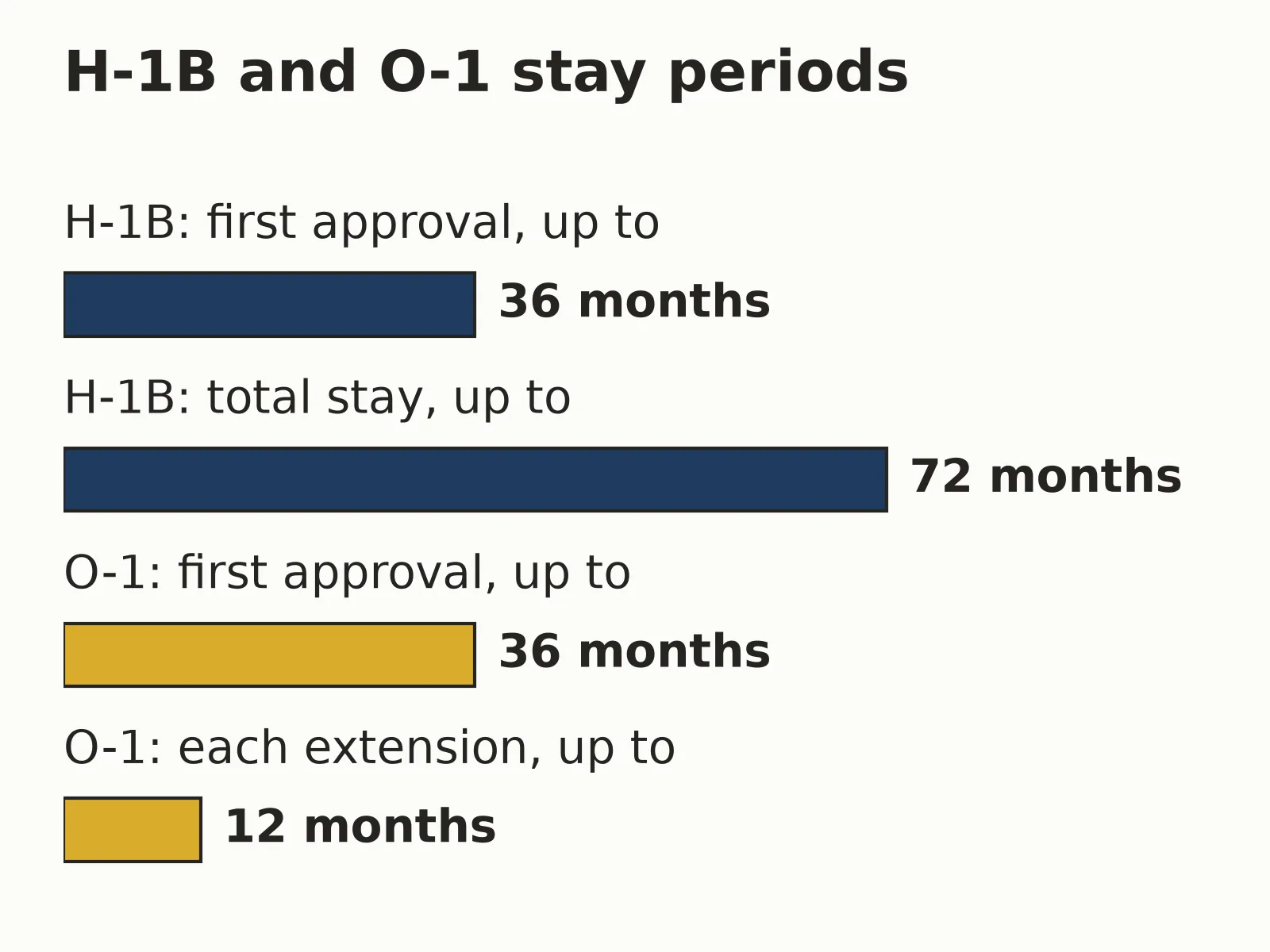
An H-1B approval generally runs for up to three years and can be extended to a total of six years, while an O-1 approval runs for up to three years and can then be extended in increments of up to one year for the same event or activity.
For the H-1B, an approval "shall be valid for a period of up to three years," an extension may be authorized for up to three years, and "the alien's total period of stay may not exceed six years" (8 CFR 214.2(h)(9)(iii)(A)(1) and (h)(15)(ii)(B)(1)). In months, the figure below shows 36 for the first approval and 72 for the total. USCIS notes on its H-1B page that an extension beyond the sixth year may be available to the beneficiary of an approved immigrant petition in the cases it lists.
For the O-1, an approved petition is valid for the time needed for the event or activity, "not to exceed 3 years," and an extension "may be authorized in increments of up to 1 year" to "continue or complete the same event or activity" (8 CFR 214.2(o)(6)(iii)(A) and (o)(12)(ii)). That extension paragraph states the one-year increment and no six-year total.
Can a founder use either for their own company?
Yes, on conditions: a company the founder controls may file an H-1B petition if the founder performs specialty occupation duties a majority of the time, with shorter first approvals, and an O-1 petition may be filed by a separate legal entity the founder owns or by a US agent, never by the founder personally.
On the H-1B side, the definition of a United States employer allows a beneficiary with a controlling interest, meaning more than 50 percent ownership or majority voting rights, on the condition that the person performs specialty occupation duties a majority of the time (8 CFR 214.2(h)(4)(ii)). The first approval and the first extension for such an owner are each limited to up to 18 months (8 CFR 214.2(h)(9)(iii)(E)). Our guide on starting a business on an H-1B covers those rules.
On the O-1 side, the USCIS Policy Manual (Volume 2, Part M, Chapter 3, current as of November 20, 2026) says O beneficiaries may not petition for themselves, but a separate legal entity owned by the beneficiary, such as a corporation or limited liability company, may file the petition on their behalf. The regulation also lets a United States agent file for workers who are traditionally self-employed (8 CFR 214.2(o)(2)(iv)(E)). The founder still has to meet the extraordinary ability standard.
Does either visa allow a green card plan?
Yes: the regulations for both say that an approved labor certification or a filed preference petition is not a basis for denying the petition, an extension or admission, which the TN and E-2 rules do not say.
This is often called dual intent. For the H-1B, the approval of a permanent labor certification or the filing of a preference petition "shall not be a basis for denying" an H-1B petition, an extension, or the person's admission, change of status or extension of stay (8 CFR 214.2(h)(16)(i)). For the O-1, 8 CFR 214.2(o)(13) says the same of an O-1 petition. The statute treats the H-1B differently again: section 1184(b) of title 8 of the United States Code presumes every applicant to be an immigrant until nonimmigrant status is shown, and it excepts the H-1B and L categories from that presumption. The O category is not in that exception.
The two Canadian routes read differently. The TN regulation defines temporary entry as "entry without the intent to establish permanent residence" (8 CFR 214.6(b)). The E-2 regulation requires that the investor intends to depart the United States when E-2 status ends (8 CFR 214.2(e)(2)(iii)). A Canadian who expects to file for permanent residence should plan the order of the steps before choosing a category, and our guide on moving from an O-1 visa to a green card shows how that path works.
What do the government fees and timing look like?
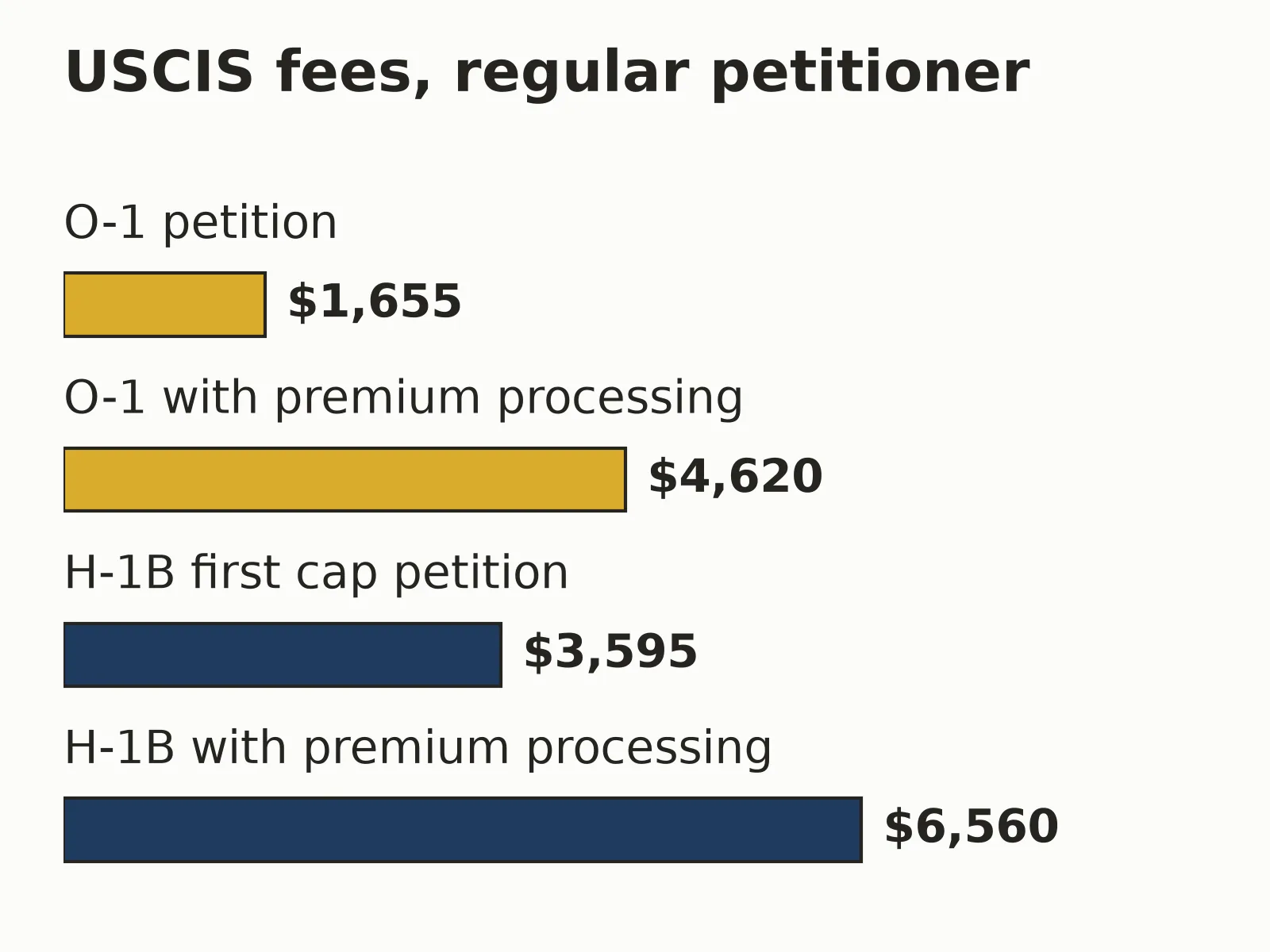
For an employer that is neither a small employer nor a nonprofit, filing on paper, we calculate USCIS fees of $3,595 for a first cap-subject H-1B petition, using the higher of two possible workforce fees, and $1,655 for an O-1 petition; premium processing, at $2,965 more, brings a decision step within 15 business days for either.
The amounts are from the USCIS Fee Schedule, Form G-1055, edition 11/19/26. The schedule calls an employer that is neither a small employer nor a nonprofit a regular petitioner. A small employer is "a firm or individual that has 25 or fewer full-time equivalent employees in the United States, including any affiliates and subsidiaries" (8 CFR 106.1(f)(1)). The table shows that the H-1B carries three charges the schedule does not list for an O petition, among them the American Competitiveness and Workforce Improvement Act (ACWIA) fee.
| USCIS fee | H-1B | O-1 |
|---|---|---|
| Form I-129, paper filing | $780 | $1,055 |
| Asylum Program Fee, regular petitioner | $600 | $600 |
| Fraud Prevention and Detection fee | $500 | Not listed |
| ACWIA fee | $1,500 or $750 | Not listed |
| Cap registration | $215 | Not listed |
| Premium processing, optional | $2,965 | $2,965 |
Our totals are calculated from those rows for a regular petitioner filing on paper. The H-1B total of $3,595 adds the registration, the filing fee, the Asylum Program Fee, the fraud fee and the higher ACWIA fee of $1,500. The O-1 total of $1,655 adds the filing fee and the Asylum Program Fee. The O-1 vs H-1B fee gap on those conditions is $1,940. With premium processing the totals are $6,560 and $4,620. The schedule says the ACWIA fee is "$1,500 or $750, depending on number of workers the petitioner employs," and that the fraud fee applies to an initial H-1B approval or a change of H-1B employer.
Several things move those numbers:
- Online filing: the schedule lists $730 for an H-1B petition and $1,005 for an O petition filed online.
- Small employers and nonprofits: the paper filing fee is $460 for an H-1B petition and $530 for an O petition, and the Asylum Program Fee is $300 for a small employer and $0 for a nonprofit.
- Employers with many H-1B and L-1 workers: the schedule lists a further $4,000 fee under Public Law 114-113 where the petitioner employs 50 or more individuals in the United States, more than 50 percent of them are in H-1B, L-1A or L-1B status, and the petition is filed on or before September 30, 2027. The schedule says it applies unless the petitioner is filing an amended petition that does not seek an extension of H-1B status.
- The $100,000 payment: a presidential proclamation issued on September 19, 2025 requires an additional $100,000 payment with certain H-1B petitions, including petitions for people who are outside the United States and do not have a valid H-1B visa, and the fee schedule still lists it. USCIS reports on its H-1B page that on June 8, 2026 the U.S. District Court for the District of Massachusetts vacated the guidance implementing the payment, that on July 24, 2026 the U.S. Court of Appeals for the First Circuit denied a stay, and that the Department of Homeland Security (DHS) will comply with the order while it considers next steps. Check its status on the day of filing.
The O-1 vs H-1B timing points that the sources state are in the second table.
| Timing point | H-1B | O-1 |
|---|---|---|
| Registration before filing | Cap-subject petitions | Not listed |
| Earliest filing | 6 months before start | 1 year before need |
| Cap start date, fiscal year 2027 | October 1, 2026 or later | Not applicable |
| Premium processing | 15 business days | 15 business days |
USCIS says on its premium processing page (last updated November 10, 2026) that it guarantees adjudicative action within 15 business days for most classifications or it refunds the premium fee, and its table of Form I-129 classifications lists both the H-1B and the O-1. Adjudicative action is a step in the case, not a promise of approval.
Frequently asked questions
Is O-1 vs H-1B the right comparison for a Canadian?
Usually it is the second comparison. A Canadian in a profession listed in the USMCA can, among other conditions, use the TN, which USCIS says does not require a visa application at a consulate, and a Canadian who makes a substantial investment in a US business and directs it can use the E-2. The O-1 and the H-1B come into view when the occupation is not listed, the person controls the company without an E-2 investment, or a green card is planned.
Is the O-1 harder to get than the H-1B?
The two are not measured on one scale, because the standards are different in kind. The H-1B asks whether the job is a specialty occupation that needs a related bachelor's degree or higher, or its equivalent. The O-1A asks whether the person has extraordinary ability as the regulation defines it, shown by a major award or at least three listed forms of evidence. For the arts, 8 CFR 214.2(o)(3)(ii) says extraordinary ability means distinction. A degree-level job offer is not, on its own, evidence of either.
Does the O-1 have a lottery?
No. The annual numerical limits in section 1184(g)(1) of title 8 of the United States Code name the H-1B and H-2B categories, and the registration and weighted selection steps that USCIS describes apply to H-1B cap-subject petitions. The O-1 rules list no registration step, and USCIS says an O-1 petition cannot be filed more than one year before the services are needed.
How long does an O-1 last compared with an H-1B?
Both can generally be approved for up to three years at first, though a controlling owner's first H-1B approval is limited to up to 18 months. An H-1B can be extended for up to three more years, and the total stay may not exceed six years under 8 CFR 214.2(h)(15)(ii)(B)(1), unless an extension beyond the sixth year applies because of a green card step. An O-1 can be extended in increments of up to one year to continue or complete the same event or activity under 8 CFR 214.2(o)(12)(ii).
Which costs more in government fees, the O-1 or the H-1B?
On the USCIS fee list (Form G-1055, edition 11/19/26), the O petition has the higher paper filing fee, $1,055 against $780. The H-1B adds a $500 fraud fee, an ACWIA fee of $1,500 or $750 and a $215 registration. By our calculation, an employer that is neither a small employer nor a nonprofit, filing on paper, pays $1,655 for an O-1 petition and $3,595 for a first cap-subject H-1B petition at the $1,500 ACWIA fee, before premium processing.
Can I apply for a green card from either status?
The regulations for both categories say that an approved labor certification or a filed preference petition is not a basis for denying the petition, an extension, or admission. That is 8 CFR 214.2(h)(16)(i) for the H-1B and 8 CFR 214.2(o)(13) for the O-1. The TN rule defines temporary entry as entry without the intent to establish permanent residence, and the E-2 rule requires an intent to depart when status ends.
Can a startup founder choose between the O-1 and the H-1B?
Yes, if the founder meets the standard for the one chosen. A company the founder controls can file an H-1B petition under 8 CFR 214.2(h)(4)(ii) if the founder performs specialty occupation duties a majority of the time, with the first approval and first extension each limited to up to 18 months. A separate legal entity owned by the founder can file an O-1 petition, according to the USCIS Policy Manual, if the founder has extraordinary ability.
Conclusion
The O-1 vs H-1B choice turns on what you can prove and when you need to start. The H-1B fits a degree-level job, but a cap-subject petition runs through an annual registration, a weighted selection when one is needed, and an October start, and the stay ends at six years unless a green card step extends it. The O-1 has no cap, and its regulation sets no six-year total, but each extension of up to one year must be to continue or complete the same event or activity, and an O-1A demands evidence of sustained national or international acclaim. For a Canadian, the first question is still whether the TN or the E-2 already fits. Check the USCIS fee schedule and the status of the $100,000 payment on the day of filing.
How Mayo Law can help
Mayo Law is a cross-border firm with offices in Toronto and New York, and Joseph Mayo is licensed in Ontario and New York. Our lawyers work with Canadian professionals, founders and their US employers on the choice between the TN, E-2, H-1B and O-1 categories and on the petition that follows. We offer a paid one-hour consultation, paid because a lawyer reviews your role, your record and your long-term plan in depth. You can start from our business immigration page or, for a TN question, our TN visa lawyer page.
Disclaimer
This guide is general information, current as of November 2026, and is not legal advice. Reading it does not create a solicitor-client or attorney-client relationship. Immigration rules, government fees and court orders change, and the right answer depends on your facts. Mayo Law provides legal services in Ontario and New York.