

Contents
- Quick answer
- Which route fits a Canadian owner: E-2, L-1 or TN?
- What can I own, and what counts as work?
- Can my own company sponsor my H-1B?
- What limits apply if I control the company?
- Can I keep my job and add my own company?
- Does the $100,000 payment apply to founders?
- What happens if I work without authorization?
- Frequently asked questions
- Conclusion
- How Mayo Law can help
- Disclaimer
Founders ask us one question in many forms: "Can I start a business on H-1B status?" Yes, you can own a US company while you hold H-1B status. What you cannot do is work for that company until the work is authorized through the company's own H-1B petition. If you are Canadian, remember that the H-1B is an employee category, and our business immigration lawyers usually compare it with the E-2 treaty investor category first. This guide leads with the Canadian routes, then explains how an H-1B through your own company works under the rules in force in November 2026.
Quick answer
Yes. An H-1B holder may own shares in a US company, but may work for it only once the company's own H-1B petition authorizes that work. If you own more than 50 percent or hold majority voting rights, the first approval and first extension are each limited to up to 18 months. Canadian owners usually compare the E-2 first.
Which route fits a Canadian owner: E-2, L-1 or TN?
For a Canadian who wants to own and run a US business, the E-2 treaty investor category is built around a person who invests in and directs a business, the L-1 can transfer an owner who already works for a related Canadian company, and the TN does not allow work for a company you control. The H-1B is different: it is an employee category with a specialty occupation test.
The E-2: built for an owner who invests
The E-2 is open to nationals of a treaty country. The Department of State's Foreign Affairs Manual (FAM) lists Canada as an E-2 treaty country since January 1, 1994 (9 FAM 402.9-10, read November 2026). Title 8 of the Code of Federal Regulations (CFR) asks for a substantial amount of capital, invested or in the process of being invested, in a real operating business, and it asks that you come to develop and direct that business. You show that by owning at least 50 percent of the enterprise, by holding operational control, or by other means (8 CFR 214.2(e)(16)).
U.S. Citizenship and Immigration Services (USCIS) states on its E-2 Treaty Investors page (last updated August 20, 2026) that the initial stay is a maximum of two years, that extensions are granted in increments of up to two years, and that there is no limit on the number of extensions. The same page says a treaty investor who is already in the United States in a lawful nonimmigrant status may file Form I-129 to request a change of status to E-2. Our guide to E-2 visa requirements covers each test, and our guide on whether a Canadian can own a business in the US explains why the E-2 visa itself comes from a consulate and not from an officer at the border.
The L-1: for an owner who works in the Canadian company
The L-1 moves a person from a company abroad to a related US company. The person must have been employed abroad by a qualifying organization for one continuous year within the preceding three years (8 CFR 214.2(l)(1)(i)). A manager or executive can come to open a new US office if premises are secured and the US operation will support the role within one year of approval (8 CFR 214.2(l)(3)(v)). USCIS describes a one-year initial approval for a new office on its page titled Options for Alien Entrepreneurs to Work in the United States (last reviewed January 24, 2025), which this guide calls the entrepreneur pathways page. Owners are not excluded: where the beneficiary is an owner or major stockholder of the company, the petition must include evidence that the services are for a temporary period and that the person will be transferred abroad afterwards (8 CFR 214.2(l)(3)(vii)).
That year abroad is the obstacle for most people who are already working in the United States on an H-1B. Time spent in L status also counts toward the H-1B six-year limit (8 CFR 214.2(h)(13)(iii)(A)). For a Canadian founder who has been running the Canadian company from Canada, our guide to the L-1 visa from Canada sets out the tests.
The TN: not for a company you control
The TN category under the United States-Mexico-Canada Agreement (USMCA) is a work route for Canadian professionals in listed occupations, but it is closed to a professional who controls the company. The regulation says the category "does not authorize the establishment of a business or practice in the United States in which the professional will be, in substance, self-employed," and it treats a professional as self-employed when rendering services to a corporation or entity "of which the professional is the sole or controlling shareholder or owner" (8 CFR 214.6(b)). A Canadian on a TN with another employer may own shares in a US company but may not work for it without separate authorization. Our TN visa guide for Canadians covers the category.
Other routes: the O-1 and entrepreneur parole
Two more routes exist for any nationality. The USCIS Policy Manual (Volume 2, Part M, Chapter 3, current as of November 20, 2026) says O beneficiaries may not petition for themselves, but a separate legal entity owned by the beneficiary, such as a corporation or limited liability company (LLC), may file the petition on their behalf. An O-1 approval may not exceed three years (8 CFR 214.2(o)(6)(iii)(A)). Our guide to O-1 visa requirements explains the evidence. The USCIS International Entrepreneur Rule page also describes a parole program that asks for ownership of at least 10 percent of the startup and a central and active role in its operations.
How the routes compare
The table shows the point that matters to an owner: every route except the TN can authorize work for a company you control, each on a different condition.
| Route | Owner can work? | Key condition | First approval |
|---|---|---|---|
| E-2 treaty investor | Yes | 50 percent or control | Up to 2 years |
| L-1A new office | Yes | One year abroad first | 1 year |
| TN | No | Self-employment barred | Not available |
| H-1B, controlling owner | Yes | Specialty occupation job | Up to 18 months |
| H-1B, other owner | Yes | Specialty occupation job | Up to 3 years |
| O-1 | Yes | Extraordinary ability | Up to 3 years |
What can I own, and what counts as work?
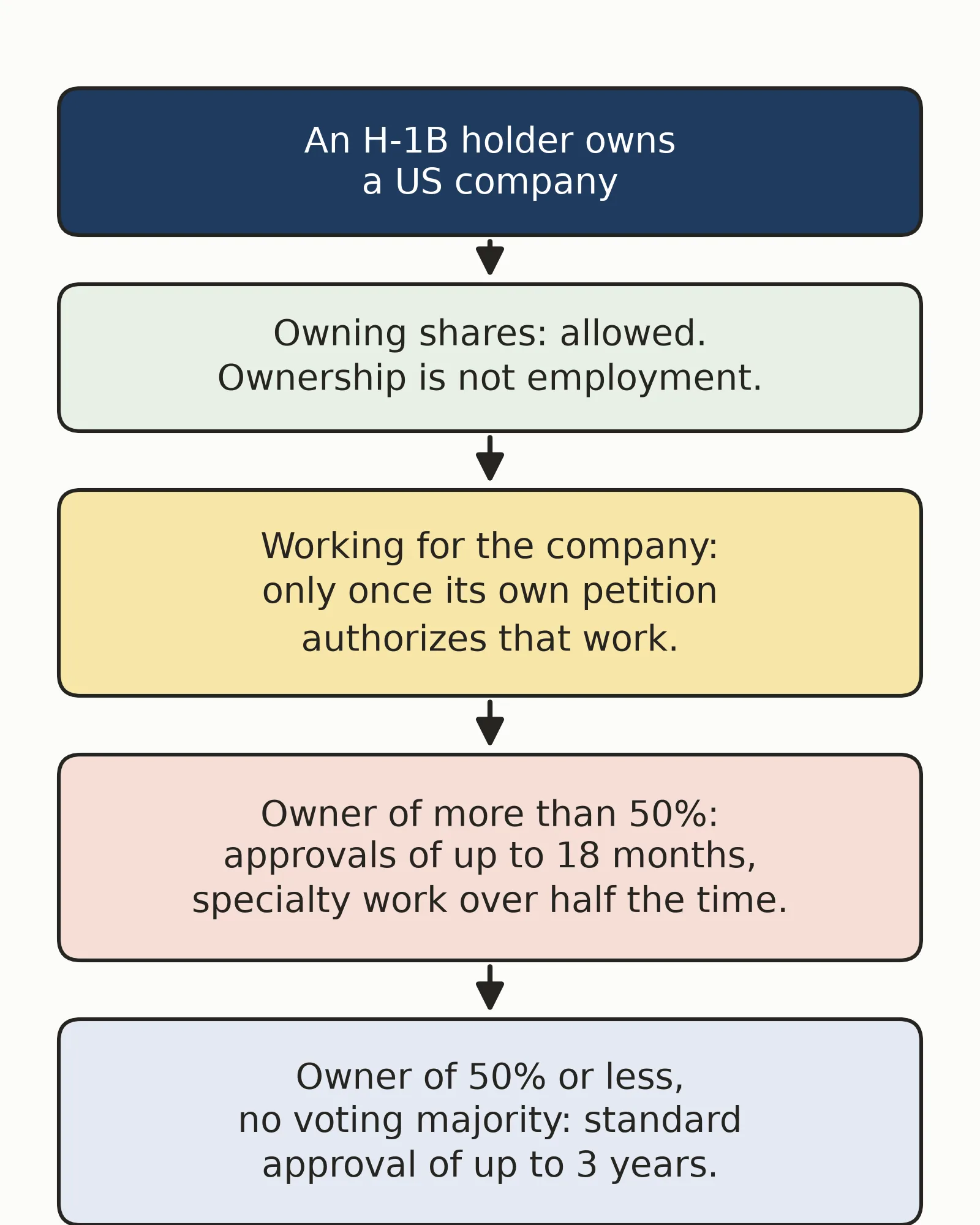
You can hold shares in a US company on H-1B status, but any service or labor you perform for that company as an employee is employment, and employment is allowed only where it has been authorized. The regulations restrict work. They do not restrict ownership.
The rule is in 8 CFR 214.1(e): "A nonimmigrant who is permitted to engage in employment may engage only in such employment as has been authorized." The same paragraph says that any unauthorized employment "constitutes a failure to maintain status." The definitions sit in 8 CFR 274a.1. Employment means "any service or labor performed by an employee for an employer within the United States," and an employee is a person who provides services or labor for an employer "for wages or other remuneration."
USCIS confirms the ownership side on its entrepreneur pathways page. The H-1B row reads: "You may have an ownership interest in the petitioning entity. However, generally the entity must file the petition as your employer."
Holding shares and receiving a return as an investor is ownership. Building the product, serving customers or running daily operations is the kind of service or labor the definitions describe. The regulations give no list of safe founder tasks, and the definition of employee reaches "other remuneration," so unpaid or equity-only work is not automatically outside it. Where a specific task falls is a question of fact to settle before you do anything for the company.
Can my own company sponsor my H-1B?
Yes: since January 17, 2025, the H-1B regulations expressly allow a company to petition for a beneficiary who owns a controlling interest in it, provided the job is a real specialty occupation role. People often call this a self-sponsored H-1B, although the petitioner is always the company and never the person.
The change came from the Department of Homeland Security (DHS) final rule titled Modernizing H-1B Requirements, published in the Federal Register on December 18, 2024 (89 FR 103054) and effective January 17, 2025. In the final rule document, DHS wrote that it "seeks to encourage more beneficiary-owned businesses to participate in the H-1B program." The document has a section headed "Beneficiary-Owners," which is why such a founder is often called an H-1B beneficiary-owner.
The definition of a United States employer in 8 CFR 214.2(h)(4)(ii) now has three core parts. The petitioner must:
- have a bona fide job offer for the beneficiary to work within the United States;
- have a legal presence in the United States and be amenable to service of process there; and
- have an Internal Revenue Service (IRS) tax identification number.
What the company must show
The job must be a specialty occupation. 8 CFR 214.2(h)(4)(ii) defines that as an occupation requiring "theoretical and practical application of a body of highly specialized knowledge" and a bachelor's degree or higher "in a directly related specific specialty, or its equivalent." A chief executive title alone does not meet that test. What is tested is the duties described in the petition.
The company must also have a Labor Condition Application (LCA). Under 20 CFR 655.731(a), the employer attests that for the entire period of authorized employment it will pay the required wage, which is the greater of the actual wage rate and the prevailing wage. The wage is an obligation, so an H-1B startup founder needs a company with the funding to pay that salary from the first day of the approved period.
Do I need the lottery again?
Usually not. If you already hold H-1B status and were counted toward the annual limit in the last six years, your company can generally file for you without a new lottery registration. Under section 1184(g)(7) of title 8 of the United States Code (2023 edition, read on govinfo.gov), a person who has already been counted toward the annual H-1B limit within the six years before a petition is approved is not counted again, unless that person would be eligible for a full six years of admission when the petition is filed. A founder who has never been counted, for example a Canadian now working on a TN, is in a different position: the USCIS entrepreneur pathways page says that, because of the annual cap, there is typically a random selection process for an initial H-1B period unless the petition is exempt from the cap. A different exemption, tied to the type of employer, is explained in our guide to the cap-exempt H-1B.
What limits apply if I control the company?
If you own more than 50 percent of the petitioner or hold majority voting rights, two extra limits apply: you must perform specialty occupation duties a majority of the time, and your first approval and first extension are each capped at 18 months.
The first limit is in the employer definition. A beneficiary with a controlling interest "may perform duties that are directly related to owning and directing the petitioner's business as long as the beneficiary will perform specialty occupation duties a majority of the time, consistent with the terms of the H-1B petition" (8 CFR 214.2(h)(4)(ii)). So a founder who is an engineer can also raise money, hire and manage, as long as engineering stays above half of the working time.
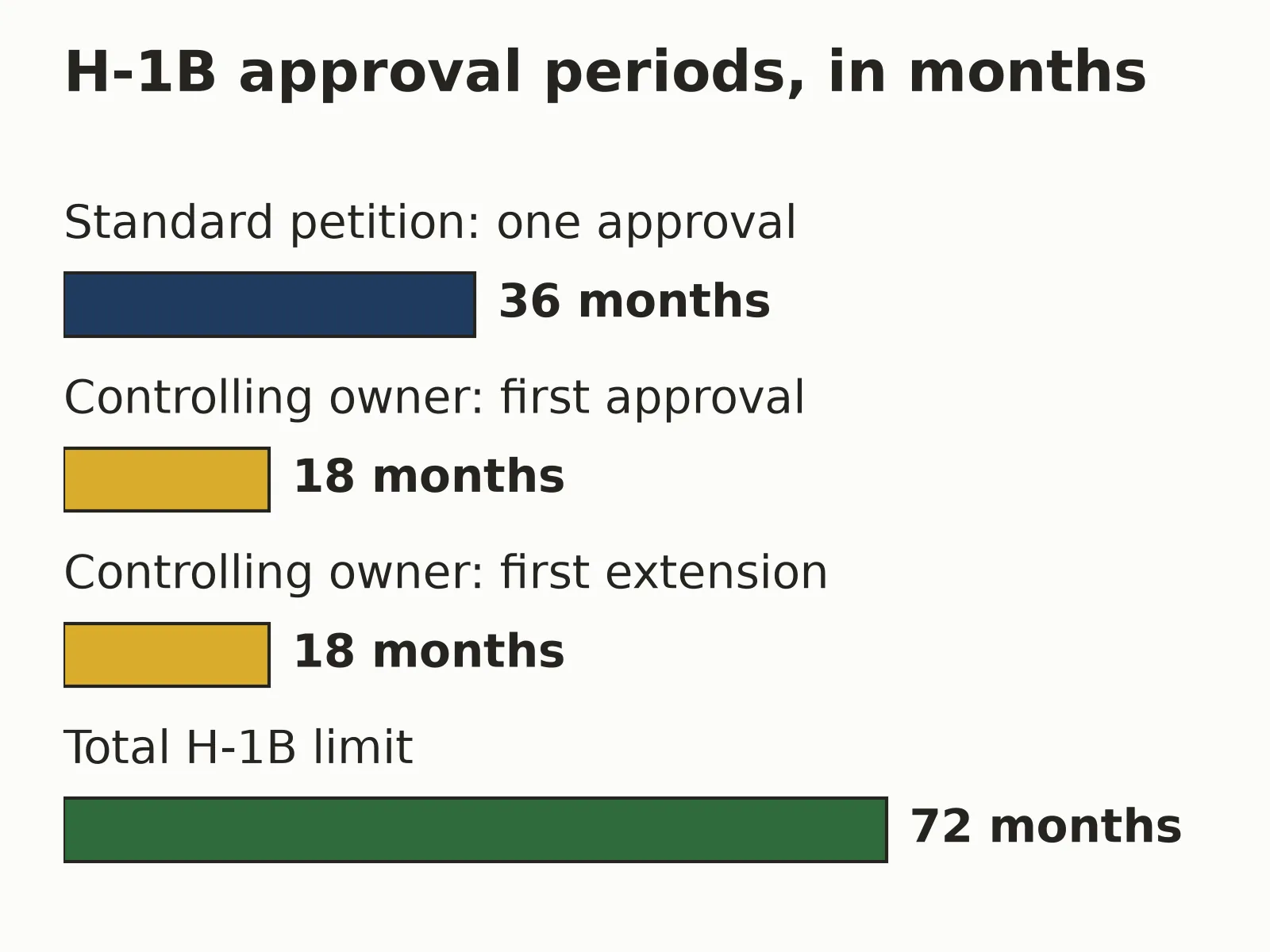
The second limit is in 8 CFR 214.2(h)(9)(iii)(E). The initial approval "will be limited to a validity period of up to 18 months," and the first extension "will also be limited to a validity period of up to 18 months." Later extensions are different: DHS wrote in the final rule document that "any subsequent extension will not be limited and may be approved for up to 3 years." A standard H-1B petition can be approved for up to three years (8 CFR 214.2(h)(9)(iii)(A)(1)). By our calculation, the two 18-month periods add up to 36 months, the same length as one standard approval, but with a second filing in the middle. The six-year total, 72 months, is unchanged (8 CFR 214.2(h)(13)(iii)(A)).
These conditions apply only to controlling owners. DHS wrote in the final rule that the framework "is not intended to hinder or impede entrepreneurs who do not have a controlling interest in their companies, to whom the additional conditions would not apply." A co-founder who holds 50 percent or less, without majority voting rights, is outside the 18-month limit. The USCIS entrepreneur pathways page also notes that extensions beyond the six-year limit may be available to people who are in the process of obtaining permanent residence, a path our guide on how to get a green card through employment describes.
Can I keep my job and add my own company?
Yes, in principle: the H-1B rules allow work for more than one employer, but each employer must file its own petition, so your company needs its own petition alongside your current employer's. Your existing approval covers work for the employer that filed it and nothing else.
The regulation is short: if the beneficiary will perform services for more than one employer, "each employer must file a separate petition with USCIS" (8 CFR 214.2(h)(2)(i)(C)). This arrangement is commonly called a concurrent H-1B. The second petition stands on its own. It needs its own specialty occupation role and its own LCA wage, and the 18-month approval limit and the majority-of-time test on specialty duties apply to it if you control the company.
Two practical points sit outside immigration law. Your employment agreement may restrict outside work or assign inventions to your employer, so read it before you build anything. And if you later leave the job to work only for your company, the company's petition must cover that change, because a change of employers also needs a petition from the new employer (8 CFR 214.2(h)(2)(i)(D)).
If the first job ends before your company's petition is in place, a grace period can help. Under 8 CFR 214.1(l)(2), an H-1B worker is not treated as out of status only because the job ended for up to 60 consecutive days or until the end of the authorized validity period, whichever is shorter, once in each validity period. DHS may eliminate or shorten that period as a matter of discretion, and the person may not work during it unless otherwise authorized. Our overview of US work visas for Canadians compares the categories a Canadian could move to in that window.
Does the $100,000 payment apply to founders?
Usually not for a founder already in the United States: USCIS reports that the $100,000 payment applied to petitions for people outside the country without a valid H-1B visa, and that DHS will comply with a June 8, 2026 court order that vacated the guidance implementing it. A Canadian founder outside the United States is in a different position. A visa is generally not required for Canadian citizens (8 CFR 212.1(a)(1)), so a Canadian abroad normally holds no H-1B visa, and a petition for that person was on the covered side of the guidance.
The background, as the USCIS H-1B Specialty Occupations page (last updated September 21, 2026) sets it out:
- The proclamation: issued September 19, 2025, it required an additional $100,000 payment with certain H-1B petitions filed at or after 12:01 a.m. Eastern on September 21, 2025.
- Who it covered: petitions for beneficiaries outside the United States without a valid H-1B visa, and petitions requesting consular notification, port of entry notification or pre-flight inspection.
- Who it did not cover: a petition requesting an amendment, change of status or extension of stay for a person inside the United States, where that request is granted.
- The court order: on June 8, 2026, the U.S. District Court for the District of Massachusetts vacated the agency guidance implementing the payment (State of California v. Mullin), and on July 24, 2026, the U.S. Court of Appeals for the First Circuit denied the government's request for a stay.
USCIS states that DHS "will comply with the court's order while DHS considers next steps" and adds: "If this order is later lifted, DHS still plans to collect the payment." That makes this a point to re-check on the USCIS page on the day your company files.
What happens if I work without authorization?
Unauthorized employment is a failure to maintain status under 8 CFR 214.1(e), and a person who is not maintaining status can be found ineligible for the change of status or extension that a founder's own petition usually requests.
USCIS makes that link itself. Its H-1B page explains that where a petition requests a change of status, amendment or extension of stay and USCIS finds the person ineligible for it, "for example, is not in a valid nonimmigrant visa status," the proclamation applies and the $100,000 payment must be paid, under the guidance that the June 2026 court order vacated. A status problem created by early work for your own company can therefore surface exactly when the company files for you.
The green card stage is affected too. Section 1255(c)(2) of title 8 of the United States Code (2023 edition, read on govinfo.gov) bars adjustment of status for a person who continues in or accepts unauthorized employment before filing, subject to subsection (k), which lets certain employment-based applicants adjust if their unauthorized employment and status failures since their last lawful admission do not exceed 180 days in total.
The two patterns we see most often are avoidable:
- Working first, filing later: doing the job for the company before its petition authorizes it.
- Treating unpaid work as safe: the definition of employee reaches "other remuneration," which is wider than a salary.
Frequently asked questions
Can I start a business on H-1B without leaving my job?
Yes. You can own a US company while you keep working for the employer that holds your H-1B approval. Owning the company is not employment. Working for it is, so that work has to be authorized through your company's own petition first, because each employer must file a separate petition under 8 CFR 214.2(h)(2)(i)(C).
Can I be a passive investor in a US company on H-1B?
Yes. USCIS states that an H-1B worker may have an ownership interest in the petitioning entity, and the regulations restrict employment, not shareholding. The risk begins when an investor starts providing services or labor to the company. The regulations give no list of safe tasks, so the line between an owner's interest and unauthorized work depends on the facts.
Can my own LLC or corporation sponsor my H-1B?
Yes, if the company offers a real specialty occupation job. Since January 17, 2025, 8 CFR 214.2(h)(4)(ii) expressly allows a petitioner in which the beneficiary holds a controlling interest. The company still has to offer a bona fide specialty occupation job, have a legal presence in the United States and a tax identification number, and attest on a Labor Condition Application that it will pay the required wage.
How long is an H-1B valid if I own most of the company?
If you own more than 50 percent of the petitioner or hold majority voting rights, the initial approval is limited to a validity period of up to 18 months, and the first extension is limited to up to 18 months as well, under 8 CFR 214.2(h)(9)(iii)(E). A standard petition can be approved for up to three years. The six-year total is the same either way.
Can a Canadian use a TN to work for their own US company?
No. The TN does not allow work for a company you control. Under 8 CFR 214.6(b), the TN category does not authorize a business or practice in which the professional is, in substance, self-employed, and a professional is treated as self-employed when rendering services to a corporation of which the professional is the sole or controlling shareholder or owner. Canadian owners look to the E-2 or L-1 categories instead, or to an H-1B or O-1 petition filed by their own company.
Does an H-1B founder have to go through the lottery again?
Usually not. Under section 1184(g)(7) of title 8 of the United States Code, a person already counted toward the annual limit within the six years before approval of a petition is not counted again, unless the person would be eligible for a full six years of admission. The USCIS entrepreneur pathways page also notes that H-1B extension petitions are not subject to the cap.
Is the E-2 or the H-1B the stronger fit for a Canadian owner?
They test different things. The E-2 asks for a substantial investment and for the investor to develop and direct the business, and the USCIS entrepreneur pathways page describes it as having no maximum duration of status and no annual numerical limit. The H-1B asks for a specialty occupation job and the required wage, and caps a controlling owner's first approval at 18 months. Which fits depends on your capital, your degree and your role.
Conclusion
The short answer to "Can I start a business on H-1B?" is yes: you can own a US company today. The work is what needs permission: it has to be authorized through your company's own petition before you perform services for the company, and if you control the company, expect the first approval and the first extension to be capped at 18 months each, with a majority-of-time test on your specialty duties. For a Canadian, the comparison should begin one step earlier, with the E-2 and, where a Canadian company already operates, the L-1, because both can cover an owner who controls the company and the TN cannot. Whatever route you choose, settle the ownership-versus-work line before you do anything for the business, and re-check the $100,000 payment status on the day of filing.
How Mayo Law can help
Mayo Law is a cross-border firm with offices in Toronto and New York, and Joseph Mayo is licensed in Ontario and New York. Our lawyers work with Canadian founders and H-1B holders on the choice between the E-2, L-1, O-1 and an H-1B through their own company, and on the corporate structure that each route needs. We offer a paid one-hour consultation, paid because a lawyer reviews your ownership, your role and your status history in depth. You can start from our business immigration page or, for an investment-based plan, our E-2 visa lawyer page.
Disclaimer
This guide is general information, current as of November 2026, and is not legal advice. Reading it does not create a solicitor-client or attorney-client relationship. Immigration rules, fees and court orders change, and the right answer depends on your facts. Mayo Law provides legal services in Ontario and New York.