

Contents
- Quick answer
- What does Form I-140 mean for a Canadian?
- Who files Form I-140 in each category?
- What do you attach to Form I-140?
- What does Form I-140 cost in 2026?
- What is the I-140 processing time with premium processing?
- What is the priority date on a Form I-140?
- What does an approved I-140 give you?
- Frequently asked questions
- Conclusion
- How Mayo Law can help
- Disclaimer
Form I-140, Immigrant Petition for Alien Workers, is the petition that asks U.S. Citizenship and Immigration Services (USCIS) to classify a worker in the EB-1, EB-2 or EB-3 green card category. In most of those categories the US employer files it. In two, the worker can file alone. Approval confirms the worker's category and lets the worker keep the priority date for later petitions, but it is not the green card itself. Our business immigration lawyers prepare these petitions for Canadian employers, executives and self-petitioners, so this guide starts with what the form means for a Canadian.
Quick answer
Form I-140, Immigrant Petition for Alien Workers, classifies a worker in the EB-1, EB-2 or EB-3 green card category. An employer usually files it. Extraordinary ability and national interest waiver applicants may file for themselves. As of November 2026, a paper filing totals $1,315, $1,015 or $715 by type of petitioner, and premium processing adds $2,965.
What does Form I-140 mean for a Canadian?
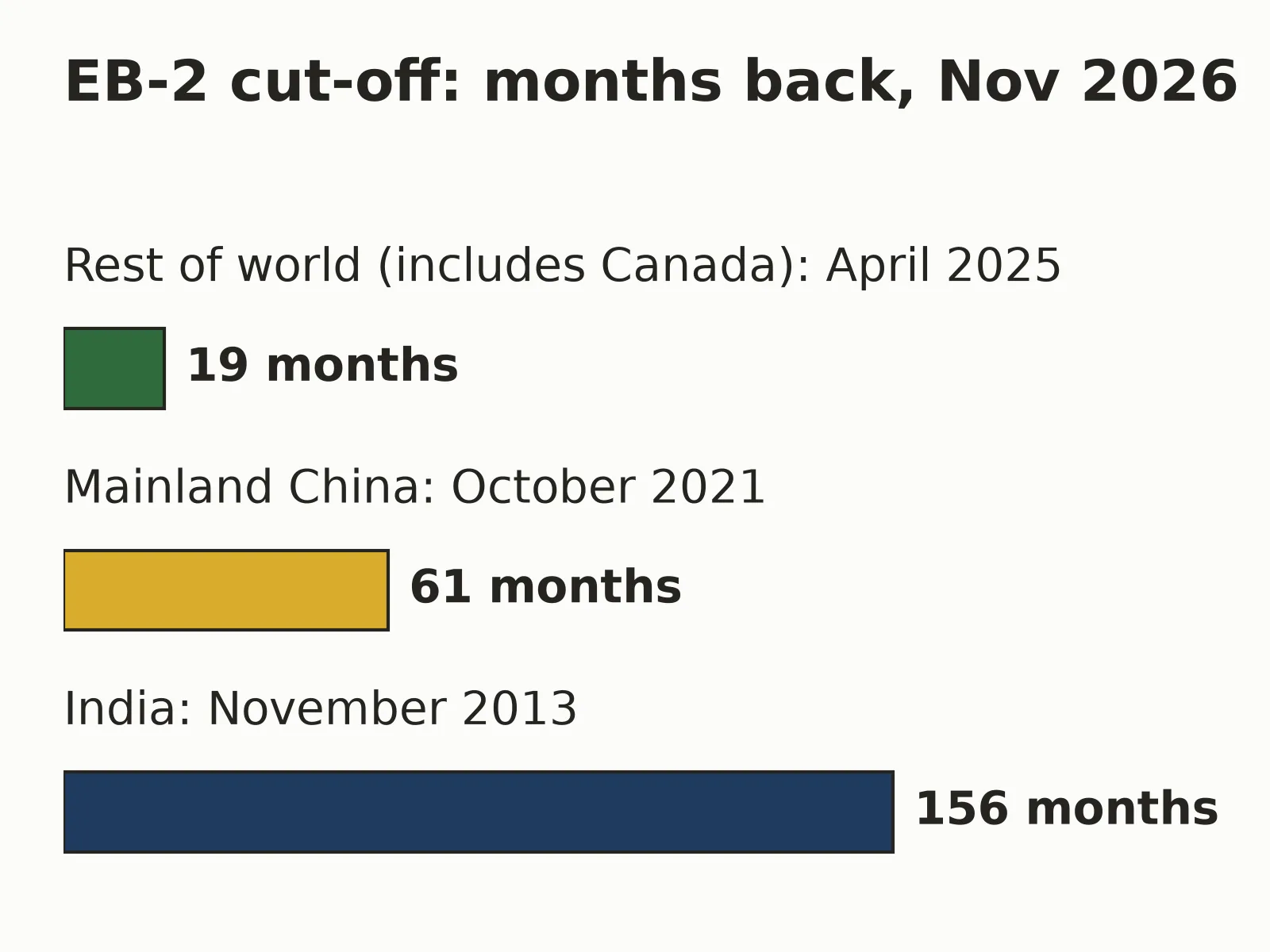
For a Canada-born worker, the EB-2 final action date in the November 2026 Visa Bulletin was April 1, 2025, which is 19 months before the bulletin month by our calculation, against 61 months for mainland China-born and 156 months for India-born applicants, because visa numbers are charged to the country of birth. For a Canadian working in TN status, the petition also raises a question of intent, because the TN regulation defines temporary entry as entry without the intent to establish permanent residence.
Canada is not an oversubscribed country
Immigrant visas are counted against the country where the applicant was born, not the country of citizenship. The statute says the foreign state to which an immigrant is chargeable "shall be determined by birth within such foreign state," with exceptions for a child and for a spouse (section 1152(b) of title 8 of the United States Code, 2023 edition).
The U.S. Department of State's Visa Bulletin for November 2026 states that the per-country limit is 7 percent of the annual family-sponsored and employment-based preference limits, or 25,620 visas. It names four oversubscribed areas: mainland-born China, India, Mexico and the Philippines. Canada is not on that list, so a Canada-born applicant uses the column headed "All Chargeability Areas Except Those Listed."
That column is not always current. In the November 2026 bulletin, its final action dates were:
- EB-1: current.
- EB-2: April 1, 2025.
- EB-3: June 15, 2024.
The EB-2 date in the same bulletin was October 1, 2021 for mainland-born China and November 1, 2013 for India. By our calculation, counting whole months back from November 2026, the dates are 19, 61 and 156 months behind the bulletin month. As a rule, a Canadian citizen born in India or China is charged to the country of birth, not to Canada.
Filing while in TN status
H-1B and L-1 workers have a written rule that applies when an immigrant petition is filed. Under 8 CFR 214.2(h)(16)(i), in title 8 of the Code of Federal Regulations (CFR), the filing of a preference petition "shall not be a basis for denying" an H-1B petition, an extension or admission. The H-1B worker may come temporarily and "at the same time, lawfully seek to become a permanent resident."
Under 8 CFR 214.2(l)(16), an L-1 worker may do the same "provided he or she intends to depart voluntarily at the end of his or her authorized stay," and the filing of a preference petition "shall not be the basis for denying" an L-1 petition or extension. Both paragraphs are in 8 CFR 214.2.
The TN regulation has no matching paragraph. It defines temporary entry as "entry without the intent to establish permanent residence" and requires the applicant to "satisfy the inspecting immigration officer that the proposed stay is temporary" (8 CFR 214.6(b)). The regulation does not say how a filed petition is weighed at a later TN admission or extension. Our employment green card guide takes up the related question, in its frequently asked questions, of whether a Canadian on TN can get a green card through employment, and our TN visa guide for Canadians covers the category itself.
Who files Form I-140 in each category?
A US employer files Form I-140 in most categories, and the worker may file it personally in two: EB-1 extraordinary ability and the EB-2 national interest waiver (NIW). The rules are in 8 CFR 204.5, which also requires a separate petition for each beneficiary.
This table lists, for each EB-1, EB-2 and EB-3 category, who may file Form I-140 and whether a labor certification must come with it under 8 CFR 204.5.
| Category | Who files | Labor certification |
|---|---|---|
| EB-1A extraordinary ability | Worker, or anyone for them | Not required |
| EB-1B professor or researcher | US employer | Not required |
| EB-1C multinational manager | US employer | Not required |
| EB-2 with job offer | US employer | Required, or Schedule A |
| EB-2 national interest waiver | Worker, or anyone for them | Waived if granted |
| EB-3 skilled, professional, other | US employer | Required, or Schedule A |
Each row comes from a paragraph of the regulation:
- EB-1A: "an alien, or any person on behalf of the alien" may file, and neither a job offer nor a labor certification is required (8 CFR 204.5(h)(1) and (h)(5)).
- EB-1B and EB-1C: the US employer files, and each paragraph states that no labor certification is required (8 CFR 204.5(i)(1), (i)(3)(iv), (j)(1) and (j)(5)).
- EB-2: "any United States employer" may file, but a worker seeking an exemption from the job offer requirement "or anyone in the alien's behalf, may be the petitioner" (8 CFR 204.5(k)(1)).
- EB-3: a US employer files (8 CFR 204.5(l)(1)).
EB-2 job-offer petitions and EB-3 petitions must come with an individual labor certification or an application for Schedule A designation (8 CFR 204.5(k)(4)(i) and (l)(3)(i)). Schedule A is the Department of Labor's list of occupations for which it has determined there are not sufficient US workers (20 CFR 656.5).
We cover the two self-petition routes in our guides to the EB-1A green card and the EB-2 NIW, and the manager route in our guide to the L-1A visa to green card.
What do you attach to Form I-140?
You attach the evidence your category requires: a labor certification or Schedule A application for EB-2 job-offer and EB-3 petitions, and proof that the employer can pay the offered wage for any petition that requires an offer of employment. The USCIS Form I-140 page (last updated July 24, 2026) has a section headed "Checklist of Required Initial Evidence (for informational purposes only)."
Four points apply across most petitions:
- The current form edition: the USCIS page lists edition 06/07/24, and says USCIS may reject a form with missing pages or pages from a different edition.
- The labor certification, in time: USCIS states that labor certifications expire 180 days from the date of certification and that it must receive the petition before that period has elapsed.
- Ability to pay: a petition that requires an offer of employment must include evidence that the employer can pay the proffered wage, from the priority date until the worker becomes a permanent resident. The evidence is annual reports, federal tax returns or audited financial statements (8 CFR 204.5(g)(2)).
- A valid signature: the USCIS page says, "We will reject or deny any improperly signed form." Its list of signatures USCIS will not accept includes "A typed name on the signature line" and "A signature by an attorney, representative, or family member signing for the requestor."
The USCIS page gives two options for filing, by mail or online. It also states: "If you are submitting Form I-140 together with Form I-907 to request premium processing, you must file by mail."
What does Form I-140 cost in 2026?
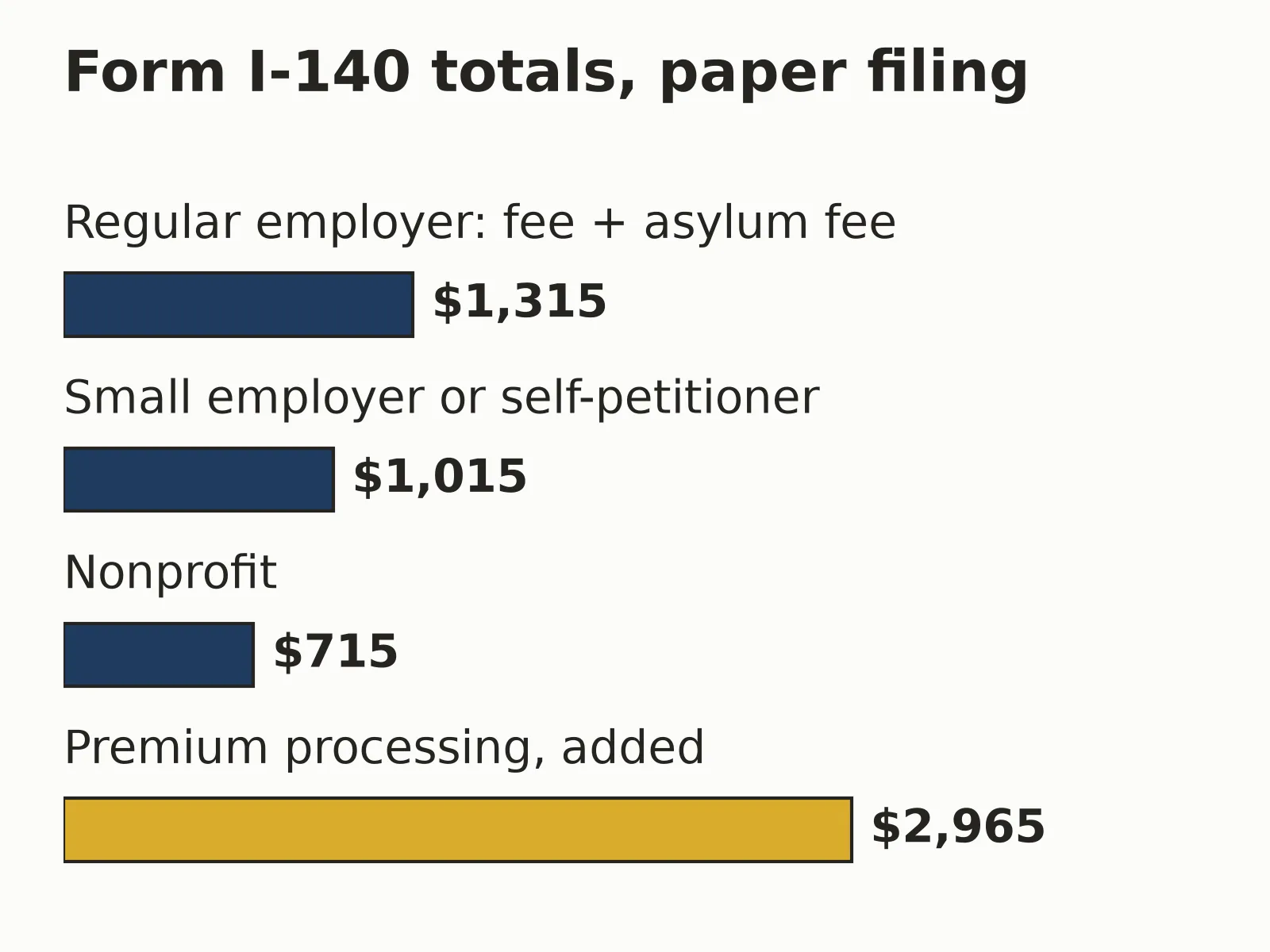
As of November 2026, a paper-filed Form I-140 totals $1,315 for a regular employer, $1,015 for a small employer or self-petitioner and $715 for a nonprofit, by our calculation from the USCIS fee schedule, Form G-1055, edition 11/19/26.
Each total is the form fee plus the Asylum Program Fee:
- Form fee: $715 on paper or $665 online.
- Asylum Program Fee, regular petitioner: $600.
- Asylum Program Fee, small employer or self-petitioner: $300.
- Asylum Program Fee, nonprofit: $0.
The fee regulation defines a small employer as "a firm or individual that has 25 or fewer full-time equivalent employees in the United States, including any affiliates and subsidiaries" (8 CFR 106.1(f)(1)). Premium processing adds $2,965 to any of the three totals. These are government fees only. USCIS posts the current schedule on its Fee Schedule page.
What is the I-140 processing time with premium processing?
With premium processing, USCIS commits to act on a Form I-140 within 15 business days for most categories and within 45 business days for EB-1C and NIW petitions, for a fee of $2,965 as of November 2026.
The request is made on Form I-907. The timeframes are set in 8 CFR 106.4(e) and repeated on the USCIS page titled How Do I Request Premium Processing? (last updated November 10, 2026). If USCIS does not act within the timeframe, the regulation says it "will refund the premium processing service fee but continue to process the case" (8 CFR 106.4(f)(4)).
Acting on a case is not the same as approving it. Under 8 CFR 106.4(f)(1), USCIS will issue "an approval notice, denial notice, a notice of intent to deny, or a request for evidence" within the timeframe. If it issues a request for evidence or a notice of intent to deny, the timeframe stops, and a new one starts on the date USCIS receives the response (8 CFR 106.4(f)(3)).
USCIS publishes regular processing times in its Check Case Processing Times tool, and our guides to NIW processing time and EB-1A processing time cover them for those two categories.
What is the priority date on a Form I-140?
The priority date is the worker's place in the queue for an immigrant visa: the date the labor certification application was accepted by the Department of Labor, or, where no labor certification is required, the date the petition was properly filed with USCIS (8 CFR 204.5(d)).
The date matters because the Visa Bulletin compares it with a cut-off. The bulletin explains that visa numbers are authorized only for applicants whose priority date is earlier than the final action date listed for their category and area. A Canada-born EB-2 applicant with a priority date of March 1, 2025 was inside the November 2026 cut-off of April 1, 2025. One with a priority date in 2026 was not.
An approved petition also carries the I-140 priority date forward. A worker with an approved EB-1, EB-2 or EB-3 petition keeps that date for any later petition in those categories, and a worker with several approved petitions is entitled to the earliest date (8 CFR 204.5(e)(1)). Under 8 CFR 204.5(e)(2), the date may not be retained if USCIS revokes the approval because of:
- fraud, or a willful misrepresentation of a material fact;
- revocation of the labor certification by the Department of Labor;
- invalidation of the labor certification by USCIS or the Department of State; or
- a determination by USCIS that the approval was based on a material error.
What does an approved I-140 give you?
An approved I-140 gives the worker a classification and a priority date that later petitions keep, and the petition supports specific H-1B, H-4 and job-change benefits, but permanent residence still requires a second step: an adjustment of status application or an immigrant visa.
The regulation describes that second step. An approved petition is sent to the Department of State's National Visa Center if the worker lives outside the United States. If the worker will apply to adjust status on Form I-485, USCIS keeps the petition for that application (8 CFR 204.5(n)(1)). Our guide on how long the green card process takes covers the stages after approval.
These benefits are tied to the petition, some to its filing and some to its approval:
- H-1B extensions while the case is pending: H-1B status is limited to six years (8 CFR 214.2(h)(13)(iii)(A)). A worker is eligible for H-1B status beyond that limit, in increments of up to one year, if at least 365 days have passed since the labor certification or the immigrant petition was filed (8 CFR 214.2(h)(13)(iii)(D)). This rule turns on filing, not approval.
- H-1B extensions after approval: a worker with an approved EB-1, EB-2 or EB-3 petition who is eligible for that status "but for application of the per country limitation" is eligible for H-1B status beyond six years, in increments of up to three years (8 CFR 214.2(h)(13)(iii)(E)). The USCIS H-1B Specialty Occupations page (last updated September 21, 2026) describes the same extension as available "but for application of the per country or worldwide limitations on immigrant visas."
- Work authorization for an H-4 spouse: an H-4 spouse may be eligible for employment authorization if the H-1B worker is the beneficiary of an approved Immigrant Petition for Alien Worker (8 CFR 214.2(h)(9)(iv)). Our guide to the H-4 visa and work permit explains the application.
- Job portability, in any status: once an adjustment application has been filed and has remained unadjudicated for 180 days or more, the petition "shall remain valid with respect to a new job" in the same or a similar occupational classification (section 1154(j) of title 8 of the United States Code, 2023 edition; 8 CFR 245.25).
What happens if the employer withdraws the petition?
A petition withdrawn 180 days or more after its approval "remains approved unless its approval is revoked on other grounds." A petition withdrawn sooner is automatically revoked, unless an associated adjustment of status application has been pending for 180 days or more. Both rules are in 8 CFR 205.1(a)(3)(iii)(C).
The same paragraph says that when a petition is withdrawn "the job offer of the petitioning employer is rescinded," and the worker must obtain a new petition to finish the green card unless eligible under the portability rule above. A petition that remains approved still carries its priority date under 8 CFR 204.5(e)(1), subject to the four revocation grounds listed in the priority date section. Under 8 CFR 205.1(a)(3)(iii)(D), the same 180-day test applies when the petitioning employer's business terminates.
Frequently asked questions
What is Form I-140 used for?
Form I-140, Immigrant Petition for Alien Workers, is used to classify a worker in the EB-1, EB-2 or EB-3 employment-based category. USCIS describes it as the form used to petition for an alien worker to become a lawful permanent resident. Under 8 CFR 204.5(a), a separate petition must be filed for each beneficiary with the applicable fee.
Can I file Form I-140 for myself?
Only in two categories. Under 8 CFR 204.5(h)(1), a person of extraordinary ability, or anyone on that person's behalf, may file an EB-1A petition. Under 8 CFR 204.5(k)(1), a worker seeking a national interest waiver of the job offer requirement may be the petitioner. Every other EB-1, EB-2 and EB-3 petition is filed by a United States employer.
How much is the Form I-140 filing fee?
As of November 2026, the USCIS fee schedule (Form G-1055, edition 11/19/26) lists $715 for a paper filing and $665 online, plus an Asylum Program Fee of $600, $300 or $0. By our calculation, a paper filing totals $1,315 for a regular employer, $1,015 for a small employer or self-petitioner and $715 for a nonprofit. Premium processing is a separate $2,965.
How long does I-140 premium processing take?
Under 8 CFR 106.4(e), the timeframe is 15 business days for most Form I-140 categories and 45 business days for EB-1C multinational executive or manager petitions and national interest waiver petitions. Within it USCIS issues an approval, a denial, a notice of intent to deny or a request for evidence. After a request for evidence, a new timeframe starts when USCIS receives the response.
Does an approved I-140 let me work in the United States?
Not on its own. Under 8 CFR 214.1(e), a nonimmigrant may engage only in employment that has been authorized, so work still depends on the worker's status. An approved petition does support narrower benefits: 8 CFR 214.2(h)(13)(iii)(E) allows H-1B status beyond six years where a visa is unavailable because of the per-country limitation, and 8 CFR 214.2(h)(9)(iv) allows an H-4 spouse to seek employment authorization.
Do Canadians wait in a visa backlog after the I-140?
Only the four oversubscribed areas named in the Visa Bulletin for November 2026 have their own columns: mainland-born China, India, Mexico and the Philippines. Everyone else, Canada-born applicants included, uses the general column. In that bulletin EB-1 was current, the EB-2 final action date was April 1, 2025 and the EB-3 date was June 15, 2024. Chargeability is determined by country of birth, with exceptions for a spouse or child.
Can my employer file Form I-140 while I am on a TN?
The filing rules do not exclude it: under 8 CFR 204.5(c), any United States employer desiring and intending to employ a worker may file. The TN rules are a separate matter. Under 8 CFR 214.6(b), the applicant must satisfy the inspecting officer that the proposed stay is temporary, and the TN regulation has no paragraph matching the H-1B and L-1 provisions on a filed preference petition.
Conclusion
Form I-140 does one job: it classifies the worker and sets or confirms the priority date. Who signs it depends on the category, the government fee depends on who the petitioner is, and premium processing brings a first response within 15 or 45 business days for $2,965 as of November 2026. A Canada-born applicant uses the general visa column, where in November 2026 EB-1 was current and the EB-2 and EB-3 cut-off dates fell in 2025 and 2024. For a Canadian in TN status, the point to understand before filing is that the TN regulation has no paragraph matching the H-1B and L-1 provisions on a filed preference petition. Fees and cut-off dates should be read from the USCIS fee schedule and the Visa Bulletin on the filing date.
How Mayo Law can help
Mayo Law is a cross-border firm with offices in Toronto and New York, and Joseph Mayo is licensed in Ontario and New York. Our lawyers prepare Form I-140 petitions for employers and self-petitioners, and we advise on status during the wait. Before a petition is filed, we check:
- the worker's country of birth, which decides the Visa Bulletin column;
- the labor certification's 180-day validity period;
- the employer's ability-to-pay evidence;
- the worker's next TN entry or extension; and
- whether premium processing is wanted, since USCIS requires mail filing when Form I-907 is submitted with the petition.
We offer a paid one-hour consultation, paid because a lawyer reviews your category, your evidence and your current status in depth. You can start from our business immigration page, or from our TN visa lawyer page if you are working in TN status today.
Disclaimer
This guide is general information, current as of November 2026, and is not legal advice. Reading it does not create a solicitor-client or attorney-client relationship. Fees, forms and visa cut-off dates change often, and the right answer depends on your facts. Mayo Law provides legal services in Ontario and New York.