

Contents
- Quick answer
- Can a Canadian company send a specialist on an L-1B?
- What counts as specialized knowledge?
- Which factors does USCIS weigh?
- What evidence proves specialized knowledge?
- Can an L-1B worker be placed at a client site?
- What limits apply under a blanket L petition?
- How long can an L-1B worker stay, and what comes next?
- Frequently asked questions
- Conclusion
- How Mayo Law can help
- Disclaimer
A Canadian company that wants to move a product engineer, an implementation lead or another specialist into its US office usually ends up looking at the L-1B visa. The category does not ask for a manager. What it asks for is harder to pin down: proof that the employee holds specialized knowledge of your organization. That proof is where most of the work sits, and it is the part of our business immigration practice, and of our L-1 visa work in particular, that employers ask about most. This guide explains how U.S. Citizenship and Immigration Services (USCIS) applies the standard in November 2026, the evidence that supports it, and the limits that catch employers out.
Quick answer
The L-1B visa lets a company transfer an employee from a parent, branch, subsidiary or affiliate abroad to its US office. The employee must generally have one continuous year with the organization abroad within three years and hold specialized knowledge, defined in title 8 of the Code of Federal Regulations (8 CFR 214.2(l)(1)(ii)(D)). L-1B stay cannot exceed five years.
Can a Canadian company send a specialist on an L-1B?
Yes: a Canadian company can transfer a specialist to a US parent, branch, subsidiary or affiliate on an L-1B if the two entities have a qualifying relationship, the employee generally has one continuous year with the organization abroad within the past three years, and the person is coming to work in a specialized knowledge capacity.
The USCIS page titled L-1B Intracompany Transferee Specialized Knowledge (last reviewed or updated August 31, 2026) sets out both sides of the test. On the employer side, the US company that files the petition must have a qualifying relationship with a foreign company, here the Canadian one, and must currently be, or will be, doing business as an employer in the United States and in at least one other country for the duration of the employee's stay. USCIS adds that the business must be viable but need not be engaged in international trade. On the employee side, the person must generally have been working for a qualifying organization abroad for one continuous year within the three years immediately preceding admission, and must be seeking to enter to provide services in a specialized knowledge capacity.
The year abroad does not have to be in a specialist role. The USCIS Policy Manual (Volume 2, Part L, Chapter 4, current as of November 20, 2026) says the qualifying year may be in a managerial, executive or specialized knowledge capacity. Chapter 8 of the same part adds that the company "does not have to transfer the beneficiary to the United States in the same capacity in which the beneficiary was employed abroad."
For a citizen of Canada, the regulation names where an individual petition may be filed. Under 8 CFR 214.2(l)(17)(i), the employer "may file an individual petition in duplicate on the form prescribed by USCIS in conjunction with an application for admission of the citizen of Canada," and that filing "may be made with an immigration officer at a Class A port of entry located on the United States-Canada land border or at a United States pre-clearance/pre-flight station in Canada." Our guide to the L-1 visa from Canada covers that port-of-entry process, and our overview of US work visas for Canadians sets the L-1 beside the TN and the other categories.
One fee point belongs with the filing. An alert on the USCIS L-1B page (last reviewed or updated August 31, 2026) reports that on August 10, 2026 the Department of Homeland Security (DHS) "issued a final rule to amend regulations concerning the statutory 9-11 Response and Biometric Entry-Exit Fee for H-1B and L-1 Visas (9-11 Biometric Fee)," effective September 9, 2026. The alert says the changes "require petitioners that are covered employers to submit the 9-11 Biometric Fee for all H-1B and L-1 petitions," except that "the fee does not apply if the petitioner is filing an amended petition that does not seek to extend the alien's currently authorized H-1B or L-1 status." A petitioner is a covered employer "if it employs 50 or more individuals in the United States, and more than 50 percent of those employees are in H-1B or L-1A or L-1B nonimmigrant status." This guide states no L-1B visa fee amounts: read the USCIS fee schedule on the day of filing.
What counts as specialized knowledge?
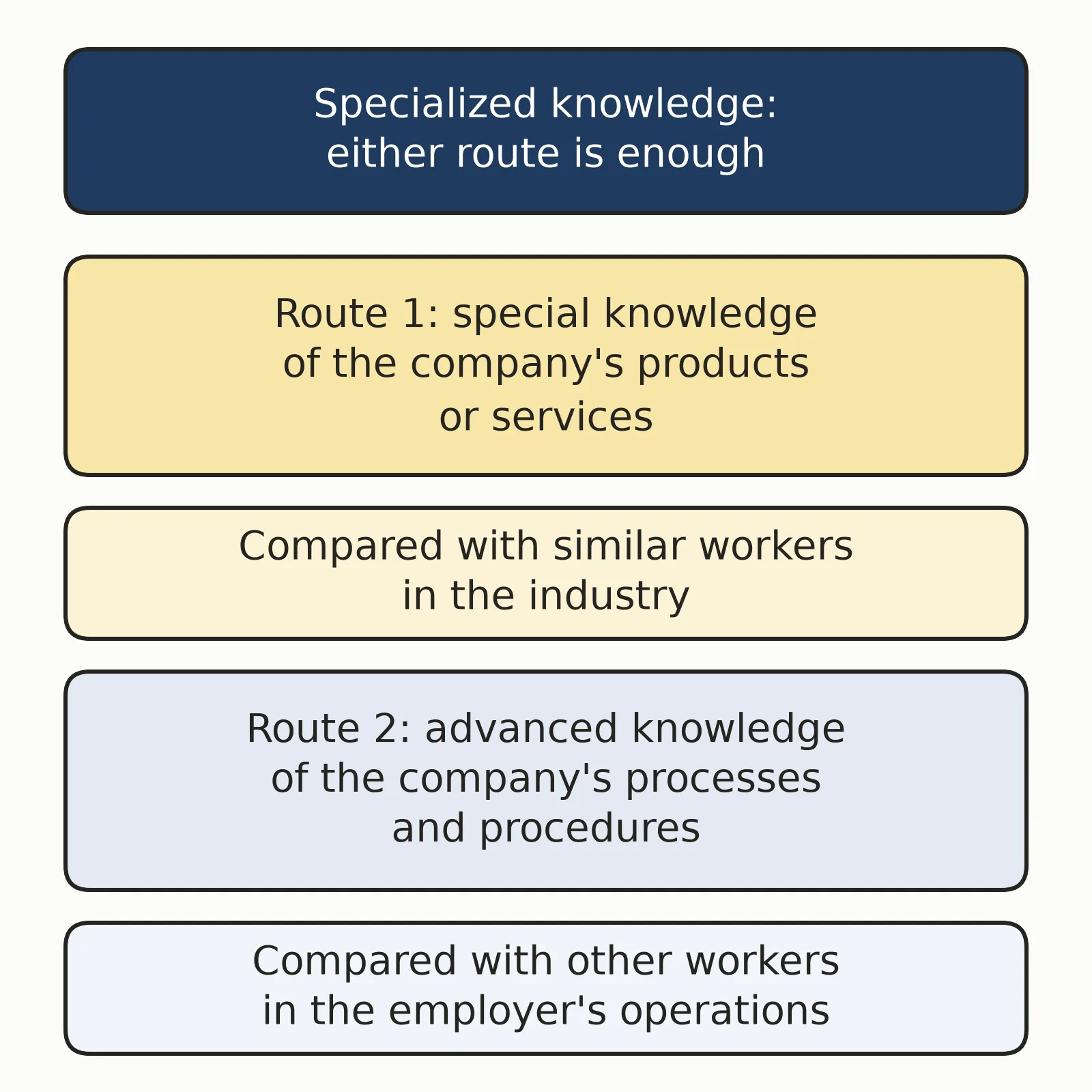
Specialized knowledge is either special knowledge of the organization's product, service, research, equipment, techniques, management or other interests and its application in international markets, or an advanced level of knowledge or expertise in the organization's processes and procedures. That is the definition in 8 CFR 214.2(l)(1)(ii)(D).
The statute is section 214(c)(2)(B) of the Immigration and Nationality Act, codified as section 1184(c)(2)(B) of title 8 of the United States Code (8 U.S.C. 1184(c)(2)(B); 2023 edition, read on govinfo.gov). It says a person serves in a capacity involving specialized knowledge "if the alien has a special knowledge of the company product and its application in international markets or has an advanced level of knowledge of processes and procedures of the company."
So there are two routes, and the USCIS Policy Manual chapter on specialized knowledge (Volume 2, Part L, Chapter 4) describes the comparison each one needs:
- Special knowledge: knowledge of how the organization manufactures, produces or develops its products or services. The employer may show knowledge that is "distinct or uncommon in comparison to the knowledge of other similarly employed workers in the particular industry."
- Advanced knowledge: knowledge of the organization's own processes and procedures. The employer may show knowledge that is "greatly developed or further along in progress, complexity, and understanding in comparison to other workers in the employer's operations."
Chapter 4 says a person "may establish specialized knowledge by possessing either special or advanced knowledge, or both." It then sets one condition on both routes: "With respect to either special or advanced knowledge, the petitioner ordinarily must demonstrate that the beneficiary's knowledge is not commonly held throughout the industry." It adds that the petitioner "bears the burden of establishing such a favorable comparison." The petition must also show, in the chapter's words, that the "position offered involves the specialized knowledge held by the beneficiary."
Which factors does USCIS weigh?
Chapter 4 of the Policy Manual gives officers six factors they may consider, and says the presence of one or more of them, assessed in the totality of the circumstances, may be sufficient to establish specialized knowledge by a preponderance of the evidence.
The factors are whether the employee:
- has knowledge of foreign operating conditions that is of significant value to the US operations;
- has been employed abroad in assignments that significantly enhanced the employer's productivity, competitiveness, image or financial position;
- has knowledge that is normally gained only through prior experience with the organization;
- has knowledge of a product or process that cannot be easily transferred or taught to another person without significant economic cost or inconvenience;
- has knowledge of a process or product that is sophisticated, complex or highly technical, although not necessarily unique to the organization; or
- has knowledge that is particularly beneficial to the organization's competitiveness in the marketplace.
The Policy Manual calls the list "illustrative, not exhaustive," and says it "does not impose requirements that a petitioner must meet."
What does the standard not require?
Chapter 4 of the Policy Manual removes several hurdles that employers often assume exist:
- Not proprietary or unique: specialized knowledge "need not be proprietary or unique to the petitioning organization."
- Not narrowly held: the "mere existence of other employees with similar knowledge should not, in and of itself, be a ground for denial."
- No labor market test: the employer "is not required to demonstrate the lack of readily available workers to perform the relevant duties in the United States."
- No rank or pay threshold: "there is no requirement that the beneficiary be of a certain rank within the organization" or be paid more than peers.
What generally does not qualify?
Chapter 4 states the other side as well. Knowledge "generally may not be considered special or advanced if it is commonly held, lacks some complexity, or can be easily imparted from one person to another." Where many workers in the United States have knowledge like the employee's, the chapter puts the burden on the employer to show that the knowledge "nevertheless is truly specialized." And where the US operation already has a significant number of employees with the same knowledge, it says a question may arise as to whether the position needs to be filled by a person having specialized knowledge.
What evidence proves specialized knowledge?
The core of an L-1B visa petition is a detailed description of the services to be performed, supported by records that show how the employee gained the knowledge and how it compares with the knowledge of others. The USCIS Policy Manual lists the evidence in Volume 2, Part L, Chapter 8 (current as of November 20, 2026).
Chapter 8 says officers "can perform their adjudicatory function most effectively when the petitioner explains in detail" four things: the nature of the industry or field, the nature of the organization's products or services, the nature of the specialized knowledge the duties require, and the need for the employee's knowledge. A petitioner's own statement "may be persuasive evidence if detailed, specific, and credible." The petitioner must also submit evidence that the employee's prior education, training and employment qualify the person to perform the intended services, a requirement that comes from 8 CFR 214.2(l)(3)(iv).
Beyond the statement, Chapter 8 lists other evidence a petitioner may submit, including:
- documentation of training, work experience or education establishing the number of years the employee has been using or developing the claimed knowledge;
- personnel or in-house training records establishing that the employee gained the knowledge through prior experience or training with the organization;
- curricula and training manuals for internal training courses that may demonstrate knowledge the organization cannot transfer or teach to another person without significant economic cost or inconvenience;
- contracts, statements of work or other documentation showing knowledge that is particularly beneficial to the organization's competitiveness;
- evidence of patents, trademarks, licenses or contracts awarded to the organization based on the employee's work; and
- payroll documents, resumes, organizational charts or similar evidence documenting the positions held by the employee and parallel employees.
Two sentences from Chapter 8 mark the limit of assertion. First: "Merely stating that a beneficiary's knowledge is somehow different from others or greatly developed does not, in and of itself, establish that the beneficiary possesses specialized knowledge." Second: "Ultimately, it is the weight and type of evidence that establishes whether the beneficiary possesses specialized knowledge." Chapter 4 adds that the petitioner must show the employee has the knowledge at the time of filing.
In our practice, we build the comparison the Policy Manual asks for in three steps. We name the comparable employees and roles, inside the organization and in the industry. We document how long the knowledge took to acquire and through which training or assignments. And we describe what replacing that knowledge in the US office would involve. This is our working method, not a USCIS requirement, and it does not predict the result of any petition.
Can an L-1B worker be placed at a client site?
Sometimes: an L-1B worker stationed primarily at the worksite of an unaffiliated company stays eligible only if that company does not principally control and supervise the worker and the placement is tied to a product or service that needs knowledge specific to the petitioner, and is not labor for hire.
The rule comes from the L-1 Visa Reform Act of 2004, which the USCIS L-1B page says applies to all petitions filed on or after June 6, 2005. It is now 8 U.S.C. 1184(c)(2)(F), which reads: an alien "who will serve in a capacity involving specialized knowledge with respect to an employer" and "will be stationed primarily at the worksite of an employer other than the petitioning employer or its affiliate, subsidiary, or parent shall not be eligible" if either of two things is true:
- the worker "will be controlled and supervised principally by such unaffiliated employer"; or
- the placement "is essentially an arrangement to provide labor for hire for the unaffiliated employer, rather than a placement in connection with the provision of a product or service for which specialized knowledge specific to the petitioning employer is necessary."
Chapter 4 of the Policy Manual explains how officers read those words. A client may give input, feedback or guidance and "may even direct specific tasks and activities," so long as "the ultimate authority over the L-1 worker's daily duties remains within the petitioning organization." Its two examples mark the line. A petitioner that is "essentially in the business of placing beneficiaries with various unaffiliated companies" falls on the ineligible side. A petitioner that is "primarily engaged in providing a specialized service" and sends its specialized knowledge staff to client sites to perform it is not subject to the bar, the chapter says, assuming the worker remains under the petitioner's principal control and supervision and otherwise meets the L requirements. For a Canadian software or engineering company whose staff work at US customer premises, this is the section to plan around before the transfer.
What limits apply under a blanket L petition?
Under a blanket L petition the bar is higher: the employee must be a specialized knowledge professional, meaning a person who has specialized knowledge and is also a member of the professions.
The definition is in 8 CFR 214.2(l)(1)(ii)(E), which points to section 101(a)(32) of the Immigration and Nationality Act. That section says the term profession "shall include but not be limited to architects, engineers, lawyers, physicians, surgeons, and teachers in elementary or secondary schools, colleges, academies, or seminaries" (8 U.S.C. 1101(a)(32), 2023 edition, read on govinfo.gov). The USCIS L-1B page states the consequence: "In order to qualify under the blanket petitioning process, the employee having specialized knowledge must also be a professional."
The same USCIS page notes that approval of a blanket petition "does not guarantee that an employee will be granted L-1B classification." 8 CFR 214.2(l)(4)(iii) says an "individual petition may be filed by the petitioner or organizations in lieu of using the blanket petition procedure." Our reading of that paragraph together with the two definitions is that a specialist who is not a professional can still be the subject of an individual petition. Which organizations can hold a blanket petition, and when one is worth setting up, is covered in the blanket section of our L-1 visa from Canada guide.
The table below compares an individual L-1B visa petition with a transfer under an approved blanket petition on three points, drawn from the USCIS L-1B page and 8 CFR 214.2(l)(1)(ii) and (l)(15)(ii).
| Point | Individual petition | Blanket petition |
|---|---|---|
| Who qualifies | Specialized knowledge employee | Specialized knowledge professional |
| Form for the employee | Form I-129 | Form I-129S |
| Maximum total stay | 5 years | 5 years |
On the forms, the USCIS page says the employer "must file Form I-129, Petition for a Nonimmigrant Worker with fee, on behalf of the employee," and that in most cases, once a blanket petition has been approved, the employer "need only complete a Form I-129S, Nonimmigrant Petition Based on Blanket L Petition, and send it to the employee."
How long can an L-1B worker stay, and what comes next?
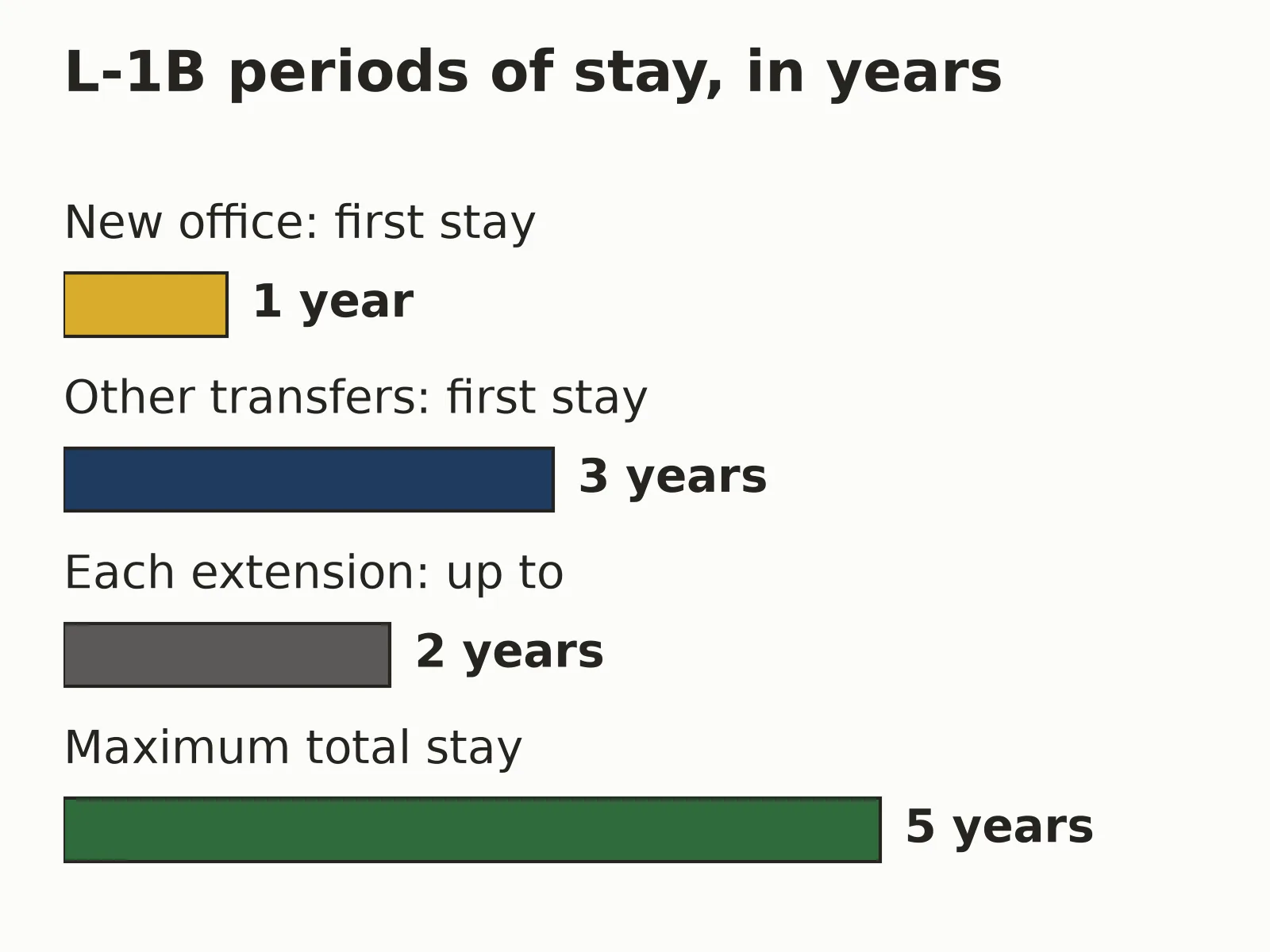
An L-1B worker can stay for up to five years in total, and what comes next is a year abroad before any new L or H admission, a promotion into the L-1A category, or a green card process started while the person is still in status.
The USCIS L-1B page gives the periods: employees entering to establish a new office "will be allowed a maximum initial stay of one year," all other qualified employees "a maximum initial stay of three years," and extensions "may be granted in increments of up to an additional two years, until the employee has reached the maximum limit of five years." The regulation sets the total: "The total period of stay may not exceed five years for aliens employed in a specialized knowledge capacity," and "No further extensions may be granted" (8 CFR 214.2(l)(15)(ii)).
A year abroad. A person who has spent five years in the United States in a specialized knowledge capacity may not be readmitted in L or H status unless the person "has resided and been physically present outside the United States, except for brief visits for business or pleasure, for the immediate prior year" (8 CFR 214.2(l)(12)(i)). Under 8 CFR 214.2(l)(12)(ii), those limits "shall not apply to aliens who do not reside continually in the United States and whose employment in the United States is seasonal, intermittent, or consists of an aggregate of six months or less per year," or to people who live abroad and regularly commute to part-time employment in the United States. Our L-1 visa from Canada guide explains how the five-year clock runs and when the limits do not apply.
A promotion to manager. The L-1A is the companion category for managers and executives, and its limit is longer: "The total period of stay for an alien employed in a managerial or executive capacity may not exceed seven years." An L-1B worker who is later promoted "must have been employed in the managerial or executive position for at least six months to be eligible for the total period of stay of seven years," and the change must have been approved in an amended, new or extended petition at the time it occurred (8 CFR 214.2(l)(15)(ii)). Our guide to the L-1B to L-1A conversion walks through the timing.
A green card. The regulation allows a person to pursue permanent residence while holding L-1 status: under 8 CFR 214.2(l)(16), the filing or approval of a permanent labor certification or an immigrant visa preference petition "shall not be the basis for denying" an L-1 petition, a request to extend it, or an application for admission. Which immigrant categories fit a specialized knowledge worker is covered in the L-1B section of our guide to the L-1A visa to green card.
Family. The USCIS L-1B page says a spouse and unmarried children under 21 may accompany or follow the worker in L-2 status. It states that spouses "in valid L-2S nonimmigrant status are considered employment authorized incident to status." L-2S is the admission code USCIS and U.S. Customs and Border Protection began putting on the Form I-94 of L-1 spouses on January 30, 2022, according to the same page.
Frequently asked questions
What is an L-1B visa?
The L-1B visa is the intracompany transferee category for employees with specialized knowledge. USCIS says it "enables a U.S. employer to transfer a professional employee with specialized knowledge relating to the organization's interests from one of its affiliated foreign offices to one of its offices in the United States." Under 8 CFR 214.2(l)(1)(ii)(E), being a member of the professions is part of the definition of a specialized knowledge professional, the test used under a blanket petition.
What are the L-1B visa requirements?
According to the USCIS L-1B page, the employer needs a qualifying relationship with a foreign company and is, or will be, doing business in the United States and at least one other country. The employee must generally have one continuous year with a qualifying organization abroad within the previous three years and be coming to provide services in a specialized knowledge capacity.
Does specialized knowledge have to be proprietary?
No. The USCIS Policy Manual says specialized knowledge need not be proprietary or unique to the petitioning organization, and it need not be narrowly held inside the company. The petitioner ordinarily must still demonstrate that the knowledge is not commonly held throughout the industry, and knowledge that can be easily imparted to another person generally may not be considered special or advanced.
How long can someone stay on an L-1B visa?
USCIS allows a maximum initial stay of three years, or one year for an employee coming to establish a new office. Extensions may be granted in increments of up to two years until the employee reaches the maximum of five years. Under 8 CFR 214.2(l)(15)(ii), no further extensions may be granted after that.
Can an L-1B employee work at a customer's site?
Only within limits. Under section 1184(c)(2)(F) of title 8 of the United States Code, a specialized knowledge worker stationed primarily at an unaffiliated company's worksite is ineligible if that company principally controls and supervises the worker, or if the placement is essentially labor for hire and not tied to a product or service that needs knowledge specific to the petitioner.
How do you get an L-1B visa under a blanket petition?
The employee must be a specialized knowledge professional, which means having specialized knowledge and being a member of the professions. USCIS says that in most cases, once the blanket petition has been approved, the employer need only complete Form I-129S and send it to the employee with the approval notice. Approval of the blanket petition does not guarantee that an employee will be granted L-1B classification.
Can the spouse of an L-1B worker work in the United States?
Yes. USCIS states that spouses of L-1 workers in valid L-2S nonimmigrant status are considered employment authorized incident to status. The same page lists, among the evidence of that authorization acceptable for Form I-9, an unexpired Form I-94 with a notation reflecting L-2S nonimmigrant status. Unmarried children under 21 may accompany the worker in L-2 status.
Conclusion
The L-1B visa turns on specialized knowledge, and the USCIS Policy Manual sets out how officers read it. It can be special knowledge of your products or services or advanced knowledge of your processes. It need not be proprietary, unique or narrowly held, but it ordinarily cannot be commonly held in the industry, and knowledge that is easily imparted generally does not qualify. The weight and type of evidence decide the petition. Before a Canadian company moves a specialist, it should also settle three structural questions: whether the person will sit at a client site, whether a blanket petition can be used for a non-professional, and how the five-year limit fits the plan for that employee.
How Mayo Law can help
Mayo Law is a cross-border firm with offices in Toronto and New York, and Joseph Mayo is licensed in Ontario and New York. Our lawyers work with Canadian companies on L-1B transfers: mapping the qualifying relationship, drafting the description of the specialized knowledge, assembling the evidence and planning for the five-year limit. We offer a paid one-hour consultation, paid because a lawyer reviews the role, the employee's history and the corporate structure in depth. You can start from our L-1 visa lawyer page or our wider business immigration page.
Disclaimer
This guide is general information, current as of November 2026, and is not legal advice. Reading it does not create a solicitor-client or attorney-client relationship. Immigration rules, fees and policy guidance change, and the right answer depends on your facts. Mayo Law provides legal services in Ontario and New York.